
Updated 8/9/11
I am adding the provisional start list with the one the USA Pro Cycling Challenge announced today.
*Team rosters are subject to change
BMC RACING TEAM
- Cadel Evans
- George Hincapie
- Brent Bookwalter
- Chris Barton
- Jeffry Louder
- Chad Beyer
- Timothy Roe
- Chris Butler
TEAM RADIOSHACK (USA)
- Levi Leipheimer
- Dmitriy Muravyev
- George Bennett
- Philip Deignan
- Ben King
- Jason McCartney
- Ivan Rovny
- Bjorn Selander
LEOPARD TREK (LUX)
- Andy Schleck
- Fränk Schleck
- Stefan Denifl
- Brice Feillu
- Anders Lund
- Martin Mortensen
- Stuart O’Grady
- Jens Voigt
TEAM GARMIN-CERVELO (USA)
- Tom Danielson
- Ryder Hesjedal
- Daniel Lloyd
- Thomas Peterson
- Peter Stetina
- Christian Vande Velde
- Dave Zabriskie
- Danny Summerhill
HTC-HIGHROAD (USA)
- Tejay Van Garderen
- Caleb Fairly
- Patrick Gretsch
- Danny Pate
- Frantisek Rabon
- Hayden Roulston
- Peter Velits
- Lachlan Norris
LIQUIGAS-CANNONDALE (ITA)
- Ivan Basso
- Davide Cimolai
- Timothy Duggan
- Edward King
- Daniel Oss
- Juraj Sagan
- Sylwester Szmyd
- Elia Viviani
SAXO BANK SUNGARD (DEN)
- André Steensen
- Brian Vandborg
- Daniel Navarro
- Jesus Hernandez
- Gustav Larsson
- Michael Mørkov
- Laurent Didier
- Richie Porte
RABOBANK CYCLING TEAM (NED)
- Robert Gesink
- Stef Clement
- Marc Goos
- Grischa Niermann
- Laurens Ten Dam
- Pieter Weening
- Dennis Van Winden
UNITEDHEALTHCARE PRO CYCLING (USA)
- Rory Sutherland
- Jonathan Clarke
- Robert Forster
- Davide Frattini
- Adrian Hegyvary
- Christopher Jones
- Bradley White
- Scott Zwizanski
TEAM TYPE 1 – sanofi-aventis (USA)
- Alexandr Efimkin
- Vladimar Efimkin
- Rubens Bertogliati
- Valeriy Kobzarenko
- Javier Megias Leal
- Scott Stewart
- William Dugan
- Fabio Calabria
SKIL-SHIMANO (NED)
- Ronan Van Zandbeek
- Kenny Van Hummel
- Thomas Bonnin
- Martin Reimer
- Sander Oostlander
- Tobias Ludvigsson
- Philipp Ries
- Albert Timmer
TEAM SPIDERTECH POWERED BY C10 (CAN)
- Lucas Euser
- Flavio De Luna
- Jonathan Patrick McCarty
- David Boily
- Bruno Langlois
- Francois Parisien
- Andrew Randell
- Ryan Roth
BISSELL PRO CYCLING (USA)
- Chris Baldwin
- Frank Pipp
- Jeremy Vennell
- Chase Pinkham
- Rob Britton
- Paul Mach
- Jay Thomson
- Ben Jacques-Maynes
TEAM EXERGY (USA)
- Andres Miguel Diaz Corrales
- Carlos Eduardo Alzate Escobar
- Freddie Rodriguez
- Matthew Cooke
- Sam Johnson
- Christopher Hong
- Erik Slack
- Kai Applequis
JELLY BELLY CYCLING TEAM p/b KENDA (USA)
- Sergio Hernandez
- Emerson Oronte
- Bernard Van Ulden
- Sean Mazich
- Ken Hanson
- Jeremy Powers
- Alex Hagman
- Nic Hamilton
GOBERNACION DE ANTIOQUIA-INDEPORTES ANTIOQUIA (COL)
- Sergio Luis Henao
- Oscar Sevilla Rivera
- Javier Acevedo Calle
- Alejandro Ramirez Calderon
- Rafael Montiel Cuello
- Carlos Ospina Hernandez
- Oscar Alvarez Paniagua
- Cristhian Montoya
EPM-UNE (COL)
- Giovanni Manuel Baez
- Juan Pablo Suarez
- Walter Fernando Pedraza
- Edward Stiber Ortiz
- Rafael Infantino Abreu
- Carlos Fernando Piamonte Rodriguez
- Eduard Alexander Beltran
- Robigzon Leandro Oyola
Many pro-cycling fans follow favorite teams, but also follow favorite riders. Because I tend to do more of the latter, I’ve started to compile a provisional start-list for the USA Pro Cycling Challenge. This list is not sanctioned by the race organizers; it’s based on what I’ve been hearing and finding through internet research. The riders with question marks after their names I feel less sure about. I’ll try to update this as I come across more information. Feel free to leave your ideas for who we might expect to see at the race.
| USA Pro Cycling Challenge |
| Provisional start list as of 8/9/2011 |
| Leopard Trek (Luxembourg) Andy Schleck, Frank Schleck, Fabian Cancellara, Jens Voigt |
| UnitedHealthcare Pro Cycling Team (USA) Rory Sutherland, Brad White, Scott Zwizanski? |
| Team Type 1-sanofi aventis (USA) |
| Skil-Shimano (Netherlands) Thomas Bonnin? |
| Team Spidertech Powered By C10 (Canada) Lucas Euser, Pat McCarty |
| Team RadioShack (USA) |
| HTC-Highroad (USA) Danny Pate, Tejay Van Garderen |
| Team Garmin-Cervélo (USA) David Zabriskie, Tom Danielson, Peter Stetina, Ryder Hesjedal, Christian Vande Velde |
| BMC Racing Team (USA) Cadel Evans, George Hincapie, |
| Liquigas-Cannondale (Italy) Timmy Duggan, Daniel Oss, Elia Viviani, Ivan Basso, Ted King |
| Saxo Bank-SungardRichie Porte? |
| RabobankRobert Gesink, Steven Kruijswijk? |
| Jelly Belly p/b Kenda Alex Hagman? |
| Team Exergy Sam Johnson, Carlos Alzate, Matt Cooke? |
| Bissell Chris Baldwin, Ben Jacques-Maynes? |
| EPM-UNE (Columbian) |
| Gobernacion De Antioquia-Indeportes Antioquia (Columbian)Janier Acevedo, Oscar Sevilla? |
This piece is a continuation of Part 1. It describes what the owner, race organizer, and Local Organizing Committee (LOC) each do to bring a pro-cycling race to life.
It all starts with money. A person or entity must step-up to fund the cost of holding the race. For the USA Pro Cycling Challenge (UPCC), race owners Rick and Richard Schaden have invested $10 million. According to the Denver Post, “The 20-year majority shareholders of Quiznos and founders of Denver’s Consumer Capital Partners said the investment beyond the sandwich company’s sponsorship ensures the race will be around for a long time.”
The Denver Post article continues, “Shawn Hunter…tapped to serve as co-chairman of the race with Rick Schaden, said Denver billionaire Philip Anschutz ‘s ownership support of the 7-year-old Tour of California has grown that race into the largest cycling event in the U.S. Coloradans can expect the Schadens to do the same. With the $10 million investment, team sponsors, USA cycling and all the other sponsors can feel safe directing their time and money into the race. ‘They know this event will be around for the long term,’ he said.”
Race Organizer
The owner funds the race, forms an entity to operate the race, and selects a race organizer to implement it. Medalist Sports is the organizer for the UPCC. Medalist manages the planning, implementing, and promotion of the entire race, and works with the host cities on arranging the start and finish particulars of each stage. After a December symposium with all 11 host cities, in January our Golden LOC began to meet with Medalist representatives almost monthly for about two hours. Early on the main topics included the route, types of sponsors the LOC could pursue, the start location, and marketing materials.
To achieve a consistent look and feel and experience, Medalist controls items that pertain to the entire race and impact all starts and finishes. This includes national media, sponsors, marketing materials, the race website and social media (Twitter account and Facebook page). Medalist also secures and communicates with the teams. Shawn Hunter described the team selection process to VeloNews: “We analyzed a number of factors including recent performance as well as who may be peaking at our event in order to have an exciting line-up in our race in its inaugural year.” The race organizer works with the Colorado State Police, the County Sheriffs, and local police regarding the route, permits, road closures, and safety on the road. Medalist provides all of the signage on the road for race day and hard materials such as the announcer and sign-in stages and tents for the VIP and Expo areas. The race organizer also provides the staff to set-up and tear-down these race day structures and work with the LOCs.
I would guess that a significant part of the organizer’s role is to work with the owner on achieving its branding and other objectives for the race, which is something the LOC doesn’t directly observe.
Local Organizing Committee
The LOC arranges things specific to its start or finish and secures resources for local operations prior to and on race day. It reserves hotel rooms for the teams and their staff, and for Medalist personnel who visit with the LOC while planning the race. The LOC provides messages for local media (eg, press releases about securing local sponsors), and if it chooses to hosts a website for its stage and staffs local social media operations. In Golden we built and maintain a local website, www.procyclinggolden.com, a Twitter account (http://twitter.com/usapccgolden), and a Facebook page (www.facebook.com/ProCyclingGolden).
The LOC conducts grass-roots local marketing and communication about the race and its stage start or finish. In addition to outreach at community venues and cycling events, since our stage start is on a Sunday, we’ve communicated with over 20 places of worship so they can make arrangements if needed to accommodate road closures. The LOC plans and implements community events (ancillary events) to generate interest in and excitement for the race and cycling. Golden’s events include: showing the film American Flyers outdoors, an evening block party, a kid’s bike safety rodeo, a veloswap, a citizen’s Lookout Mountain hill climb, a two-day sustainability, health, and wellness expo, and costumed bike cruisers parading on race day.
Additional activities the LOC is responsible for include but are not limited to: providing box lunches for team staff, sourcing volunteers for pre-race day activities such as outreach and ancillary events, and creating and distributing information about the race route and street closures to the residential and business communities.
In my opinion one of a new host city’s greatest challenges is understanding its role vis-à-vis the race organizer and which work falls to whom. Medalist provides a start and a finish handbook for LOCs which is helpful, but many items require additional clarification. For example, Medalist secures overall race sponsors (for the UPCC, this includes Quiznos, UnitedHealthcare and others); the LOC secures local sponsors to fund its activities and use of local public services (such as police). To avoid conflict and protect the value of a sponsor’s investment, the race organizer will initially exclude certain categories of sponsors from the LOC’s prospects (such as health care, automobiles, fast food). This narrows the scope of the LOC’s prospects to local organizations. Categories of sponsors come up that are not on the excluded list and need to be discussed to decide if they are fair game for the LOC. Raising $200K locally is a daunting task. This is probably the high end for a LOC’s costs; we’ve heard the low end is $20K for a stage start, though that seems awfully low and might not include in-kind contributions of city services. Small towns with a diminutive economic base could find it difficult to fund a stage start or finish unless they can secure significant in-kind donations of services, focus on a small number of ancillary events, and / or design a route through town with few intersections and road closures.
Race Organizer and LOC Work Together
You could say Medalist is the musculo-skeleton of the race implementation body and the LOC is the skin that forms a unique start or finish. It is a symbiotic relationship; neither can pull off a multi-day stage race without the other.
Here’s how they work together. Our LOC proposes several routes as part of its bid. Medalist determines the final route, through dialogue with the LOC and by taking into account safety, road construction projects, the creation of a competitive and exciting course for the athletes and the spectators, timing of television coverage, and other factors. The race organizer and the LOC work together to identify the start/finish lines, a location for media check-in, and parking locations for team buses, race organizer staff, VIPs, and media. The LOC manages closing parking lots to vehicles in advance and monitors them on race day; the race organizer provides street signage to the lots. Medalist, together with the police entities, will monitor major intersections; the LOC’s volunteers, as course marshals, will monitor smaller roads and driveways. Medalist collects volunteer sign-ups for course marshals through the race website and provides race day tee-shirts for them; the LOC communicates with these volunteers to orient them and assign them to places along the route. Our Golden LOC will have 220 course marshals on the road on race day.
Calling the race organizer the backbone of race implementation is not meant to diminish the amount of effort an LOC puts out to carry off a successful start or finish. Once can liken the LOC’s work to that of a team doing behind the scenes work to deliver its leader to the finish line. Our Golden LOC is composed of 14 volunteer committees*, nearly all co-chaired with a handful to dozens of additional volunteers on each committee. The Golden co-chairs meet about every two weeks with our LOC lead. Find brief bios for the committee chairs here.
Why has the name changed from QPC to UPCC?
One of the most common questions folks ask when we talk to them about the race is why the name of the race changed from the initial Quiznos Pro Challenge (QPC) to the UPCC. This quote from USAToday provides the best explanation.
“The Colorado race was originally named the Quiznos Pro Challenge but was changed to USA Pro Cycling Challenge earlier this year, in part to allow organizers to attach a charity’s name as the presenting sponsor. Quiznos remains a founding sponsor. ‘Our goal is to build a permanent world sporting property based in Colorado and really standing for the U.S., and we felt to start with a specific brand in the name could be limiting,’ said Schaden, who founded Quiznos and remains a shareholder. ‘We knew we were going to want to be innovative in what we did with the race, because it is a sporting event, not a corporation.’”
Disclaimer
I do not know everything that occurs to put together and pull off our Golden Stage 6 start of the UPCC. I share my observations as a LOC member, as co-chair of the community outreach and education committee. I am not an employee of the race organizer, Medalist Sports. I am a volunteer and do this work because I love professional cycling, I love Golden as a cycling destination, and I want the race to succeed so it continues in Colorado into the future.
*Golden LOC committees: ancillary events, expo, sustainability, outreach and education, start ceremony, marketing, operations, PR/media, sponsorship, technical, VIP/hospitality, volunteers (race day), pre-race day volunteers, merchandise.
List of LOC UPCC Websites (I could not locate stand-alone websites for Avon, Vail, or Colorado Springs)
Golden www.procyclinggolden.com
Breckenridge www.BreckProCycling.com
Steamboat www.steamboatprocycling.com
Salida http://salidastagestart.com/usa-pro-cycling-challenge/
Crested Butte http://www.gunnisoncrestedbutte.com/event/upcc
Denver http://www.denver.org/usa-pro-cycling-challenge
Gunnison http://www.gunnisoncrestedbutte.com/event/upcc
Aspen http://www.aspenupcc.com/
[updated 5/28/2012]
Meet Timmy Duggan, member of the Italian Liquigas-Cannondale Pro Cycling Team. Twenty-eight years old, born and now living in Boulder, Colorado, Timmy is in his words, “full gas for the USA Pro Cycling Challenge.” He began racing professionally in 2005 with the Slipstream Sports program and fought to return to the sport after sustaining a traumatic brain injury in a crash in 2008. Timmy shares his objectives for the up-coming race, why Golden is a special place for him, and how his wife contributes to his limitless motivation.
(Note: My interview with Timmy continues after this introduction on http://www.procyclinggolden.com. This post contains additional comments not included on procyclinggolden.com.)
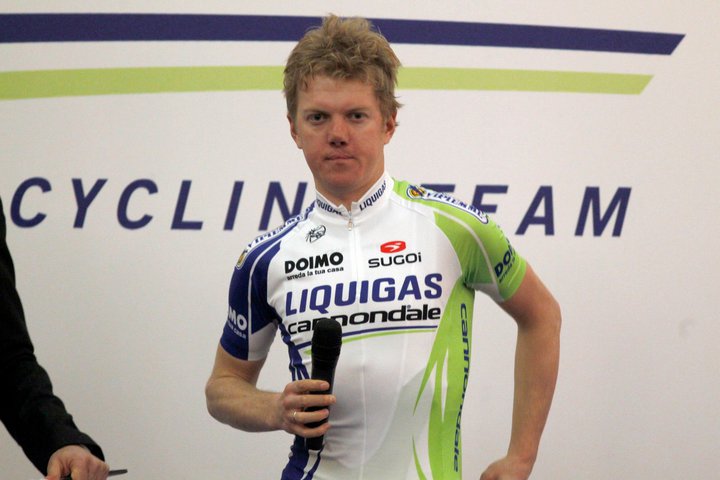
Timmy Duggan
You recently tweeted about reconning Lookout Mountain. What are your thoughts about the final stage and how you see it unfolding?
With the mountain in the first part of the race it can unfold in a number different ways. It’s the last stage of the race and I always say that the last day of a stage race is either the easiest day or the hardest day. It kind of depends on the circuit that the race is going on, it depends on how tired all riders are from the previous week of racing, and how motivated they are for a sprint finish or a GC shakedown or whatever. It’s either everything’s settled and everyone just wants to cruise around and sprint at the end or it’s not settled and in which case it’s the last chance for some teams who haven’t won yet to get a stage win or the last chance to shake up the general classification, so a lot of teams are motivated to be aggressive, and if that happens it can be the hardest day of week.
Do you think that the fact that there is a lot of high altitude in this race gives an advantage to someone like you who lives at high altitude?
Certainly you definitely have a lot fewer bullets to fire at altitude, so when you go for it, when you attack, you gotta make sure it’s a good one because it’s really hard to recover both within the race that day and also the next day if you go too deep.
You frequently mention how much you miss your wife when you are away racing. What role does she play in your motivation?
She’s just nothing but supportive. We were together before I even started bike racing, so she’s kind of seen me climb up the whole ladder and go through the whole process and she knows how much time and effort and energy and love I put into it and what it means to me. She really knows when to put in the support and she knows when to back off and let me do my thing. She knows most of all how to put up with an athlete in the house.
Do you think we in the States should make it easier for men and women to get to the level of pro-cycling, or is it good that it’s more of a challenge?
Americans only really started racing at the highest level in Europe back in the 80s with the 7-11, Davis Phinney, Andy Hampsten era, so that’s 25 something years ago. Obviously back then it was a huge leap for an American to come over to Europe and be in a totally different place and culture and make a name for themselves and become a real professional. Those guys kind of paved the way and ever since then there’s been more and more of a cycling presence in America as well as more and more Americans going to Europe. So it’s still necessary I think to cross the pond, and race in Europe, and find a team there, and kick-start your career there, but there’s also a very, very strong American pro-racing scene. So you can certainly become a professional cyclist in America without ever even setting foot in Europe. But it’s a different league, the domestic professional teams. The style of racing is different; the length is different. But it’s still a professional bike race. It’s still really difficult to win a race. Certainly now in America there’s a lot more infrastructure — someone just starting out, if they’re 19 or 20 years-old, there’s a lot more high level racing opportunities just within the United States than there used to be.

Jérémy Roy Gave His All: Stage 13 finish line, 2011 TDF (jlhuss.blog.lemonde.fr, via @StanContador, Twitter)
As he crossed the finish line today in Stage 13 of the TDF, Jérémy Roy patted his heart twice with his right hand, then held that hand palm out as if to say: enough, I have given it all to you (j’ai tous donné) — you the fans, you the road, you this heaving unforgiving beast that is the Tour. There is no more to give.
Today’s break was the fifth Jérémy has found since the start of this year’s Tour. As he crested the Tourmalet and began the descent to Lourdes, the win in the Tour he has dreamed of seemed within reach. Then in the final kilometers Thor Hushvod wrenched the win from Jérémy’s heart.
Watching Jérémy today reminded me of all the pro-cyclists who, through courageous efforts and the messages they send, have left their hearts on the road. Surely enough exist to form a nine-man team. This All Heart team would never win a fantasy team contest based on traditional rules, as most often its members’ acts of courage do not result in the rulebook’s definition of winning. Jérémy knows that definition. “It’s the win that counts,” he said in an interview with French TV today; the polka-dot jersey was a consolation prize.
Here are my picks for the 2011 All Heart Pro-Cycling Fantasy Team.
| Pro-cyclist | All Heart Demonstrations |
| Jérémy Roy | 2011 TDF — five breaks, almost win on Stage 13 |
| Thomas Voeckler | 2004 TDF — battling the mountains to hold the yellow jersey |
| Ryder Hesjedal | 2010 TDF — top 10 effort |
| Jens Voight | 2010 TDF — killing himself on the Tourmalet |
| Ben King | 2011 ATOC — pulling at the front again and again |
| Tyler Farrar | multiple sprint finishes behind Cavendish |
| Lance Armstrong | 1999 TDF — first win post-cancer |
| Andy Schleck | 2010 TDF — best time trial he’s ever done |
| Taylor Phinney | Twitter love |
There are surely deserving guys I have omitted, especially those on domestic teams I have not seen race. Let’s consider this team selection a work in progress.
The continuation of the piece about what it’s like to be a LOC member for the USA Pro Cycling Challenge has been underwater for three days — at least that’s fewer days of rain than the Tour de France has experienced this year. Each time I have sat down to write it, a severe thunderstorm descended, unleashing thunderclaps that bounced me out of my chair and sent the cats slinking to the basement. I either shut down the desktop or a power outage took care of it for me.
Today I decided to give it a go at the Denver Botanic Gardens. Sure enough, after sitting at a table near the Monet pond’s phosphorescent water lillies for 30 minutes, the heavy gray sky started to grumble. I moved to the covered greenhouse patio. High-pitched tornado warning sirens upped the ante for today‘s storm. I ran to the main building, and now I’m in the library with a dozen other visitors seeking shelter (l‘abri).
On French TV coverage of the TDF today, as the yellow jersey group neared the crest of the Tourmalet, Jalabert commented that Contador was seeking shelter in the middle of the group.
It seems an odd description. Taking that position in the pack feels more like hiding out to me, as much as one can hide on an alpine road devoid of trees. Nearly all of the riders surrounding him were his competition, guys that would run over rather than shelter him. The expression seems additionally odd to me because I would describe Contador as isolated in this Tour. He is the most marked man in the peloton. Signs of weakness abound, including questionable support from his co-équipiers. All of this bestows upon him the prize of most likely to catch tomatoes in the face — and the slinging began with booing at the presentation.
It’s strange to feel a modicum of compassion for Contador. I refused to put him on my TDF fantasy team. Really, what can I have against him? Sure there were some anti-team actions during past Tours that I took for arrogance, probably even snickered about. Yep, his clenbuterol appeal hangs in the wings; this doesn’t bother me so much, given admissions by riders I‘ve admired. Yes, the rivalry with Lance pit me against Contador; I took a side.
After thinking through it, I can’t find a valid reason to not admire him as an accomplished champion in the sport.
Another thunderclap outside. It makes me grateful I found shelter to I huddle in, reminding me of my own vulnerability to uncontrolled outside forces. How much more vulnerable are the guys in the Tour peloton, including Contador. Bring on the thunder.
Here’s a count of riders in the breakaways by country of origin up to and including Stage 10. The French lead by a wide margin. Riders who have been in two breaks are counted twice, and so on.
Country of rider, # in breakaways as of Stage 10
France, 22
Spain, 9
Netherlands, 8
Belgium, 2
Italy, 2
Columbia, 1
Portugal, 1
USA, 1
Russia, 1
It all started last September, when she walked out the door of the Higher Grounds coffee shop in Golden and asked us a question. “We’re going to have a ride-by at noon. Can you join us? The Quiznos Pro-Challenge organizers are in town visiting, and we want to show support for our bid to be a host city.” Marcie said. My husband Donald and I stood near our road bikes which we lean against the coffee shop’s brick exterior nearly every weekend. We were heading home and couldn’t make it. But I didn’t want to let it go at that. I introduced myself and asked, “How does a person get involved to help with the bid?” Marcie shared the location and time of the next meeting to talk about the preparation of the City of Golden’s bid, a pitch for why Medalist, the race organizer, should pick Golden.
At the meeting the folks drafting the bid asked for a couple of things for the document: blurbs about riding on Lookout Mountain to support including it in the stage Golden would host, and photos of cyclists. I went home and got to work. Over a dozen people worked very hard on the bid; I was very happy to contribute a few small things to help bring pro-cycling back to Golden. Find my blurb on Lookout on page 21 of the bid, and the photos I provided on the cover (peloton on the Col de Peyresourde in the 2008 TDF) and on page 10 (upper right photo, Donald in the blue with a friend).
We were ecstatic when we were selected for the start of the final day of the race, Stage 6. Then the work began. I started as a member of the PR/Media committee so I could contribute my writing skills. Then a call went out for a new chair of the Education and Outreach committee. All of the other committees were chaired, and I wanted to do more. I raised my hand, pitching my project management skills and pro-cycling knowledge. Now as co-chair of this committee, I’m a member of the Golden Local Organizing Committee (LOC).
I’ve spent hours working with my co-chair and our committee volunteers to define the purpose of our committee and identify and select venues for us to staff with race information. Our home stapler has gotten a workout as it’s joined lists of Golden events to race marketing material. I’ve stood behind tables and waved to, smiled at, and talked to strangers about the race and what’s going on in Golden that they might enjoy (the 8/26 Friday night in the park showing of the film American Flyers is a popular one). But the most exciting part for me has been learning about how to put together and pull off a professional bike race.
Part 2 to come in a subsequent post. Get out and enjoy a ride!
Yesterday I interviewed Timmy Duggan, rider on the Liquigas-Cannondale Pro-Cycling Team. A few minutes before our 2pm call, I circled my office taking deep breaths and flapping my arms across my chest. I had had plenty of coffee; fatigue wasn’t the issue. While I have interviewed people before, I sensed this one was going to be extra-special. It would be my first interview of a pro-cyclist. And, having learned some of Timmy’s story earlier in the day, I anticipated a message I needed to hear.
My morning research began with the Liquigas-Cannondale website. It includes a short video on each rider. Timmy’s opened my eyes. Here’s what he said in the video.
“In 2008 at the Tour of Georgia I was part of a really nasty crash and came out of it with a traumatic brain injury that nearly killed me. To be able to come back to the top of the sport and keep improving after all that is pretty cool. For me, I won’t be happy until I know that I can’t do it, and it turned out I could do it. The motivation to keep pushing is always there no matter what happens.”
My husband and I watched several stages of the 2005 Tour of Georgia. As I listened to Timmy speak in the video, I seemed to recall spying him in a break-away in 2005, wearing the blue and white kit of the TIAA-CREF team. They were a young team; Timmy would have been 22 years old. I imagined him in 2008 flying down the same streets we stood on in 2005, surrounded by flowering wild dogwood.
A friend of my husband’s, whose age is at least three times 22, now fights to recover from a traumatic brain injury sustained while cycling. It’s an extremely slow recovery process. It means relearning all we take for granted – movement, speech, memories.
As I continued my pre-interview research I located the website for Timmy’s Just Go Harder Foundation. “We” refers to Timmy and Ian MacGregor in these comments from the website.
“We quickly rose through the ranks of cycling, creating our own teams along the way, riding under the Eldora Mtn. Ski Club, Vecchio’s Bike Shop, and in 2003, Duane Duggan ReMax-Paketa Cycles, helping us out at a critical point in our careers. We believed we had the ability to succeed in cycling, but nobody knew who we were yet. Through the support of this team, we traveled the country to NRC races in Timmy’s parent’s minivan, which we successfully ran into the ground, sleeping in the back and driving through the night…We trained and raced hard by day and delivered pizzas by night to fund our mission…”
Thank you, Timmy, for your courage, persistence, and passion; it astounds me, and it’s why I love this sport. And thank you for inspiring me, without saying so, to keep writing about it.
Here are a few links regarding Timmy.
Alexi Grewal and Timmy Duggan Look at the Quiznos Challenge: http://pezcyclingnews.com/?pg=fullstory&id=9148
Just Go Harder Foundation: http://justgoharder.com/jgh-foundation
Liquigas-Cannondale Pro-cycling Team website video of Timmy: http://www.teamliquigascannondale.com/2011/eng/main.php?mod=scAtleti&id=9
Timmy on Twitter: @timmydugganjgh

Cadel Evans after Stage 4 of 2011 TDF, photo by Steephill.tv/reuters
About 20 kilometers from the finish of today’s 173 kilometer TDF stage from Carhaix to Cap Fréhel, the announcer on French TV counted ten crashes thus far in the stage. The crashes involved several to many riders at a time. One of the crashes left Jani Brajkovic of Team Radioshack like a rag doll tossed onto the pavement from a car. I was terrified. He didn’t move. Race vehicles streamed past him. The race doctor ran to him and talked to Jani as he lay there. Still no movement.

Jani Brajkovic on the pavement, photo by Graham Watson
Until now I wondered why pro-cyclists frequently don’t get up right away after falling off their bikes in a crash (“chute” in French); instead, they lie on the pavement. Of course I want them to get up to know they are going to be alright. But there’s another reason I want them up and back on their bikes, if I am honest with myself. I want them back in action, chasing to rejoin the peloton, because on the pavement they are losing precious time.
It feels a bit embarrassing to admit it wasn’t until I saw Jani today that I understood why a rider might lie motionless after falling from the bike at 30 mph. He may not be sure what has happened. Probably he takes an unconscious inventory of his body parts and the source of any pain before moving anything to see if it still works. He could also be unconscious.
While it’s well-known that riders will fight all kinds of pain to stay in a race, especially the TDF, if a pro-cyclist doesn’t take care of the body that allows him to make a living from his passion for cycling, it’s a disaster. This must factor into the decision of whether to get back on the bike or abandon the race after a crash. The doctor and Jani decided it was better for him to sink onto the stretcher and go to a hospital by ambulance for examination. The immediate inaction of lying still after crashing used to seem counterproductive to me, a giving away of opportunities. But it’s not; it’s putting currency in the bank for future races.
It’s so easy for armchair fans and budding sports analysts to judge pro-cyclists’ actions with an air of authority. I did this just yesterday in a tweet I sent in reply to a comment @inrng made about Alberto Contador’s finish in yesterday’s stage. My comments relate to Contador’s attack on the main contenders as they ascended the Mûr (French for “wall”) to the finish line.
inrng: You know those films where asomeone has a gun that jams at the crucial moment with an empty click? Reminds me of El Pistolero at the finish (This was in my post yesterday)
butterflywriter (that’s me) @inrng I don’t think Contador looked good. Usually when he jumps, he drops more than today; he looked to be breathing heavier than usual
inrng @butterflywriter true, he was grimacing a bit today, same face as Flèche Wallonne, but he still did well.
As we settled onto the couch to watch the evening TDF TV coverage, I said to my husband, “When it gets to the Mûr, look at Contador. Tell me what you think about how he was doing.”
Donald didn’t find any basis for the conclusion in my tweet. He said, “They were all maxed out; they rode extremely fast to the bottom of the Mûr. And keep in mind he almost won the race, finishing second. Usually if you’re hurting you can’t attack.”
Only the pro-cyclists we tweet about know whether they are feeling strong or washed out. I’m more reluctant now to cast assessments on their performance. It’s hard not to judge them. It makes us feel good to think we know something, and it helps us process what’s going on in the race. I hope for me from now on my motivation is more the latter, which is probably a sign of maturity as a fan and commentator on the sport.

 ProVéloPassion