
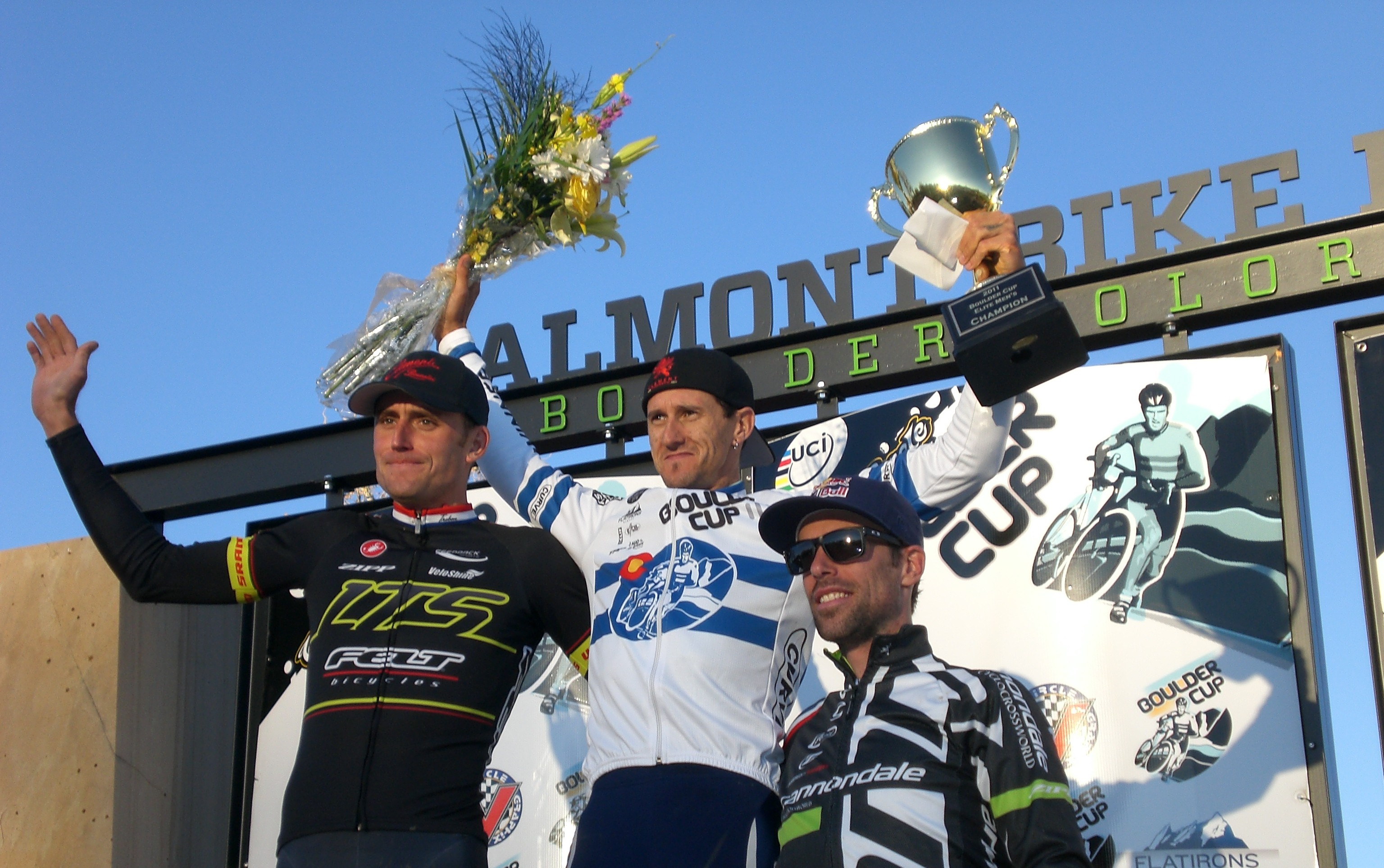
2011 Boulder Cup podium: Ryan Trebon 2nd, Ben Berden 1st, Tim Johnson 3rd (l to r) (Mary Topping)
Does winning the 2011 Boulder Cup make it any easier for Belgian’s Ben Berden to live in the U.S., away from his wife and two small children for four months, moving from one host family house to another?
“It’s my biggest win in five years,” Ben said, speaking to velonews.com after the race. Ben told the crowd gathered around the podium that he took it easier than usual the morning of the race, spending less time warming up. He also liked the course. The Valmont Bike Park venue included more hills, sand/gravel, and muddy sections than Saturday’s course at the Colorado Cross Classic where Ben finished fourth.
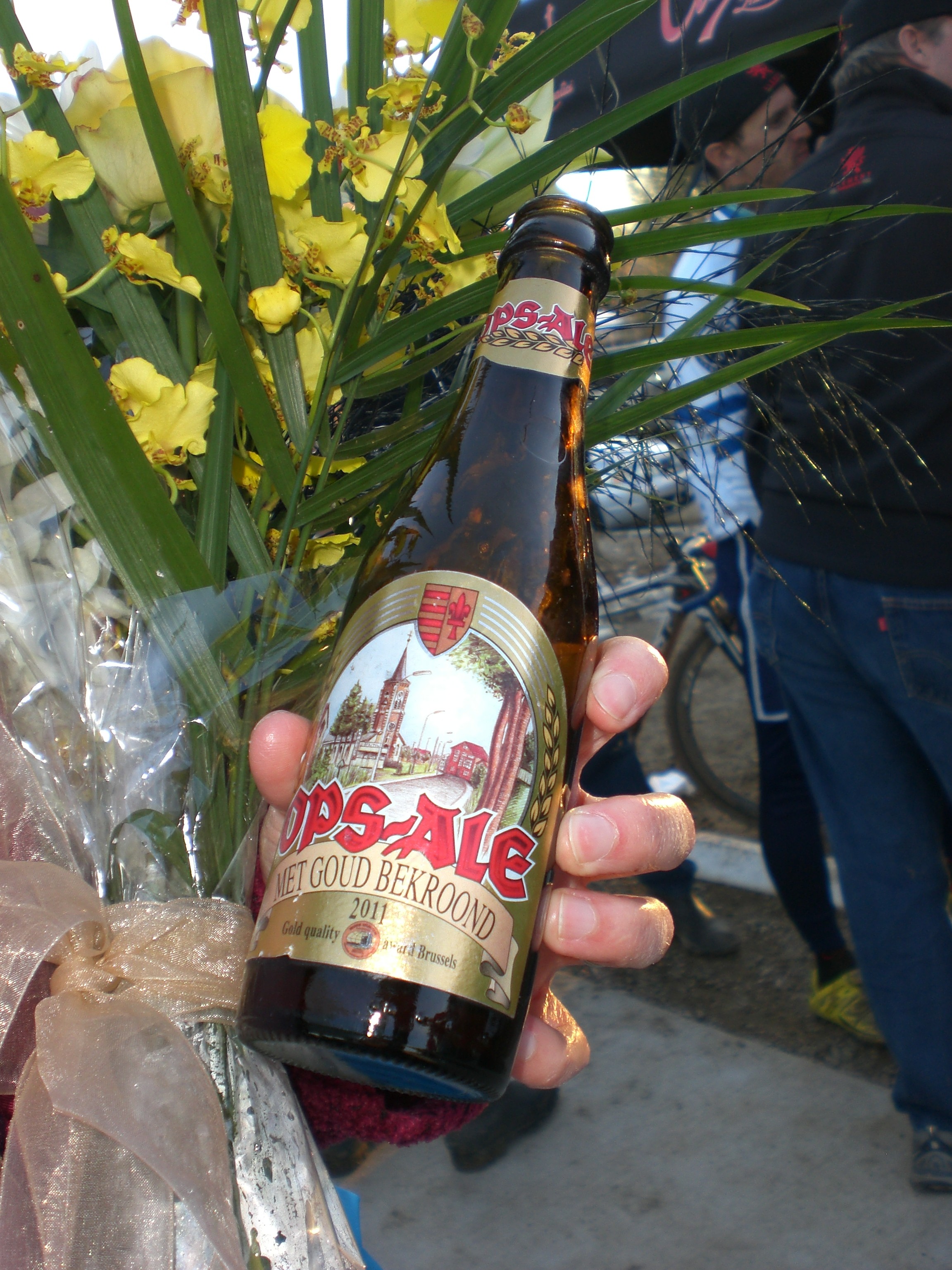
Ops-Ale, Belgian beer, one of Ben Berden's sponsors (Mary Topping)
Ben shared some details about one of his sponsors, Ops-Ale, with podium spectators. A family-run brewery crafts Ops-Ale; it’s so local that, according to Ben, it’s only known in the Flanders part of Belgium. But it’s not foreign to Ben who has known the family that owns the business since he was 15 years-old. Clement, a tire manufacturer, also sponsors Ben; Clement’s tents sheltered Ben and his equipment at the Boulder Cup. On hand to make sure Ben’s machine, a Stoemper bike, worked well, was Jordan Schware, Ben’s mechanic. Jordan reveled in Ben’s win along with Donn Kellogg of Donnelly Sports, Clement licensee. Donn’s been working to rebuild the over 100-year old brand.
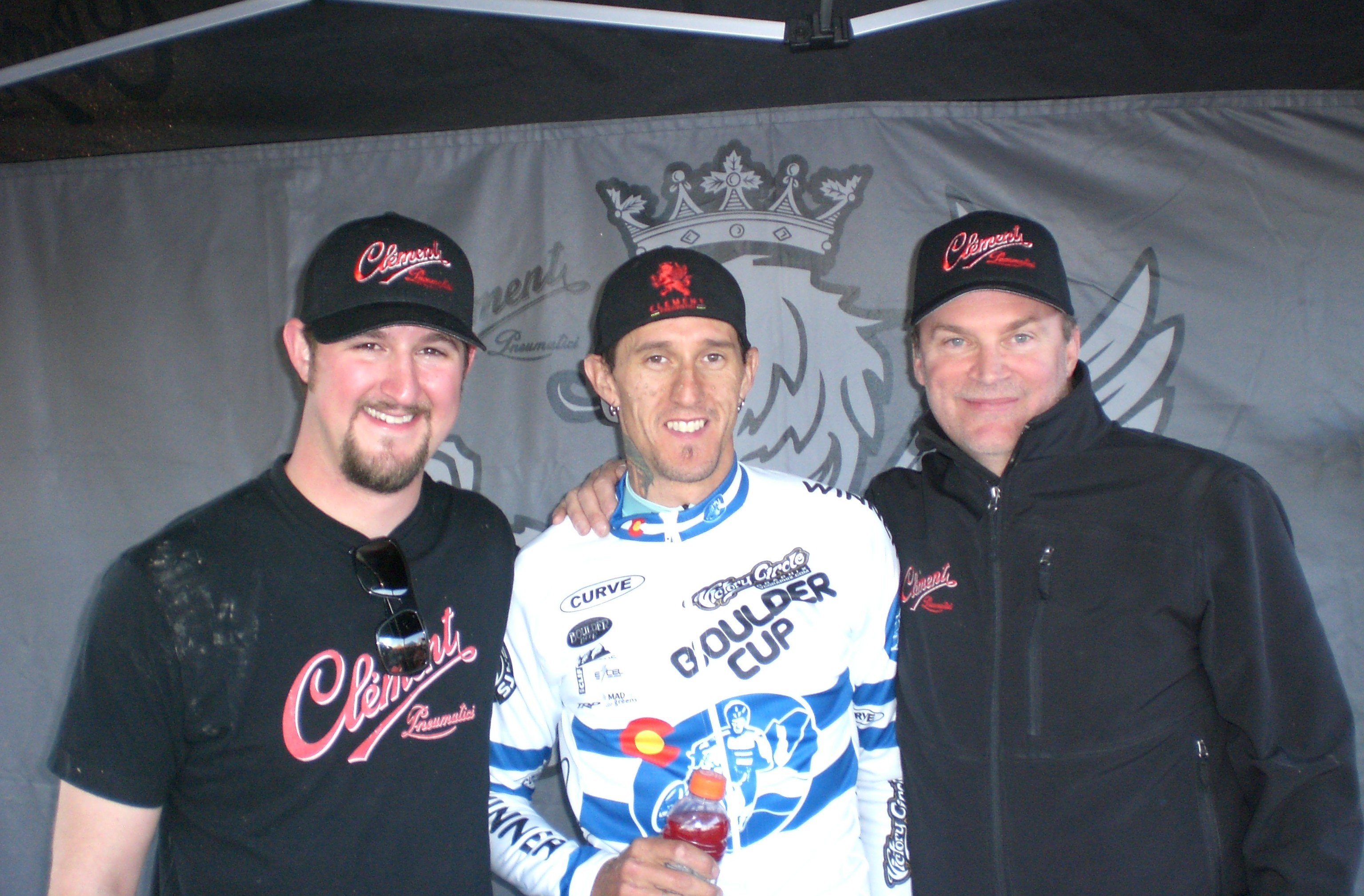
Ben Berden (center) with mechanic Jordan Schware (l) and Donn Kellogg (r) (Mary Topping)
In this post-race video Ben shares the key moment in the race when he took advantage of his skill in the sand, how he feels about racing in the U.S., and what’s next for him after he returns to Belgium. Thank you, Ben, and congratulations on your 2011 Boulder Cup win. For more detail on how the race progressed, visit velonews.com. Ben’s U.S. racing calendar, a list of his sponsors, and other information can be found on his website.
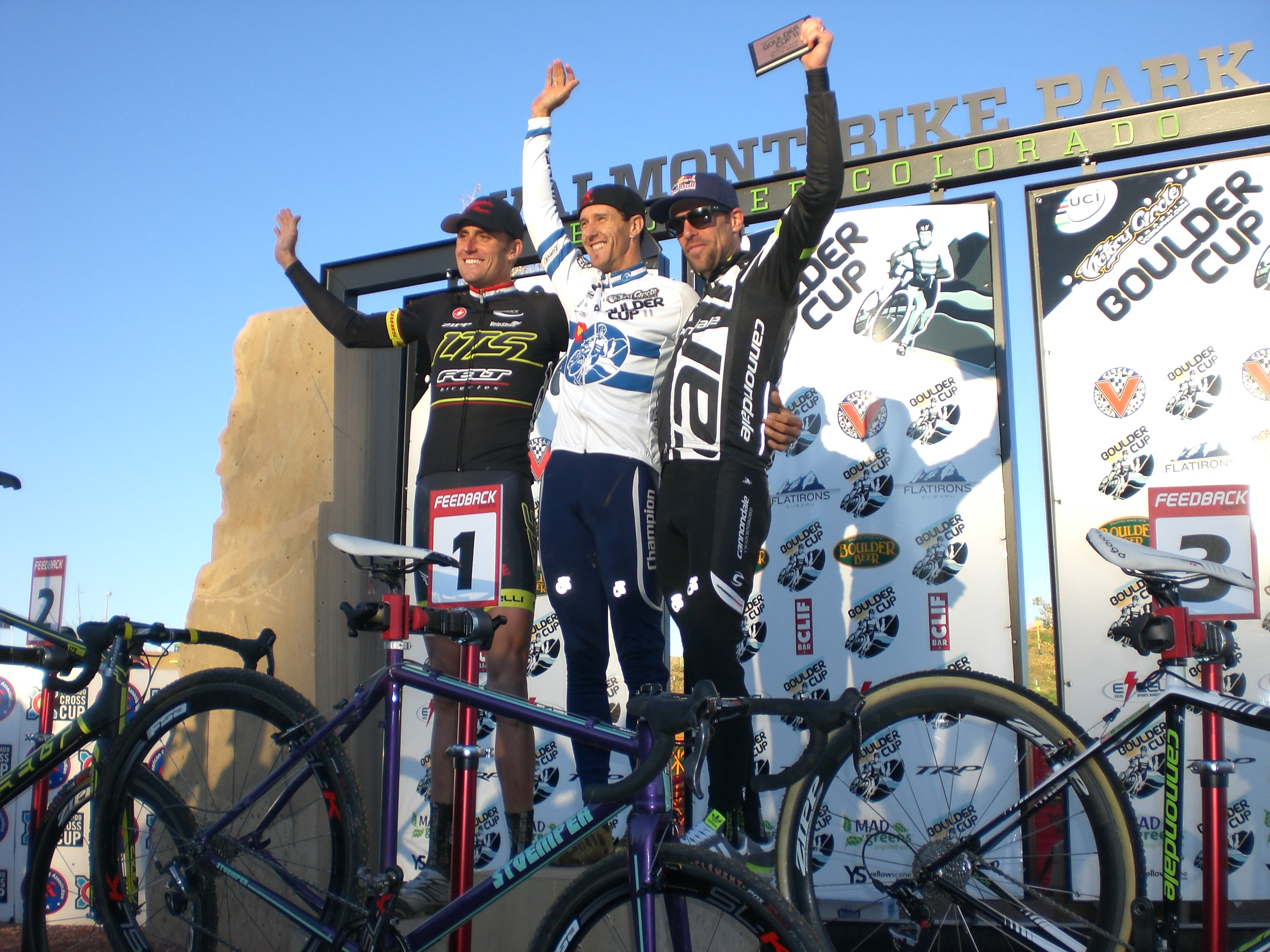
2011 Boulder Cup podium: Ryan Trebon 2nd, Ben Berden 1st, Tim Johnson 3rd (l to r) (Mary Topping)

2011 Boulder Cup Course Map
Jamey Driscoll is a busy man. When he’s not racing cyclocross for Cannondale p/b Cyclocrossworld.com, he competes on the road for Jamis/Sutter Home Pro Cycling Team. He sat down to talk before the start of the 2011 Boulder Cup after he previewed the technical course. Jamey wears his kit well, even after he’s kicked up some mud.
Fresh off a third place finish at the Colorado Cross Classic yesterday, Jamey’s busy again, pinning his number to a jersey. He talks about his cyclocross season, how he combines both racing disciplines, what he likes about cyclocross, and where he’ll be racing next. Thank you, Jamey. Good luck in Cincinnati.
2011 Boulder Cup Course Map
A set of photos of Jamey Driscoll riding for Team Cannondale p/b Cyclocrossworld.com at the 2011 Colorado Cross Classic. Jamey finished third, with a great effort to move up the field with each lap. (note: the date is 10/29/2011).

Start line close-up, Jamey Driscoll #21, 2011 Colorado Cross Classic (Mary Topping)

Start line, 2011 Colorado Cross Classic (Mary Topping)
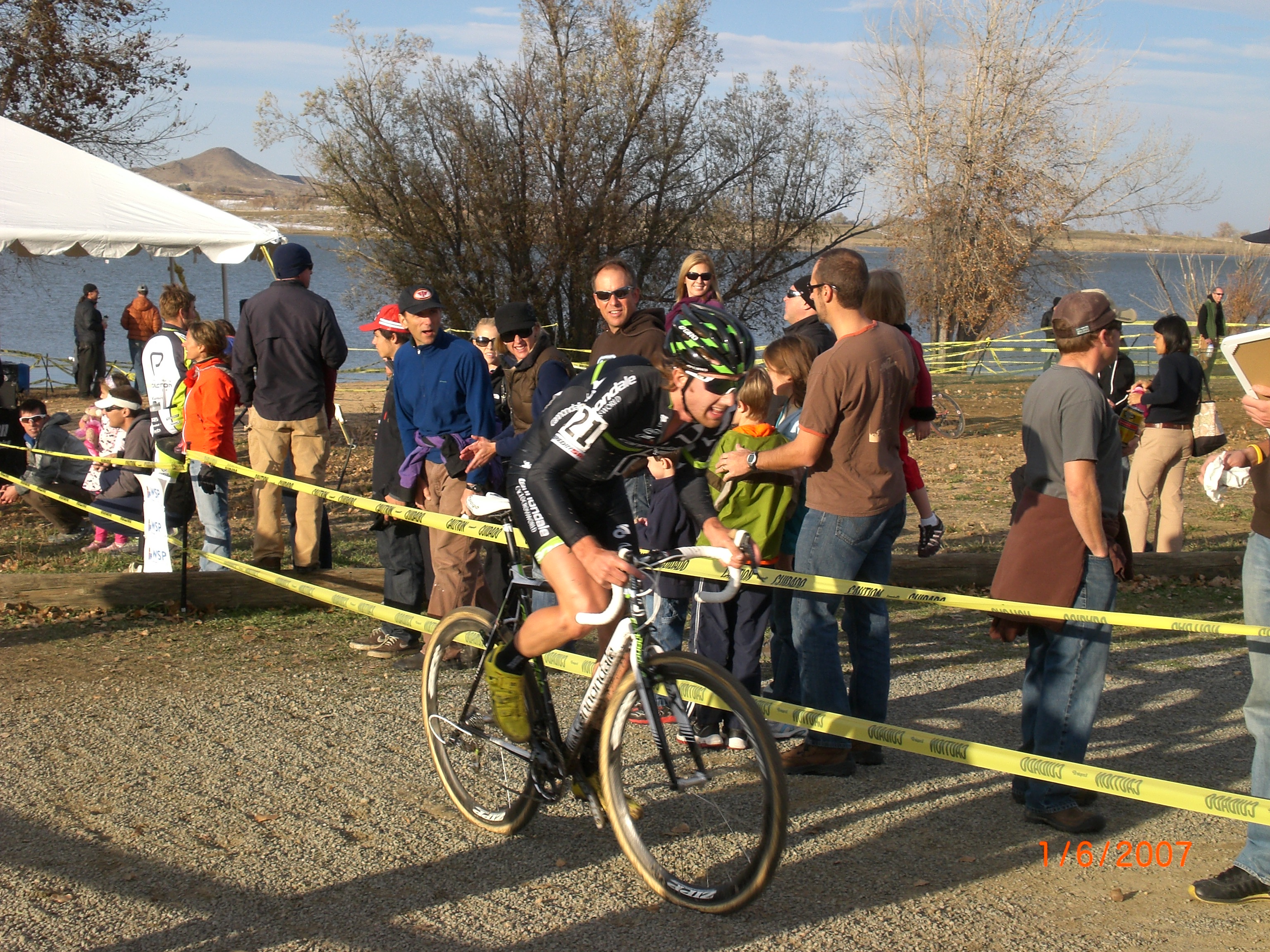
Jamey Driscoll early in the race, 2011 Colorado Cross Classic (Mary Topping)

Jamey Driscoll, on third place podium step, 2011 Colorado Cross Classic (Mary Topping)

Jamey Driscoll, post-podium, 2011 Colorado Cross Classic (Mary Topping)
Ryan Trebon, LTS/Felt, warmed-down after winning the 2011 Colorado Cross Classic. He talks about the race, how LTS/Felt is progressing, sisu, and more. Heads-up: the wind is really blowing, but Ryan is still his amazing self. Make sure to stay for the end and comments on tomorrow’s Boulder Cup.

Ryan Trebon pinning on his number before the Colorado Cross Classic Start (Mary Topping)
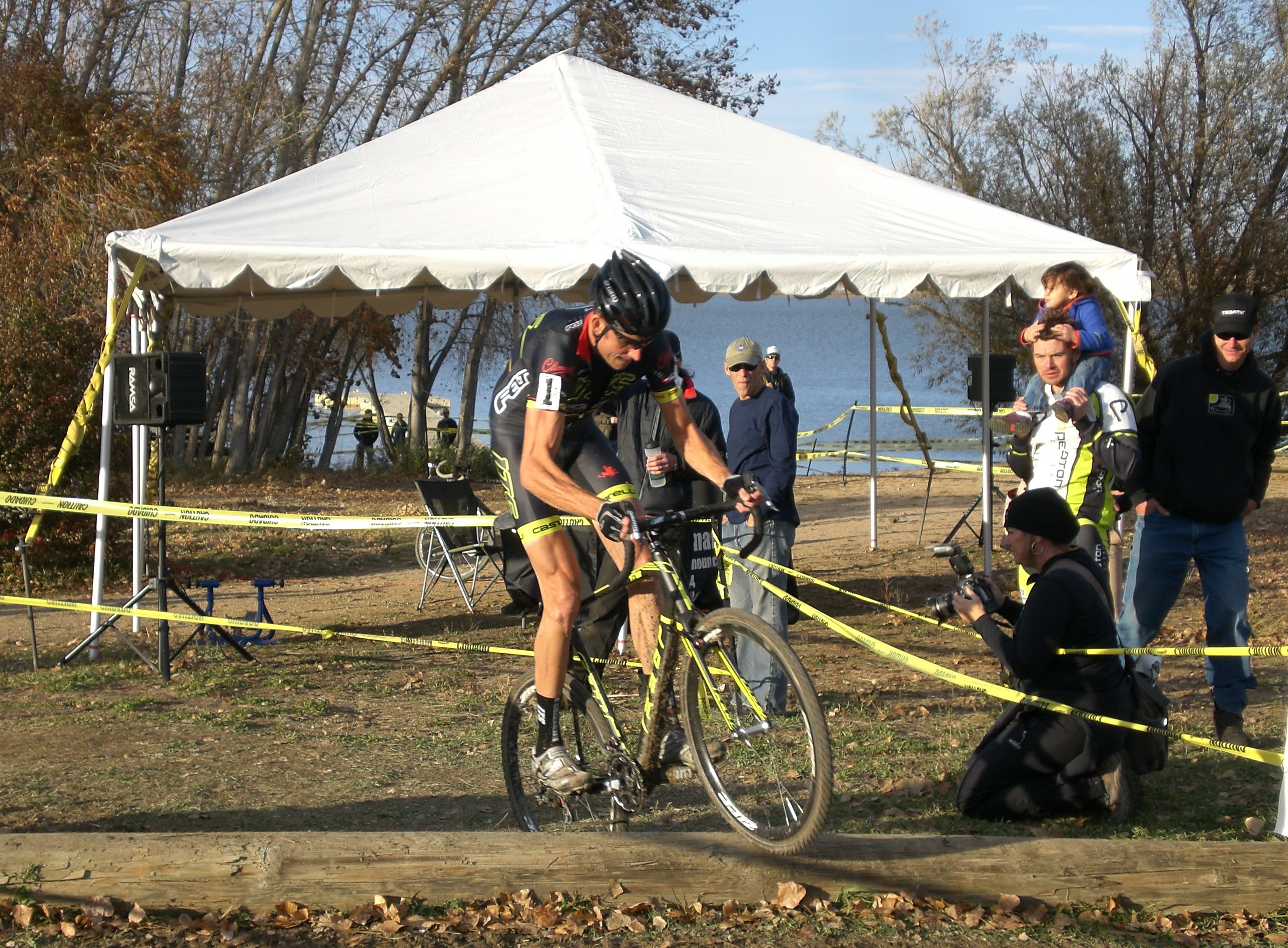
Ryan Trebon, LTS/Felt, 2011 Colorado Cross Classic (Mary Topping)
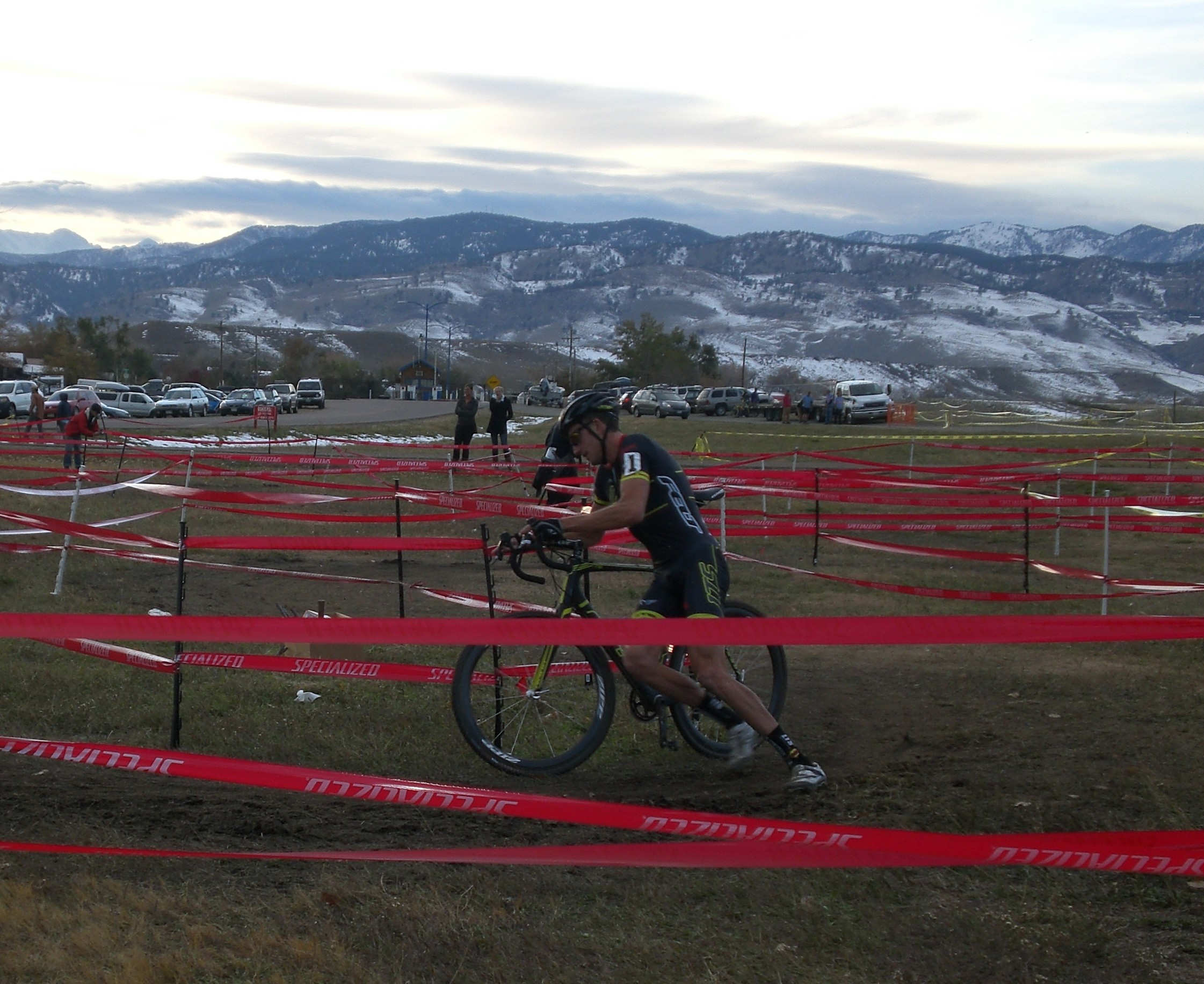
Ryan Trebon, LTS/Felt, heading to barriers, 2011 Colorado Cross Classic (Mary Topping)
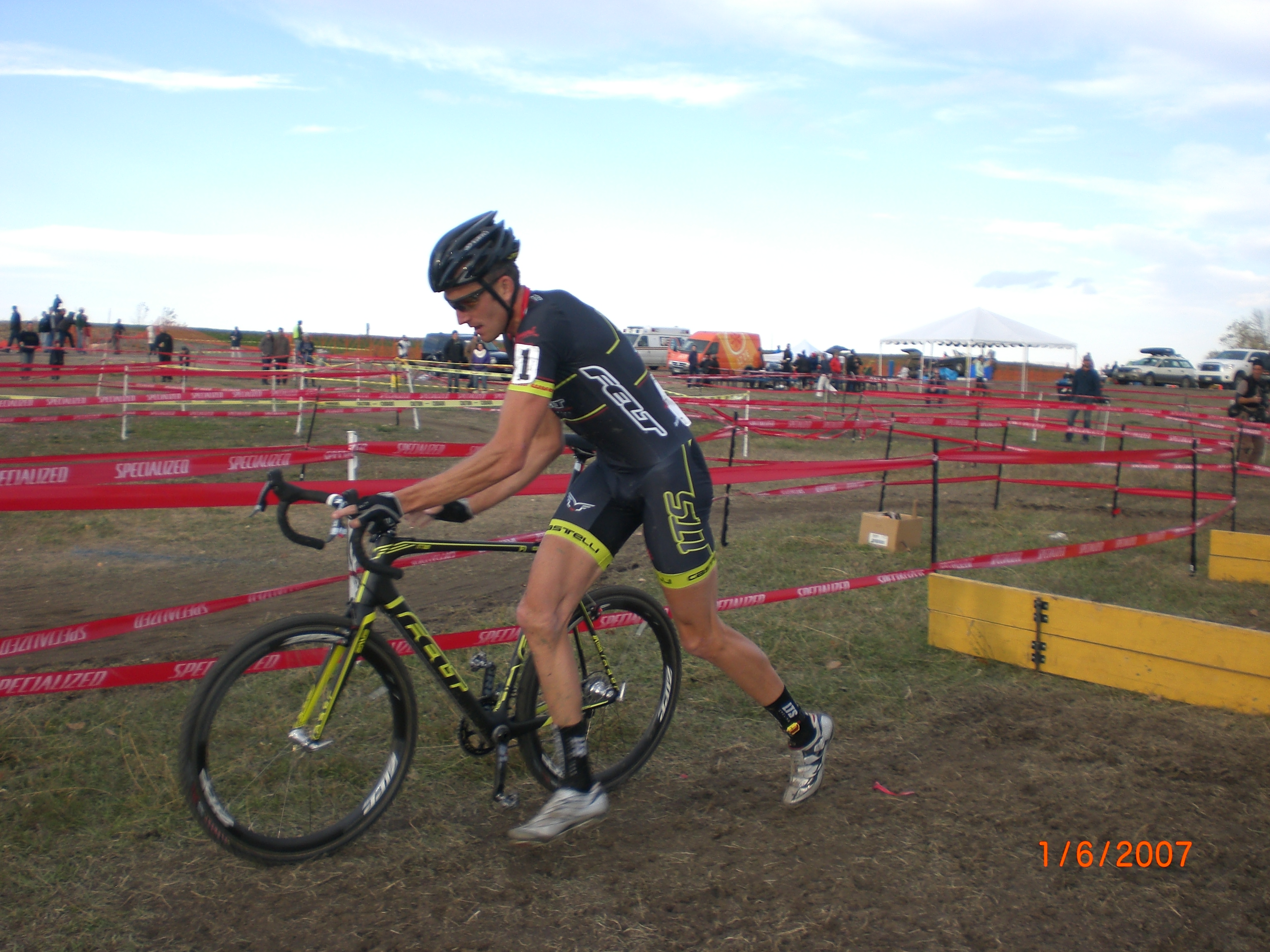
Ryan Trebon after the barriers, 2011 Colorado Cross Classic (Mary Topping)
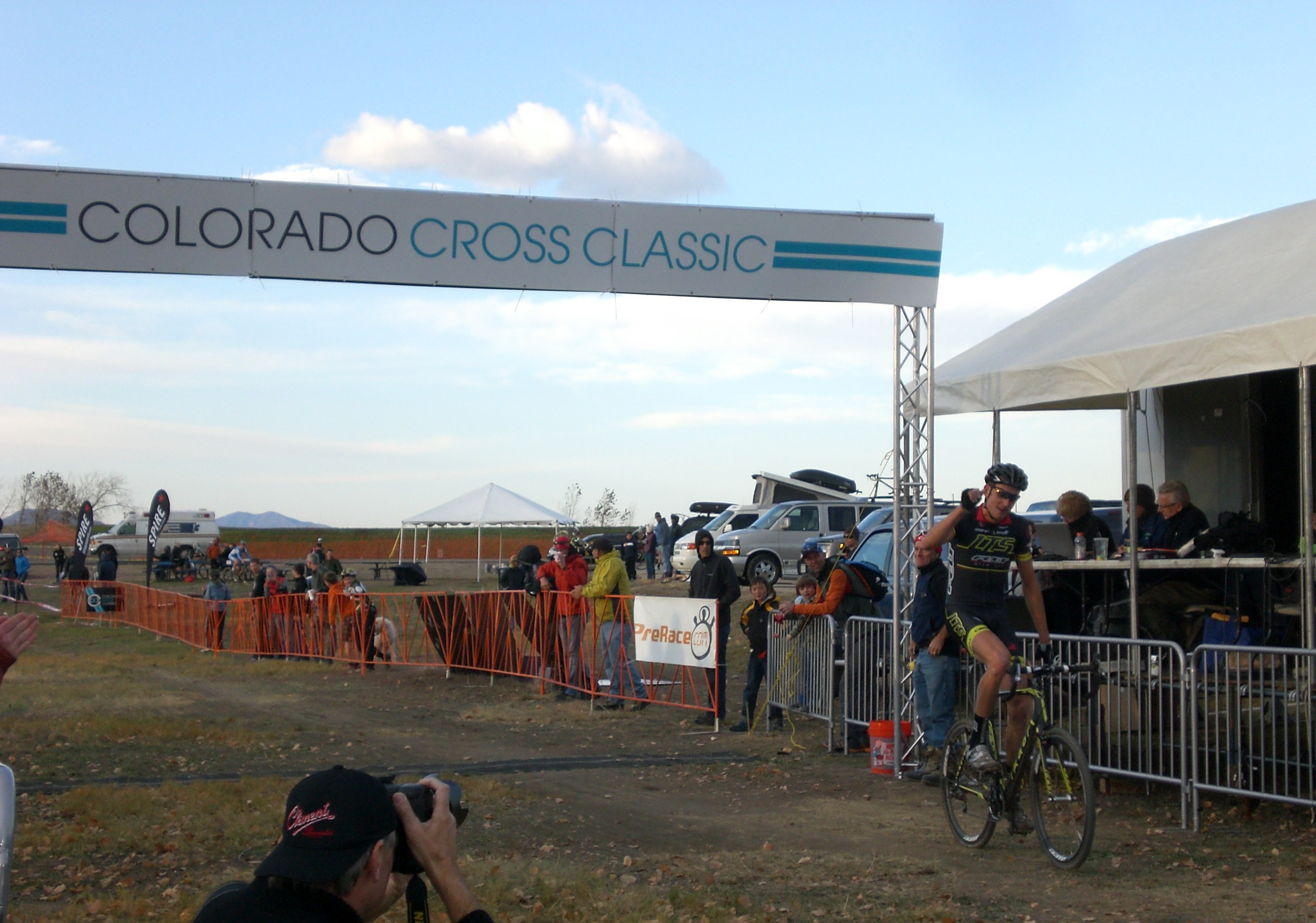
Ryan Trebon crosses the line first, 2011 Colorado Cross Classic (Mary Topping)

Ryan Trebon, LTS/Felt, relaxing after his 2011 Colorado Cross Classic win (Mary Topping)
To learn more about Ryan’s new team, LTS/Felt, visit this Podium Insight interview with Ryan from March, 2011.
Career highlights for Ryan Trebon:
-
2006 CX National champion
-
2006 MTB National champion
-
2007 MTB National champion
-
2007 NACT overall winner
-
2008 CX National champion
-
Four times USGP overall first place
-
Two times Cross Vegas first place
Most people need a fantastic prize to entice them to enter something like this.
But not Steven Thompson, Ian Sheppard, Todd Shaffer, and Andy Dukes. They took turns riding a 13.5 mile loop all day and night in Palmer Park under the amateur Fli Bye Racing team at the 24 Hours of COS (Colorado Springs), the venue for the 2011 USA Cycling 24-Hour Mountain Bike National Championships. They rode hard over sandstone and dirt trail even though they couldn’t hope to win the event’s top prize, one of the most coveted in bike racing: a national champion’s stars and stripes jersey.
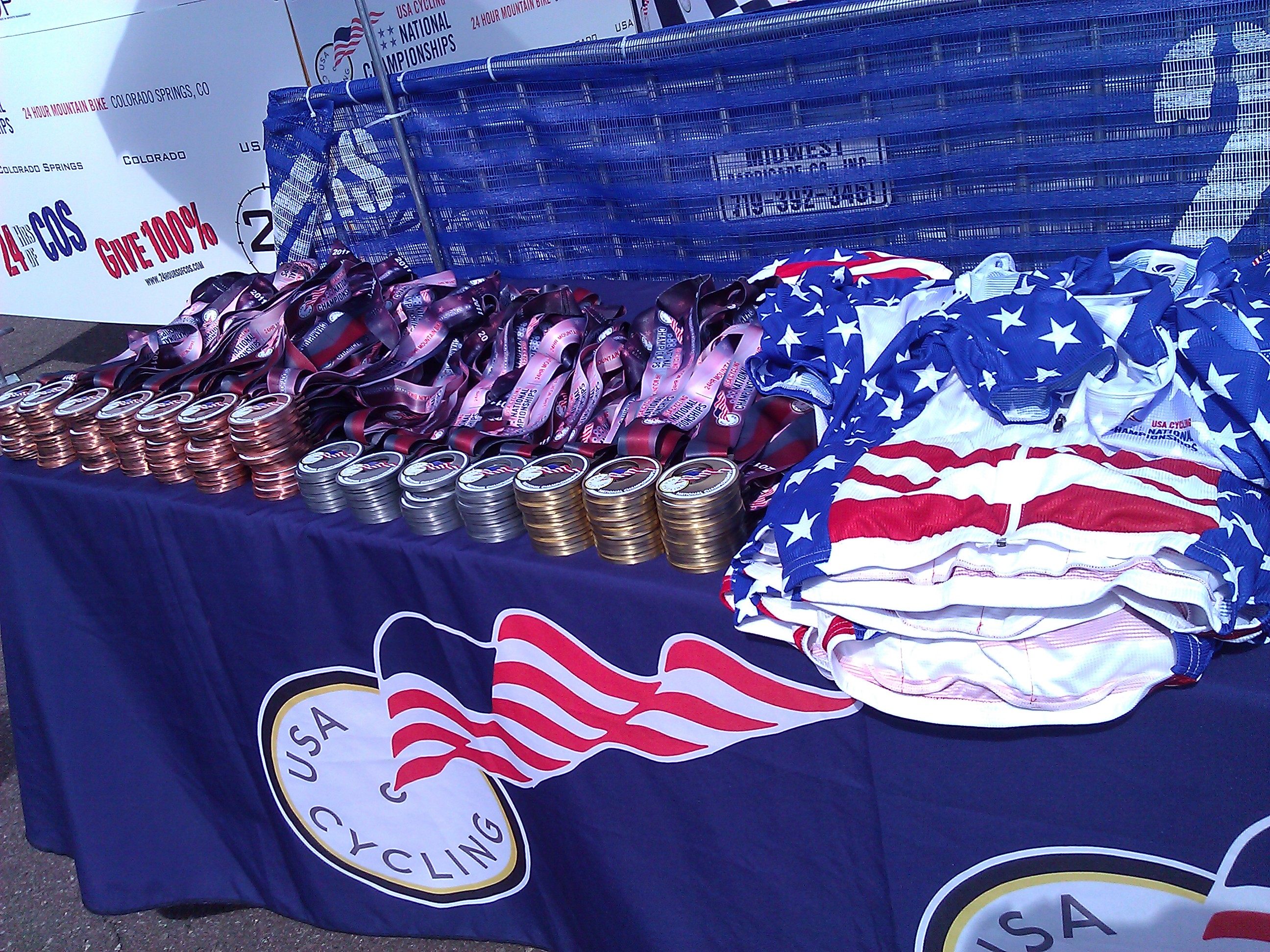
USA Cycling national championship medals and jerseys at 24 Hours of COS (Mary Topping)
Fli Bye Racing competed against 21 other teams in the non-national four-man open class at the event, which took place during the first weekend in October. Non-national teams were not eligible for a national championship title. “The open category is more competitive,” Steve Thompson, Fli Bye Racing’s leader said. “I would rather get 8th place out of 25 than 5th place out of 5.” The open class carries no age restrictions except a minimum age of 18 years-old. Solo men and women, duo and junior teams, four-woman teams, and four-man age 35+ and 45+ teams also raced for stars and stripes on the same course.
It’s about having fun
Fli Bye Racing didn’t arrive with high expectations. “Trophies are cool, but it’s more about having fun with a bunch of guys,” Steve said, while mixing a chocolate protein drink to fuel his 6’1” tall frame after his first lap. Tattoos of Thor and Aphrodite color his left arm red, yellow, and blue. “We all understand we’re not getting paid [to race], so putting on pressure isn’t necessary. We all have jobs. This is just a hobby.” Hobby? OK, three of them don’t race frequently. While practicing a hobby, Steve, Ian, Todd, and Andy were the only non-national four-man open team that came close to the performances of guys who race bikes professionally and were qualified to become national champions at the end of the race.
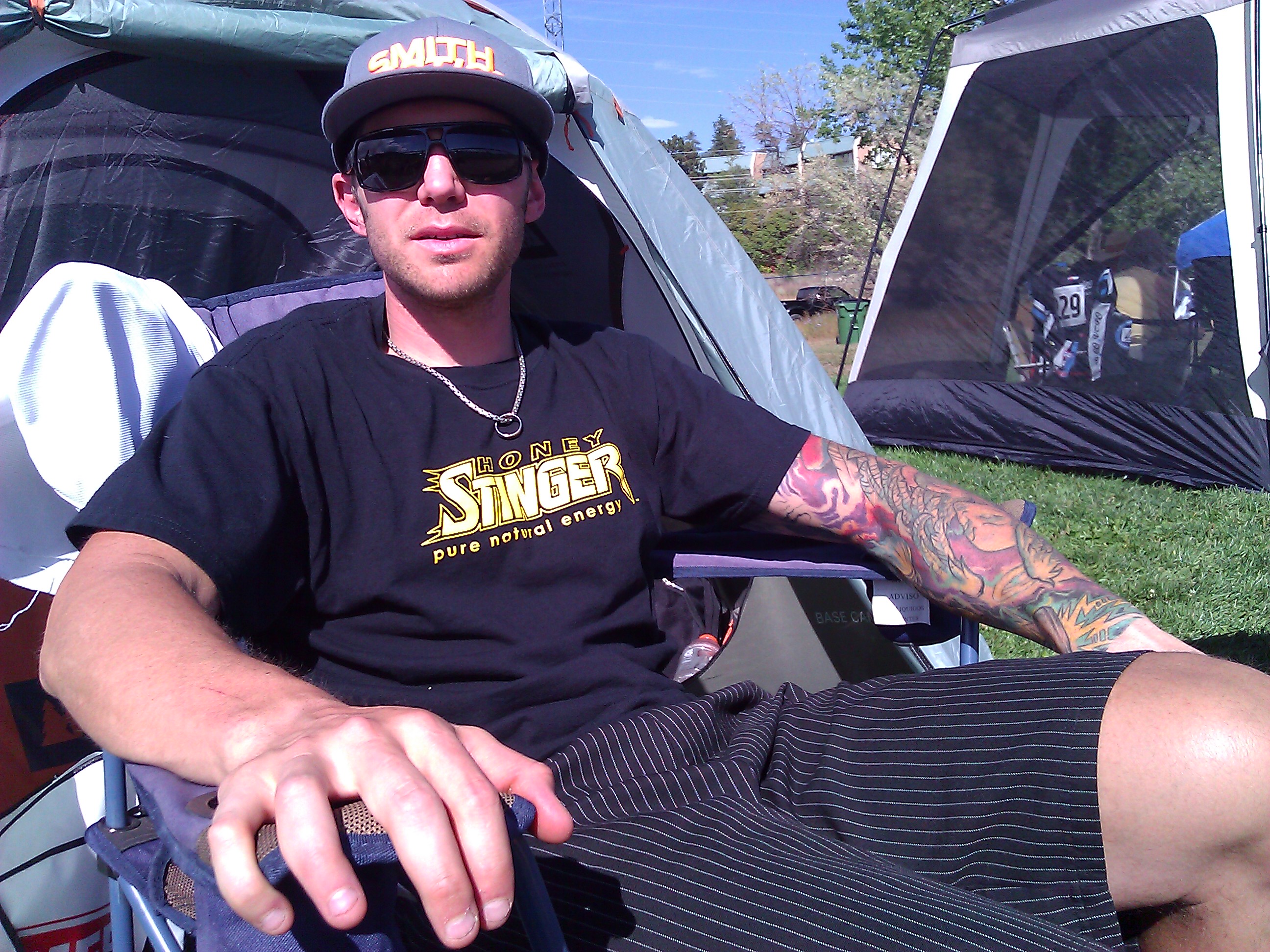
Steven Thompson, Fli Bye Racing, resting after lap 1 at 24 Hours of COS (Mary Topping)
What did four guys having fun look like at the 24 Hours of COS? At the end of his first lap, Ian leaned his head forward and pressed his helmet to his forehead. A stream of sweat spilled onto the ground. When asked about the most challenging aspects of the race, Steve said, “We don’t know what we’re getting into. I’ve heard the wee a.m. hours are hard – staying alert – you don’t want to make a mistake. There are rock drop-offs, rocks that stick out. There’s a field of cactus.” At 11:15 a.m. on Sunday, Todd said the 24 hour race experience was like a marathon. “1 a.m. to 4 a.m. was just survival,” he said.
Priorities
Only two four-man open class teams qualified to race for the stars and stripes, Pro Cycling and Honey Stinger/Trek. To qualify for a national championship title each rider must hold an annual USA Cycling license and be a U.S. citizen or in some cases a permanent resident. Only Steve on the Fli Bye Racing team held an annual license.
Steve’s realistic. He knows that his team members can’t call bike racing their first priority – jobs or family own that spot. Yet while Steve works at his private athletic training facility, and refrains from pressuring his teammates, he harbors ambitions. Prior to the race, Steve wrote in his blog on flibyeracing.com: “This will be my first ever 24hr event and should be a great experience, so after a couple days off I will re-mount one of the trusty steeds and have the top step of the box in my vision come October 1-2.”
Fli Bye Racing began to take shape in the summer of 2009. After two years of racing, Steve realized he needed a team and sponsors to support his passion for competition. He said, “If I went alone, the chance of attracting sponsors was minimal. Plus it’s more fun to race with others than by yourself.” Team members participated in their first races under the team name in 2010. Currently the team counts ten athletes, including one woman.

Andy Dukes (middle) and Ian Sheppard (right), Fli Bye Racing, 24 Hours of COS transition area (Mary Topping)
Amateurs, but like professionals
Despite the physical and mental challenges ahead of them, Steve, Ian, Todd, and Andy remained calm and confident before their first laps. The 24 hour race is one of the USA Cycling national championship events where riders of different abilities can compete on the same course at the same time, even if they can’t all qualify for stars and stripes glory. Steve took the Le Mans start and rode the team’s first lap. How did he do it? He said, “I just got behind Dejay Birtch and stayed with him.” Birtch is a multi-national champion.
The amateur Fli Bye Racing team shares many characteristics of professional mountain bikers whose work is to ride. They have to ride their bikes. They enjoy competition. Sponsors like Tomac Bikes, Smith Optics, SRAM, and others supply Fli Bye Racing members with materials they need to compete well.
Having team members who represent sponsors in a professional manner ranked high on Steve’s priority list when he started Fli Bye Racing. The name Fli Bye means a combination of performance, speed and style, a play on the expression “fly.” Fli Bye Racing athletes don’t have to win all the time, “as long as they ride hard to finish as high as they can,” Steve said, and carry themselves with pride on and off the race course.
Steve races frequently and has finished in the top ten at nearly two dozen races. He rode the six-day Breck Epic this year. A silver medal he earned at the USA Cycling 2010 Mountain Bike National Cross-country race hangs in his home. The team’s first place result in the four-man open non-national category at the 24 Hours of COS is due in no small part to Steve’s “do as I do” approach to managing the team. “It’s funny, the other day we were talking about how we wanted to approach the race. The question of who would ride first came up, and no one stepped up. The other guys said, ‘it’s your team, you go.’ They didn’t want to deal with first lap congestion. Anyway, I’d rather lead the team out and set the tone.”
A winning tone
Set the tone he did. Steve sped into the transition zone after a first lap in 64 minutes. He completed the team’s last of 21 laps just before noon on Sunday, powering across the finish line and skidding to a stop. After a couple of minutes of breathing with his arms and head draped over the handle bars, he walked his Tomac bike to the grass, removed his helmet, and lay on his back. The four-man open teams competing for the national championship title each logged 23 laps; the next best non-national four-man open team after Fli Bye Racing finished 19 laps.
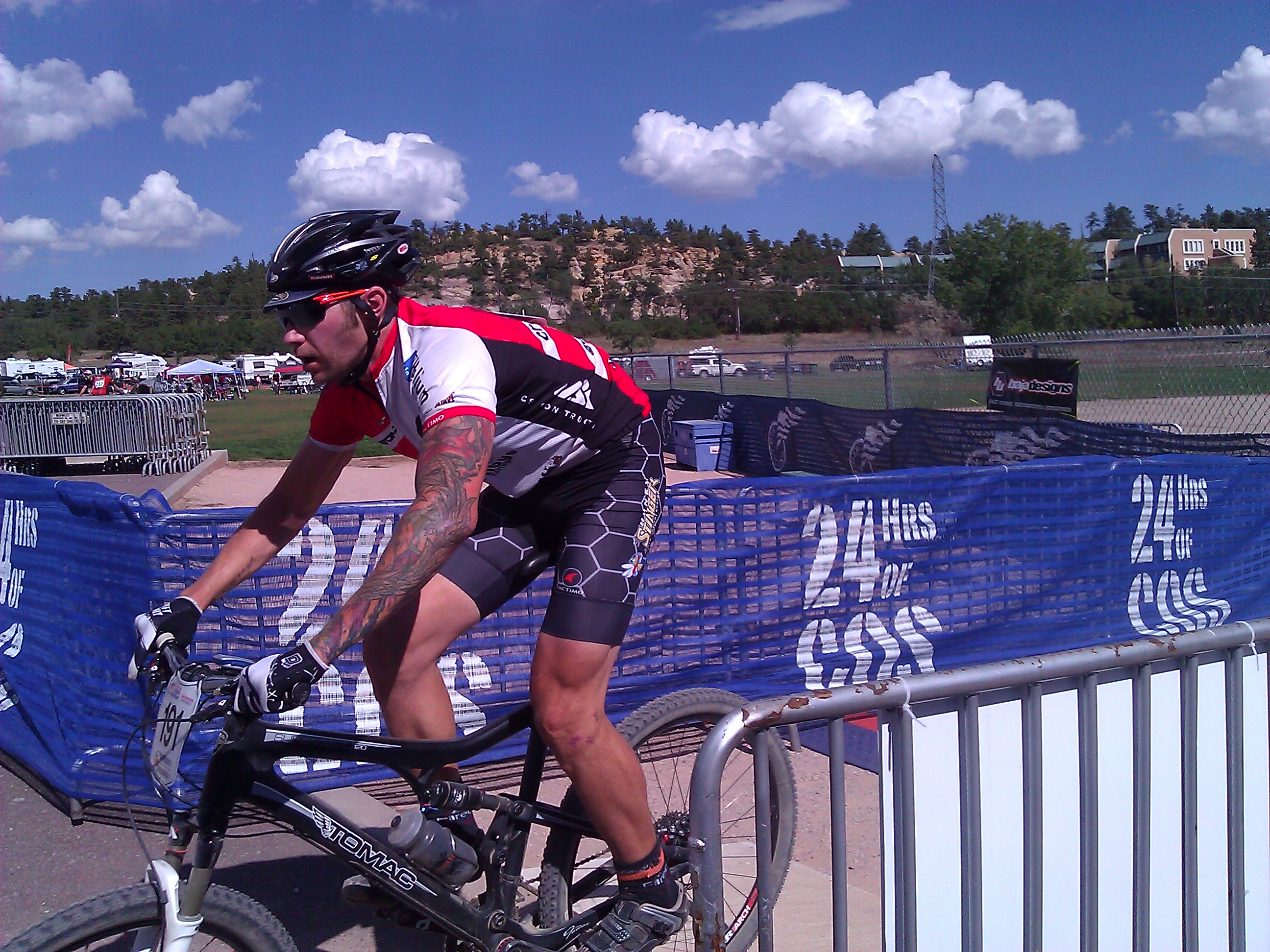
Steve Thompson, Fli Bye Racing, near finish of the team's last lap, 24 Hours of COS (Mary Topping)
No pressure. Yet Ian, Todd, Andy and Steve all delivered their best, with not one guy skipping a single turn during 24 hours of racing. Maybe they did want something. After the podium ceremonies, Steve, wearing a Smith Optics logo cap, said, “All four guys rode well and did solid laps. Plain and simple, we just rode hard. We wanted to show what the locals can do.” If Steve and three guys who ride their bikes more than most can perform this well, what about next year? “I’ve already made it clear to the others that they need to get a license,” he said a couple of weeks after the race.
Ian, Todd, Andy, and Steve would have stood on the third place podium step and received USA Cycling bronze medals if their four-man open team had met the national championship criteria. Instead they stood in the sun on the top non-national four-man open team step and received a red, white, and blue ribbon with a golden bullet shell pendant, the prize awarded by the 24 Hours of COS event that reflected its support of the Wounded Warrior Project. In the end, a fitting symbol to commemorate their speed.

Fli Bye Racing after 24 Hours of COS: Andy Dukes, Steve Thompson, Todd Shaffer (l to r, Ian Sheppard unavailable)

Colorado National Monument (Mary Topping)
With the big economic impact study and press conference now in the past, news on the USA Pro Cycling Challenge (UPCC) will likely remain spartan until the host cities are announced in late November. If you found news in the last week that you don’t see here, please share below.
There is one exciting find. It’s as old as the 2011 UPCC, but who knew that a UPCC fantasy game existed for free? The website owner says folks can expect to play again in 2012. The best team name: “Oreo Abs.” This could present a much better way of handling predictions for 2012.
More news from the economic impact press conference: more TV, one day events in other states
Shawn Hunter quoted by Westword:
- “It is highly likely you will see us increase the amount of hours that are televised not only domestically, but internationally, and that’s really being driven by the networks.”
- “I think the race, our community partners, will all be ahead of the curve when it comes to promoting the event and individual communities and week-long race packages where people can plan their vacations far in advance. So I think the tourism impact will be even greater in 2012.”
- “We want our race brand to live nationally, but we also want it to live year-round. The race will always be in Colorado, it will always be the USA Pro Cycling Challenge, but you will look to see us do, around the year, one-day events in other places. So you might see a USA Pro Challenge Dallas or a USA Pro Challenge Richmond.”

USA Pro Cycling Challenge, overall podium (Mary Topping)
Why no votes for Tom Danielson?
The results of a poll on the UPCC website are sketchy with just 17 voters responding to the question, “which rider do you want to return to the 2012 race?” Still, can only TDF and UPCC podium finishers garner votes?
- Cadel Evans: 6%
- Levi Leipheimer: 35%
- Andy Schleck: 35%
- Tom Danielson: 0%
- Tejay Van Garderen: 12%
- Christian Vande Velde 12%
Prospective 2012 host cities
- Delta will not bid for 2012 but is considering a bid for 2013.
- Grand Junction plans to bid and is weighing routes that include Colorado National Monument (even though the Park Service nixed the idea earlier this year), the Grand Mesa, Palisade or Gateway. Grand Junction has also set up a 2012 UPCC Facebook page.
- Fort Collins held a town hall to discuss a possible bid that drew 100 people who voted to bid for a finish. Their main concern: raising the dollars to fund costs. Fort Collins may prefer a stage between August 22nd to the 25th.
- Golden’s start crowd in 2011 was, many riders confided to Shawn Hunter, the largest they had seen in their careers, even exceeding the Tour de France.
- Organizers anticipate receiving about 40 bids to host a 2012 stage.

UPCC stage 6, downtown Golden Start at noon after last riders passed through (Mary Topping)
Sunday night, on TourChats, Tom Danielson of Team Garmin-Cervélo helped shed light on something many of us have heard but probably not fully understood: winners win and they win because they know they can.
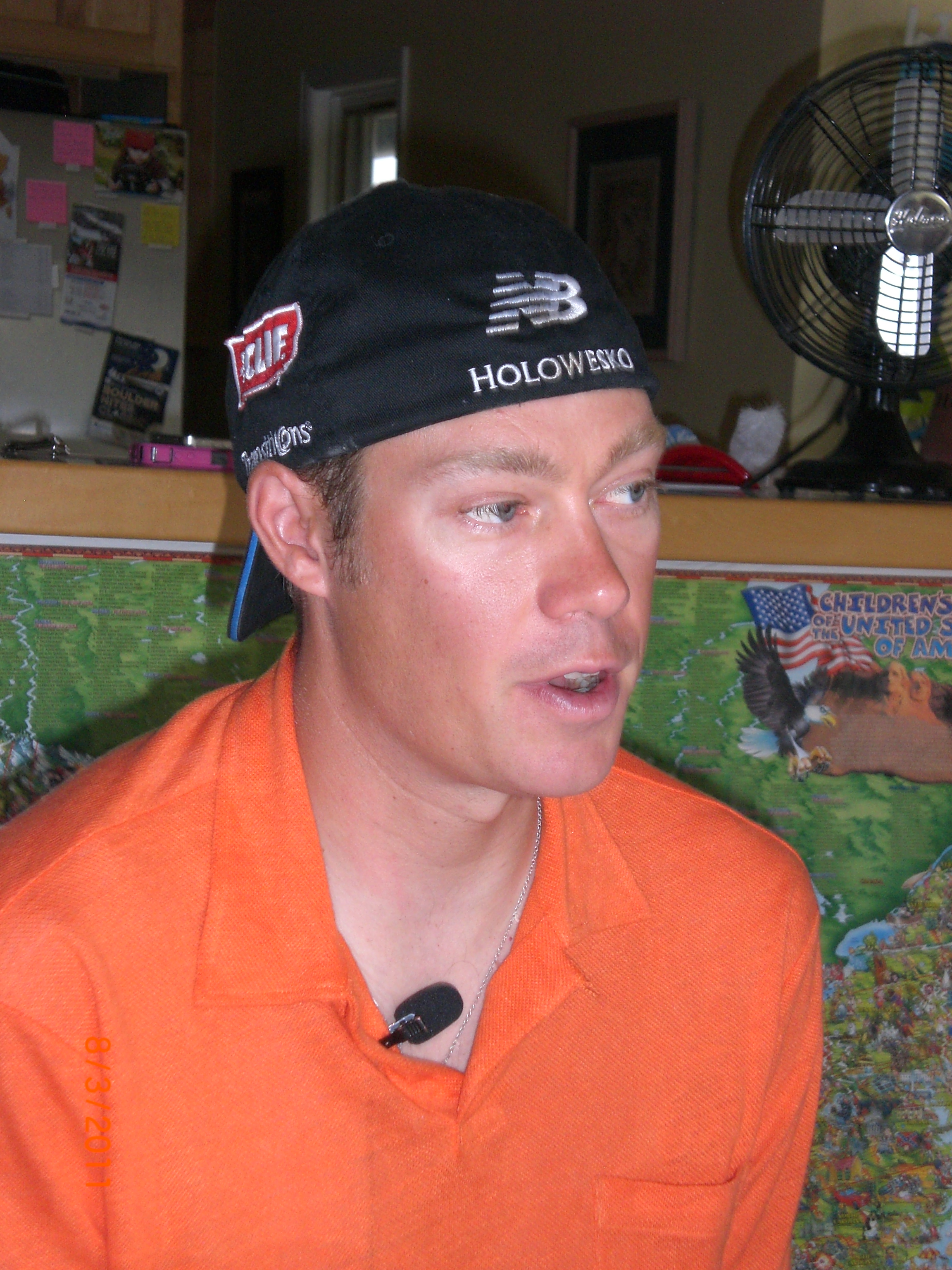
Tom Danielson at home after the 2011 TDF (by Mary Topping)
“Mentally, once you perform well, that helps you perform better in the future,” he said. He illustrated this concept using Johan Van Summeren’s experience. Van Summeren used to ride one-day classics as a support rider. Everything changed when he won Paris-Roubaix in 2011. “Now he’s going to train all winter with that mental outlook,” Tom said. The mental outlook of a winner.
Tom parlays overcoming personal troublesome times into motivation. He knows he can “go any direction and get through anything.” He focuses on the overcoming part. Overcoming something is another form of winning.
Threading his way up Alpe d’Huez in the 2011 Tour de France through 40 guys to reach and climb with Evans and the Schleck brothers was another “mental check” for Tom. Once there, he told himself, “This is your company, where you belong.” It’s where he plans to be in 2012: where the winners ride.

Arepa de Choclo cooking in butter
Humble beginnings
Disappointment. I expected that as soon as I pried open the bag of P.A.N. it would feel like I had broken through the casing and into the center of a giant corn kernel. Instead I had to lower my nose into the bag of white corn meal, a.k.a. arepa flour, to detect the subtlest corn aroma. The consistency of this main arepa ingredient, however, delivered immense sensory joy.
White corn meal’s texture differs from wheat flour. It is bulkier. Whereas wheat flour is powdery, white corn meal seems less refined; each buttery-yellow speck resembles a bit of grain. White corn meal feels like silt, the silt resting at the bottom of a river or lake that shifts into wavy patterns that bring to mind corduroy when you step on them.
Maize, while it is not Colombia’s largest agricultural product, has long been a staple of the people of the Colombian Department of Antioquia. In Kings of the Mountains, How Colombia’s Cycling Heroes Changed their Nation’s History, the author Matt Rendell writes that the appetite of cyclists from the Antioquian city Medellin for maize-based foods like the arepa secured for them the nickname “maize-men.” I am tempted to call the arepa a food of the people, but this would have to encompass people of all classes, if statements from a video* made in 1992 about arepas still hold: “Arepas are an integrator. Everyone regardless of social class eats arepas.”
It’s hard to ignore a sequence of connections that flow from the word corn, even more so from the word maize (from Spanish: maíz): Native American, earthy, natural, tribe, staple, thanksgiving (OK, I’m American). Reflections on the meaning of the opposite of the word refined result in words like coarse, homespun. Humble beginnings.
The arepa may not figure as a staple of only those with humble beginnings, but historically many bike racers were born to humble beginnings.
Fausto Coppi left school at age 13 to work in a butcher’s shop. Jacques Anquetil grew up on a strawberry farm. Raymond Poulidor’s parents worked as small farmers. Poulidor recalled, “The soil was poor and we had to work hard; farming incomes were poor.” More recently we have the example of Timmy Duggan; he worked nights delivering pizzas. Rigoberto Urán became the head of his household at age 14 after his father was murdered. He sold lottery tickets in the street while he continued school, training, and racing. When you start with humble beginnings somehow you grow up believing you must work harder than anyone else to succeed. Arepas are a good choice to fuel extraordinary effort.
Making arepa de choclo
I made these on a Sunday and served them with roasted chicken and broccoli for dinner.
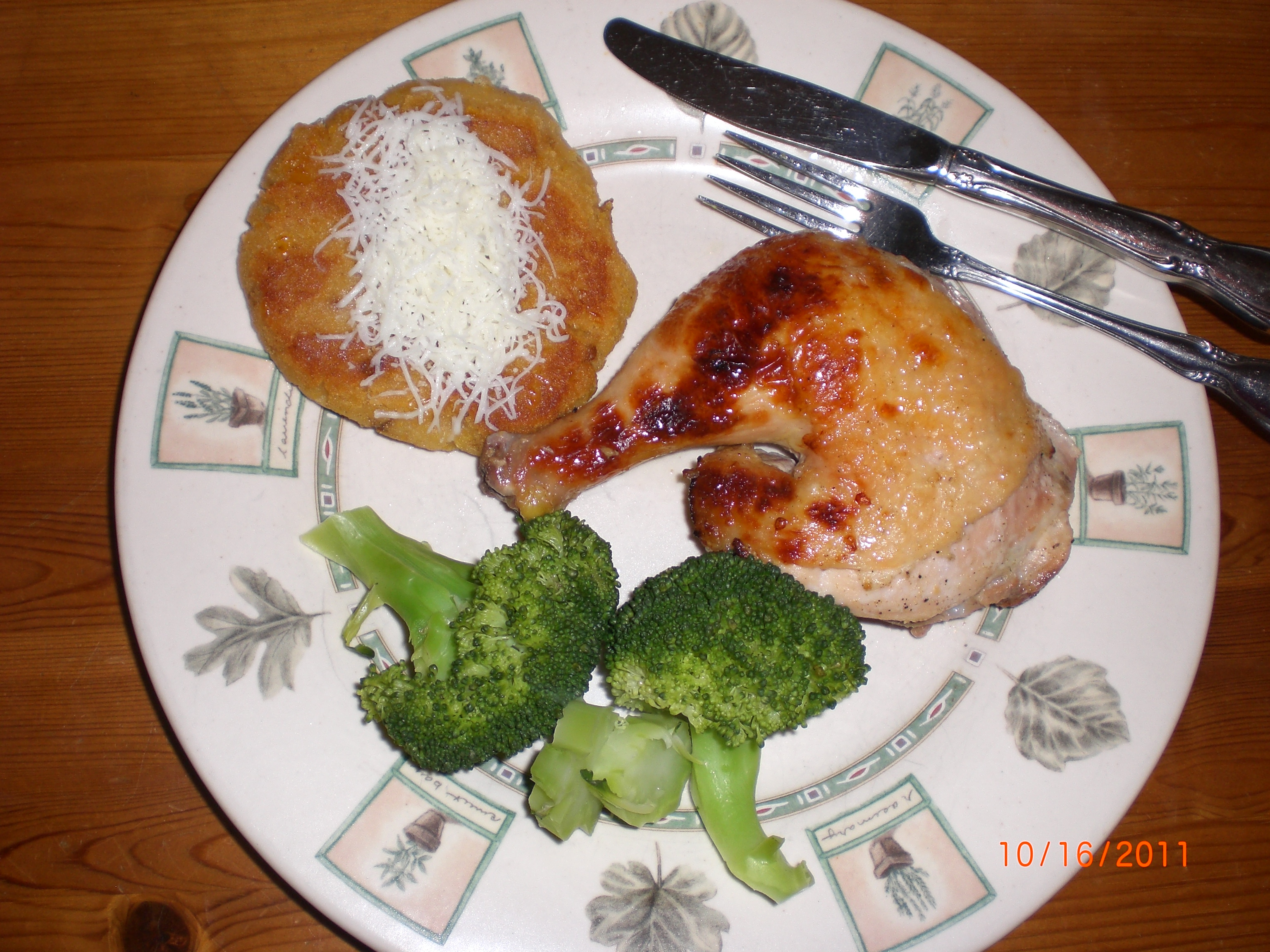
Dinner with arepa de choclo
Preparation is simple with a small number of ingredients.
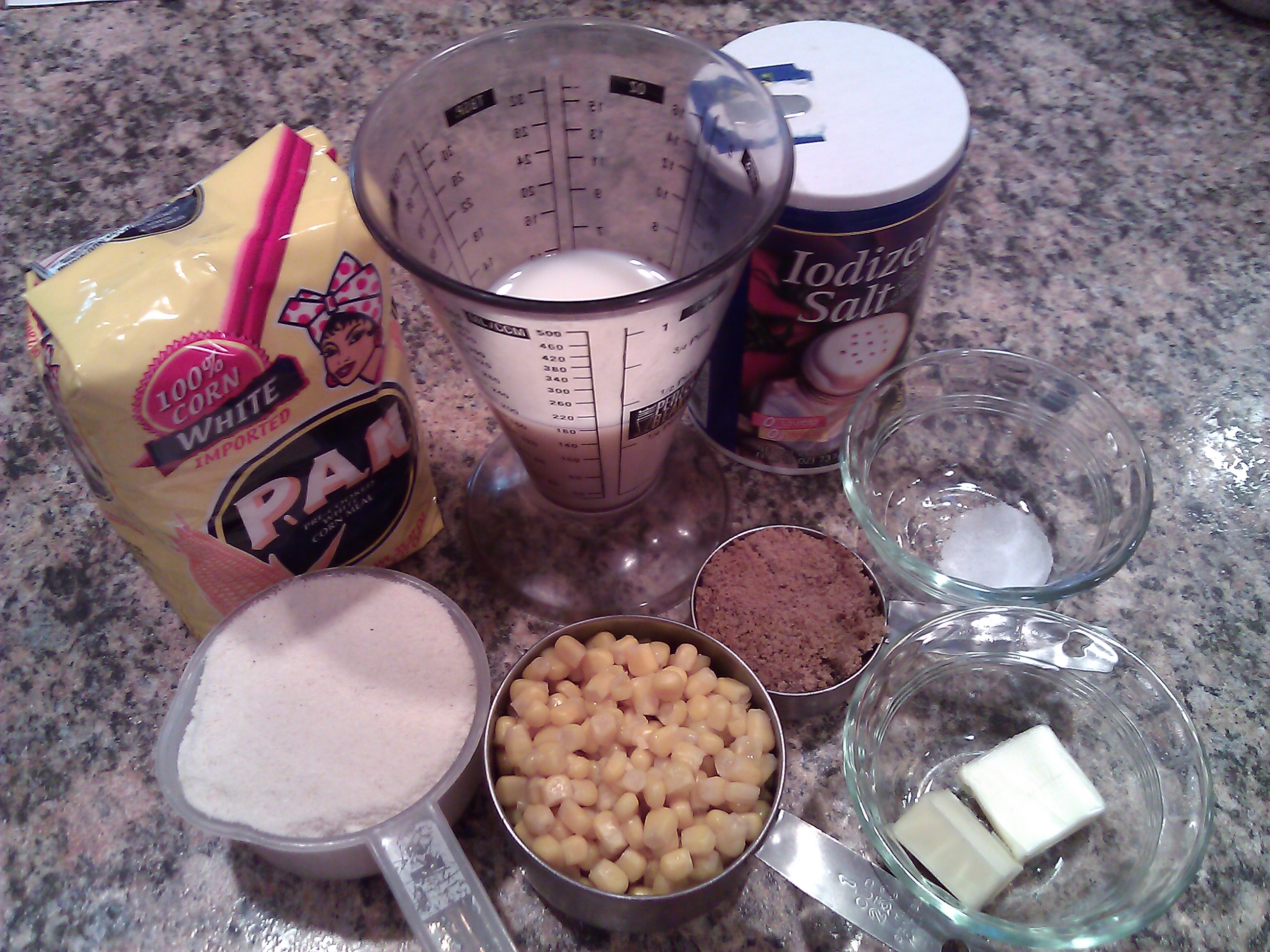
Arepa de Choclo ingredients
The arepa fruits of my labor turned out a bit ragged at the edges, unlike the perfect circles in the video referenced earlier, and about half an inch thick. After they are cooked in butter or oil the arepas turned out crispy on the outside, soft inside. This recipe yields a concoction almost sweet enough to eat for dessert.
From the video I learned that a favorite way to take arepas for breakfast is to enjoy them with hot chocolate. As one who craves Mexican spiced chocolate in my coffee for breakfast, I appreciate this combination. And now I realize that I must have lived in Colombia in another life, somewhere rural, where my mother fed me arepas and hot chocolate for breakfast.
I cooked the first batch in butter and sprinkled mozzarella cheese on top as a substitute for the Colombian farmer’s cheese. The cheese toned down the corn cake’s sweetness, but the two flavors didn’t combine well for me. I preferred this arepa naked. With the butter-fried version a milky taste mingled with flavors of corn, brown sugar, and butter. My thoughts as I chewed through this arepa: weighty, substantial, filling. A good food for a hard day’s work.
The second batch fried in a little olive oil. These finished crispier than the butter sautéed version, with a more singular flavor of pure corn — a savory maize delight.
————————————
By the way, for readers of Part 1, arepa magic continued to the day after purchasing the arepa flour. I rode my bike for the first time in two weeks. A tailwind pushed me on Rooney road; normally the wind on that road batters your face or leans your bicycle over to one side.
*If you watch any of this video, be sure to see the vignette about the woman “arepera” from about 12:50 to minute 15. She comes back at 15:30 and at 22:40. The first half of the video is about the arepa.
[updated 11:05 p.m., 10/20/11]
“I haven’t had this much fun since 1995.” – Shawn Hunter, CEO & co-chair of the USA Pro Cycling Challenge (UPCC)
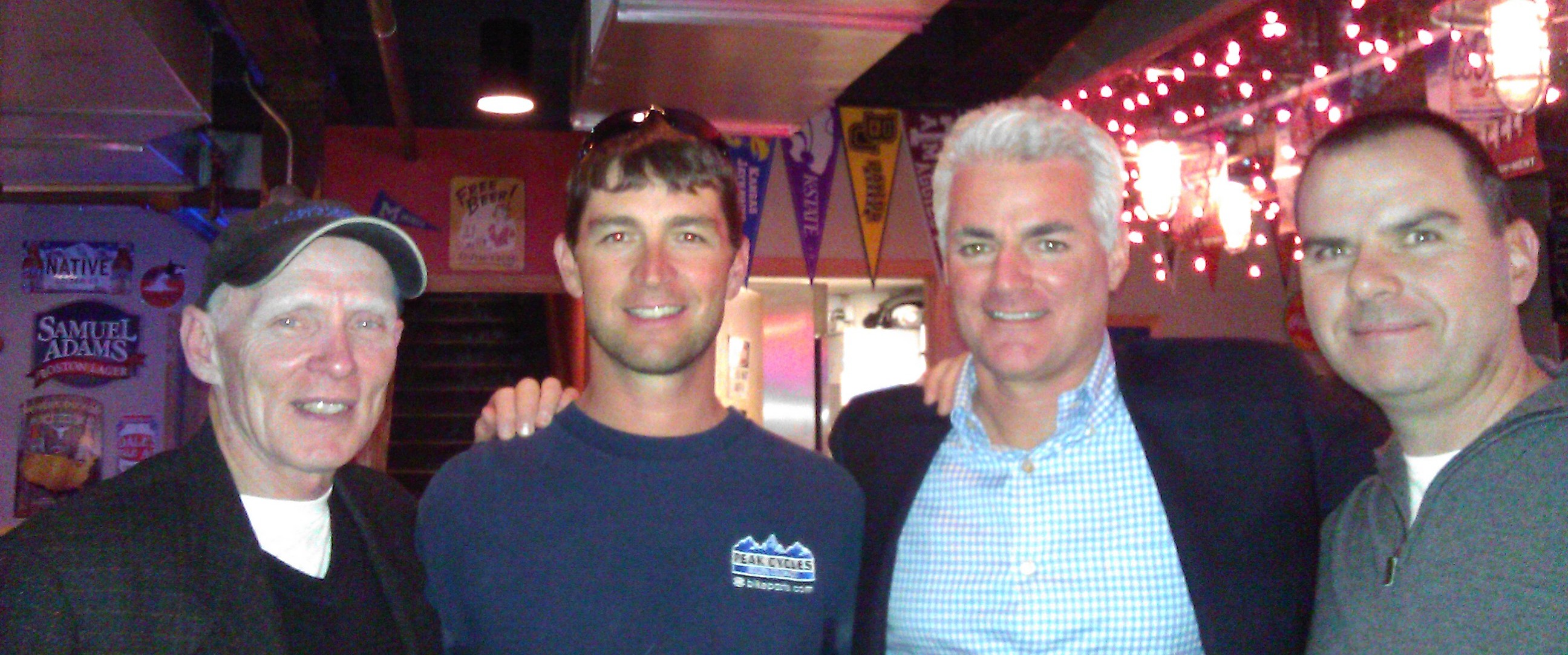
(l to r) Golden LOC members Dan Dwyer & John Polli; UPCC's Shawn Hunter & Brian Farris
In 1995, Shawn Hunter launched the Avalanche in Colorado. In February, 2011 he accepted the CEO and co-chair role with the UPCC. Last night Shawn and Brian Farris, UPCC COO, joined Golden 2011 local organizing committee members in an informal celebration of a successful Golden stage start in the inaugural UPCC. Shawn graciously responded to several questions that have been begging for answers since I started weekly updates on the UPCC. Responses are paraphrased unless quoted.
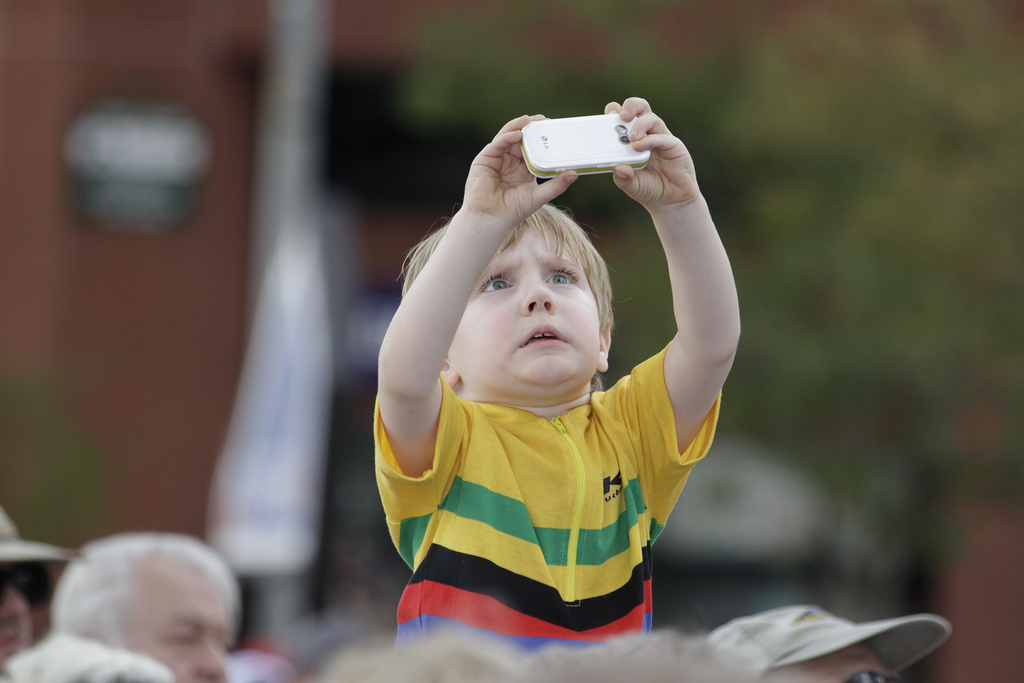
Young UPCC Fan (UPCC.com Flickr)
In the days after the riders crossed the last finish line in Denver, several media outlets implied that certain cities had been specifically invited to submit bids to host the race in 2012. Shawn dispelled that notion. “No one was handpicked to submit a bid,” he said. An open invitation exists for any city to bid for 2012. The UPCC also offered any city that had ever expressed even “one ounce” of interest at any point the opportunity to experience the race in 2011 so they could better understand what it takes to implement a stage start or finish. Shawn said, “There were no special invites.”
Shawn indicated that the UPCC has not yet decided if the race will visit the southwestern part of the state. News sources have said Durango and Montrose will bid for 2012.
When asked about whether Levi Leipheimer’s new Omega-Pharma Quick-Step team would be invited to race in 2012, Shawn said, “It’s way too early to comment on team invites.” Levi Leipheimer stated in video filmed at Specialized that as part of his 2012 program he’s planning to ride in California and to defend his Utah and Colorado wins.
Shawn also shared how the UPCC will select host cities for 2012. “It doesn’t come down to just economics; that’s not the primary factor,” he said. The quality of the host city’s leadership is important. Geography matters with respect to course possibilities and treating the riders well. Shawn elaborated: “Rider safety and comfort is very important. We don’t want long transfers between stages. We’re looking for great properties and meals for the riders; they remember.” Shawn added that host cities should also offer events around the race to create a multi-day atmosphere that builds excitement for the race’s arrival; host cities should also help grow the race’s brand. The UPCC is expected to announce 2012 host cities by the end of November.
A race official said in September that she had received many thank you notes from the athletes after the race regarding their lodging and food. At least one said the UPCC podium girls ranked first in beauty compared to those at other U.S. races.

Andy seems to like the UPCC podium girls (UPCC.com Flickr)
The Schadens decided to invest $10 million in cycling for at least three reasons, according to Shawn. Both Richard Schaden and his son Rick cycle for fitness. They are strong consumer marketers, and had interest in an event that would attract consumer brands. In addition they wanted to find a way to give back to the State of Colorado.
Shawn added that when he spoke with potential sponsors while the race was named “Quiznos Pro Challenge,” people assumed he was calling about a charity. He’d have to explain that wasn’t the case, and soon realized the name had to be changed for this reason and in order to align the name with the event’s vision. The UPCC intends to maintain multiple sponsors. A single sponsor for the Coors Classic led to that race’s demise.
From Shawn’s point of view, a pro-cycling race provides a lot for spectators to enjoy regardless of who wins. Where else can a group of five – the average traveling party size based on the economic impact report by IFM – watch a great sporting event for free? Everybody wins, including the young fan pictured above, as well as Shawn, who is having the time of his life.
UPCC stage 6, downtown Golden at noon after last riders passed through (Mary Topping)
In a high-ceilinged wing of the Colorado State Capitol, under the watchful eyes of portraits of former governors including Governor Ritter, Denver Mayor Michael Hancock, Governor John Hickenlooper, and Shawn Hunter shared news about the economic impact of the inaugural USA Pro Cycling Challenge (UPCC).

Denver Mayor Michael Hancock at podium

Shawn Hunter, Govenor Hickenlooper (l to r)
Behind them stood the mayors or other city representatives of the inaugural host cities, each eager to be reselected for 2012. And in the shadows along the wall an attentive Richard Schaden observed. One of the pieces of information conveyed: the continued financial support and vision of Richard and Rick Schaden who invested $10 million to get the UPCC off the ground.

Brian Farris, UPCC COO and Richard Schaden (l to r)
Speakers referred to the slow start of the race in an almost apologetic fashion, then continued to express how the addition of Shawn Hunter, CEO and co-chair of the UPCC, moved the event forward.
Some highlights of the economic impact and visitor survey follow; full details are available in the official press release:
- The UPCC created more than $83.5 million in economic impact to the State of Colorado. Direct spending by traveling spectators accounted for more than $67 million of this amount.
- Average spectator household income: $113,918.
- 94% of on-site spectators said they are likely or very likely to return to watch the race in 2012.
- Almost 85% of out-of-state visitors are more likely or much more likely to visit Colorado again based on their experiences at the UPCC.
- 55% of spectators were male, 45% female.
- Spectators from 16 countries outside of the U.S. watched the race.
- 95% of the spectators cycle at least occasionally.
- On average, spectators attended 2.9 stages.
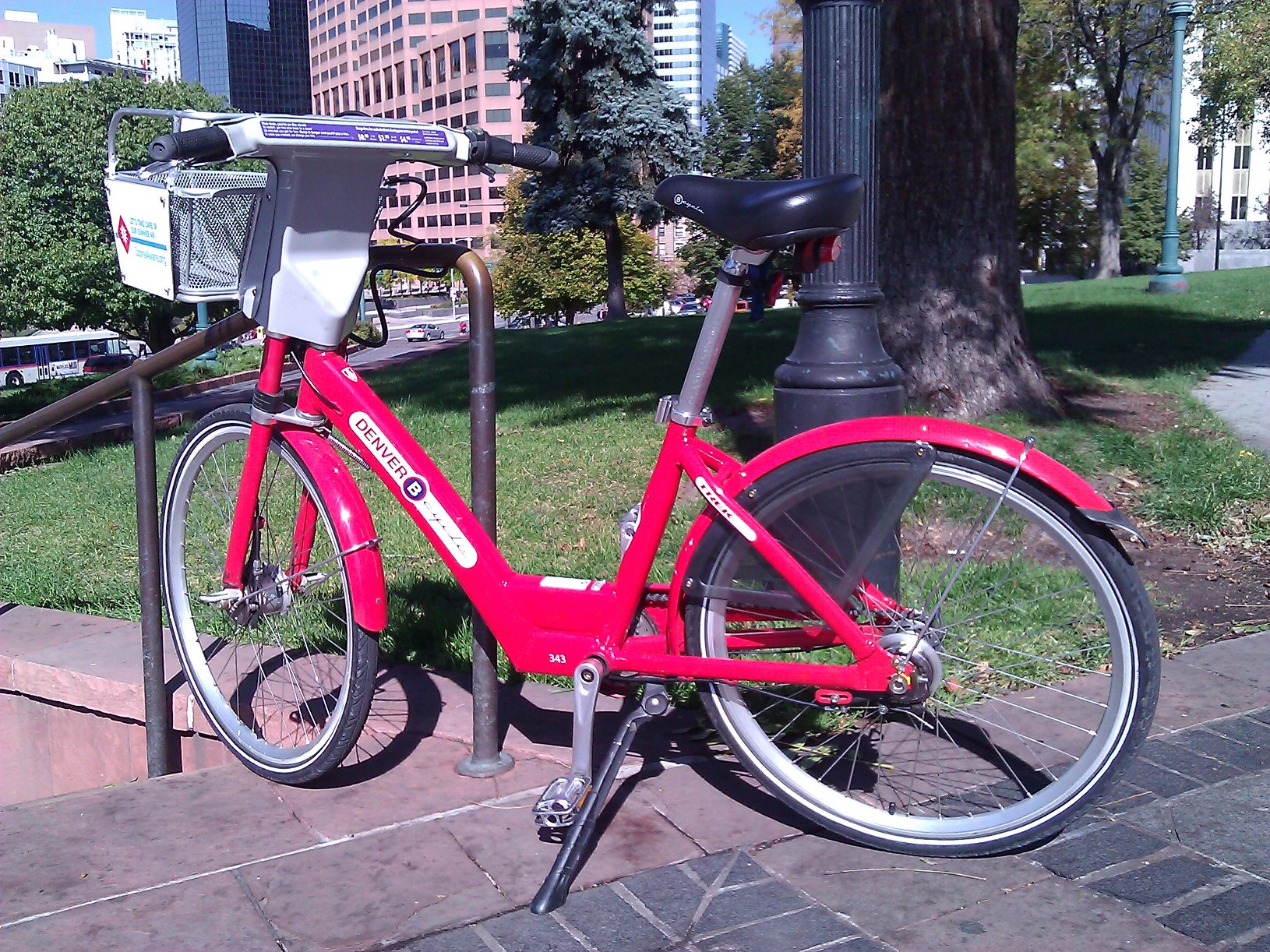
Denver borrowable B-cycle
A Denver official arrived at the State Capitol on a “B-cycle,” one of 510 bikes available at 51 stations throughout the city for public use. In the next year 250 new bikes will be added to the current stable of sturdy machines.

 ProVéloPassion