
Was it a disappointment that Matt Cooke of Team Exergy finished 5th on the San Dimas Stage Race uphill time trial yesterday? No, according to Tad Hamilton, the team’s Sports Director, who shared with ProVéloPassion prior to the beginning of stage 2 that Cooke is still building his form.

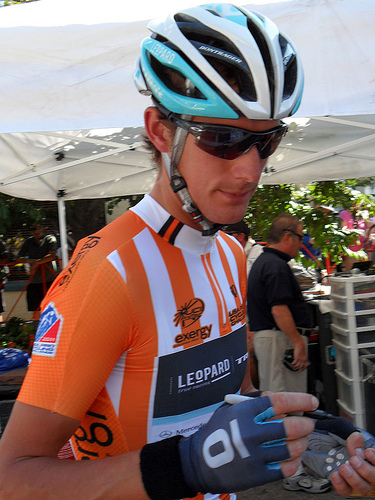
Matt Cooke (photo via Team Exergy website)
“I think the winner rode a fantastic race,” Hamilton said, referring to Phil Gaimon’s stage 1 win on Glendora Mountain Road. “Matt was not that far off. His real focus is on the [Amgen] Tour of California which is two months from now.”
The weather during the pro-women’s stage race has resembled a hurricane. Nicola Cranmer, General Manager of Exergy Twenty 12, sent off multiple tweets related to the weather. She said, “insane wind…bucketing down, field shattered.” Hamilton shared that the locals are calling the day’s weather “the storm of the year.”
With the horrible weather conditions the women’s field experienced multiple crashes and split to create a select leading group of four including Kristin Armstrong of Exergy Twenty 12.
When asked about Team Exergy’s objectives for stage 2, Hamilton said given Ben Day’s ability to hold his yellow jersey through stage 2 with just a 14 second lead over the second place rider last year, it would be difficult for Team Exergy to claw back over 20 seconds to put Morgan Schmitt or Cooke into the lead today. He said, “We have to put on pressure to break the race open. We’ll try to do that.”
Hamilton added that a stage win or having a rider in the climber’s or sprinter’s jersey at the end of the day would be a successful result for the team.

Predicted rain showed up as fog and mist on Glendora Mountain yesterday, but an imaginary beam of sunshine shone on Phil Gaimon. The Kenda/5-Hour Energy p/b Geargrinder rider climbed into the race leader’s yellow jersey on stage 1 of the 2012 San Dimas Stage Race with a ride of 13 minutes 10 seconds.
Just a few hours earlier, Kristin Armstrong bested Clara Huges of Team Specialized Lululemon by 31 seconds to claim the race lead for her Exergy Twenty12 team.
Armstrong’s time of 15 minutes 1 second shaved eight seconds off Amber Neben’s winning time last year on a course some described as slightly more difficult due to moving the start line 1,100 feet up the mountain this year. Neither Neben nor Ben Day were present to defend their overall victories in last year’s edition of the race.
Matt Cooke of Team Exergy, who finished second behind Day on this stage in 2011, figured among the favorites going into today’s race. Cooke crossed the line 29 seconds behind Gaimon’s time, his mouth stretched open with effort, in what must have been a disappointing ride for the strong climber. Team Exergy fared well overall with Cooke placed fifth and Morgan Schmitt fourth for the stage.
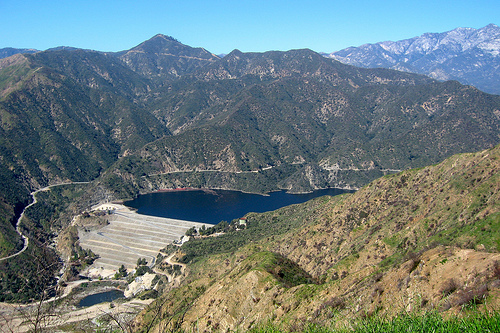
Glendora Mountain Road (photo by nanotron, Flickr)
Racing uphill for 3.8 miles at a 6.5% average grade requires special pacing to release an athlete’s best performance. The equipment can be a factor as well. Almost all competitors choose road bikes for the time trial. Gaimon choose what one observer described as a deep dish front wheel and light rear wheel.
Gaimon’s preparation going into the SDSR included spins up Madera Canyon, Gate’s Pass, and Mount Lemmon near Tucson. He’s won other uphill races, notably the Mount Washington Hillclimb in 2008 and 2009. In 2009 he also carried away the best young rider classification at the SDSR as well of first place on stage 2. On his website Gaimon calls climbing and time trials his strengths; he also lists his resting heart rate as about 35 beats per minute.
The top step of the podium at this season’s time trials seems to have Armstrong’s name cemented on it like celebrity footsteps at Grauman’s Chinese Theatre. A multiple national and world time trial champion and Olympic gold medalist, she recently won the time trials at the Tour of New Zealand and at the Merco Cycling Classic where she also finished first overall. In a statement on the Exergy Twenty12 blog, Armstrong said after the race, “Every time trial is important to me. It’s especially good to come away with the win. The competition is awesome this year and as always the San Dimas Stage Race is a wonderful event.”
Stage 2 test next
Both Armstrong and Gaimon face a tough day on stage 2. The seven mile lap with a KOM historically separates the strongest from the rest. Time bonuses for sprints and on the finish line will force Gaimon to be especially attentive with just a 14 second gap to second place Rob Britton on Competitive Cyclist. There’s rain in the forecast again for stage 2, which is scheduled to begin at 1:15 p.m. for the pro-men and 10:10 a.m. Pacific Standard Time for the pro-women. Can Gaimon and Armstrong both keep the sunny yellow on their backs?
The women should challenge Exergy Twenty 12’s leadership with aggressive racing. According to Norcalcyclingnews.com, “Exergy are now the team to beat, sitting in prime position with 2 other riders also inside the top ten. All the major teams are within striking distance, and things are sure to be shaken up on what is looking like being a wet and windy road race course. So buckle up and get ready for the thrills and spill of the road race.”
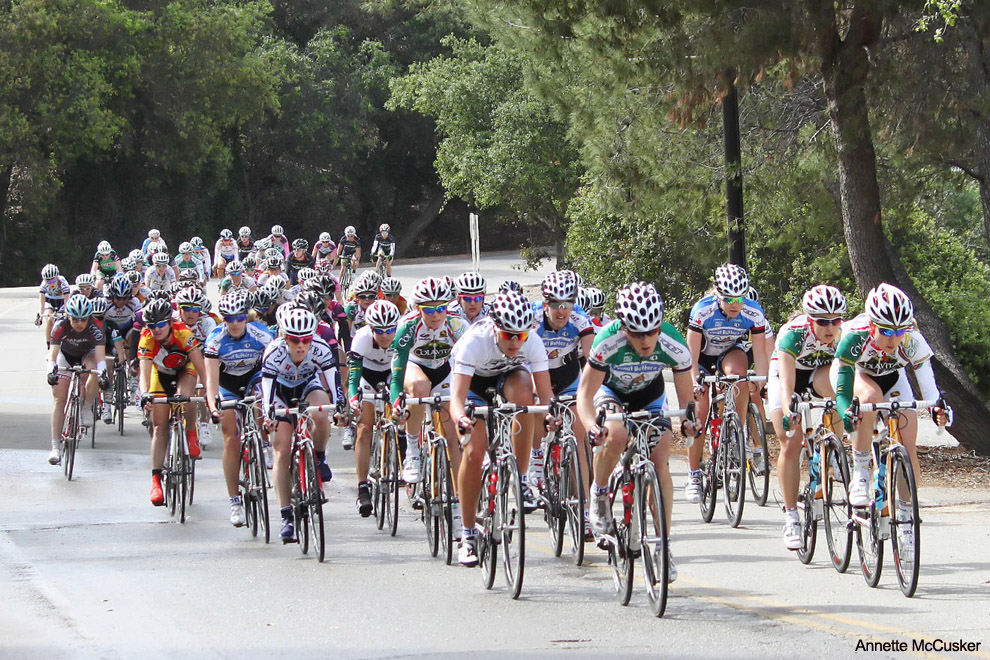
SDSR Stage 2 Women's Peloton in Bonelli Park (photo by Annette McCusker)
Follow the San Dimas Stage race for a few reasons:
- The competition to win the opening stage uphill time trial on Friday, March 16 will be fierce,
- the field includes many strong riders and attention-seekers who should animate the roads,
- live-video coverage will be available according to race organizers, and
- if Sam Johnson of Team Exergy blogs about the race, you’ll know enough about the event to share its intimate details with him.
For some teams, like Competitive Cyclist Racing Team, the San Dimas Stage Race is the first race of the season. As such it’s a serious place to test out the legs against a competitive field even though it doesn’t provide points on the National Racing Calendar series.
2012 is the 13th edition of this race, which SC Velo hosts. Here’s a great summary of the race’s history from the Team Winded website:
“Twelve years ago a few local riders had a crazy idea: Let’s put on a stage race in the heart of the San Gabriel Valley. Originally called the Pomona Valley Stage Race, the race drew mostly local racers. Each successive year the race’s reputation grew, as it became the premier local stage race. Soon after its inauguration racers from across the country made their way to compete in the San Dimas Stage Race. The list of winners demonstrates the caliber of national talent drawn by the San Dimas Stage Race. Past winners include: Tom Danielson, Chris Horner, Amber Neban, Scott Moninger, Christine Thorburn, Ina Yoko Teutenberg and Ben Day.”
True to form, the 2012 San Dimas Stage Race provisional roster includes top professionals in the men’s and women’s fields, including former winners Heath Blackgrove who is riding with Elbowz Racing, Team Specialized Lululemon’s Ina Yoko Teutenberg, and Kristin Armstrong of Exergy Twenty 12.
Stages
All categories follow the same course for all stages, though the pro-women’s stages 2 and 3 are shorter in length and time respectively.
Stage 1: Chaffey Auto Body Time Trial. Organizers dub this winding 3.8 mile hill climb along Glendora Mountain Road a “mini Alpe d’Huez.” Total elevation gain is 1,375 feet.
Stage 2: San Dimas Community Hospital Road Race. Riders will circle a 7 mile loop with a flat 1 km leading up to the finish line. What makes this stage challenging is the KOM; at the top of Cannon Ave., it rises approximately 200 feet over 0.6 miles with one section at 13%. That should tire the legs of some riders over twelve laps for the pro-men and eight for the pro-women as they speed through and around Bonelli Park.

2012 San Dimas Stage Race stage 2 profile (from SDSR "Bible")
Forty-eight pro-men and thirty-three pro-women did not make the time cut or DNF’d on last year’s stage 2. The women’s field yielded a solo victory and a group of nine fought out a sprint finish for the men. Time bonuses of 10, 6, and 4 seconds for 1st, 2nd, and 3rd places could make this a significant stage if the uphill time trial results are within seconds for the top contenders. The sprint time bonuses are 3, 2, and 1 second(s) for 1st through 3rd places.
Stage 3: INCYCLE / CANNONDALE San Dimas Classic. The “L” shape of the course gives the last stage the nickname “six corners of speed.” It passes through downtown San Dimas. A slight climb with an elevation gain of 40 feet shouldn’t disperse the field significantly, with a mass freight-train sprint expected. The pro-men will race the 1.2 mile circuit for 90 minutes and the pro-women for 55 minutes.
Favorites for stage 1
UnitedHealthcare Pro cycling team isn’t taking part in the race this year, so Ben Day won’t be present to defend his three-year winning streak. Matt Cooke of Team Exergy finished second last year in stage 1 and in the overall GC. Matt recently won the team’s uphill driveway time trial, a short steep climb the team celebrates annually at training camp by competing against each other. Matt’s ready, and the team is ready to support him to win.
Sebastian Salas rode on Team Exergy last year, and in 2012 he races with Optum Pro Cycling p/b Kelly Benefit Strategies. Check out his blog. Salas writes about climbing in Colombia and photos of mountain roads populate his homepage. He could podium, if not win.
Cesar Grajales and Francisco Mancebo on Competitive Cyclist Racing Team could place in the top five, as well as Bissell Pro Cycling Team’s Chris Baldwin. Baldwin won the Glendora Mountain time trial in 2006.
For the pro-women, Mara Abbott and Amber Neben do not appear on the pro-women’s provisional start list. Team TIBCO’s Veronique Fortin or Lindsay Myers, Kristin Armstrong on Exergy Twenty 12, and Primal/MapMyRide’s Alisha Welsh among others could deliver great rides tomorrow. Those out there with expertise on the best women climbers, please comment with your picks for the stage 1 pro-women’s race and add deserving names to this list.
Following the race
The race Twitter feed is @SDStageRace.
San Dimas Stage Race Facebook page.
uRide.tv video streaming of the race.
See the race website for the stage 1 startlist. Pro-women start at 12:40 p.m. and pro-men at 3:15 p.m., Pacific time.

SDSR Stage 1 Glendora Mountain Road (photo by Annette McCusker)
Uphill time trials are captivating. And when they are short, like the opening stage time trial for the 2012 San Dimas Stage Race on March 16th, there’s no place to hide.
This year the Glendora Mountain Road stage of 3.8 miles begins 1,100 feet further up the road than in previous years. Riders will climb 1,375 feet which nets to an approximate average gradient of 6.8%.

2012 San Dimas Stage Race Glendora Mountain time trial profile, from race "Bible." Elevation on top, grade on bottom.
Ben Day won this stage last year, when he rode for Kenda p/b Geargrinder, in 12 minutes 48 seconds. Matt Cooke of Team Exergy finished second about 14 seconds behind Day’s time and Cesar Grajales of Realcyclist.com Team came in about 20 seconds behind the leader for third place.
Day’s time puts him at an average speed of 17.8 miles per hour up Glendora Mountain Road.
This is just an hors d’oeuvre. More to come on the 2012 San Dimas Stage Race tomorrow.

Simon Spilak (photo by Petit Brun, Flickr)
Most cycling fans only remember first place.
So they might not recognize Simon Spilak, the Lampre rider who finished second overall at the Tour of Romandy in 2010 – though since the disqualification of Alejandro Valverde, Spilak moved up to a first place result in that race.
Spilak, nicknamed “Spile,” joined Katusha in 2012. He showed off his climbing and time trialing skills at this year’s Paris-Nice with a fifth place on the stage 5 uphill finish into Mende alongside Levi Leipheimer and a strong fourth in today’s stage 8 time trial.
His profile on the Katusha website says his “Cycling Secret Wish” is to win a Classics race.
Based on his performance in Paris-Nice, that dream may become a reality very soon.
Career Highlights
Born: 06/23/1986, in Tisina (Slovenia)
2012 – 4thoverall, Paris-Nice
2011 – 3rd, stage 2 Tour of Slovenia; 6th, stage 1 Giro d’Italia
2010 – 1st, stage 4 Tour de Romandy; 1st overall Tour de Romandy (after disqualification of Valverde’s win); 2nd, stage 3 Presidential Tour of Turkey
2009 – 1st, stage 3 Tour of Slovenia
2007 – 1st, La Côte de Picarde (U23); 4th, Tour de l’Avenir
2006 – 1st, Trofej Plava Laguna 1;1st, overall Steiermark Rundfahrt
2005 – Slovenia U23 national road champion
2004 – Slovenia Junior national road and TT champion; 3rd, Junior World Championship road race
Teams
2012 Katusha Team
2011 Lampre – ISD
2010 Lampre – Farnese Vini
2009 Lampre-N.G.C.
2008 Lampre
2006, 2007 Adria Mobil
2005 Krka – Adria Mobil
[With gratitude to Petit Brun for Creative Commons photo sharing on Flickr.]

Historic downtown Gunnison (photo by Jeffrey Beall, Flickr)
Gunnison enjoys its reputation as a real western town.
When the best cyclists in the world line up there on August 22nd to start stage three of the USA Pro Cycling Challenge (UPCC), they’ll stand in the land of rugged men past and present, where the fishing’s great and the stars shine over clear skies.
Rugged men and women
In 1882, Wyatt Earp – lawman, investor, and fierce gunman – and his brother Warren sojourned in the Gunnison area after taking revenge on the suspected killers of one of their brothers.
Today Gunnison is home to David Wiens, world champion mountain biker and six-time winner of the Leadville 100 MTB race.
Residents of both sexes tough out some cold winters. The Weather Channel selected Gunnison as one of America’s five coldest cities. Gunnison’s all-time record low is a frosty -47° Farenheit and the average last freeze date is June 24th. If the averages hold true, daytime temperature should reach about 77 degrees Farenheit on stage 3 of the UPCC.
Great fishing in water and on land
How is it that “Gunnison County‘s population is mostly fish”? Nine miles from the city of Gunnison anglers can cast their lines for Kokanee salmon as well as several varieties of trout in the Blue Mesa Reservoir. It’s the largest body of water in Colorado. Rocky, dry canyon hills and cliffs rise in striking contrast along both sides of the long cool blue reservoir. Fish also thrive in the many rivers in Gunnison County, including the Taylor and Gunnison Rivers.
It might be a stretch to call it fishing when a cowboy tosses a lasso to rope a calf, but it’s not a stretch to call Gunnison’s Cattlemen’s Days the oldest and longest running rodeo in Colorado. Cattlemen’s Days began in 1900 at about the time Wyatt Earp checked in a pistol with the Juneau Alsaska marshall’s office.
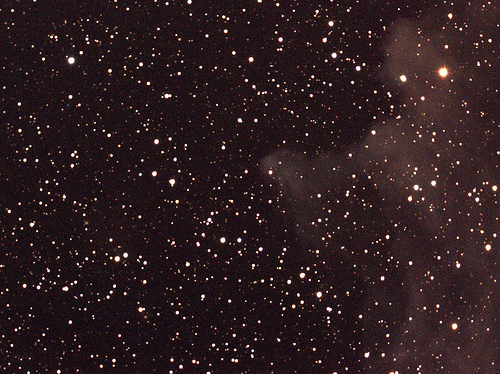
starry sky (photo by Daniele Malleo, dmalleo, Flickr)
Clear skies
Friday and Saturday evenings in summer the Gunnison Valley Observatory shares its 30 inch reflector telescope with the public. See a photo of the blue and pink Ring Nebula on the observatory’s website.
Clear skies and a dry climate make Gunnison the perfect place for an antique car collection. The Andy Mallett Antique Car Museum at the Gunnison Pioneer Museum displays one of the largest antique car collections in Colorado with 63 vehicles.
See also:
USA Pro Cycling Challenge host city, Durango: facts and fables
USA Pro Cycling Challenge host city, Telluride: facts and fables
USA Pro Cycling Challenge host city, Montrose: facts and fables
USA Pro Cycling Challenge host city, Mount / Crested Butte: facts and fables
USA Pro Cycling Challenge host city, Aspen: facts and fables
USA Pro Cycling Challenge host city, Beaver Creek: facts and fables
[Many thanks to Daniele Malleo and Jeffrey Beall for Creative Commons sharing on Flickr.]
Danny Summerhill at the prologue in Garden of the Gods.
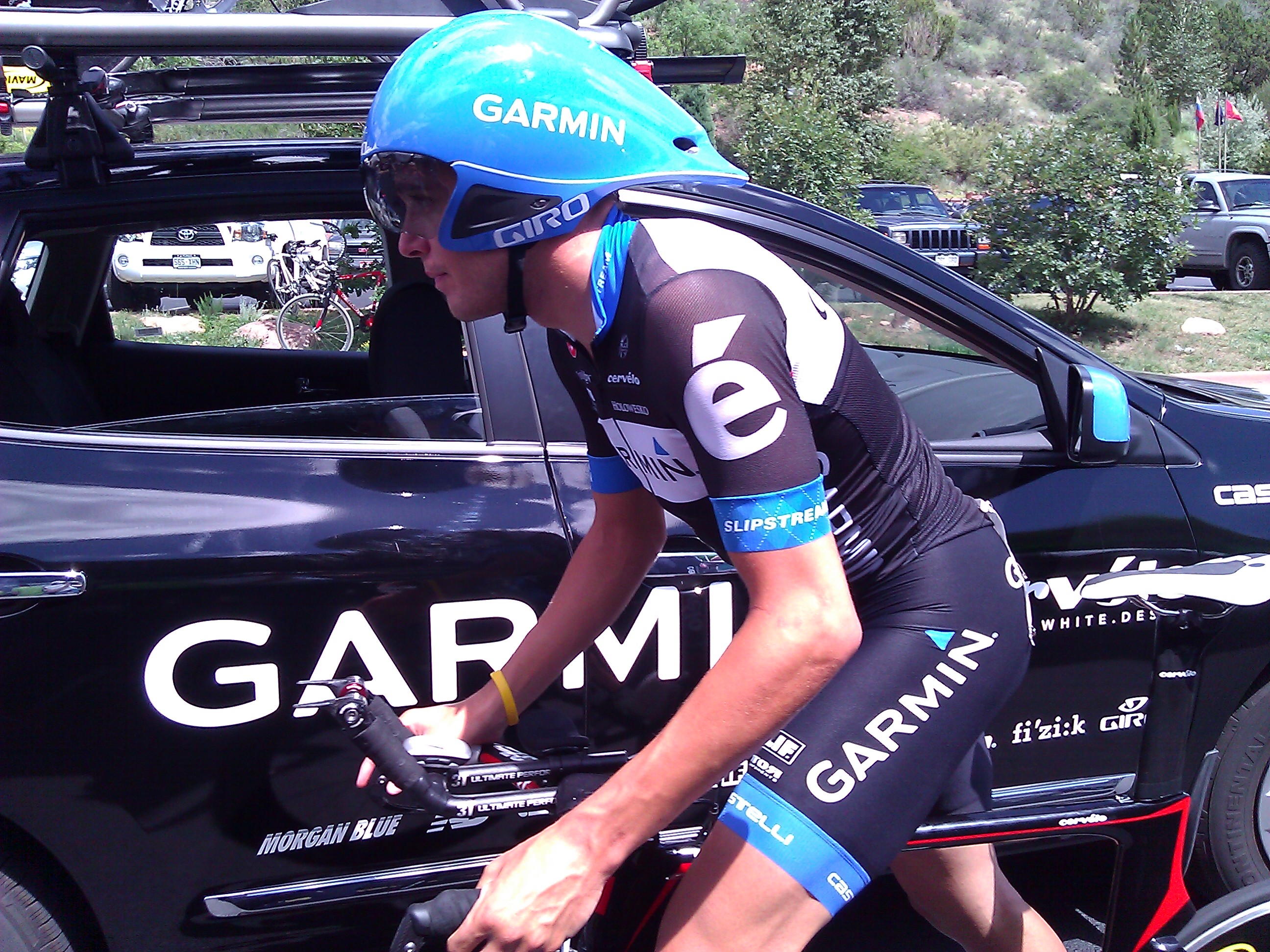
Danny Summerhill heading to the prologue start house, 2011 USA Pro Cycling Challenge (photo by Mary Topping)
Athletes — amateurs and pros alike, have taken to logging their rides and runs on Strava using a GPS tracking device. Strava users or visitors can view athletes’ activities, including miles ridden and feet climbed for cyclists.
The company says it wants to become more valuable than a training log: “Strava is committed to becoming the premier online club for passionate cyclists and runners. Strava is a quickly growing global community of athletes who share activities with each other, compete on segments of road and trail, and more.”

Ben King at 2011 Tour of Utah (photo by Mary Topping)
A page on Strava lists pro-cyclists who log their ride data and the number of fans who follow them on Strava.
Who among the pro-cyclists can boast the most fans as of March 7, 2012? Is it Tim Johnson with 3,421, or Ben King with 4,252?
While Ben King updates his page regularly with rides and responds to comments left by readers, Ted King takes first place with 4,535 fans.
Dave Zabriskie and Tom Danielson are reportedly Strava advocates, however they don’t appear on the pro list and don’t turn up in the search function.
Other pro-cyclists on Strava include:
- Jesse Anthony
- Jamey Driscoll
- Timmy Duggan
- Freddie Rodriguez
- Craig Lewis
- Evelyn Stevens
- Jennifer Wheeler
For more about Strava, see:
October, 2011 review of Strava by a cycling blogger
Cycling Tips interview with Strava co-founder and CEO, Michael Horvath. The meaning of Strava is “to strive.”
Andy Schleck at USA Pro Cycling Challenge (photo by Roxanne King, Flickr)
[updated March 5, 2012]
As Andy Schleck balanced on his bike in the start house for the prologue opening stage of Paris-Nice, many cycling lovers wondered: has his time trialing improved?
Some pro-cyclists like Luis Leon Sanchez and Bradley Wiggins ride the TT bike with backs so flat plates could balance on them. Andy and Frank Schleck each sit on the TT bike with an arched back and chest position that seems much less aerodynamic. Is that why they finished in 142nd and 121st places in the Paris-Nice prologue versus 40th and 2nd for Sanchez and Wiggins, respectively?
Greg Henderson on the Lotto-Belisol Team noticed body positions today too. He tweeted a photo of side by side images by Graham Watson, cycling photographer, of the back/chest angles of Bradley Wiggins and Andy Schleck.
About the same time Henderson tweeted that photo I asked my Twitter followers if they thought the Schlecks look scrunched on their TT bikes, like they need to stretch out more.
@DanKalbacher: “I think body position is dependent upon how much power the position produces. Look at Cadel.”

Cadel Evans USA Pro Cycling Challenge Vail TT 2011 (photo by Roxanne King, Flickr)
@SvenDemeyere: “Position on TT bike can be improved a lot. But if they don’t do enough core training, changing the position won’t help :)” and “Position isn’t everything in TT. Jurgen VDB had perfect position last year but didn’t feel good, so he changed it again :)”
These replies suggest position matters, as well as power and ease on the machine. So what factors are most important to pull off an excellent TT performance?
Aerodynamics and power
Chris Boardman says a great time trialist is very efficient, and must do three things:
- “Ride at a consistently high speed for a very long time
- “Circulate huge amounts of oxygen
- “Make yourself very small.” According to Boardman aerodynamics “play a big part in how fast you can go. The bike itself is about 20% of the whole frontal area whereas you as a person are 80%,” he pointed out.
Training4cyclists.com claims that, “more than 90% of power output is used to break the wind.” I translate this as: less wind resistance, that is, a better aerodynamic position, will conserve power or energy for going faster.
But a rider can make himself aerodynamically perfect to the detriment of performance. Steve Pyle, an endurance training coach, explains this well:
“…we know that to increase length without increasing girth (frontal area) improves air/water flow characteristics. So, this would lead us to believe that the more stretched out we are on our aero bars the better. But, another consideration is our power output and stress to our lower back muscles. I find that a rider given a trial and error session with a variety of aero bar adjustments, can always find a good compromise between comfort and speed.”
Given the capacity of pro-cyclists to suffer for good performance, are the best time trialists enduring the discomfort of their best aerodynamic position while still producing their maximum effort, that is speed? Or are they training more on the TT bike so they have become more familiar with the TT position? Perhaps both.
Mental state and concentration
A contributor to a BikeRadar forum cited Alex Simmons’ “Three Ps” for good time trialing: power, piercing the wind, and pacing. The contributor describes pacing as, “the ability to completely ‘empty the tank’ while riding a TT but not run out of gas before the finish.” Boardman describes this as concentration: “They have to go at the maximum speed they can sustain and then stay right on the edge of that for the duration of the race.”
How about yoga?
When yoga enthusiasts focus their minds on sustaining a position or pose with their best efforts, they’re accomplishing what Boardman says good time trailers do: reaching their edge and remaining there.
In an article on BikeRadar.com, David Motton says, “Riding with your head down, backside in the air, and elbows close together doesn’t look comfortable, and to some extent it isn’t. However, a rider can use stretches or yoga to improve their flexibility. Professor Greg Whyte, head of cycling performance at 76 Harley Street and author of Get Fit Not Fat, recommends that time-trial racers should stretch their lower back, glutes (your backside) and hamstrings (the back of the thigh).”
The night before the Paris-Nice prologue, Andy Schleck acknowledged in an interview with Le Quotidien, the importance of having his head in the right place. He said, “Obviously, I don’t plan to be great Sunday, but I would like to notice some progress.I hope to be able to stay focused. I have understood that this plays out especially in the head. So yes, I hope to improve in this area and do good time trials.” [translated from the original French]
It’s still early in the season, so maybe the progress he refers to is still to come, perhaps after more yoga.
[Thank you to Roxanne King for allowing use of her photos via Flickr. Link to Andy Schleck photo. Link to Cadel Evans photo.]
The eight stage 2012 Paris-Nice race starts March 4th.
History
From the A.S.O.’s website about the race: “Albert Lejune, owner of two newspapers Le Petit Journal based in Paris, and Le Petit Niçois based in Nice, created Les Six Jours de la Route in 1933 to establish a link between the two newspapers…The jersey of the leader was azure and gold in colour, evoking the blue of the Mediterranee and the golden sun in Nice.”
INRNG: “Often whole stages have been ridden whilst the snow falls and in 1980 the riders finally had enough of this and protested, organising a peloton strike.”
What some are saying about the race
Bradley Wiggins: “By now most of the riders have got a warm-up race or two in, but those are more low-key: everyone is smiling, and they are there to see how their legs are. Paris-Nice is a serious race. It carries a lot of World Tour points, and the points you score here help decide the position of your team car in the Classics, which is done through the best rider’s World Tour ranking.”
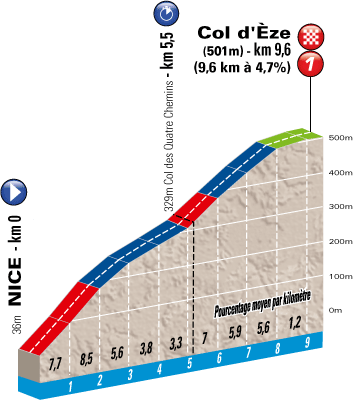
Cycling Weekly: “The final Col d’Eze time trial returns after an 11-year absence from the event. Over the years, cycling greats Eddy Merckx, Sean Kelly, Raymond Poulidor and Stephen Roche all sealed their wins in Paris-Nice on the climb.” The Col d’Eze is the final stage.
Paris-Nice Col d'Eze profile
Mikkel Condé’s picks for possible winners: “One could argue that the course favors riders like Tony Martin and Bradley Wiggins, but with steep stages finishes like the one on Mende, suddenly Alejandro Valverde becomes the favorite – or what?”
Winners since 2000
| 2011 | Tony MARTIN |
| 2010 | Alberto CONTADOR |
| 2009 | Luis Leon SANCHEZ |
| 2008 | Davide REBELLIN |
| 2007 | Alberto CONTADOR |
| 2006 | Floyd LANDIS |
| 2005 | Bobby JULICH |
| 2004 | Jorg JAKSCHE |
| 2003 | Alexandre VINOKOUROV |
| 2002 | Alexandre VINOKOUROV |
| 2001 | Dario FRIGO |
| 2000 | Andreas KLÖDEN |


