
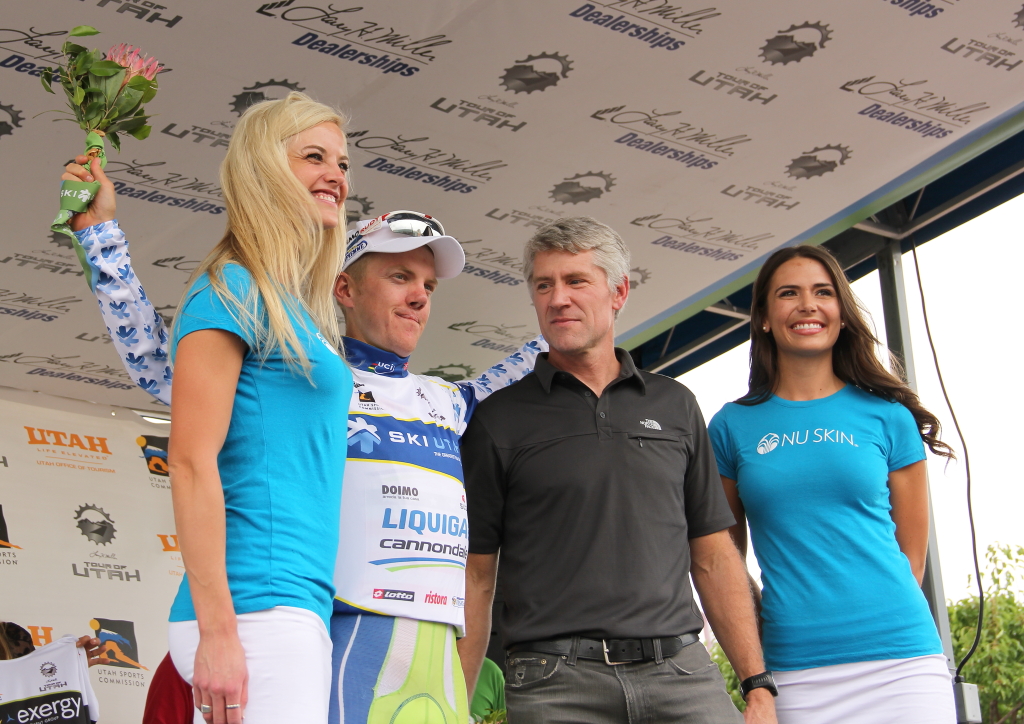
Timmy Duggan keeps KOM jersey for a second day, the Tour of Utah
Most athletes don’t put themselves through hours of training, pain, and isolation from friends and family because their heads tell them to. They do it because, in the words of one pro-cyclist, it’s “a need.” A passion. That kind of motivation has to make it tough to forfeit acting on what feels good in order to stick with “the plan.”
Acting on impulse can lead to a poor result. A rider goes too hard and blows up, or feels so strong he’s unconcerned about towing another rider behind him only to watch the other rider, more rested, pull away and win. The head’s important and some of the best executed plans in a bike race yield their intended results. But many do not.
Too many variables conspire against “the plan” in a bike race. A sudden thunderstorm. Cramps. Teammates who crash and can’t execute their portions of “the plan.” Competitors who don’t act as expected.

Timmy Duggan finishes Tour of Utah Stage 6
It’s easy to construct expectations about other riders’ behavior because bike racing at a professional level can unfold in an incredibly formulaic way. Like waiting until the last climb to launch an attack, which is the direction Timmy Duggan (Liquigas-Cannondale) received for Stage 5 of the Larry H. Miller Tour of Utah.
Instead, Duggan did what felt right. He attacked two climbs before the final ascent up to Snowbird and joined a chase group which later merged with the break-away. Now Duggan rode at the front of the race.
Judging by his efforts at the Tour of California and in the 2012 Olympic Games’ road race, Duggan feels good at the front. It also made logical sense from a few perspectives. Riding with the yellow jersey group to the base of Snowbird might not have given him the chance to pull back 92 seconds on the race leader, Christian Vande Velde (Garmin-Sharp). By joining his teammate in the break-away they could work together to increase their lead over the peloton and get a head-start up to Snowbird. Duggan also picked up KOM points, though not enough to keep the KOM jersey. He rode fast enough to drop riders in the break-away and lead the race for a while with Thomas Slagter (Rabobank).
The next day on the final stage of the race Duggan found the break-away at the beginning of the stage. This time that was the plan; the team expected a chaotic race, and chaos helps a rider out of the break-away to win.
“I just wanted to maintain the rhythm of the break and have as much a head-start into the bottom of the last climb as we could and that’s what we did,” Duggan said. “And I just had to hope that I could hang on over the climb.” Duggan dropped his break-away mates and led the race up the lower slopes of Empire Pass. Another rider bridged up to him and rode away. Duggan later crossed the finish line in Park City in 29th place, a little over six minutes behind stage winner Levi Leipheimer (Omega Pharma—Quick-Step).
Speaking about his goals for the day, Duggan said, “I was more looking out for the stage and if the KOM came along with it then great. Unfortunately neither happened. But hey that’s bike racing – you’ve got to give it a shot.”

Tour of Utah Stage 4 start
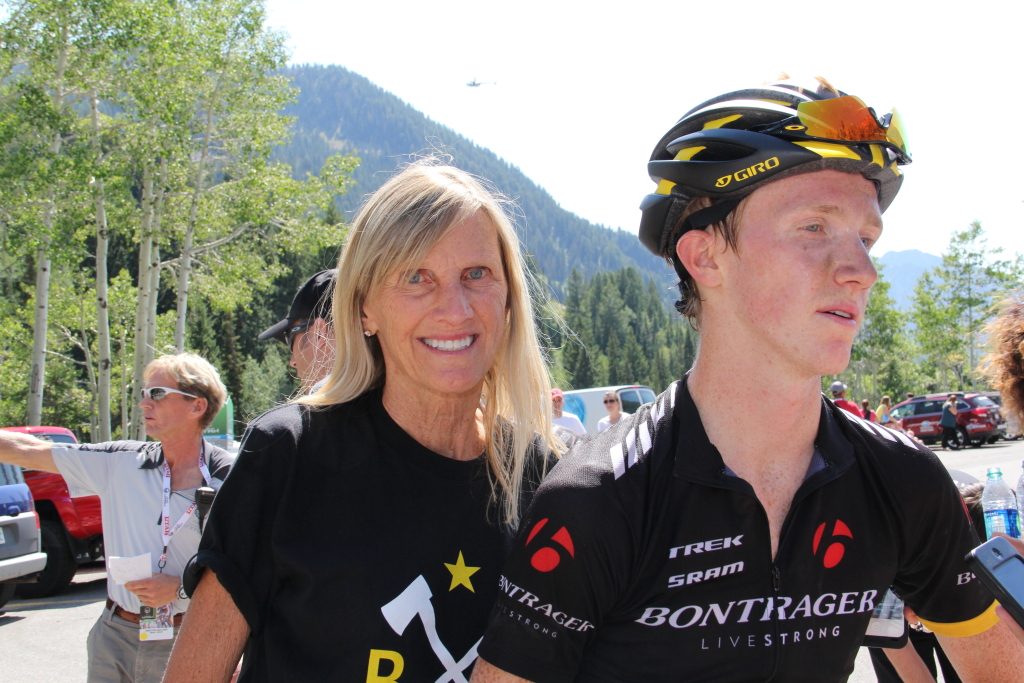
Ian Boswell (Bontrager-Livestrong) with his mom, Molly, on Snowbird after Stage 5 at the Tour of Utah
Ian Boswell (Bontrager-Livestrong) received a unique push today up to Snowbird on Stage 5 of the Larry H. Miller Tour of Utah.
Two months ago his brother’s childhood friend, Matt Gold, passed away in a sky diving accident. Gold, a good friend to Boswell too, loved the Tour of Utah. Together with Boswell’s mom, Gold’s family spread his ashes today up on the mountain where he lived. Boswell met his mom and Gold’s family just after the finish of the stage.
Boswell sped away from the peloton before the Tanners Flat area of the climb and rode solo until teammate Joe Dombrowski and three other riders caught him. Boswell latched onto that group and continued with them to the finish line, placing fourth on one of the most difficult days of the race. He also leapt up the general classification from 26th to sixth.
“I rode today for him [Gold]. It’s a super special day for me and my family,” Boswell said. “It means a lot to have a friend like that and have someone special to ride for beyond just results and yea, he helped me today.”
Gold passed away at age 33. He was an outdoor adventure man who loved to fly, who according to a friend, had an “insane determination to always succeed.” If he had been on Snowbird today, he’d have been one of Boswell’s greatest supporters, encouraging him to go faster.
Boswell spun his gears fluidly and with ease up the climb, as if Gold’s hand pressed on his back the entire way up Snowbird.
“I’ve cried twice before a race,” Boswell said. “One was Liege-Bastogne-Liege this year when I was going through some troubles and the other was this morning when I watched a video that I posted of him, of his life, and his adventures. It was a special day for me. He was my good friend and a huge supporter of mine.”
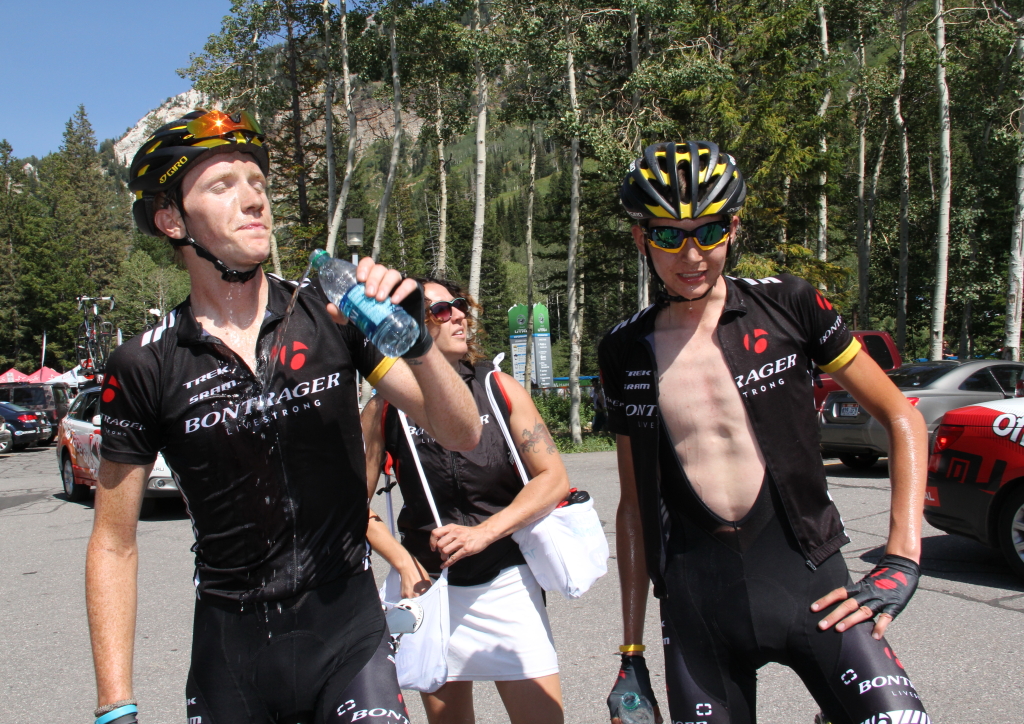
Ian Boswell and Joe Dombrowski right after Tour of Utah Stage 5 finish

Ian Boswell, left, with Bontrager-Livestrong teammates
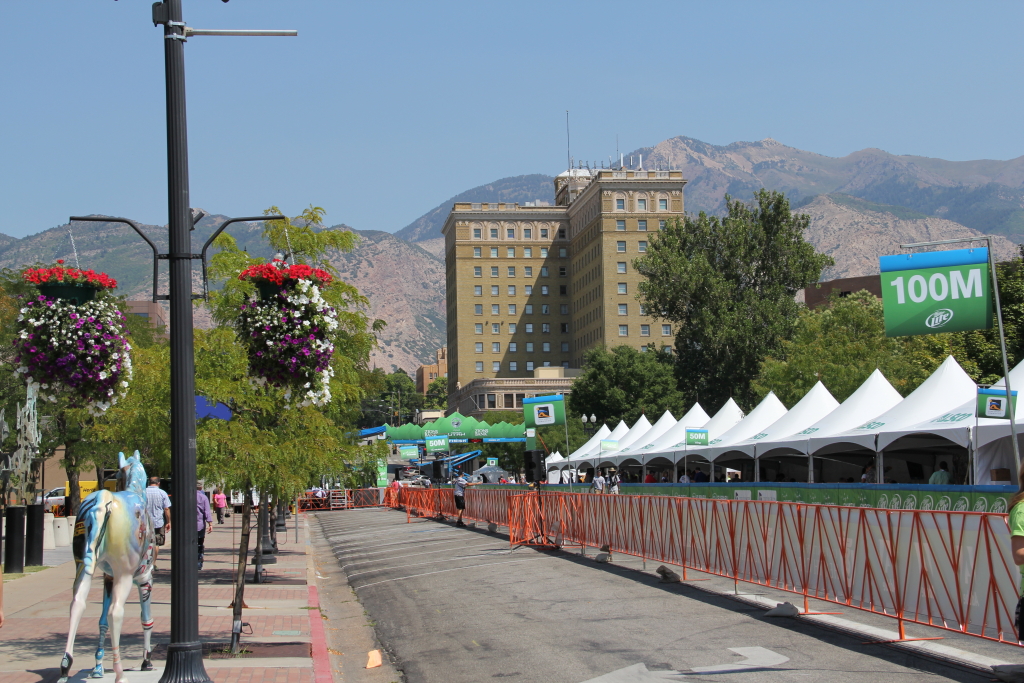
Downtown Ogden finish, Tour of Utah Stage 1
Here’s where Colorado-based riders in the Larry H. Miller Tour of Utah stand after four stages. The riders face the pivotal Stages 5 and 6 this weekend.
………………………………………………..GC after…………………..KOM……Sprint
Rider Team stage 4 GC time jersey jersey
| Tom Danielson | Garmin-Sharp | 2 | +3″ | ||
| Chris Baldwin | Bissell | 12 | +53″ | 25th | |
| Julian Kyer | Bissell | 13 | +53″ | ||
| Rory Sutherland | UnitedHealthcare | 19 | +1’05” | ||
| Andrew Bajadali | Optum p/b KBS | 21 | +1’06” | ||
| Mike Creed | Optum p/b KBS | 22 | +1’06” | ||
| Lucas Euser | Spidertech p/b C10 | 30 | +1’19” | 2nd | |
| Timmy Duggan | Liquigas-Cannondale | 32 | +1’32” | 1st | 23rd |
| Matt Cooke | Exergy | 33 | +1’42” | ||
| Ben Day | UnitedHealthcare | 46 | +3’17” | ||
| Taylor Sheldon | Competitive Cyclist | 51 | +5’44” | ||
| Craig Lewis | Champion System | 68 | +10’50” | 17th | |
| Ian Burnett | Competitive Cyclist | 100 | +21’47” | ||
| Alex Howes | Garmin-Sharp | 112 | +25’45” |
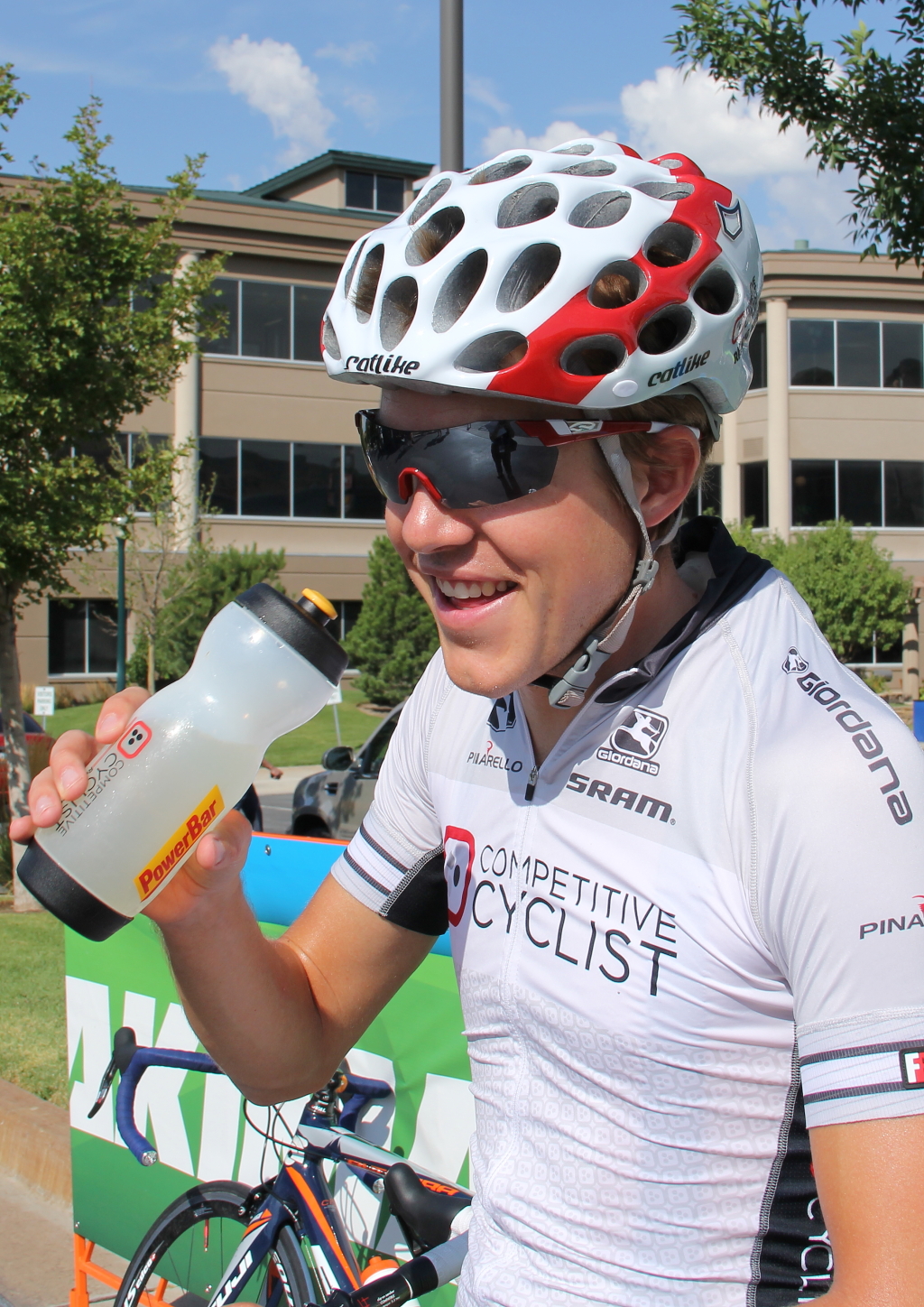
Taylor Sheldon (Competitive Cyclist), ice sock on neck, hydrating before Stage 4, Tour of Utah
….
Ben Day, Taylor Sheldon, Ian Burnett, and Alex Howes have been riding support roles for their teams.
Day helped teammate Jake Keough (UnitedHealthcare) win in the sprint finish today by riding at the front well before the race was over and at 2 km to the finish to bring back the break-away.
Howes is a familiar sight leading the peloton up climbs with the same objective as Day’s — to shut-down break-aways and keep Garmin-Sharp’s leaders safe at the front of the the field of 119 riders.
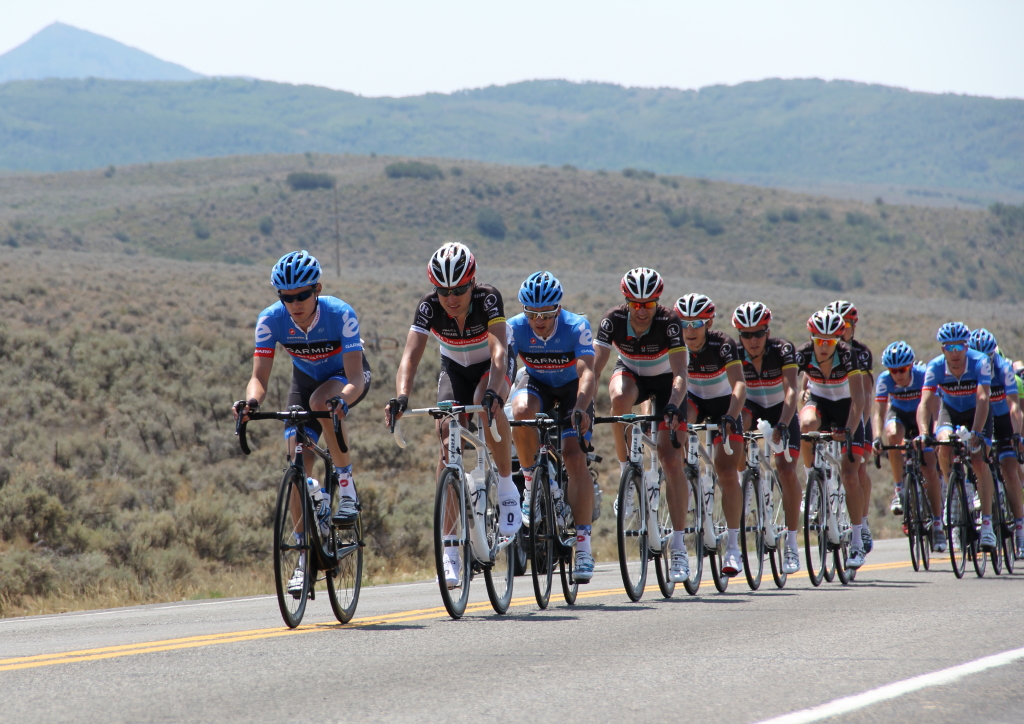
Alex Howes (Garmin-Sharp) pulls the peloton up a climb in Tour of Utah Stage 1
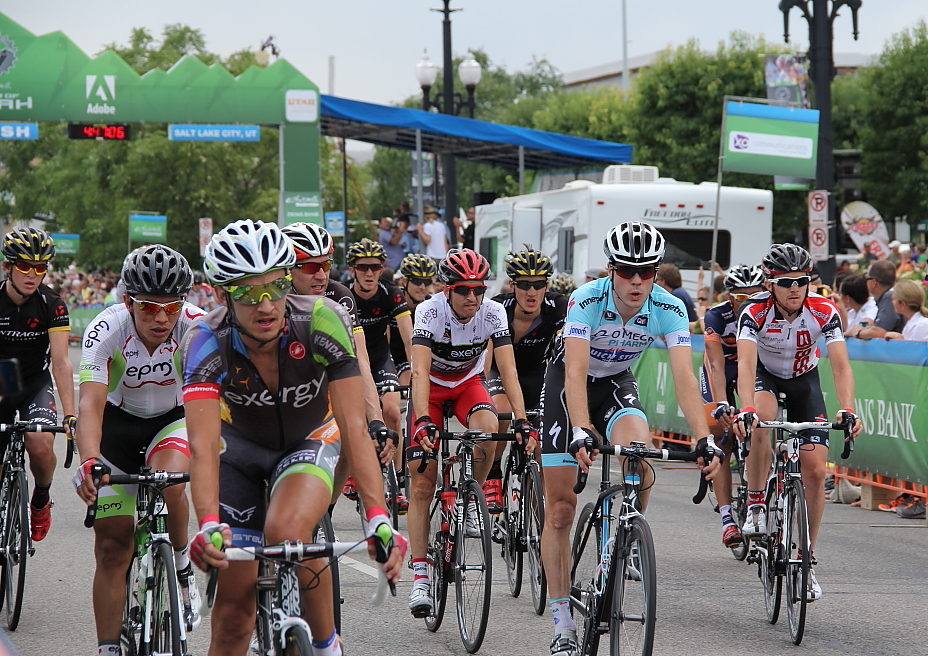
Julian Kyer (Bissell) on the right, at the Tour of Utah Stage 4 finish
Julian Kyer rides for the first time with his new Bissell team in the Tour of Utah. His 13th place on GC wasn’t something he expected, he said today; at the same time it’s “not a massive surprise” because he’s been riding consistently well. He added that the finishes through Stage 3 hadn’t been too selective.
Craig Lewis lost time on Stages 1 to 3, but he rode powerfully in the break-away on Stage 4. The peloton caught the break-away 800 meters from the finish line; Lewis lost 47 seconds on Stage 4.
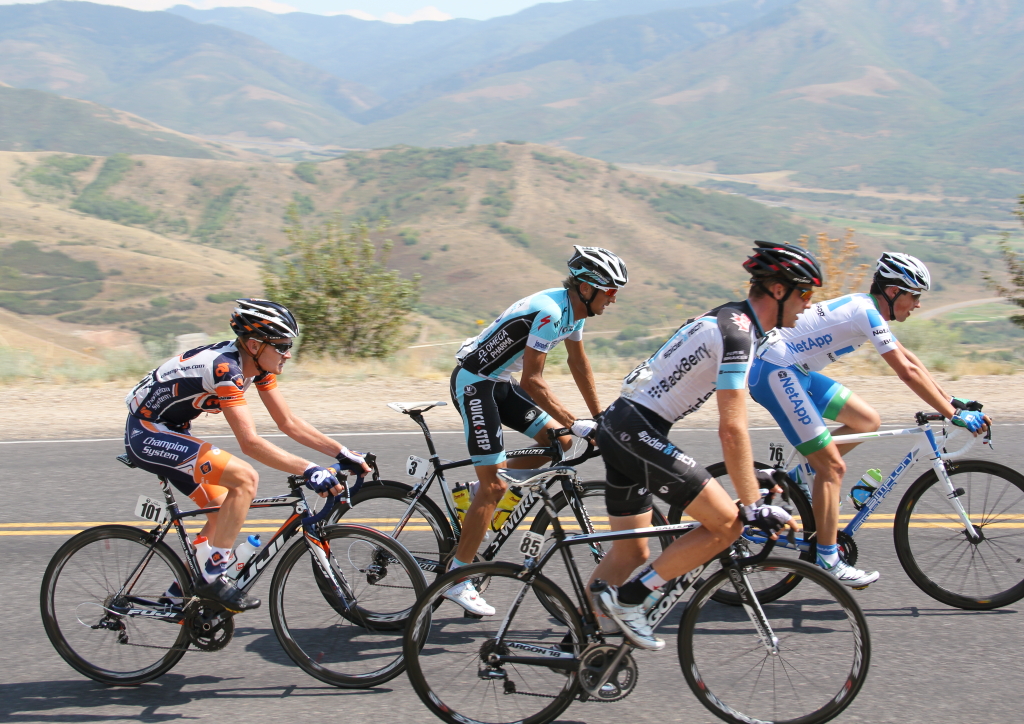
Craig Lewis (Champion System) on the left, on Little Mountain, Stage 3 Tour of Utah
Tom Danielson sits in a position to win the overall in Utah. Chris Baldwin, Matt Cooke, and Lucas Euser are also enjoying good tours so far in Utah and could all move higher on GC and/or land on the final podium with epic rides this weekend.
Euser mentioned today that he’s feeling really good. “I’ve been working hard for this,” he said. He credited his form to changing his training program over the last two months, together with Golden Eagle training camp in late July with Taylor Phinney and other Colorado riders. Euser called the Tour of Utah through Stage 3 “easy,” explaining that they rode race pace for 250 km in Golden Eagle camp (so named because of the Golden Eagle sighted early in the camp). The longest stage in Utah, Stage 4, covers 216 km.
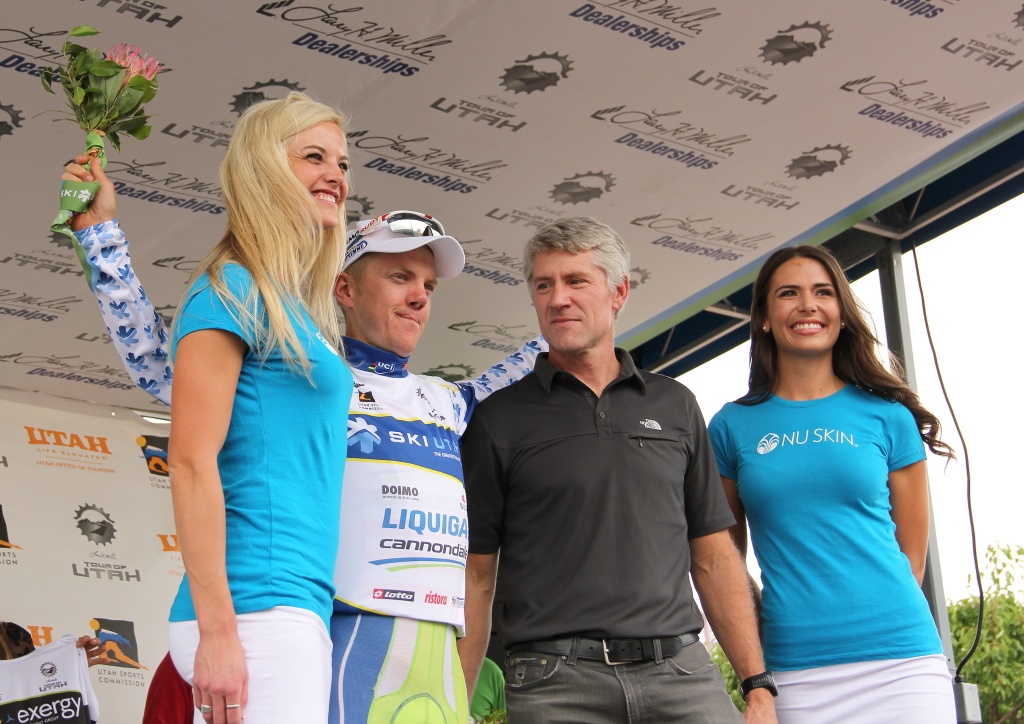
Timmy Duggan (Liquigas-Cannondale) will carry the KOM jersey for a second day heading into Stage 5, Tour of Utah
Timmy Duggan heads into Stage 5 in the KOM jersey he picked up in Stage 3 after collecting points when he rode in the break-away.
When asked where Utah would be won, Duggan said, “For sure the final two stages, those are the money makers. But just because you had a thirty second lead after the Snowbird stage doesn’t mean that can’t be erased the next day because it’s a very different stage. The climb up to Snowbird is just a long, steady drag; it’s never super steep. But the climb the next day is at the end of a shorter, punchier, more explosive stage. The final climb is super steep in contrast with Snowbird, and then a technical descent to the finish, so you might see a different type of rider being successful on each of those stages.”
Stage 1 ended with a win for Rory Sutherland (UnitedHealthcare), who said he’s the back-up sprint man on the team if the sprinters can’t make it over the hills. In that role he’s “been trying to win one of these for six years.” It looks like he’ll have to start counting from zero again.
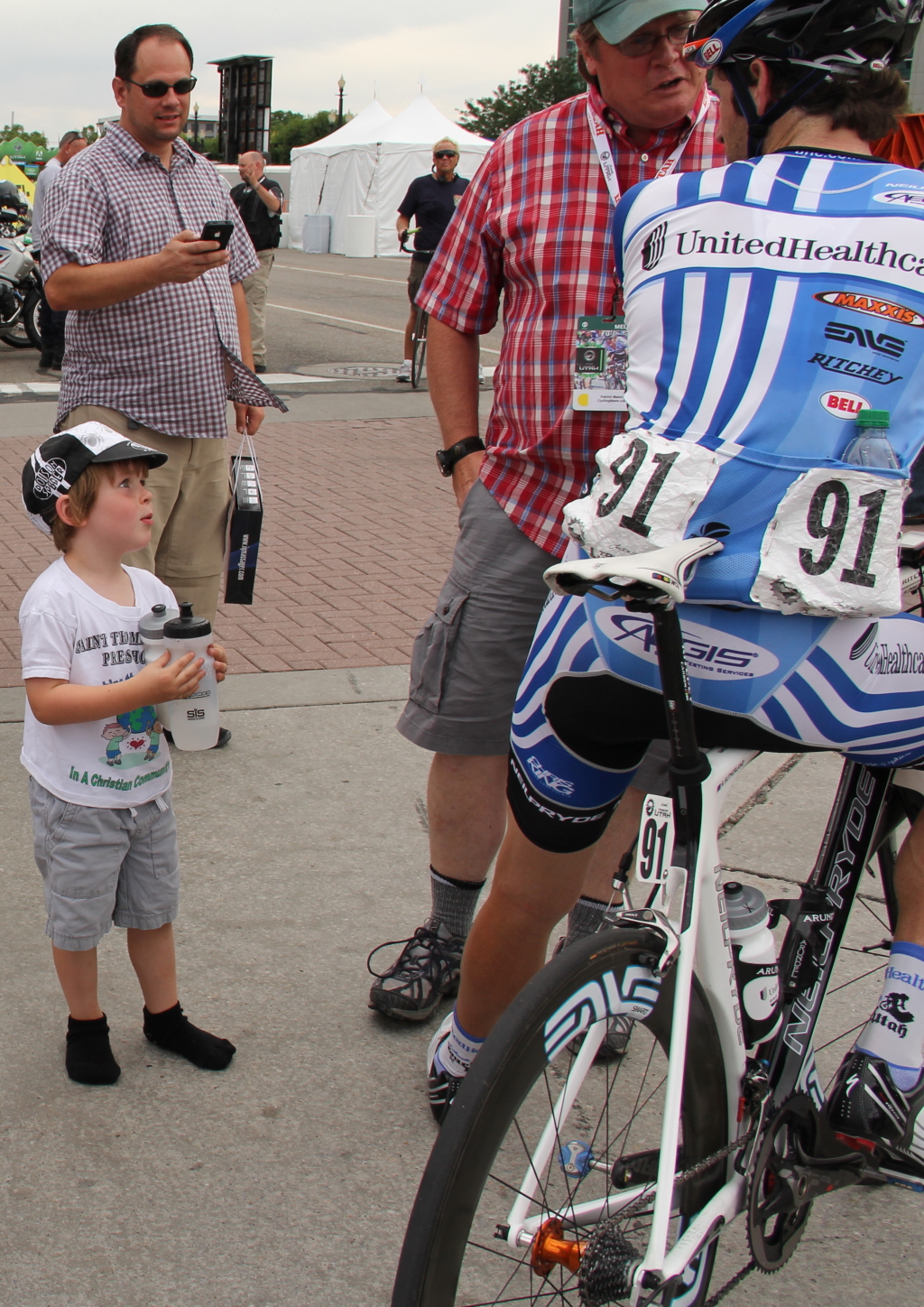
Rory Sutherland (UnitedHealthcare) greets a fan after Stage 4, Tour of Utah. “Where are your shoes?” Sutherland asked.
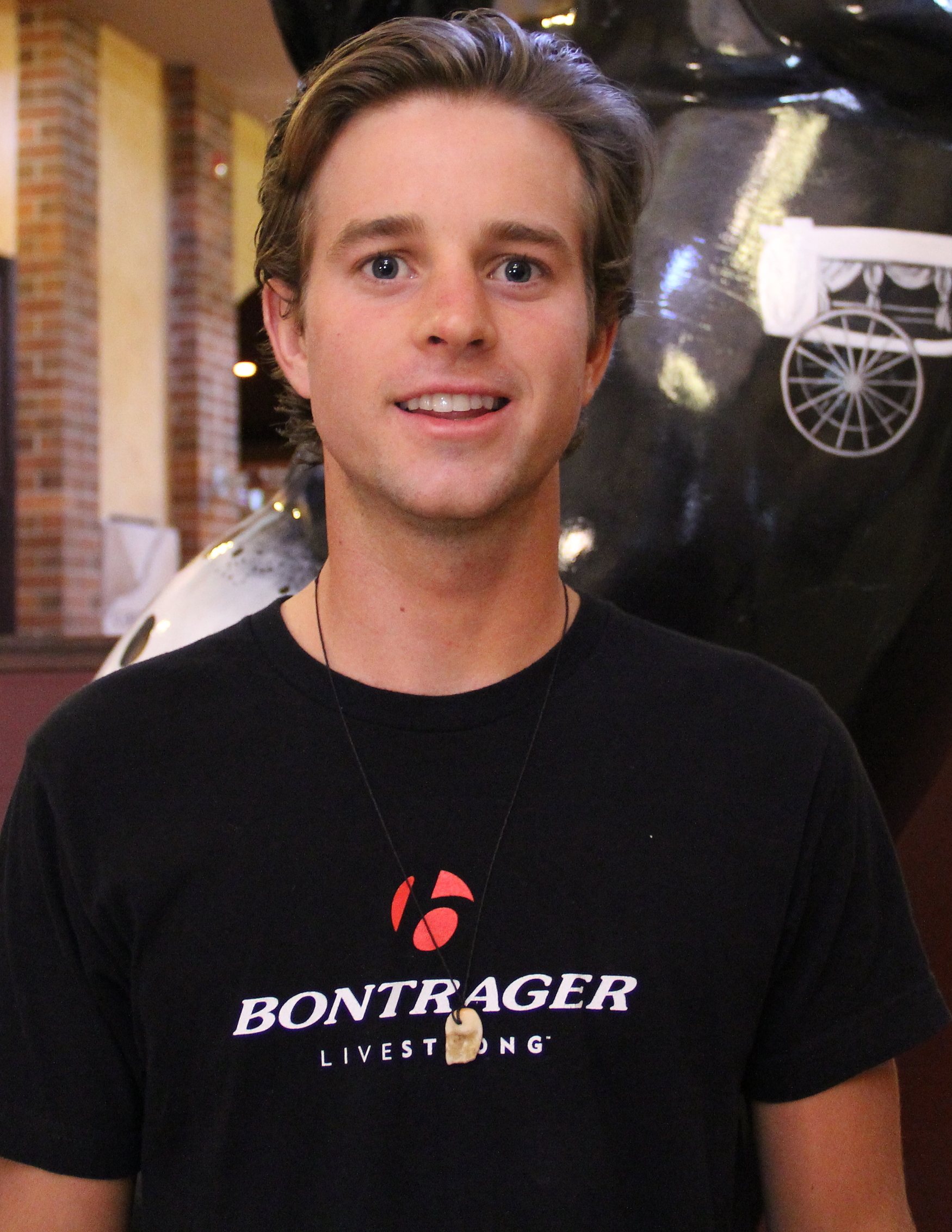
Connor O’Leary
On Stage 1 of the Tour of Utah Connor O’Leary on the Bontrager-Livestrong team netted the Best Utah Rider jersey by crossing the finish line ahead of the three other riders contending for that prize. It was a one in four shot to win the jersey. But that measure doesn’t take into account the long odds he recently faced and the hard work O’Leary put in just to make it to the start line.
O’Leary, who is now 21 years-old, learned two years ago that he had testicular cancer. He turned his attention immediately to fighting the disease, canceling plans to leave the next day for the U.S. national championship race, a special event for him. He placed third in the juniors 13 – 14 national championship time trial not long after he started racing.

Connor O’Leary (left) on Little Mountain
Then just when it seemed like he was turning a corner in December 2010, two and a half weeks before the end of cancer treatments he experienced chest pain that progressed down his back. Emboli (blood clots) had lodged in his lungs and heart. A different round of treatment began.
“I was really worried after those pulmonary embolisms because obviously it scarred my lungs…I really didn’t know, they didn’t know if I was going to be able to get back to the top of the sport,” O’Leary said.
The doctors knew one thing, and so did O’Leary. “The doctors told me if I didn’t have a strong heart I would have died. I guess cycling kind of saved my life.”
Beginnings
O’Leary’s heart had already grown super strong by the age of nine. That year he became the youngest rider to complete the 550 mile Register’s Annual Great Bicycle Ride Across Iowa, a popular event he rode with his dad over seven days.
Riding and training in his own fashion, O’Leary began racing at age 13. As he grew he paid for his bikes with earnings from his own small lawn mowing business and jobs at Golsan Cycles and Highlander Bike, local bicycle shops.
In 2007 he won the Utah State time trial championships in the junior 15 – 16 category. His talent secured him the opportunity to race in Europe with the U.S. national team in 2009 and 2010.
O’Leary marks the beginning of his professional cycling career in 2010 when he raced with the Waste Management U23 team. The upward trajectory of his cycling career seemed unstoppable until the cancer diagnosis in June 2010.
The fight
At first he probably wouldn’t have called dealing with cancer a battle. “It was way harder than I thought it was going to be,” O’Leary said. “I think I was a little arrogant going into it just because I’m young, bulletproof, nothing can break me down. But it was humbling.” Five foot ten inches tall, he now weighs 144 pounds. During cancer treatment he dropped to 128 pounds.
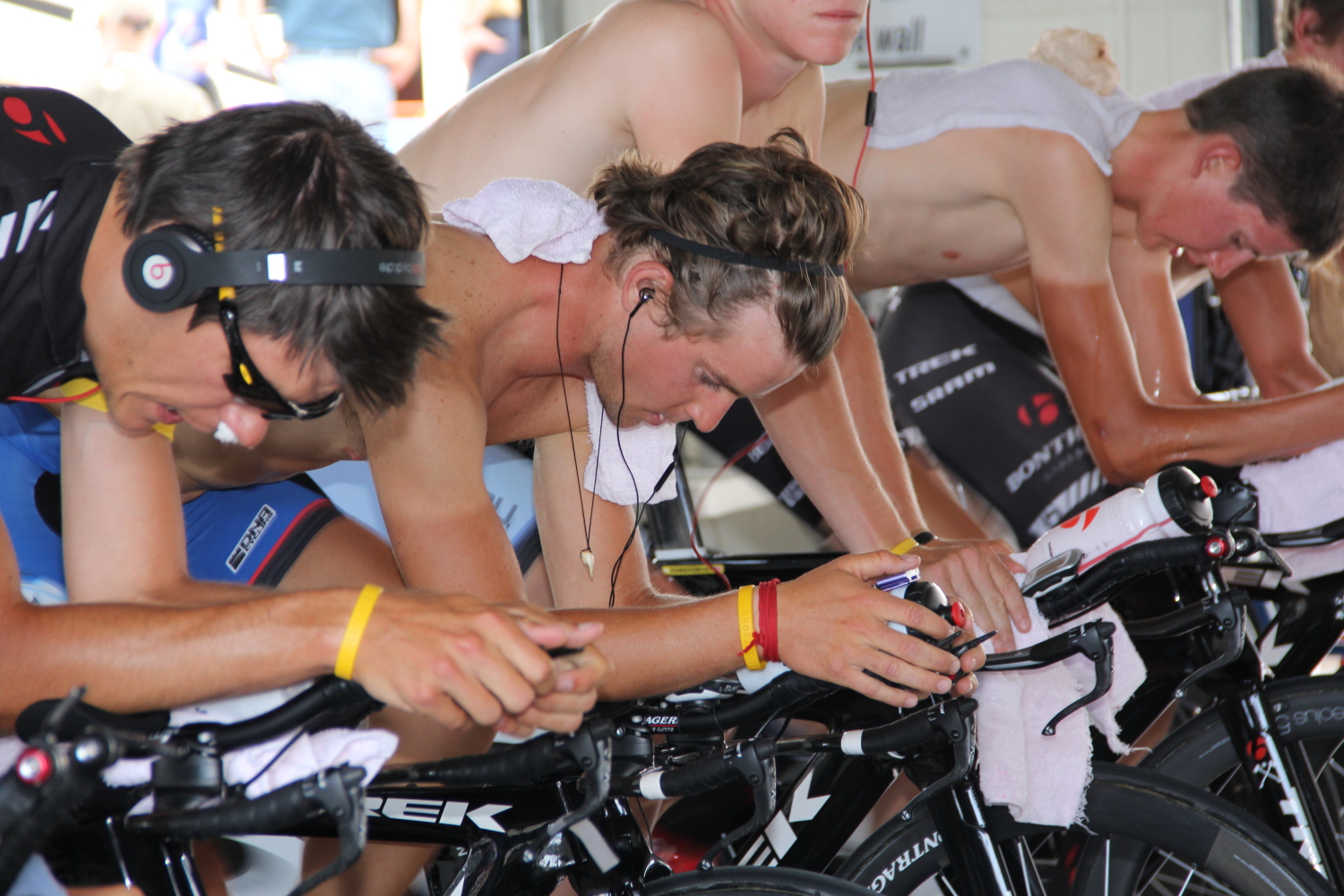
Connor O’Leary (second from left) warming-up with his Bontrager-Livestrong team for the team time trial)
O’Leary described 2011 as a rebuilding year, starting from ground zero. He said, “I lost all my muscle. I got back on the bike, and it really took quite a long time, longer than I thought…I really forgot how hard the sport is.”
He entered the East Canyon Road Race in April, a race he won as a category 3 rider in 2007. “It was a race where the previous year I probably could have won it fairly easy, and I got dropped in 15 minutes…I remember turning around on the course, getting in my car and just bawling, [feeling] like I’m done.”
At about the same time he discontinued the blood thinner medication doctors prescribed after the embolism diagnosis. He’d been taking them for three months; the doctors wanted twelve.
“I couldn’t do it for a year,” O’Leary said. “I couldn’t really race on blood thinners…I just could not ride or race for that long. I just wanted to get back.” It seemed like a low risk decision; he thought the port inserted into his chest for cancer treatments had caused the blood clots. There seemed to be no reason to continue the blood thinners since the port had been removed.
The devastating experience in the East Canyon Road Race motivated him to rebuild. He had a lot of work ahead of him.
Recovery
To rebuild his fitness O’Leary started Nordic ski skating which improved his core and upper body strength. He cycled while on blood thinner medication, building up to 10 to 12 hours a week in the spring of 2011. He used a half-dome-shaped tool, the Bosu Ball, as well as a full ball for core training. “I was doing a lot of core off the bike but the main thing I was doing was just riding.”
All the hard work paid off when the Bontrager-Livestrong team signed him in October 2011 and O’Leary joined many of his former U.S. national teammates. He quickly demonstrated he had returned to form by winning stages in the Tour of Walla Walla and Tour of the Depot in April 2012.
O’Leary reflects constantly on how he’s achieved the restored health and fitness he yearned for when he lay in a hospital bed two years ago. It’s as if he has gained a new appreciation for his talent and possibilities. “I really want to push it harder,” he said. “…going through something that hard, it [cancer] made me realize after doing this I can ride a bike hard. I definitely think mentally it made me a lot stronger.”
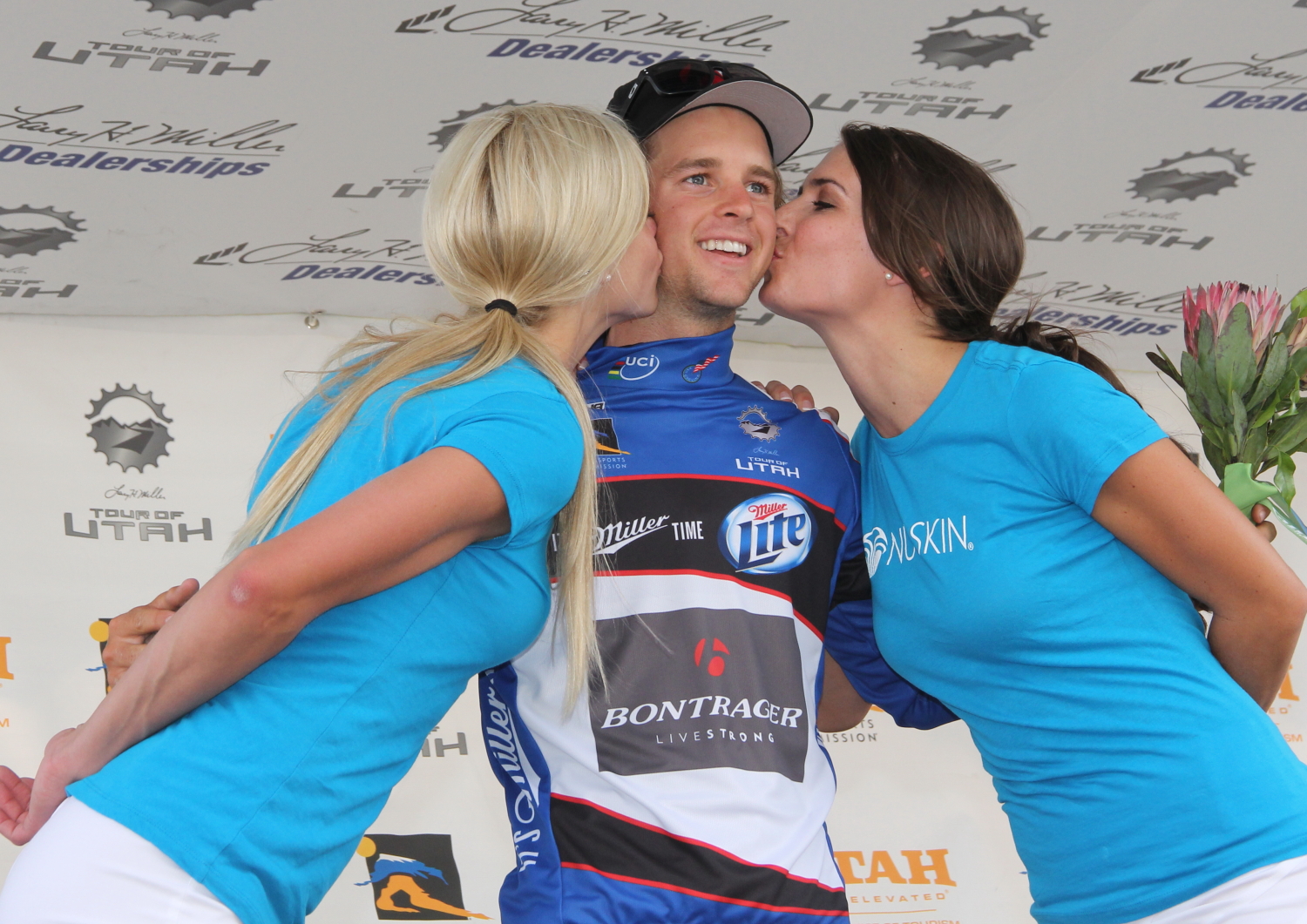
Connor O’Leary wore the Miller Lite Best Utah Rider jersey for two days
Utah’s big
The Larry H. Miller Tour of Utah is the biggest race O’Leary has ever participated in. He watched from the sidelines for the past two years and now he’s inside the peloton, doing his job. Because his Bontrager-Livestrong team at the Tour of Utah includes riders who can place high in the General Classification, the race provides him the perfect opportunity to do what he loves most, which is to ride in a support role to help a teammate win. “It sounds weird,” he said, “but I love going back to the car to get bottles, and riding in the front.”
For O’Leary, racing in and around his hometown of Salt Lake City is “big for me and my family to get to see me race, because they can’t always come over to Europe and see me in the bigger races over there that I do…I’m just happy that my family gets to see it.” His parents plan to watch all six days of racing. O’Leary called them a “huge support.”
To get ready for the Tour of Utah, O’Leary trained locally. After his teammates competed in the Cascade Cycling Classic they joined him in the mountains around Park City, in Midway, Utah, where his family owns a home. They spent two weeks training together, reconning stages, and for those from sea level, adjusting to the altitude.
O’Leary labeled the last two days of the event as pivotal, including the Guardsman Pass climb on the final day. His family’s Midway home is located at the base of that climb. When asked how many times he’s been up and down that pass, O’Leary said, “I don’t like to go up it, but yea, I’ve done it quite a bit. Especially when the courses came out I started riding it quite a bit.”
Guardsman Pass is important because according to O’Leary riders can lose more than five minutes there. “You can just blow up, that thing is so steep,” he said.
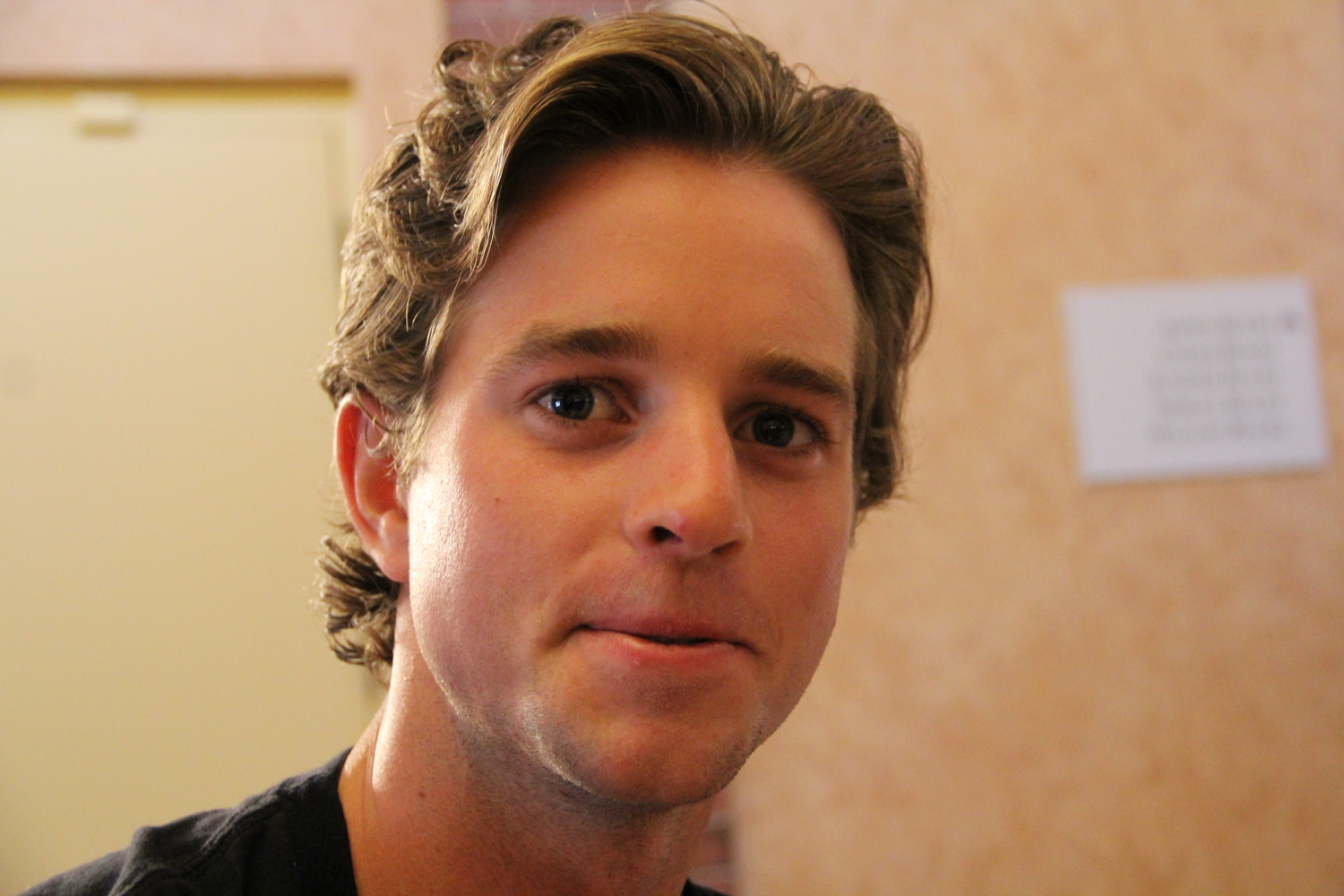
Connor O’Leary
As O’Leary approaches that climb on Sunday he will probably consider how hard he can ride to pace a teammate to the top of it. He fought to restore his future and succeeded, so he knows he can fight to help a teammate achieve a high placing by the end of the race.
“It’s pretty crazy. I love cycling but I never thought it would save my life like it did,” he said. “Being dedicated to something like cycling that’s such a hard sport, it made it that much easier to fight through [cancer] because you fight through stuff on the bike all the time.”
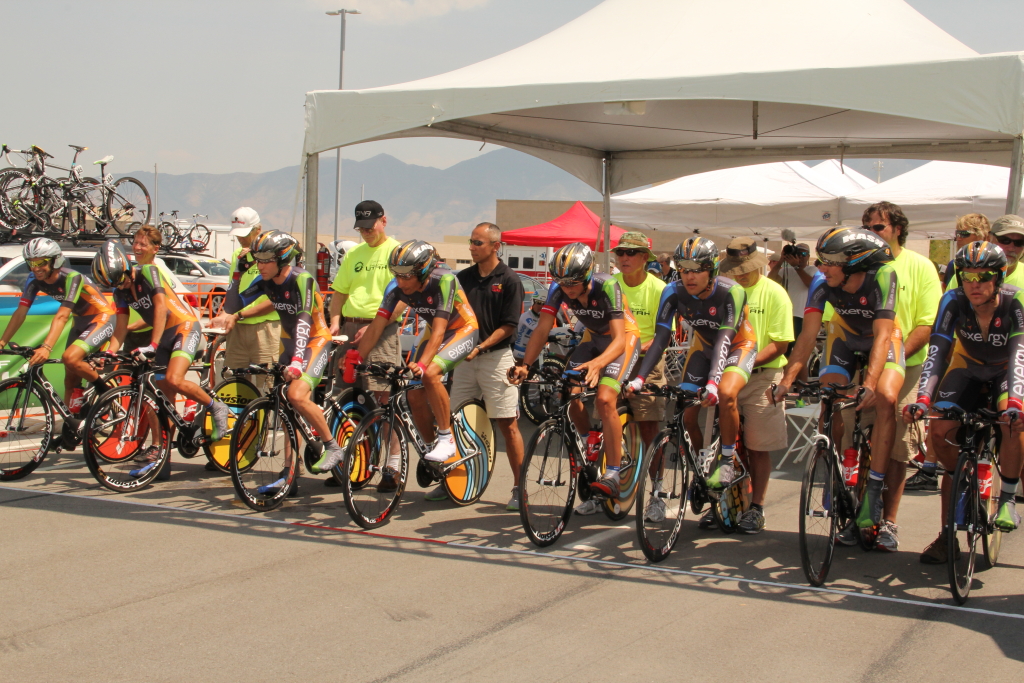
Team Exergy in the Tour of Utah TTT start house
“We do one of these about every 4 years,” Matt Cooke of Team Exergy said on the team time trial day at the Larry H. Miller Tour of Utah.

Tad Hamilton
Despite that the team’s sports director, Tad Hamilton, said the day before that he was excited to try the TTT. “It adds to the adventure,” he said.
Not one iota of apprehension hung about him, even though the American continental team would face the TTT without as much experience as other teams in the Utah race. Then again, speaking with Hamilton is usually like sailing on smooth water.
Regardless of the amount of TTT experience, the event presents challenges to every team, from the continental to the World Tour level, especially on a course like the Miller Motorsports Park outside of Salt Lake City, Utah. Talk to any of the 17 teams that wound through the eleven turns of the 7.2 km (4.5 mile) loop three times, and they’ll tell you the same thing: you have to keep the guys at the back of the paceline in mind.

Matt Cooke, Noe Gianetti (l to r) warming up before the Tour of Utah TTT
When taking corners at 35 to 40 mph a rider can’t take the turn as tightly as he would riding alone. “It was extremely painful because you are not controlling the pace, the guys at the front are,” Cooke said. “If they go full tilt, you have to go with them.” After the race in the press conference, Alex Howes (Garmin-Sharp) relayed his TTT experience: “I was at the back a lot; it was pretty difficult back there.”
“On a course like this small guys have trouble,” Cooke said. The smaller guys have to be able to hold the wheel of a taller teammate who is a powerhouse on the flats, someone like Sam Johnson, Cooke’s teammate. “You can only go as fast as your slowest guy – I kept thinking this out there,” Cooke said. Cooke has a narrower, shorter climber’s build, as does Team Exergy’s Noe Gianetti.
Hamilton said the team brought more climbing strength to Utah in Gianetti and Kirk Carlsen to help leader Freddie Rodriguez get over the hills. Gianetti got dropped from the team of eight that left the start house. He finished alone.

Kirk Carlsen (right) warming up before the Tour of Utah TTT
One thing that helps with keeping the guys at the back in mind is practice. Rodriguez and Carlsen have a good amount of experience racing TTTs. Carlsen’s last TTT was at the Tour of Qatar in 2010 when he raced on the Garmin-Transitions team. “If you practice a lot you can do well even if you’re not as fit [as other riders],” Carlsen commented.
Carlsen helped his teammates with some pointers: where to pull off, and how hard to pull or not when leading the paceline. A single paceline instead of a double echelon worked best for the Utah TTT venue, Carlsen said, because of the wind out on the course. The wind could blow from a single direction, but with the eleven turns on each lap it hit the riders from different sides with each curve. It’s easier to take the corners and manage the wind direction with a single paceline. That’s how all of the teams approached the day.
The paved course which is as wide as a four lane road provided lots of room to get blown around. The turns are named with expressions like “Black Rock Hairpin,” and “Devil,” the latter appropriate to the heat that bounced off the pavement.
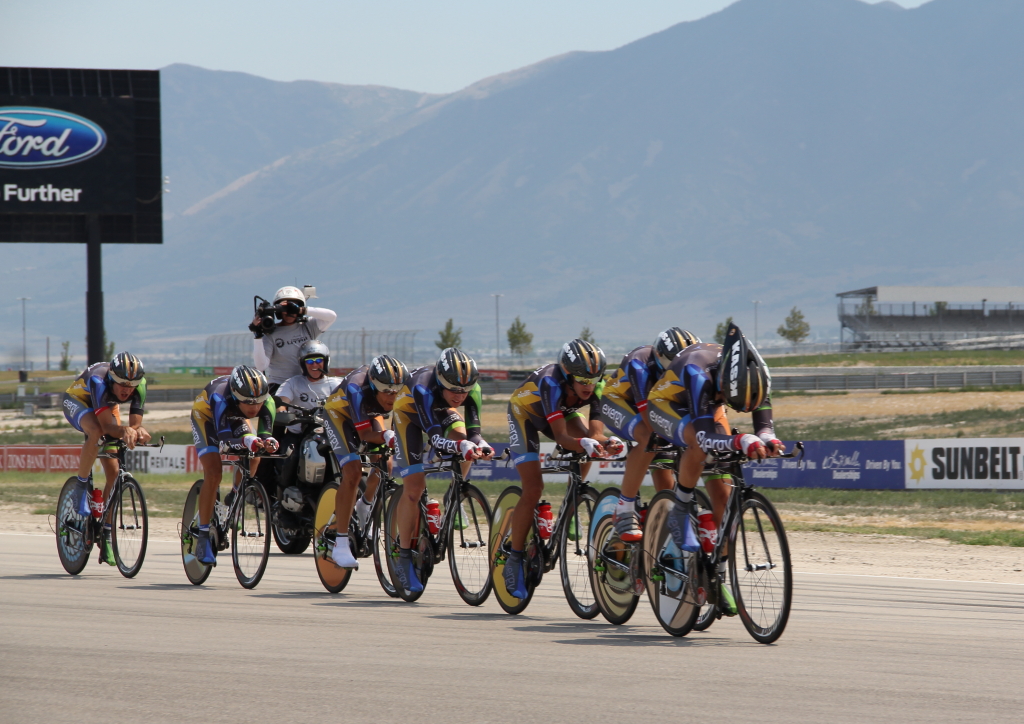
Team Exergy on the Miller Motorsports Park TTT course
Out on the course Carlsen poured himself into a last hard pull near the end of the third lap and then dropped off the back as the six remaining Team Exergy men sped across the finish line. The team’s effort landed them in 13th position.
The guys returned to their warm-up space and climbed back on the bikes to warm-down on trainers. The debriefing continued for some time as they relived certain corners and the changing wind direction. “I think we did pretty darn good,” Cooke said.

Team Exergy riders debriefing after the Tour of Utah TTT, Freddie Rodriguez, Serghei Tvetcov, Morgan Schmitt (l to r)
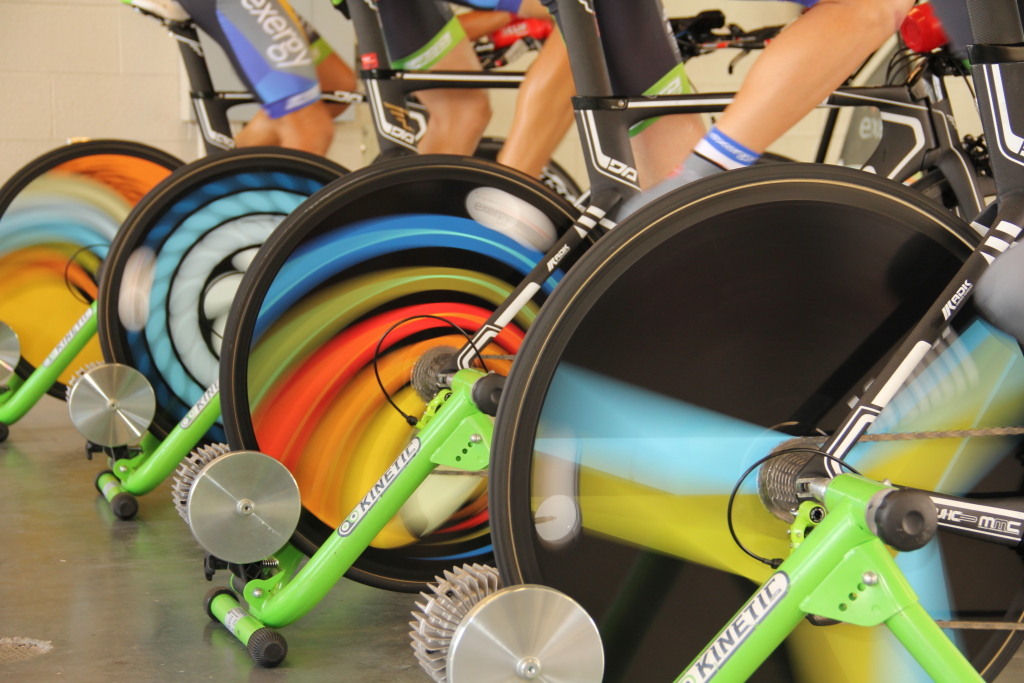
Team Exergy’s disc wheels are the most colorful of the 17 teams
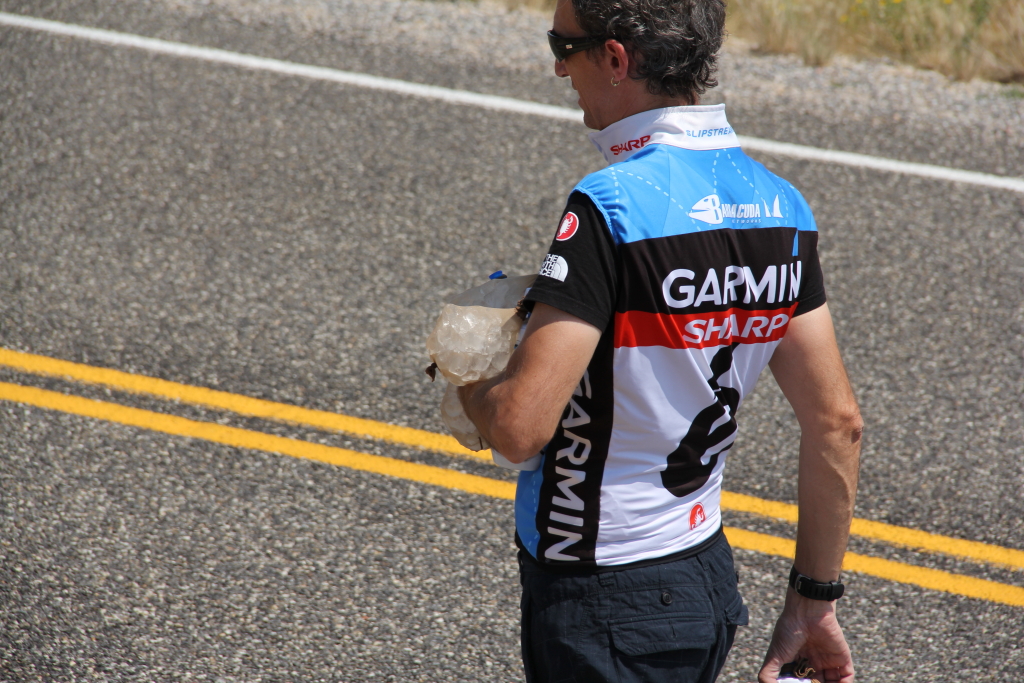
Garmin-Sharp Soigneur with ice socks on top of Hogsback KOM, Tour of Utah Stage 1
With temperatures expected in the high 90’s Fahrenheit this week at the Larry H. Miller Tour of Utah, talk focuses on the heat and how the riders adapt to it.
Chris Butler (UnitedHealthcare) answered questions about the heat after revealing what he enjoyed for breakfast, oatmeal and eggs. “When it gets hot like it will today it’s hard to eat later in the day, so you try to cram it in early,” Butler said. “We’ll be rotating a crew of three guys going back [to the car] for bottles during the day.”
One team’s press officer said one week in the heat doesn’t matter to the athletes. They’d be in for trouble if they raced in heat for three weeks – their stomachs would bother them because they’d drink so much, she said.
Joe Dombrowski (Bontrager-Livestrong) commented after the finish of Stage 1 in Ogden. In the hills on the course the temperature hovered around 92 and in Ogden it reached 97. Fox Sports reported 16% humidity. “It was hot. I think I drank 25 water bottles,” Dombrowski said. “We get ice socks in the mussettes and drape the socks around our necks. It’s funny when you open your jersey — all the socks fall out.”
The “socks” Dombrowki referred to are pantyhose stuffed with ice, as shown in the photo above of the Garmin-Sharp soigneur on top of one of Stage 1’s KOM’s.
By the time the race finishes on Sunday, the streets around Salt Lake City should be lined with pantyhose legs knotted at the ends.
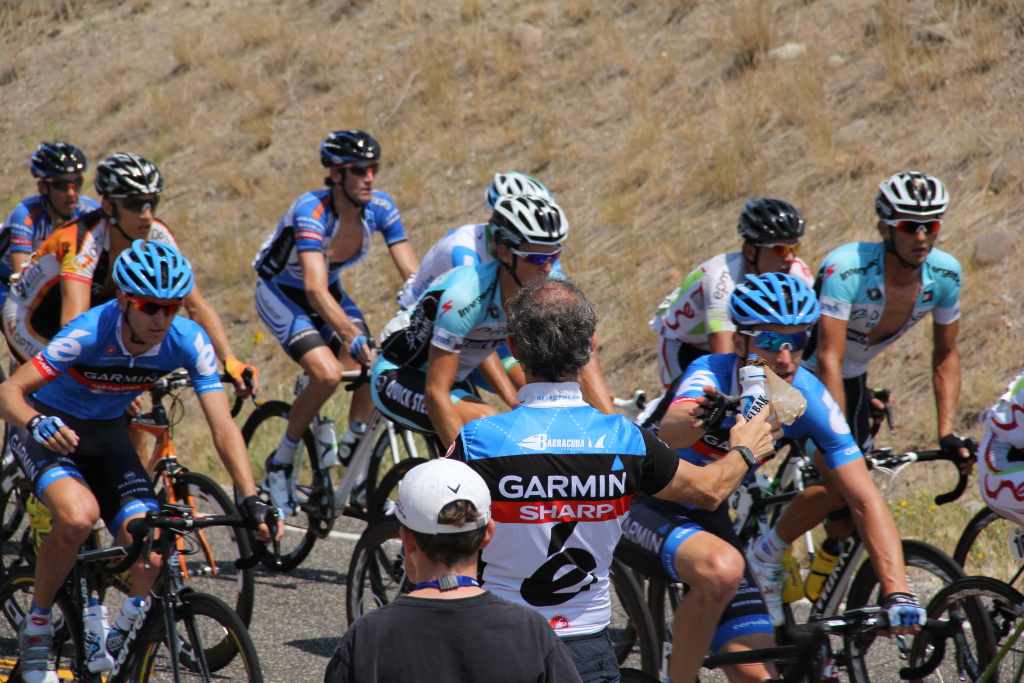
Christian Vande Velde (Garmin-Sharp) aiming for bottle draped with ice sock
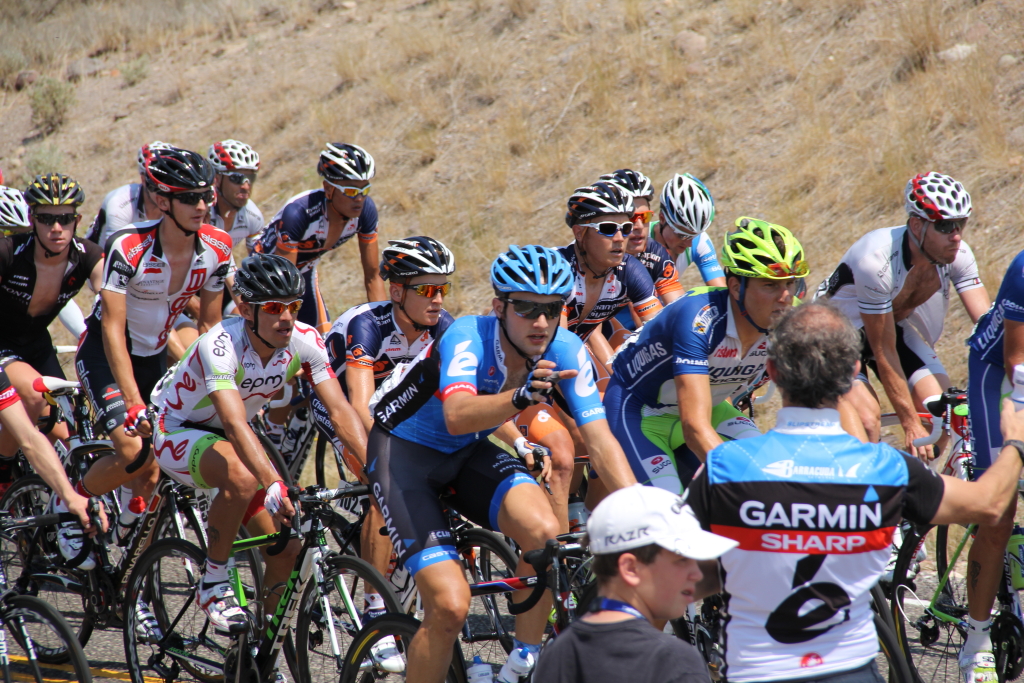
Jacob Rathe (Garmin-Sharp) reaches for bottle with ice sock
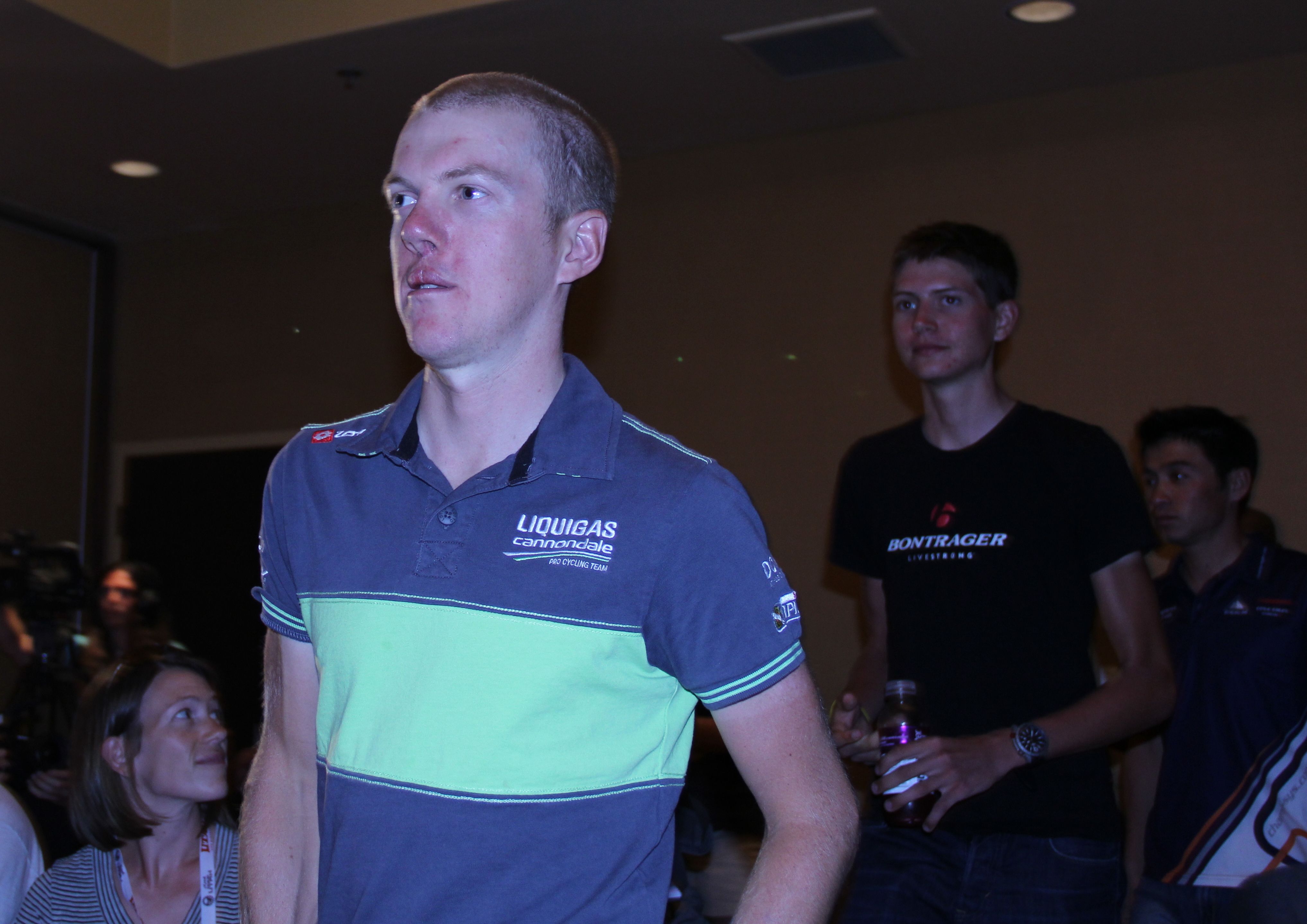
Timmy Duggan enters the Tour of Utah press conference ahead of Joe Dombrowski
[updated 8/8/2012]
Timmy Duggan (Liquigas-Cannondale) has been racing a lot. He’s just returned from a block of time in Europe which ended with the Olympic road race. So he hasn’t had much time to realize he’d be wearing his national championship kit in a U.S. race for the first time during this week’s Tour of Utah.
Since he and his wife moved into their new home in Nederland, Colorado in May, he’s only slept there about six nights. “My next goal is to learn which lights the light switches turn on; I’m learning that right now,” Duggan said in Ogden, the day before the first stage of the Larry H. Miller Tour of Utah.
The light’s shining on him as leader of the Liquigas-Cannondale team in Utah. He’s arrived with a diverse squad. Duggan described teammates Valerio Agnoli and Damiano Caruso as “proven punchy climbers.” Paolo Longo Borghini is a rider like teammate Ted King, a strong all-arounder, a bigger guy who can climb really well. Talking about King and Borghini, Duggan said, “That’s a wheel I want to be on to stay safe and fresh around the race. Those guys can do anything, go anywhere and be strong all day.” Marco Benfatto, a stagiare, completes the six-man team.
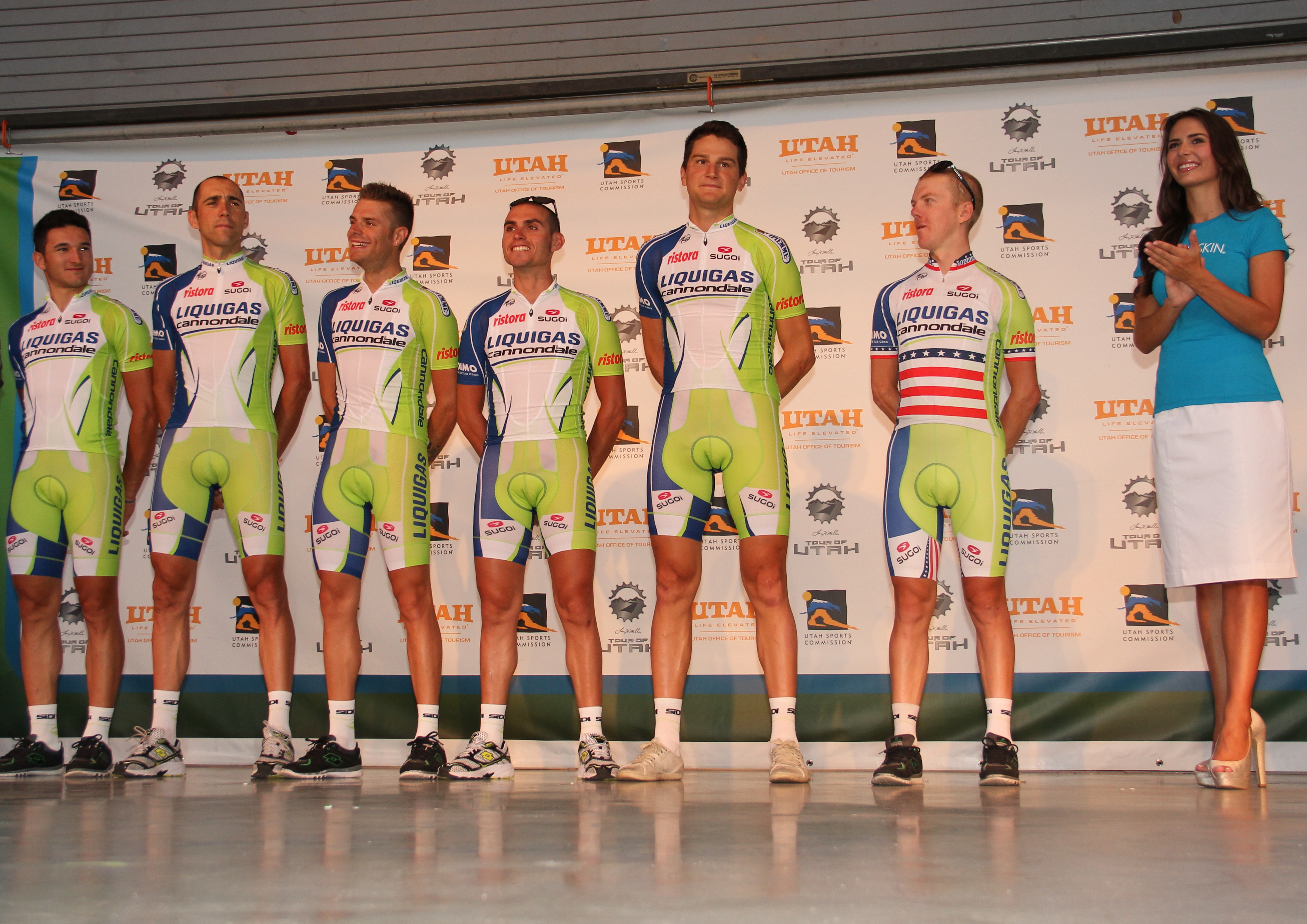
Liquigas-Cannondale’s 2012 Tour of Utah line-up
Duggan feels tomorrow’s Stage 1 is a difficult day; with four KOMs and an unrated climb, anything can happen. “You could see a big breakaway situation, a big split,” Duggan said, “especially…with a hard parcours and obviously no leader, no control yet because it’s the first day [of the race]. I think you can see some fireworks tomorrow.”
When asked if past Tour of Utah winner Francisco Mancebo (Competitive Cyclist) could light those fireworks from the first race day tomorrow, Duggan said, “He always does. He’s one of my favorite riders to watch and race with and key off of in the race, because I know he’s strong, and I know he’s aggressive, and he’s going to be a factor in the race for sure.”
What does Duggan think about wearing his U.S. kit tomorrow? “It’s a little more special,” he said, “so I’m a little more excited to throw the jersey over my head tomorrow.”

While the elements of luck and weather are always in play when it comes to pro-cycling, potential winners of the Larry H. Miller Tour of Utah will have these characteristics in common:
- Good at altitude. The average elevation in Salt Lake City is 1,319 meters (4,327 feet); the elevation only increases with all of the stages. At higher altitudes there is less oxygen in total available to breathe and amount of physical work an athlete can produce is lower.
- A speedy team for the TTT. The TTT course at Miller Motorsports Park covers 21.8 km (13.5 miles) which, depending on how final time is measured, could be long enough to open up nice leads for some and exile others from the podium or set them up for a significant fight to gain back time.
- Strong climber. The winner doesn’t have to conquer the uphill Snowbird finish first, but he will have to go uphill fast enough to finish with the other GC contenders or gain time on them. Riders will ascend in total 11,430 meters (37,501 feet) over the entire race.
- A strong team to defend the jersey and / or make other teams and their leaders suffer. It’s possible for whoever wears the leader’s jersey after the Stage 2 TTT to defend it to the end, but it won’t be easy, especially with all of the mountains: Big Mountain on Stage 3, the uphill finish on Stage 5, and the steep Guardsman Pass close to the finish on the last day.
- Able to recover well and excel at a nearly one-week race. This needs no further explanation. Levi Leipheimer, when he’s healthy, fits this category very well.
So who is the magic man that possesses all of these qualities and will win the 2012 Larry H. Miller Tour of Utah? Predictions are so difficult to make, and so tantalizing. When it comes to weather predictions, NOAA currently forecasts temperatures through Stage 4 to reach the mid to upper 90’s Fahrenheit (35 degrees Celcius).
The short list for the top step
Assigning two points to each characteristic above yields an overall score for each competitor out of a maximum of ten points.

Levi greets fans in Santa Rosa, 2012 Amgen Tour of CA stage 1
Levi Leipheimer (Omega Pharma – Quick-Step): 7. Leipheimer excels at one week races, he’s won this event two years in a row, and his wins last year in Utah and Colorado demonstrate he performs well at altitude.
The key question about Leipheimer’s chances are how good he’s feeling. He finished the Tour de France in 32nd place, but couldn’t climb with the leaders. Bradley Wiggins (Sky), Vincenzo Nibali (Liquigas-Cannondale), and Chris Froome (Sky) won’t be spinning up the Utah climbs, but 2012 TDF finishers Chris Horner (RadioShack Nissan Trek) and Christian Vande Velde (Garmin-Sharp) will, and Horner finished ahead of Leipheimer in GC at the TDF. It’s curious that according to the preliminary startlist last year’s winner of the Tour of Utah will arrive with five teammates when most teams are sending the eight-rider maximum. This could hurt Leipheimer in the TTT and leave him isolated in the mountains.
Joe Dombrowski (Bontrager-Livestrong): 9. The only American victor of the Baby Giro could really soar in the Tour of Utah. Bontrager-Livestrong’s TTT results are uncertain and Dombrowski’s youth should perhaps reduce his score. Contrast that to his performance at altitude (third overall at the Tour of the Gila and fourth on Mt. Baldy in California this year), a strong eight-man team, and his potential to win on Snowbird, and voilà, he lands on the short list of favorites for the Tour of Utah.
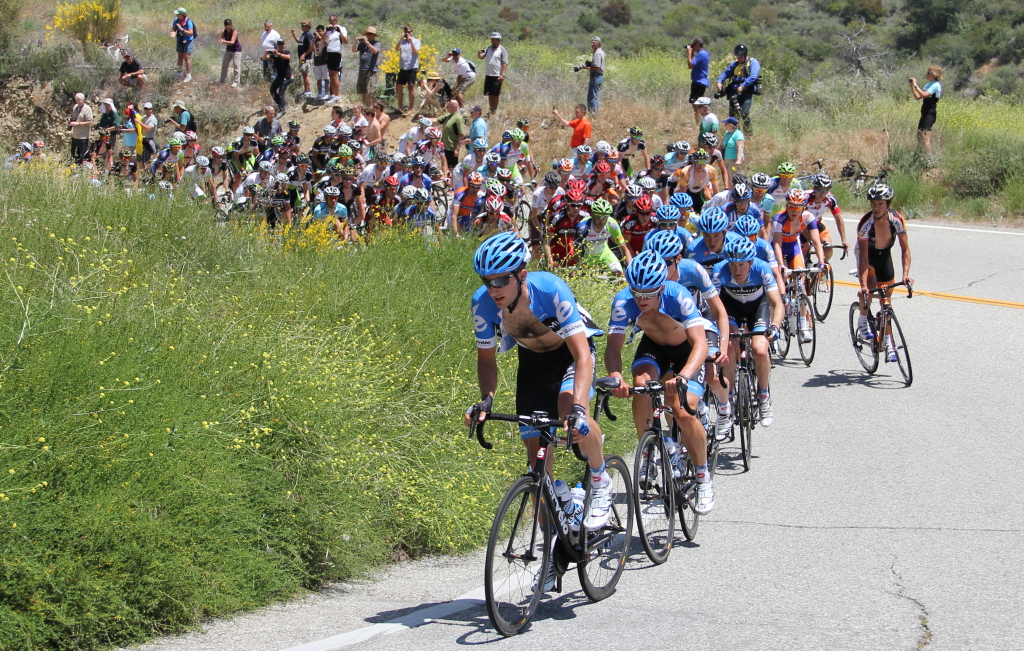
Chasing Mt. Baldy break, Jacob Rathe leads Garmin-Barracuda, now Garmin-Sharp
Tom Danielson (Garmin-Sharp): 9. If Danielson hadn’t been severely injured in the TDF, his score based on the five characteristics would be a pretty solid ten. Good at altitude: check (he currently holds the record for the Mt. Evans Hill climb which reaches over 14,000 feet). Strong, experienced team overall and in the TTT: check. Danielson’s been riding; what’s unknown is the extent of his recovery, and how much will he hold back if he’s targeting the USA Pro Challenge in Colorado.
Francisco Mancebo (Competitive Cyclist Racing Team): 8.5. Tour of Utah overall winner in 2009, second in 2010, and eleventh in 2011. Fresh off winning the five-day Cascade Cycling Classic. Number one in the individual National Racing Calendar rankings with more than twice as many points as second place Rory Sutherland, Mancebo arrives in Utah with a strong full-complement team. His weakness is the roster’s TTT performance. The team has gotten behind Mancebo by hiring Rick Crawford, a collegiate cycling coach with TTT experience, to advise the team and practice the TTT on course the week before the race.

Chris Horner at 2012 Amgen Tour of California
Chris Horner (RadioShack-Nissan-Trek): 8.5. Horner climbed really well in the TDF and RadioShack-Nissan-Trek sends a strong group of climbers with just plain powerhouses like Jens Voigt to support him.
So what’s going to be different for Horner in Utah than in California this year? The team should do better in the TTT compared to the individual TT Horner couldn’t pull off in May, the team’s composition is more climbing-weighted, and Horner has a very good TDF finish in his head and his legs. With about two-thirds less climbing per mile in Utah than California, additional climbing strength may not be a significant factor.
The long list
To the short-list above add the potential for strong performances from Rory Sutherland (UnitedHealthcare), Matt Cooke (Exergy), Timmy Duggan (Liquigas-Cannondale) and Chris Baldwin (Bissell).
It’s going to be a great show.
ProVéloPassion’s Larry H. Miller Tour of Utah overview and stage analysis provide information about the race overall and specific stage highlights.
If you’re arriving in Durango before the USA Pro Challenge (UPC) starts on August 20th and have one week available to play, here’s a suggested itinerary to enjoy the beauty and wonder that both Colorado and the first half of the race have to offer. Warning: this is an active person’s schedule that attempts to squeeze in many activities.
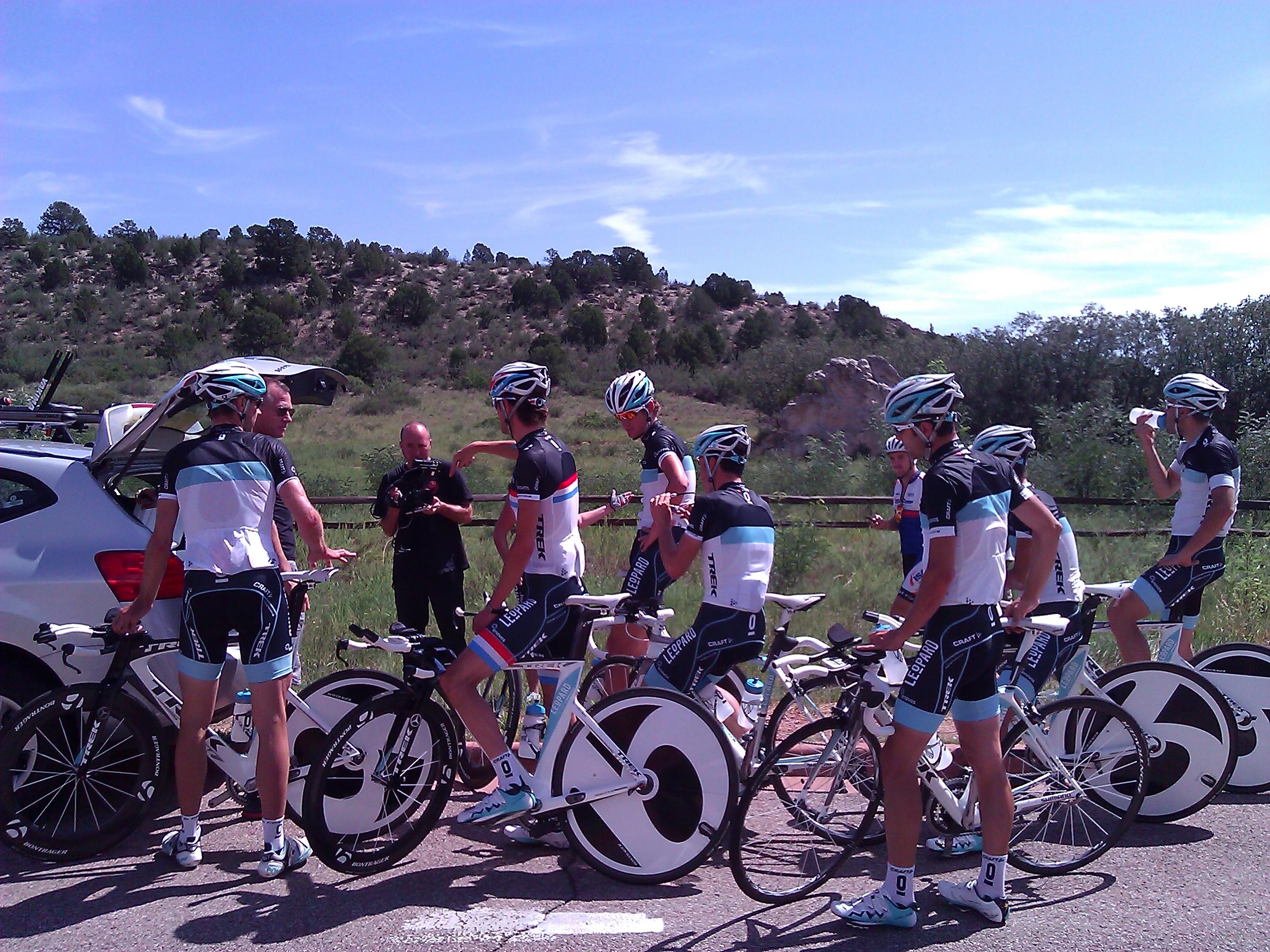
Leopards in Garden of the Gods, Colorado Springs, 2011 UPC
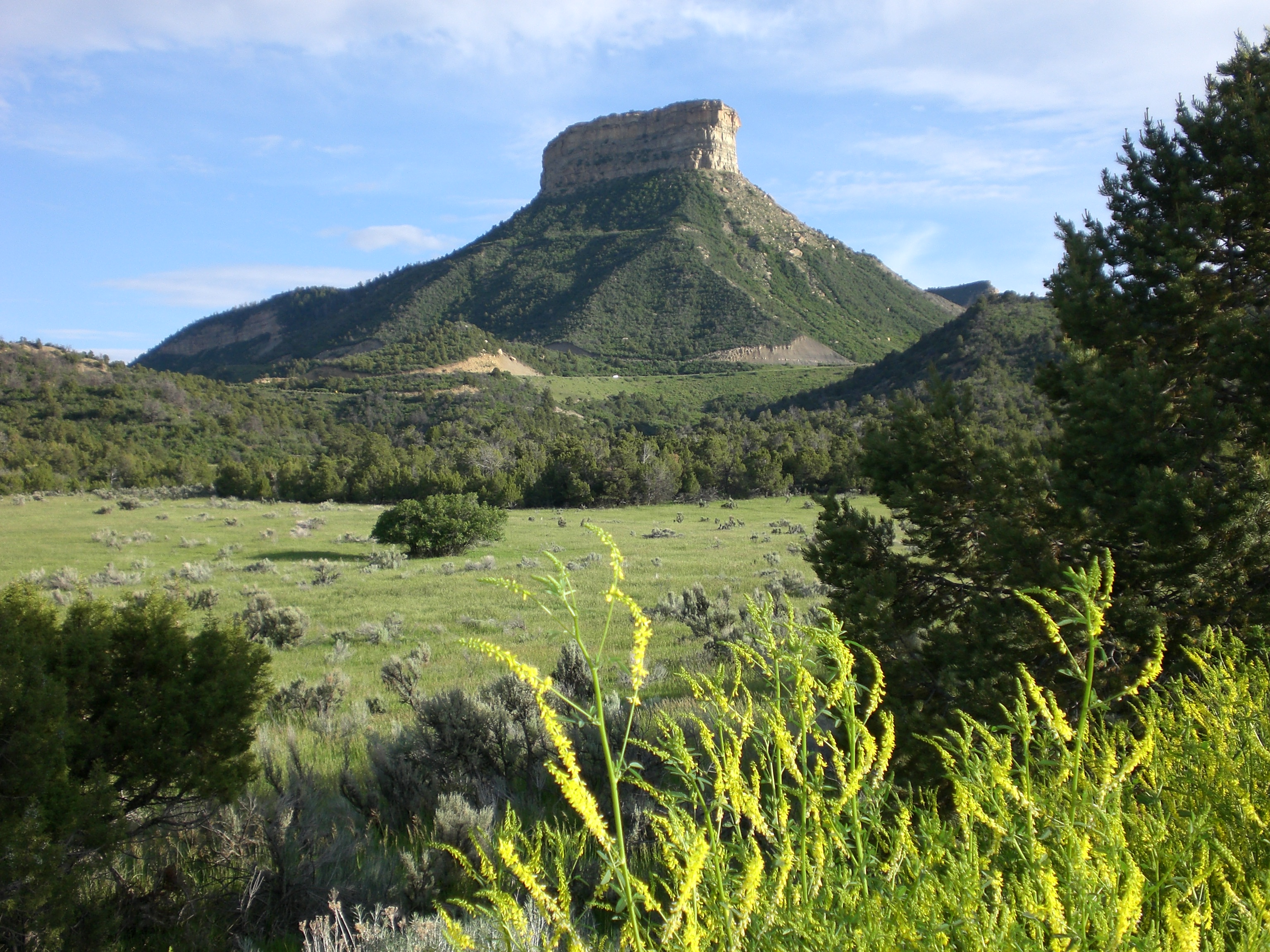
Near Mesa Verde National Park entrance
For all road closure information, check the Colorado Department of Transportation (CDOT) website. It’s a good idea to check the host city websites below too as they may provide additional information on road closures, parking, and events. This article is current as of August 1, 2012; start and finish times, road closure information, and even the course can change.
Get in before August 20th
Numerous unique places near Durango beg for attention, plus the riders will take up residence in advance of the race. So get to Durango anytime from one to three days before the overall UPC start on August 20th.

Mesa Verde’s Cliff Palace
Spend a night or two camping or at one of the park lodges in Mesa Verde National Park. The park protects cliff dwellings once inhabited by Ancestral Puebloans (previously called Anasazi) dating back to the year 600. They range in size from a few rooms up to over a dozen in the Cliff Palace. Prefer to save your vacation days for race viewing? See one or two highlights in the park with a one day trip from Durango which is 35 miles from the park entrance. The ruins are found a good drive past the entrance. Mesa Verde gets hot in August, so prepare for heat.
Durango offers many events the weekend prior to the race start. Scope out the start festival on the Fort Lewis College campus which will operate on Saturday and Sunday before the race start on Monday, August 20th.
The team presentation on the Fort Lewis campus begins Saturday at 5 p.m. and includes dinner for a cost of $200 per ticket. For a more budget-friendly option, find out where on campus the presentation will occur and hang out an hour or so before it starts to catch some riders on their way in. Another good place for advance rider sightings is the Stage 1 route from Durango to Telluride which some of the guys may check-out for training.
Craft beer lovers can sample at least four different labels in Durango, including Durango Brewing Company, Carver Brewing Company, Ska Brewing, and Steamworks Brewing Company.
How to watch Stage 1, Durango to Telluride
Watch the start in Durango then quick-in-a-hurry run to your car and drive over Highway 550 via Silverton and Ouray and Dallas Divide to Telluride. It’s a gorgeous drive (which could be fit in on a pre-race day) but there isn’t much time to tarry; it’s about a three hour trip (without stops) and the race should arrive on the finish line in Telluride at 3:50 p.m. give or take some minutes.
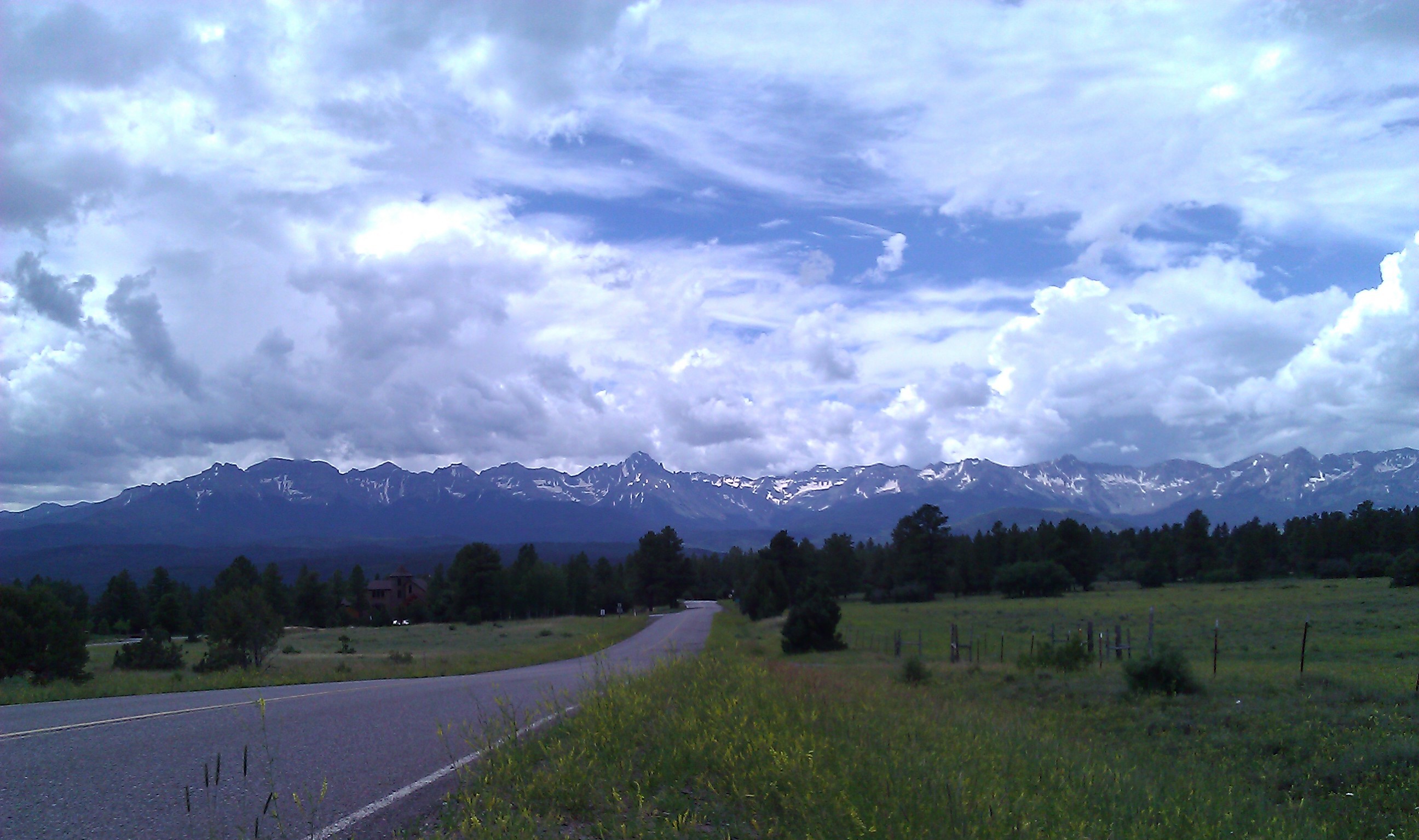
San Juan Mountains
The view of the San Juan Mountains on the way up Dallas Divide is one of the most stunning samples of mountain scenery anywhere.
Alternatively, enjoy checking out the team buses and riders then head over to Telluride before the start at 10 a.m. so you can enjoy a bit of the scenery, a stop at a microbrewery (yes, there is a theme here) and still secure a good spot near the finish line. Microbreweries: Telluride Brewing Company and Smuggler Joe’s.
After the race fun winds down head back over Highway 550 toward Ridgway. Just south of Ridgway is Orvis Hot Springs where four soaking pools in a lawn and flower garden setting, two with cascading fountains, invite quiet relaxation. Orvis is clothing optional. It has beautiful rooms, a camping area, and a community kitchen.
Montrose is a great place to stay on Monday night; it’s a city without the city feel and lots of places of stay. If dinner is on the menu here, consider one of the many great Mexican restaurants. El Jimador on Highway 550 is a ProVéloPassion favorite. The Horsefly Brewing Company offers a selection of microbrews. Monday night is $1 beef taco night at the Horsefly.
How to watch Stage 2, Montrose to Mt. Crested Butte
At this point in the journey viewing alternatives split into a Cottonwood Pass plan and an Aspen plan. The one that works for you rests on where you prefer to spectate during Stage 3 as the names of these alternatives suggest.
Cottonwood Pass plan
The route between Montrose and Crested Butte / Mt. Crested Butte offers so much diverse beauty, from high desert plain to ranchland to high mountains. The short uphill end of Stage 2 will deliver exciting action with the GC hopefuls aiming to gain seconds and the top finishers bent over to catch their breath after the line, making Mt. Crested Butte the place to watch for Stage 2.
Skip the Stage 2 start and head-out on the race route well before the 11:25 a.m. start time. The ride from Montrose to Mt. Crested Butte takes about two hours. On the way along Highway 50 before Gunnison enjoy the beauty of the Blue Mesa Reservoir. Or rise extra early and visit the Black Canyon of the Gunnison National Park. The heat can get intense here so be at the gate at 8 a.m. when the park opens. Leave by 10:30 a.m. to get in front of the race which starts in Montrose at 11:25 a.m. and allow enough time to reach Mt. Crested Butte well before the expected 3:50 p.m. finish.
Aspen plan
An alternative which makes travel to the finish at Beaver Creek easier is to watch Stage 2 from one of the KOMs early on the course. From there Black Canyon of the Gunnison National Park is accessible. Drive about two hours and 45 minutes back to Montrose and over to Glenwood Springs via Interstate 70. Overnight Tuesday in Glenwood Springs (yes, there is a second theme to this article which involves hot water…Carbondale or Aspen are options for lodging as well). Glenwood Canyon Brewing Company occupies the first floor of the Hotel Denver.
Accommodations for Tuesday night depend on how you choose to see Stage 3.
How to watch Stage 3, Gunnison to Aspen
Cottonwood Pass plan
- Independence Pass ascent view from 1K to top

The race included this stage last year also on the third day of the event. While it was exciting to watch the peloton ascend near the top, the real action for the race leaders unfolded on the descent off Independence Pass into Aspen.
So a choice option for Stage 3 is to watch the race from the dirt road section of Cottonwood Pass. It provides a different kind of back-drop for those who enjoy photographing the race and the scenery is stunning.
However, CDOT plans to close the road over Cottonwood Pass to vehicles from 3 p.m. Tuesday until 1 p.m. on Stage 3. Walking and cycling is permitted. This leaves a few options, each of which might lead to different places to stay on Tuesday night.
Option 1. Drive up Cottonwood Pass before it closes on Tuesday and camp overnight [assuming camping permitted]. This means viewing stage 2 by checking out pit row and leaving before the start at 11:25 to get ahead of the race and up the pass as there is basically one road from Montrose to Crested Butte. After the race passes come down the Buena Vista side of the pass as in option 3 below.
Option 2. Stay in Gunnison on Tuesday night. Ride up Cottonwood Pass from the Almont side. It’s about 36 miles to the top of the pass, the last 14 miles on dirt road. The Gunnison County Public Works Department will run shuttles up Cottonwood Pass from the parking area near Taylor Park Trading Post (near the end of the paved road) for a fee of $10. Make reservations before August 20th. After the peloton climbs by descend back to Almont and either drive over the pass to Buena Vista (about 2 hours 45 minutes) or take Highway 50 there.
Option 3. Leave Mt. Crested Butte soon after the finish and complete a two-hour drive to Salida to overnight there or a bit further north in Buena Vista. Ride up Cottonwood Pass from the Buena Vista side, then roll back down to stay at the same place for Wednesday night and watch the conclusion of the race live on TV. Hot springs aficionados have the choice of stopping at Cottonwood Hot Springs (which provides motel rooms and camping) on the descent from the pass or heading just south of Buena Vista to soak at Princeton Hot Springs.
Aspen plan
Watch Stage 3 in downtown Aspen (then you can see the women’s criterium there too) or up on Independence Pass (access from Aspen before Highway 82 closes at 10:30 a.m. or cycle up). Spend Wednesday night in Glenwood Springs again. And yes, Aspen has a microbrewery, the Aspen Brewing Company.
How to watch Stage 4, Aspen to Beaver Creek
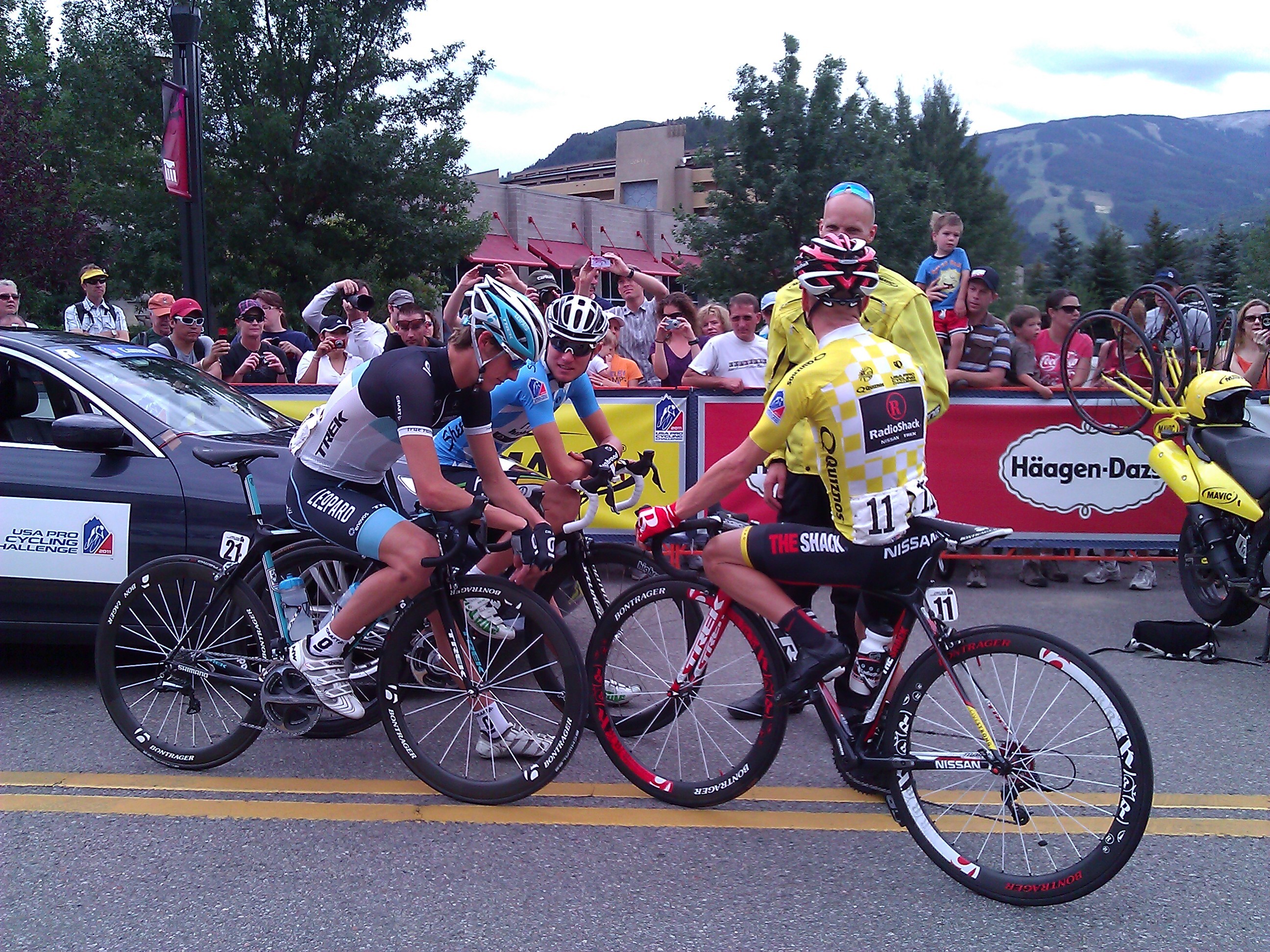
Andy Schleck, Tejay van Garderen, & Levi Leipheimer in Avon
The Beaver Creek uphill finish at 2,473 meters (8,114 feet) elevation could separate the GC contenders so it’s a great place to watch Stage 4. The uphill portion is a 4 km (2.5 mile) ascent of 305 meters (1,000 feet), which makes for an average gradient of about 7.5%. The finish line is at the ski resort, Beaver Creek Village, which occupies hillside above the town of Avon.
Cottonwood Pass plan
If you saw Stage 3 from Cottonwood Pass, the drive to the Beaver Creek finish from Buena Vista is 1 hour and 40 minutes via Highway 24 and Interstate 70. To avoid road closures start out before 11 a.m.
Aspen plan
One of the nice aspects of this plan is the easy one hour drive from Glenwood Springs on Interstate 70 to the uphill finish at Beaver Creek for Stage 4 where riders are expected at 3:50 p.m.
Thursday options for lodging include Avon and any of the towns east off of Interstate 70, such as Breckenridge, Frisco, or Dillon.
Back home
That leaves Friday for the journey home and the end of this one-week itinerary.
Host city websites:
Stage 1, Durango (start 10:00 a.m.) http://www.durango2012.com/ to Telluride (finish 3:50 p.m.) http://www.tellurideprocyclingchallenge.com/
Stage 2, Montrose (start 11:25 a.m.) www.montrose.org/race to Mt. Crested Butte (finish 3:50 p.m.) http://www.gunnisoncrestedbutte.com/event/upcc
Stage 3, Gunnison (start 10:10 a.m.) https://www.facebook.com/GunnisonQPC to Aspen (finish 3:50 p.m.) http://www.aspenupcc.com/
Stage 4, Aspen (start 11:35 a.m.) http://www.aspenupcc.com/ to Beaver Creek (finish 3:50 p.m.) http://www.beavercreek.com/events-and-activities/usa-pro-cycling-challenge.aspx?page=viewall
Stage 5, Breckenridge (start 10:50 a.m.) http://upcc.gobreck.com/ to Colorado Springs (finish 3:50 p.m.) http://www.ridestage5.com
Stage 6, Golden (start 11:10 a.m.) http://www.procyclinggolden.com to Boulder (finish 3:55 p.m.) http://www.usaproboulder.com/
Stage 7/TT, Denver (start 1:00 p.m. finish 3:45 p.m.) http://www.denver.org/usa-pro-cycling-challenge/
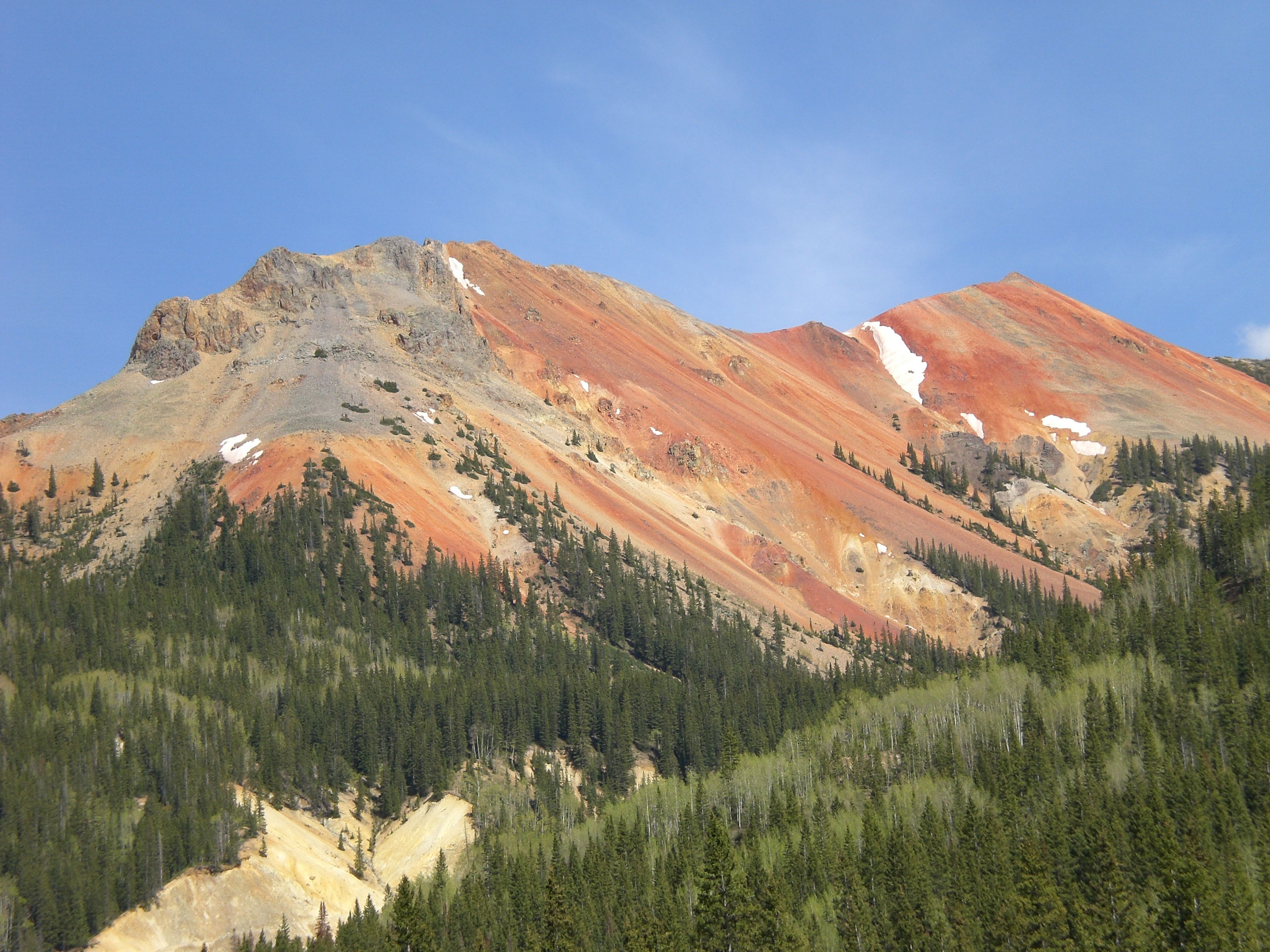
Mountain view on Highway 550 between Durango and Ouray

Davis Phinney waits for Taylor near his son’s Boulder Olympic training route
There’s no doubt Taylor Phinney’s lucky when it comes to his family.
Recently, at a press conference in Boulder for Taylor about his Olympic selection, his father Davis Phinney commented on how he and mom Connie Carpenter have influenced Taylor. He said, “He’s absorbed the best of both of us in the sense of being able to express himself well and clearly and genuinely, and the kid, he’s got a great personality.”
Possibly racing his bike didn’t rank for Taylor as the most challenging part of joining Pro Tour BMC Racing Team at the age of twenty. Likely it was living part of the year in Italy and juggling the “business” aspects of life as a pro-cyclist with a hectic travel schedule.
His parents Davis and Connie have been instrumental in helping Taylor adjust to this new stage in his career. According to Davis, they save him energy by coordinating as needed with Taylor’s agent and his team; they helped him re-locate to his part-time home in the Tuscany region of Italy.
“He’s very mature and he’s very comfortable in public. He speaks Italian well,” Davis said. “But as with any kid trying to live on a global stage and be successful, he needs help and his team has been very helpful in that regard and we just try to facilitate or ease his passage through making this transition.”
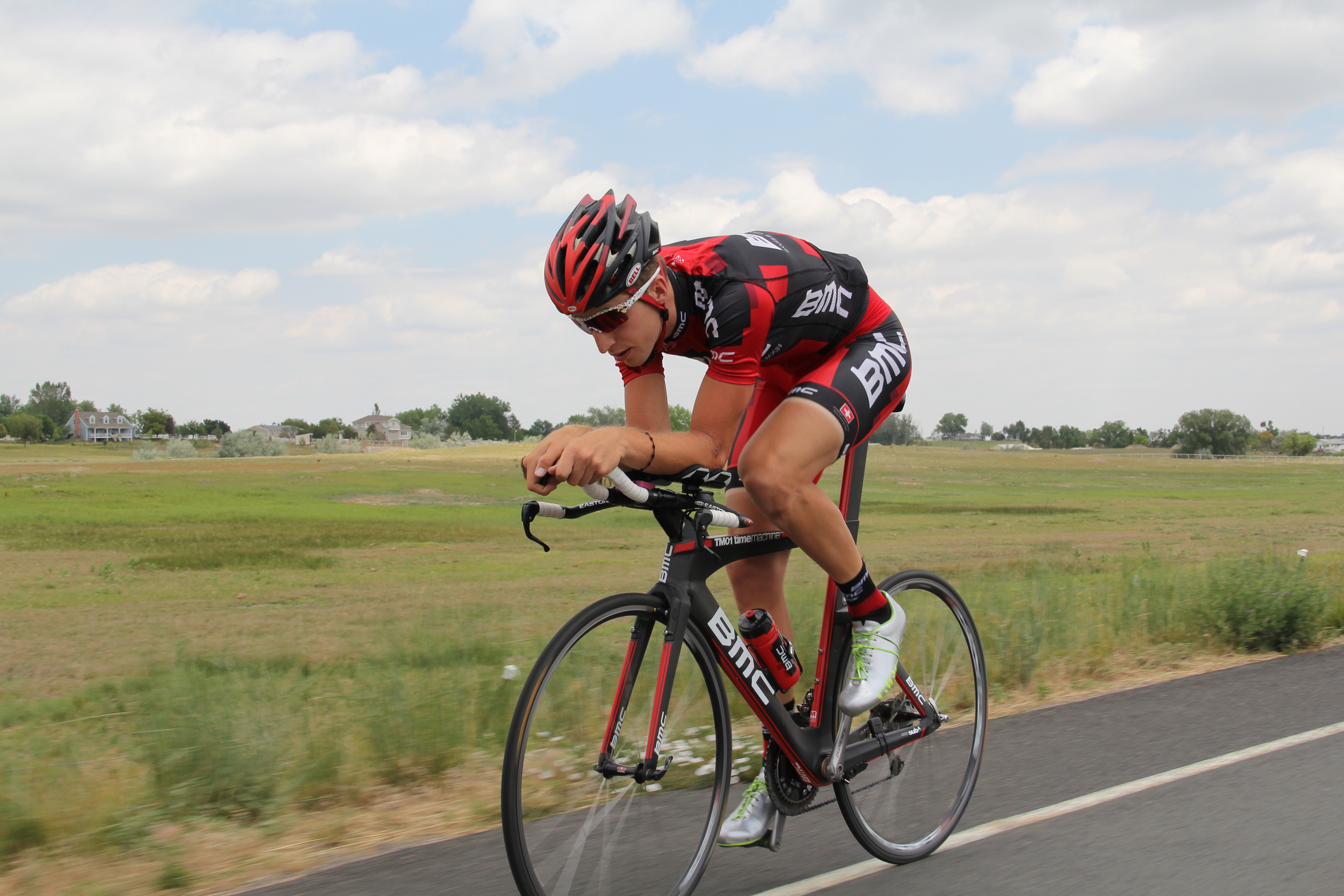
Taylor Phinney riding his TT bike on Boulder roads
But most of all, Davis assists Taylor with equipment. For example, he’ll contact BMC Racing Team’s Santa Rosa office to ask for helmets, wheels, and other items to carry out aerodynamic testing. Davis acknowledged Taylor could do this himself, but he likes the equipment side of racing and feels it’s “one less thing [Taylor] needs to worry about.”
Over the years Davis said, he has “filled the role as [Taylor’s] overseer of equipment needs and his basic positioning. Throughout his whole career I’ve been involved with overseeing wind tunnel testing and aerodynamics. For me that’s a really enjoyable aspect – keeping mentally engaged, keeping involved with the sport, and of course it’s just being able to help him become as good as he can be.”

 ProVéloPassion