
by Mary Topping on August 10, 2011
Tom Danielson didn’t believe it when he learned he would race in the 2011 Tour de France (Tour). He took utmost care to make sure he’d get there. “Everything I did I looked at with a microscope,” he said. His mantra became: “I cannot fall off my bike. I cannot get sick. Nothing is going to stop me this year.”
Although his objectives for the Tour of Suisse (Switzerland), which preceded the Tour, included staying out of crashes, it didn’t stop him from (interview continues at procyclinggolden.com.)
Wow, the queen stage of the USA Pro Cycling Challenge (UPCC) arrives on August 24th.
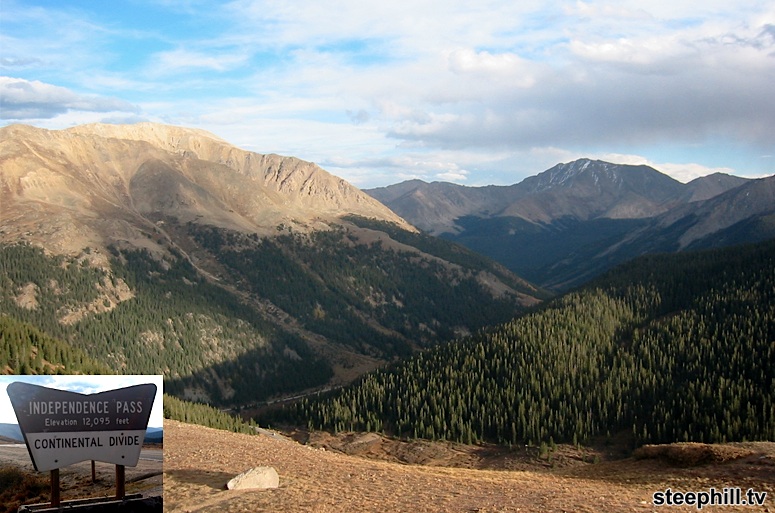
Independence Pass, Colorado 12,095 feet (photo by Steephill TV)
So much can happen. Check out the video of the stage.
The GC contenders could be wary of maxing themselves out before the Vail time trial, the stage which may decide the final podium. They might be unsure of how much rope they have to burn by putting in attacks at 12,000 feet. If these concerns carry the day for the GC contenders, they will go over both passes and descend into the Aspen finish together — assuming Andy Schleck hangs on during the descent. In this GC-riders-lay-low-scenario, someone from a break-away could win, someone who excels at altitude and drops his mates or compadres on Independence Pass. If one of the GC guys is riding stronger than the others, he could be the one to drop others there and win the stage. Ifs, ifs, ifs….
Here’s what a selection of fans and one of the experts from Triple Crankset believe is the answer to who can win stage 2.
@triplecrankset, www.triplecrankset.com, Len Basobas: The Queen Stage of the USA Pro Cycling Challenge will definitely favor the climbers and adventurous breakaway specialists. Riders will already have a Prologue and Stage 1 under their belts to acclimate themselves to the thin Colorado air, but with the elevation gains on both Cottonwood and Independence pass local riders like Tom Danielson, Peter Stetina (Team Garmin-Cervelo) and Tim Duggan (Liquigas-Cannondale) will certainly carry a distinct advantage over the favored Schleck brothers and Tour de France champion, Cadel Evans (BMC Racing).
Two riders who will also play a role in the unfolding drama on Stage 2 are the young American, Tejay Van Garderen (HTC-Highroad), who held the maillot à pois rouges for one stage at this year’s Tour de France, and the Netherlands’ Robert Gesink (Rabobank), who has previously excelled on American soil and is looking for a bit of redemption after a disappointing Tour.
How it may possibly play out: without a mountain top finish, look for an early break to get off the front. If Van Garderen and Gesink are in the break, look for Van Garderen to make a late move on the descent into Aspen to take the win.
@Biff_Bruise, David Napoli: a climber who can descend real well (I’ve done it)…hmm – I’ll go out on a limb on this one… @tomdanielson.I’ll say he’ll create a gap up Independence Pass and maintain enough down the narrow descent.
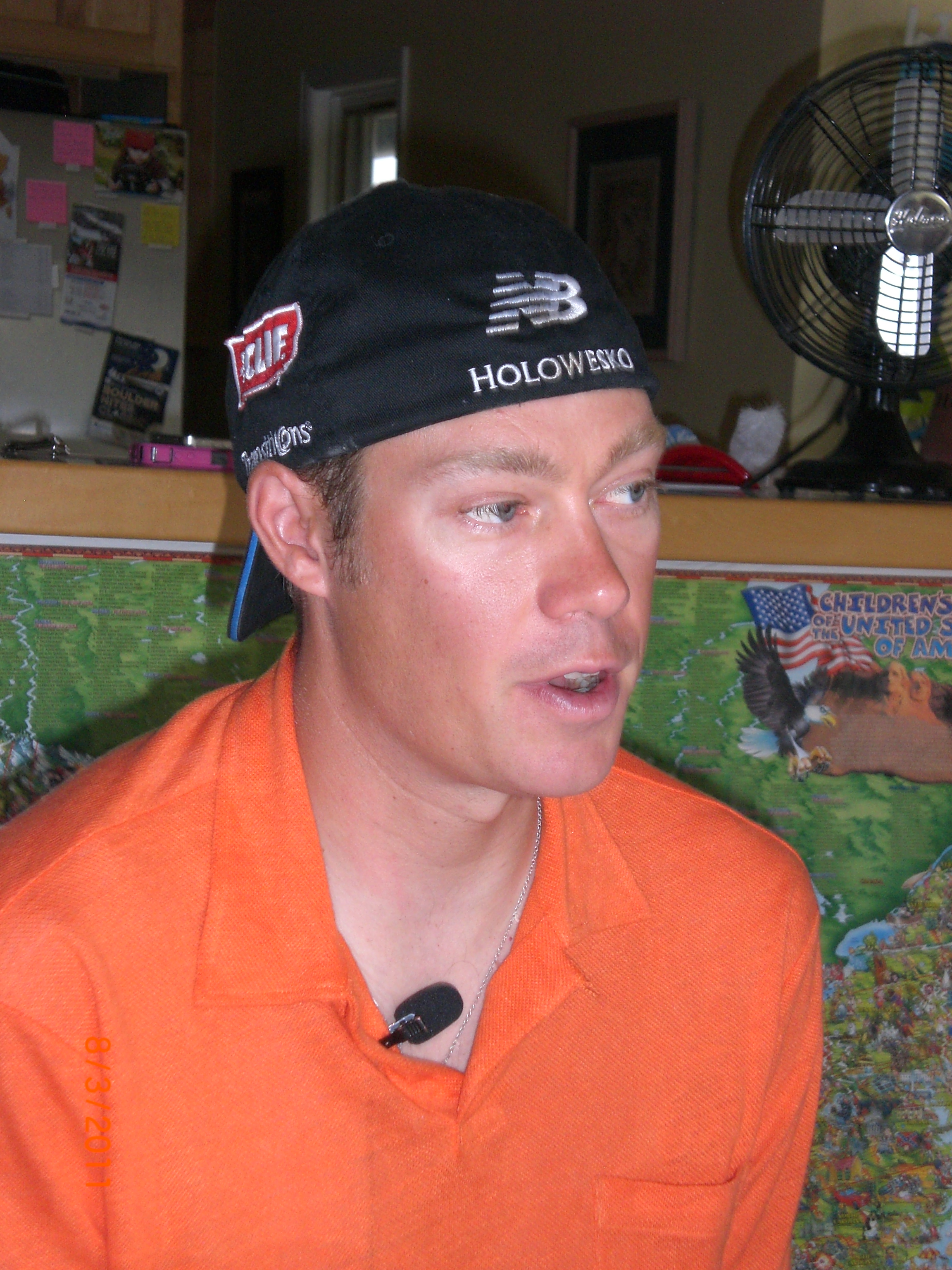
Tom Danielson at home after the 2011 TDF (by Mary Topping)
@JonesWolf, Jordan Jones: Stage 2 is where we’ll see separation in the field and get a look at who will contend for the overall victory. Two mountain passes, dirt riding, and a fast final descent into Aspen will test the riders in a number of ways. Tom Danielson has won the Mount Evans ascent and holds the record up Lookout Mtn. Will he continue his state domination while adding in the world’s best riders? I think his 9th place at the TDF and his focus on the race shows that he will come through. Look for him to take Stage 2 as part of his plan for overall victory.
Julie Morales: I’m picking Andy Schleck. First, he’s gotta be steaming for a second chance to beat Cadel overall–and that’s great motivation. Second, he’s got brother Frank to help him up the 12,000 foot peaks. And who’s better than a brother to be at your side in the high mountains. Third, he won on the Galibier on Stage 18 of the Tour de France –which is the most similiar of all the stages in Le Tour to our USA Procycling Challenge tour’s Queen Stage. Stage 18 was the highest stage of Le Tour with the Col d’ Agnel at 9002 feet, the Col d’Izoard at 7742 feet, and then the finish on the Col du Galibier at 8677 feet. Yep, Cottonwood and Independence are both 3000 to 4500 feet higher than those peaks but that will be part of the fun! Allez Allez Andy!!
Analysis
Two votes for Danielson, one for TJ, and one for Andy. Since I’ve already picked two Leopards, I’ll need to look to a different team for stage 2. This reduces the field of possible winners by a whopping 6%. You can tell this one isn’t easy.
The hours I’ve spent studying the effects of altitude on athletic performance are sending me to a winner that we suspect may have an advantage in thinner air. We know from the interview with Tom Danielson that he has been targeting the UPCC to win it. As much as he might love to be first over Independence Pass, I think he’ll mark his rivals on stage 2 and really go for it during the stage 3 time trial. We’ll need to watch @RorySutherland1 of UnitedHealthcare; he’s been training hard in Colorado at altitude. I was about to say that I don’t think the GC contenders will let Gesink get away, but at 12,000 feet they might not have a choice if Gesink can fly.
Who could win from a break-away? History calls Peter Stetina — both his dad Dale and his uncle Wayne have won the Coors Classic. In 2010 Peter won the MTB division of the Bob Cook Memorial-Mount Evans race. A strong climber, he could be riding to support Danielson. TJ showed in the Tour de France that he can climb well. Can Peter or TJ outclimb Timmy Duggan who has tweeted about moto-pacing on dirt behind a Ford F-150? Timmy was raised at the same altitude as Peter, in Boulder. He looked great in a break-away in this year’s USA road championship race; his performance there also shows he can race well in the heat — we could see hot weather in late August.
After studying up a bit on the Antioquia Indeportes and EPM-UNE Colombian teams who will participate in the UPCC, I believe there will be at least two riders between these two teams who will be in the break. Colombia is home to peaks that reach up to 18,000 feet and notable pro-cyclists Mauricio Soler, Lucho Herrera (won the 1987 Vuelta a España), Fabio Parra (third at the 1988 Tour) and Santiago Botero.
Oscar Sevilla wins stage 9 of 2011 Vuelta a Columbia (photo by Luis Barbosa)
Kirk Flinte wrote on the Hincapie Sportswear blog after visiting with the Antioquia team: “The biggest thing I learned in my time with the riders is why Colombians are famous for their climbing abilities. There is not a single flat road in the whole region of Antioquia. Every inch of paved road is on an incline. And most of it’s not gentle five percent grade hills. We’re talking kilometers of 10%+ climbing.”
Kirk referred to Janier Acevedo as team Antioquia’s “secret weapon” at the UPCC; he did well in this June’s Vuelta a Colombia, and his teammate Oscar Sevilla Ribera (ESP) won two stages. Walter Pedraza of EPM-UNE won the first road stage of the 2011 Vuelta a Colombia. His teammate Giovanni Manuel Baez finished second overall. Assuming a guy from the break wins, a Colombian — or a Spanish member of a Colombian team — has to stand on the podium for stage 2.
ProVéloPassion prediction for Stage 2 podium:
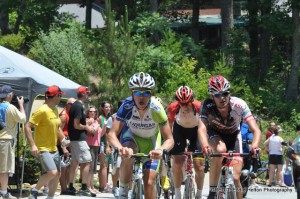
Timmy Duggan leads break in 2011 USA Championships (by Eddie Helton Photography)
- Timmy Duggan (Team Liquigas-Cannondale)
- Janier Acevedo or Oscar Sevilla Ribera (Team Gobernacion De Antioquia-Indeportes Antioquia)
- Alex Hagman (Team Jelly Belly)
OK, maybe I’m a bit of a softie on the young Americans. But if Tom Danielson wants to win the UPCC real bad, Timmy Duggan is right up there with him and the GC guys might not chase him. Timmy is comfortable at home, which gives him an edge over the Columbians. Alex Hagman, if he races, lives in Colorado, so he can also master the altitude.
| stage | start | elevation (ft) | finish | elevation (ft) | highest point (ft) |
| Prologue | COS | 6,381 | COS | 6,025 | 6,440 |
| Stage 1 | Salida | 7,076 | Mt. Crested Butte | 9,343 | 11,319 |
| Stage 2 | Gunnison | 7,735 | Aspen | 7,952 | 12,156 |
| Stage 3 TT | Vail | 8,203 | Vail | 9,273 | 9,331 |
| Stage 4 | Avon | 7,412 | Steamboat Springs | 6,751 | 8,599 |
| Stage 5 | Steamboat Springs | 6,778 | Breckenridge | 9,535 | 9,603 |
| Stage 6 | Golden | 5,720 | Denver | 5,231 | 7,526 |
Information about altitude on the internet varies from highly scientific to relatively straightforward. My goal is to present a condensed (no pun intended) description of why and how high altitude has an effect on athletic performance and then draw conclusions about what this all means for the USA Pro Cycling Challenge (UPCC) in Colorado. Jump to the bottom for these conclusions.
What is different at altitude?
The root of physiological and resulting performance impacts at higher altitude is this: higher elevation equates to lower pressure. The air’s barometric pressure and the partial pressure of oxygen both decrease as elevation increases. Folks refer to air at higher elevations as “thinner;” while the percent of oxygen in the air is 21% at any level, the number of molecules is lower at lower pressure in a given volume. There is less oxygen in total available to breathe. According to Matt Fitzgerald writing for Competitor, “at 8,000 feet the barometric pressure is twenty-five percent lower than it is at sea level—meaning you get 25 percent less oxygen per breath than you get at sea level.”
Partial pressure is the pressure a gas (eg, oxygen) in a mixed gas environment would have if it were the only gas present. Oxygen’s partial pressure lowers as elevation rises, which means less oxygen is able to pass from the lungs to the blood and tissues to fuel muscles. These numbers from sport fitness advisor demonstrate the effect of elevation on oxygen’s partial pressure: “At sea level, oxygen has a partial pressure of 159mmHg. In Mexico City [7,350 foot elevation] it is approximately 125mmHg. At the top of Everest, it drops to 48mmHg, which is nearly equal to the [pressure of] blood surrounding the lungs.”
How does the body respond?
Here’s a good summary from roadcycling.com, with some additions.
The body’s initial response to altitude is to increase breathing rate to consume the same amount of oxygen as at sea level, and to increase heart rate at both rest and during submaximal exercise. In addition, blood is concentrated by reducing the fluid or plasma component; reducing this watery part of the blood has the effect of increasing red blood cell density. “Collectively, these changes improve oxygen uptake by the lungs and its delivery to tissues. The disadvantages of these changes are that perceived exertion at any workload is increased and circulating blood volume is reduced.”
How is performance affected?
Trail Runner Mag.com sums it up well: “the amount of work you can do is less.”
Some detail from sport fitness advisor on decreased maximal cardiac output: “During exhaustive exercise at maximum levels both maximal stroke volume and maximal heart rate decrease with altitude. This obviously combines to have a significant effect on maximal cardiac output. In conjunction with the reduced diffusion gradient to drive oxygen from the blood to working tissues, it is easy to see why VO2 max and endurance performance is hindered…Maximal oxygen uptake begins to decrease significantly above an altitude of 1600m (5249ft). For every 1000m (3281ft) above that VO2 max drops by approximately 8-11%.”
Can the physiological changes due to altitude be “fixed?”
Yes, partially, and it depends on length of stay at altitude to acclimatize and the elevation at which an athlete competes. While the sources I consulted varied a bit in their timeframe conclusions, these excerpts offer a framework to start from.
From cyclingperformancetips: “An increase in the blood hemoglobin (hematocrit) level over 3 to 4 weeks increases the oxygen carrying capacity of the blood and is the most important of all the performance adaptations to altitude.” There are cellular changes as well. “The capillary concentration in skeletal muscle is increased in animals living at altitude compared to those at sea level, and muscle biopsies in acclimatized men have shown an increase in myoglobin, mitochondria, and the metabolic enzymes necessary for aerobic energy production. Taken together, these changes improve the efficiency of oxygen delivery to the muscle cell as well as the extraction of blood oxygen at the muscle cell level. These adaptations are sufficient to restore maximum aerobic exercise capacity (VO2max) to NEAR sea level values at altitudes up to 2500 meters (7500 feet). At higher elevations, acclimatization will never restore VO2 max. to what is possible at sea level.”
Riders in the UPCC will compete above 7,500 feet on nearly all of the stages.
Matt Fitzgerald offers two suggestions athletes can consider aside from spending time at altitude. Both of these are supported by research studies on cycling time trial performance: green tea extract which counteracts increased production of free radicals by working muscles at altitude, and 0.2 to 0.4 gram of baking soda (sodium bicarbonate) per kilogram of bodyweight before exercise to buffer increased blood acidity from increased respiration. On the latter, Matt adds: “Be aware, however, that possible side effects include nausea, vomiting, and diarrhea.”
If supplemental oxygen is allowed during competition, there’s always the Oxygen Lounge Oxygen Bar in Breckenridge as well as door-to-door oxygen delivery.
What might we expect to see in the UPCC as a result?
- Fewer attacks. Levi referred to a single speed in his quote in Part 1. If the guys are unsure about how to dose their efforts, we might see less attacking on the climbs.
- A very fast sprint into Steamboat Springs. According to at least one study, moderate altitude “is likely to enhance cycling performance on flat terrain because the benefit of reduced aerodynamic drag outweighs the decrease in maximum aerobic power [maximal oxygen uptake (O)].”
- Wins from those living and training at altitude, or arriving very early to acclimatize. It’s hard to tell if the physiological benefit advantage is significant enough given all the other factors that need to align to win a race, but at a minimum increased familiarity with how high altitude feels should be helpful.
- Surprise winners. It’s also hard to know if the riders in the UPCC will respond in a similar fashion to the athletes studied in the articles I reviewed. Could there be a rider whose body chemistry would allow him to thrive when others suffer?
- Guarding recovery time. Those serious about the race may be less available publically as they maximize opportunities for recovery.
I’m anxious to see how this altitude test lab of a race turns out. Hope to see you at one of the stages.
—————
Sources for this article:
http://www.roadcycling.com/training/Altitude_Training_for_Improved_Cycling_Performance_002474.shtml
http://www.sport-fitness-advisor.com/acclimatization-to-altitude.html
http://www.cptips.com/altitud.htm
http://running.competitor.com/2011/05/training/racing-at-high-altitude_28105
http://www.ingentaconnect.com/content/adis/smd/2001/00000031/00000007/art00008
“Don’t tell anybody, but I take Viagra to combat the effects of high altitude.”
QUESTIONABLE. In 2006, Science Daily published a study citing that cyclists taking Viagra improved their performance at altitude by as much as 45 percent. In theory, Viagra causes blood vessels in certain tissues, such as the lungs, to relax, which helps increase oxygen transport to working muscles. (from Trail Runner Magazine)
There’s been so much talk about how the high altitude makes the USA Pro Cycling Challenge (UPCC) in Colorado different from any other stage race. This image depicts elevation over Independence Pass in Stage 2 which tops out a little over 12,000 feet (click on the photo for easier viewing).
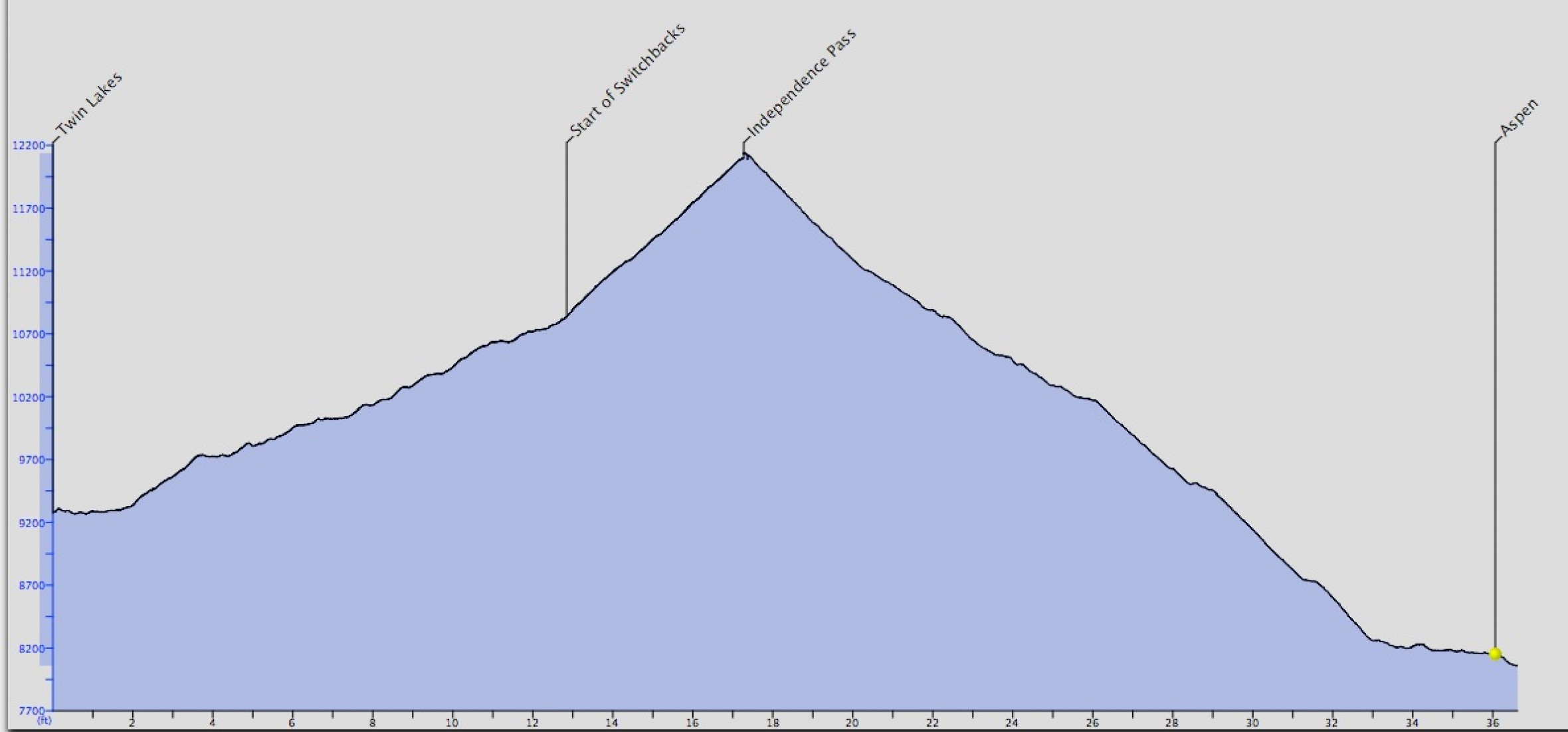
Independence Pass Profile (summitbiking.org)
Here’s what some of the pros say in YouTube videos:
- Taylor Phinney: “Because you can’t get oxygen, you feel like you’re creeping along. Everyone’s at their maximum. Oxygen is the most vital part of circulating blood, making your legs feel good.”
- Brent Bookwalter: “The biggest thing to remember is pacing yourself. You can’t go too deep into that red — there’s a point of no return and once you go into it there’s no coming back out. It’s not a bad atmosphere for a time trialist like myself; it’s a lot about gauging effort and feathering that line.”
- Levi Leipheimer: “I did Leadville, so I know what altitude is like. When you get up to 12,000 feet it’s definitely an extreme element. It’s going to separate the race quite a bit. It’s hard to describe; you can’t go super hard and you can’t go easy, it’s kind of like this one speed.”
Tom Danielson, in the interview on procyclinggolden.com, mentioned that altitude affects everyone by decreasing their efficiency by 10%, so that would in effect level the playing field. What would give those who live and train at altitude an edge is their ability to adjust to this decreased power because they are more familiar with how it feels.
Timmy Duggan responded to the altitude question in our interview; he stressed how racing at altitude makes it more difficult to recover.
To better understand the affects of altitude on endurance athletes and what it could mean for the UPCC, I checked the internet for more information. You’ll see this in Part 2 of the altitude series.
I hoisted my woman’s Trek 5200 onto the top of our Forester and left for Boulder under dark gray clouds. It rained on the drive up Highway 93. It drizzled in Boulder as I eased my car past the gate adorned with a large metal heart that led to the Danielsons’ home.
“Will we still ride?” I asked Tom as stood in his kitchen and poured coffee before the interview started. His “yes” response seemed to imply: what’s a little rain?
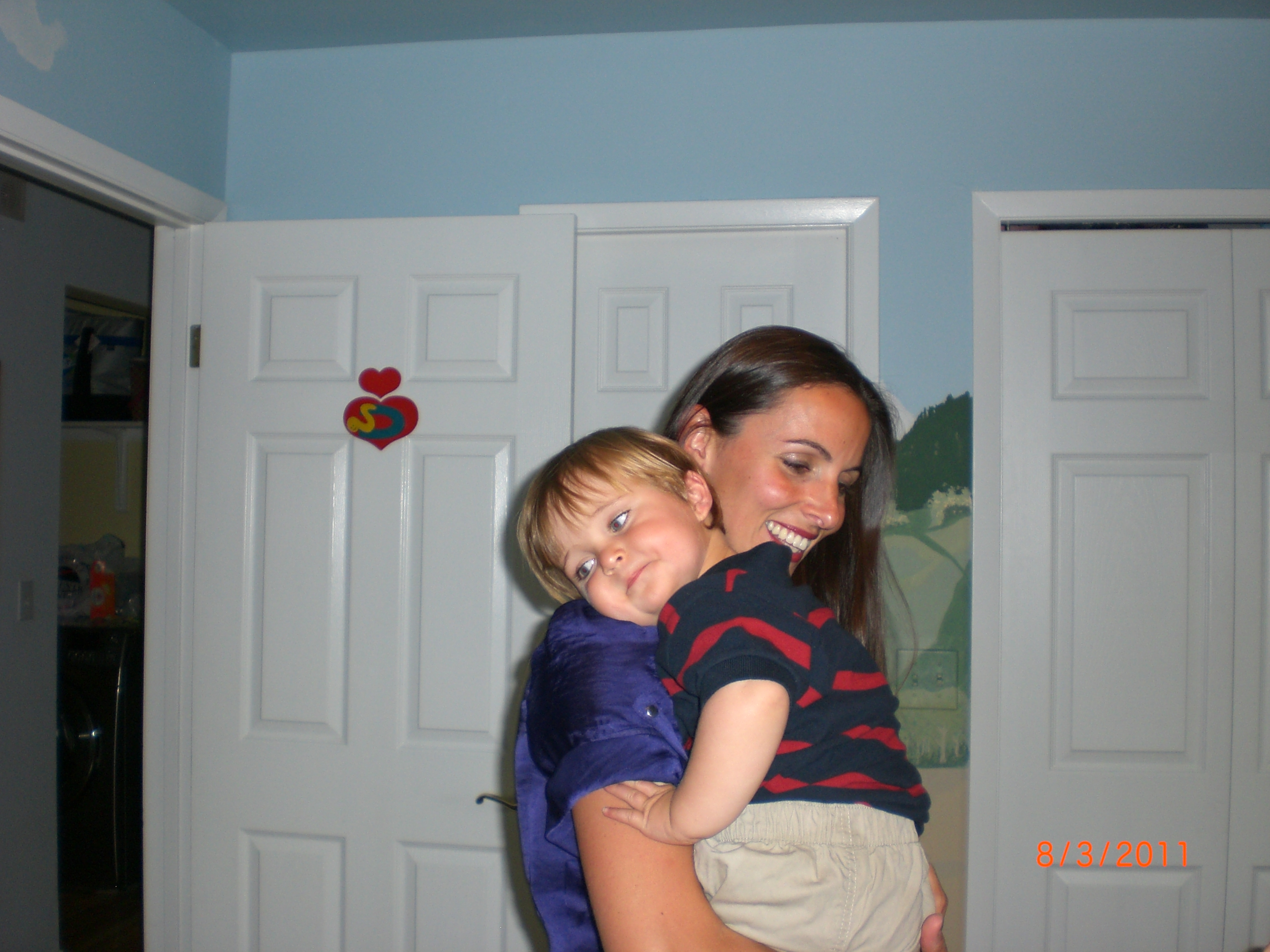
Stephanie and Stevie Danielson
After the tape recorders and cameras clicked off, Tom changed into his Garmin-Cervélo kit and rolled his bike onto the patio in front of the house. Vic Lombardi, CBS4 Sports anchor, joined him and immediately fired off question after question: “So why is everything you wear so tight? Why do you shave your legs? What are your dimensions?” Maybe his questions were coming from the perspective of his Channel 4 audience, who wouldn’t know these things.
I trotted over to where I had parked my car. Unsure if they would leave without me, I scrambled to pull down my bike, shove my feet into bike shoes, put on my helmet, and slip a piece of paper and pen into my jersey back pocket as the remaining questions I had wanted to ask Tom leaked out of my brain.
My shoes crunched over blue stones as I rolled my bike over to the driveway. All three of us lined up behind a white Channel 4 Jeep, hatch opened where a guy in a green tee-shirt aimed a video camera at us. OK, was I supposed to be there? I asked the guy in the green shirt. He said, “It doesn’t matter. I’m only filming those two.” Well OK then. Truly, I didn’t want to be filmed. I weigh ten pounds more than Tom, but my hips appear to be twice as wide.
We set off to do a small loop around Tom’s home several times. Roosters crowed. We pedaled past goats and grassy fields with the FlatIrons somewhat visible through the mist. Vic continued his rapid-fire questions.
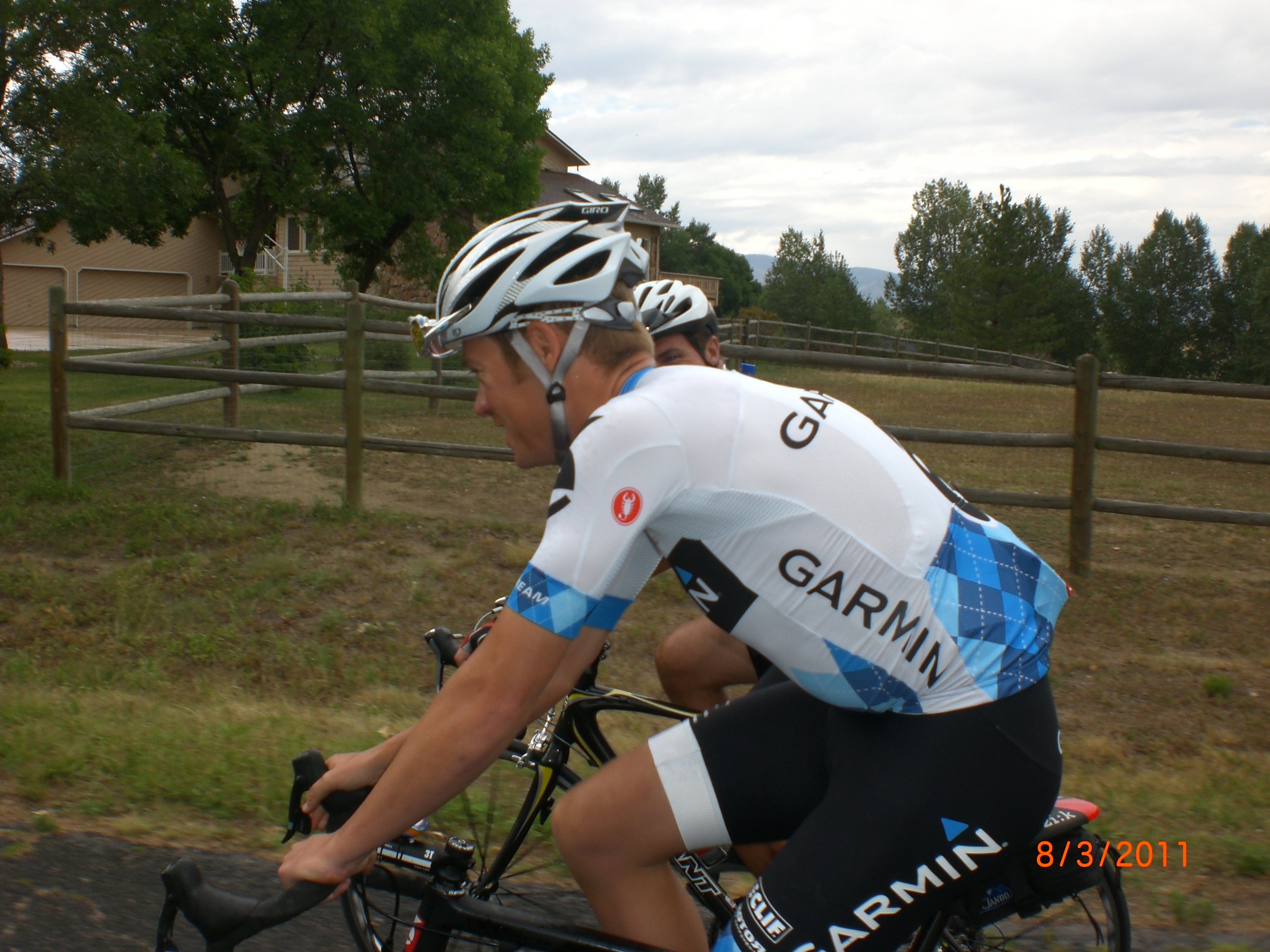
Tom Danielson riding in Boulder, Vic Lombardi next to him
Actually, I didn’t mind. I had already gotten the answer to one of the questions I had most wanted to ask. “Tom, can I ask you a personal question?” I managed to squeeze this in before Vic caught up to us as we headed out the driveway. “Sure,” he said. “Did you sleep every night during the Tour de France with the pillow you posted on Twitter?” He said yes.
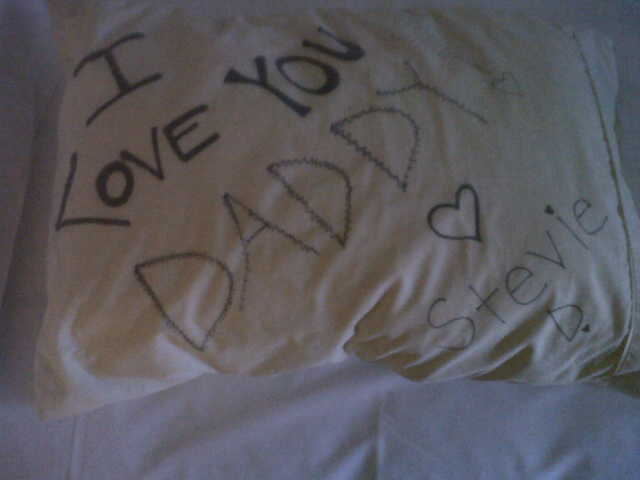
Pillow made by Stephanie Danielson that Tom packed for the 2011 TDF, photo by Tom Danielson
For the interview with Tom, go to http://procyclinggolden.com.
Yesterday was Tuesday and exactly three weeks to stage 1 of the USA Pro Cycling Challenge in Colorado which starts in Salida and ends at Mount Crested Butte. It’s an interesting stage that includes the first major climb and a short uphill finish. I really like the MapMyRide version of the stage, which includes details on the starting and finishing elevations of the stage’s three climbs rated 2, 1, and 3 using their MapMyFitness categorization methodology. The final climb to Mount Crested Butte, the ski resort just above the quaint town (love the coffee shop plastered with license plates if it is still there), has an elevation gain from 8,907 feet to 9,342 feet in a distance of 2.11 miles; the grade is 3.9%.
Here’s who some uber-fans think can win stage 1 and why.
@roadrider80226, Don Schmertz: Cadel Evans will win Stage 1 because he should win an uphill finish like this one, which is not too steep. He’s won similar races with a short uphill finish.
Robin NeJame: I predict Tom Danielson because he is from Colorado, so he knows these mountains well, and understands what it is like to ride at 11,000 feet. In many mountain stages in Europe, sportscasters talk about the grueling altitude, and I always chuckle, because we have significant altitude in the Rocky Mountains!!!! Tom also did amazingly well in this year’s Tour de France. I believe he is in excellent form, and READY for this event! The motivation has to be there too… I am sure he wants to “bring it home”!
Nathan Mosley: Although there is a large mountain pass to contend with, I think there is too much road afterward to hold off the sprinters. I think the teams catch any breakaways and an American wins stage one. Tyler Farrar from Garmin-Cervelo.
@Biff_Bruise, David Napoli: hmm… tough one, as it’ll probably be from a breakaway group. Time to throw a dart at the rider list… 😉 [to be transparent, I cut David off here because I was ready to move to stage 2 when I received his Tweet.]
@smthchkvlvt, Chuck Parsons: I can’t tell you who I think will win, only who I’d like to see win — Jens Voigt or Danny Pate. In the late ’90s, I took a semester off from college before I made my final push toward graduation. I raced mountain bikes at the time. I spent my eight months at Colorado Cyclist in the warehouse, shipping out orders for bikes I could never afford. Colorado Cyclist still sponsored a race team with talent such as a young Michael Creed or Danny Pate. Around the same time, I began renewing my interest in road racing. Over time I became a fan of the riders in the near-hopeless breakaways, the men who would jump early and suffer hard for hours on end for the slim chance of a stage win. At their best these breaks had the toughest men of the Tour among them, and more often than not this included Jens Voigt. I really can’t see Jens or Danny winning. Neither seems well suited for the Crested Butte stage, and both will likely be working for other goals. But still…to see Jens back at his peak form, or a win for the local hero? Count me in.
Things are getting interesting. Fans see three different types of riders who could win stage 1: GC guys, sprinters, or échappés. Each has it’s merits for a stage like this. There were a few short uphill finishes in the TDF this year which were either won by specialists (Gilbert), break-away guys (Voeckler), GC guys (Cadel) or sprinters (Edvald Boasson-Hagen). I’m linking to the Bicycling maps of the stages, which include interesting commentary, in the bullets that follow.
- The GC guys because aside from the time trail in Vail on stage 3 there aren’t a lot of opportunities to pick up time. The Mûr de Bretagne finish which Cadel won in this year’s TDF stage 4 covered 2 kilometers with an average 7% grade. this is shorter and steeper than the finish up to Mt. Crested Butte.
- The sprinters because it is not a very steep climb to the finish. The climb at the end of Stage 6 that EBH won in Lisieux was 1.5 kilometers long at 6.3% according to what looks like the route log the TDF provides to the teams. I can see a Matt Goss or a Thor in the mix, especially since this UPCC finish is not very steep.
- The break-away hopefuls because after the descent from Monarch Pass the course runs generally uphill to the finish. Hmm, if a break-away gets enough time, the sprinters’ teams may not be able to catch them. I can see this as a stage Jens would go for, maybe also Timmy Duggan, Ben Jacques-Maynes, Alex Hagman, one of the Columbian teams’ members, and I am probably missing a few others.
Freewheel spin, please, for the ProVéloPassion prologue podium prediction: there will be a break, but only one man will succeed, and the sprinters who can go uphill and the GC guys will be very close behind.
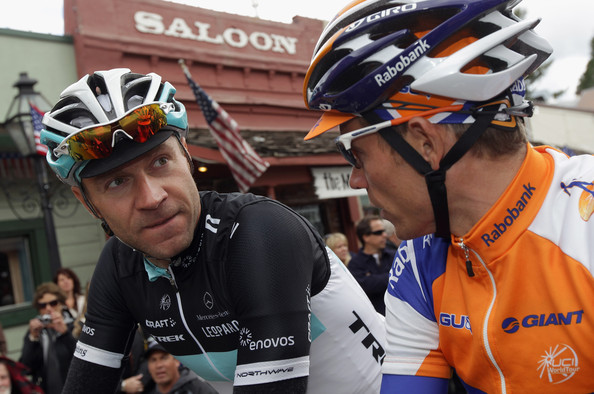
Jens Voigt, ATOC 2011 Stage 2, Photo by Doug Pensinger/Getty Images North America
- Jens Voigt
- Tom Danielson
- Matt Goss (if he comes)
How can you not pick Jens? Let’s hope he does fine on the descent from Monarch. Oh boy, second guessing creeping in, maybe a guy with better descending skills? And if Fabian is in the leader’s jersey from yesterday, could he be over the line first? It’s a possibility. That’s why these predictions are so utterly insane and fun. For the second over the line GC guy, I choose Tom Danielson — he has said he’s not so good at short, steep climbs; 3.9% will have to pass as not too steep in his book for him to make second. Matt Goss was second in stage 6 of the TDF, which merits him third place, though he won’t be happy on the lowest step.
It’s Monday and exactly three weeks to the first stage of the USA Pro Cycling Challenge in Colorado, a five mile prologue course. It seems like a good time to start making predictions about who can win the stages and the overall. Even though the start list isn’t confirmed, more than a few riders have announced they will be racing, either via Twitter (Ben King), interviews (Timmy Duggan and others from Liquigas), or the cycling media, all sources for the provisional start list I’ve compiled.
I asked some uber-fans to predict who could win the prologue. Here’s what they think.
@Biff_Bruise, David Napoli: I’ll say Dave Z, given his focus on this event (well, this and Comic Con) after exiting the Tour de France early.
@kalenski, Kalenski: It’s a stage Thor could take. (Followed by) The climb isn’t that long or sustained (not like stage 1….) and there’s a sprint finish.
John Polli, PeakCyclesRaceTeam, has a longer list of possibilities:
- Dave Zabriskie. Since the last three miles are a flat-out drag, and Zabriskie is the most aero-dynamic, he’s the top pick as long as he’s healed from the TDF injury.
- Fabian Cancellara. It’s so short and no one goes faster than him in five miles. If it was a little more technical of a course, he’d be the top pick.
- A handful of others who could do really well. Levi Leipheimer — he’ll try to redeem himself because he had a bad TDF. Cadel Evans — if he’s motivated. Tony Martin and David Millar, if they are coming. Tom Danielson — he could sneak into the top ten. Tejay van Garderen — He’ll have a ton of family on the course and will be motivated for sure; did you see him pulling at the front near the end of the TDF?
Before receiving @kalenski‘s prediction, Zabriskie and Cancellara were my clear favorites. Her prediction of Thor Hushovd is fascinating, given the generally downhill nature of the course. We saw in this year’s TDF that Thor carried an amazing amount of speed downhill, 69 mph, during stage 13. While the descent, after a quarter mile rise, from the Garden of the Gods into downtown Colorado Springs is not as long as the descents during stage 13 of the TDF, it is predicted the riders will hit high speeds. Thor is a legitimate contender. Everyone is always talking about Thor’s weight; could his weight be an advantage on this course?
- Thor Hushovd: 83kg
- Dave Zabriskie: 70kg
- Fabian Cancellara: 82kg
I have to add Danny Pate to those already mentioned. Danny lives in Colorado Springs. Talk about family and friends on the course; I bet his will outnumber any of the competitors. Danny should be strong after his Tour de France completion. He should be super-motivated, maybe the most of all the riders.
Drumroll, please, for the ProVéloPassion prologue podium prediction:

Fabian Cancellara, from Team Leopard Trek website
- Fabian Cancellara
- Cadel Evans
- Thor Hushovd
Of course this assumes Fabian and Thor will compete; Fabian was confirmed in March by the Denver Post, though roster plans can change.
As I wrote in Taking Chances: TDF Fantasy Teams, predictions in a complex system are a crap-shoot. But they’re still fun to make. Let’s see what happens on August 22, 2011.

Pro-cycling facts fortune teller
Last night I tweeted this — “Uber #pro-cycling fans: this may come as a shock, but we are an anomoly in mainstream society.”
I should have inserted the words “United States” before “society.” This tweet is not a derogatory comment about mainstream society or pro-cycling fans. It’s a reaction to the results of a pro-cycling education effort I launched last night.
We conduct education and outreach for our UPCC stage 6 start in part by attending community events. While we listed the Buffalo Bill Days festival on our outreach calendar months ago, as the days inched closer to the event we weren’t sure if we should attend it. Several people had begun to say they weren’t sure it was a “good crowd for us.” To make this more explicit, one person described the crowd as, “Fat people who eat hot dogs.” Hmmm. Summer does mean, among other things, hot dogs.
In May I read the U.S. Cycling Report stories on the state of pro-cycling in the United States. Educating people about the sport rose to the top of the recommendations for how to strengthen pro-cycling here. Since reading that piece I’ve believed even more strongly that we need to direct education and outreach to those who have never attended a bike race or watched it on TV. So when an opportunity to have a table at the Buffalo Bill Days festival presented itself, I decided to take it. That’s why last night I walked across the trampled grass in Parfet Park to a white tent next to the strongman’s bell thump contest, a mini Ferris wheel, and live band.
Another volunteer and I hung up our banner from the back of the tent and filled the table with our standard materials: educational booklet, rack card, list of related Golden events, a contact card with our website URL and Twitter and Facebook accounts, map focused on downtown Golden portion of the stage 6 route, and the entire stage 6 route map in detail fixed to a foam-core board.
Then I unveiled the new materials: two paper “fortune tellers,” my homemade pro-cycling educational game.

Name the UPCC team's country fortune teller
As a visitor to our table if you answered a question from the fortune tellers you won a chance at a prize. The visitor picked a number on the outside of the fortune teller and we opened and closed it that number of times. Then depending on which fortune teller the visitor had picked, he guessed the country of one of the teams in the race or answered one of four questions about the sport of pro-cycling: What is the large, main group of pro-cyclists called (French word)? Is pro-cycling a team sport, yes or no? What does KOM stand for? What is an individual time trial?
About fifty adults and children played the game and had a good time in the three hours we attended the festival.
When I returned home at 9 pm with a raspy voice, my husband asked me: “How did it go?”
I responded, “No one knows anything,” and slammed my water cup on the counter for emphasis.
“Really?” he asked.
“Well, that’s an exaggeration.” I said, “Some folks knew who the American teams are, and surprisingly, several knew pro-cycling is a team sport. But beyond that, not much.” I reflected on how the game went. In general folks didn’t play the name-the-team’s-country fortune teller and those that chose it avoided selecting non-American teams. A good portion of those who rode bikes and knew about the race couldn’t answer the questions.
I don’t want to sound like a know-it-all. There are many things with which I am not familiar. The other night when I plopped on the couch to unwind and turned on the TV, I could only remember the channel numbers for two TV stations: Versus and Public TV. It’s just that last night’s experience felt like a wake-up call. We have a lot of educating to do, and it’s up to all of us who love the sport to do it.
Last night after saying goodnight to my husband I proceeded to Twitter to surround myself with uber pro-cycling fans. One thought consoled me. Even if just one kid who played the game points to the pack while watching the UPCC on TV and says to his parents, “That’s a peloton!” I’ll be over the moon.
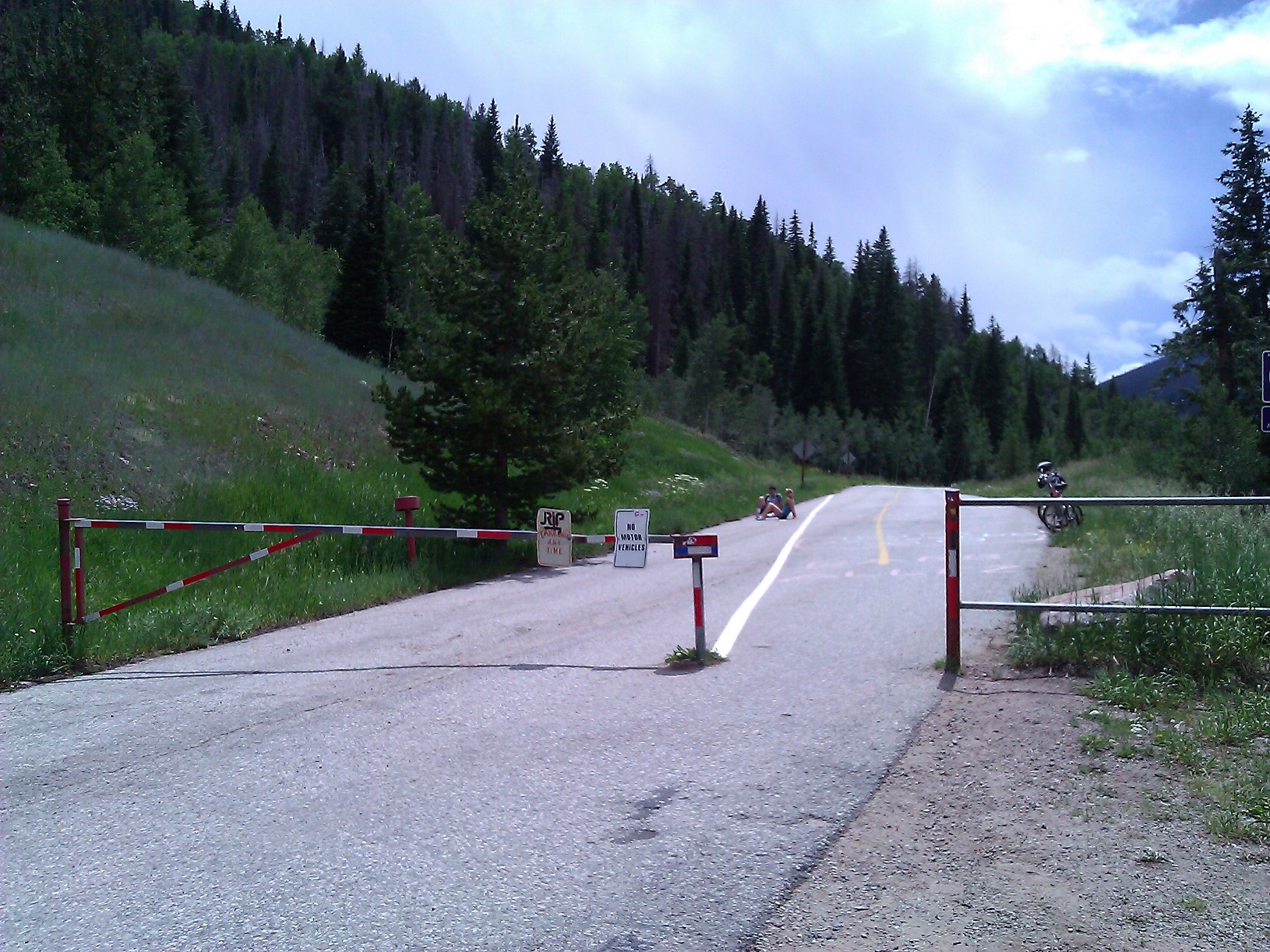
Old Vail Pass Rd, Closed to Vehicles Gate
The most common damage consists of narrow vertical cracks in the road which don’t seem wide enough to grab a tire. Grass has put down roots in some cracks, but not many considering the epic snow season and the ensuing run-off; very little grows in the middle of the road. I want to emphasize that all four miles of road do not resemble the next two photos.

Old Vail Pass Rd., example of cracks #1

Grass has taken up residence in some of the cracks, but not many, on Vail Pass Road
This one, however, seems troubling. I believe I found two sections like this:
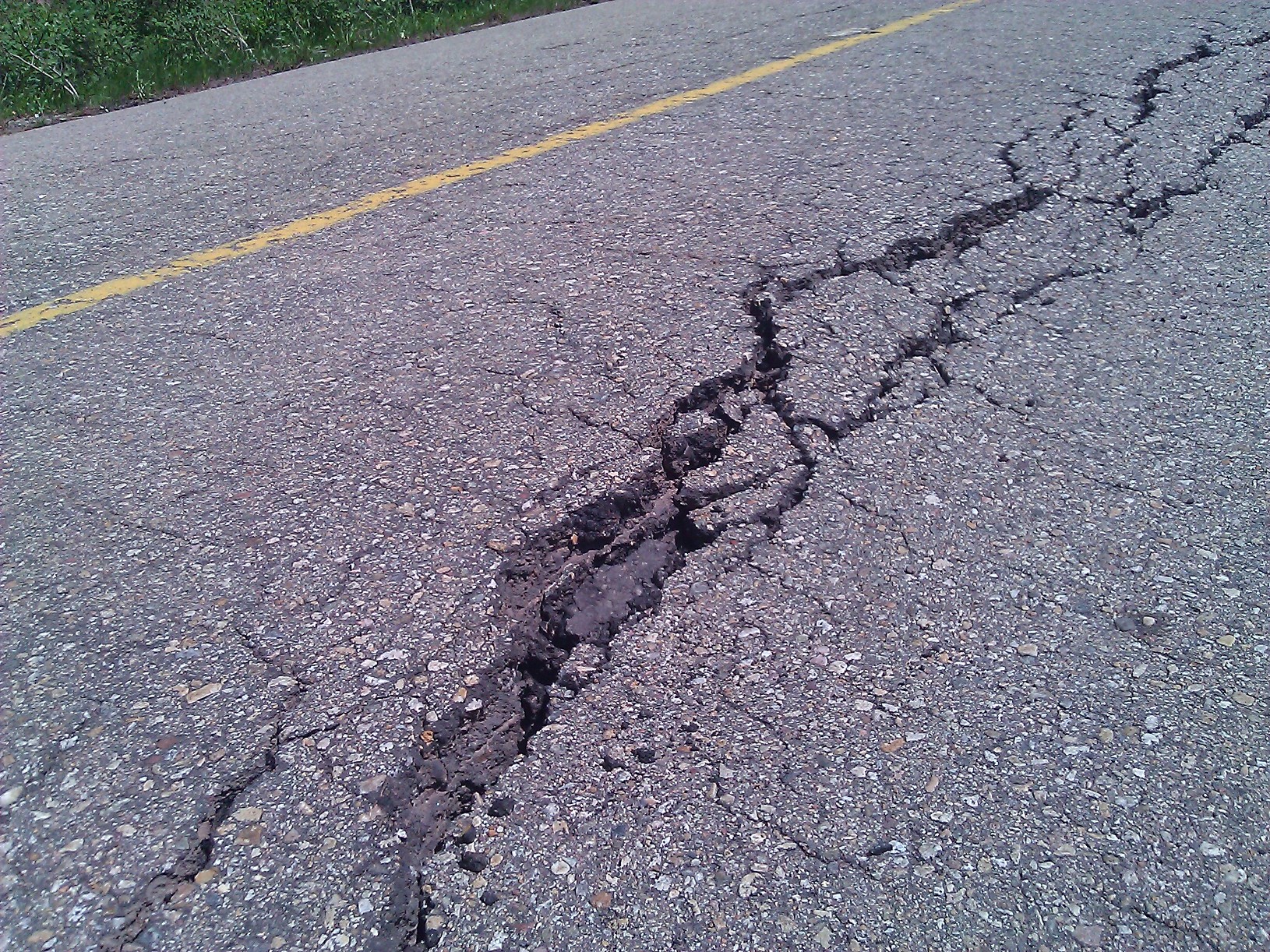
Old Vail Pass Road, Crack #2
And then I came across these two areas of severe road damage. Hills rise from a good portion of the north side of the road. According to one of the locals on bikes I spoke to, this damage occurred recently due to the unusual level of spring run-off.

Old Vail Pass Rd, worst damage #2

The worst road damage on Old Vail Pass Rd, about 1.5 miles up
About half-way up the road I met a Colorado Department of Transportion (CDOT) employee and buggy. Her job that day was to locate the culverts and mark them (the marker is the tall green stake with orange paint on top). She explained to me that the culverts, underground pipes that carry water from ditches along the north side of the road to the creek below, can get plugged with terra-cotta-colored silt. The poor drainage causes road damage.

Colorado Department of Transportation Vehicle on Old Vail Pass Rd.
The CDOT employee didn’t know if there are plans to fix the road in time for the bike race, especially in the two areas where some of the road had fallen away. She mentioned revenues are down, the budget is tight, and oil prices are high (oil is a component of pavement, whether asphalt or chip seal). These are the realities of our current economy. Because I desire safety for the athletes and staff, I was amazed that her immediate answer wasn’t “yes.” This was unfair of me. Of course she may not be aware of plans to repair the road; certainly at my last job many plans and decisions never came across my desk, and they didn’t need to.
Then I thought back to my husband’s experience not long ago. Three-inch deep potholes lurked on the side of one of the roads we frequently ride on. He thought it might help to make a few calls and see if the potholes could be filled; maybe the potholes had not made the radar screen of the entity responsible for the road. He called the nearby city and CDOT. Both said they weren’t responsible for the road. I can’t recall if he tried the county. It shocked both of us that it was possible that no one is responsible for maintaining certain roads or portions thereof. Perhaps another call might have located the “owner.” Or maybe a good samaritan was the one who eventually filled some of them with asphalt?
Clearly someone is aware of the damage on Old Vail Pass Road; initial but unfinished repairs have begun where the road has fallen away. But what about the wider cracks, and are repairs scheduled to be completed by August 25th? Perhaps I am making a mountain out of a molehill. With all the miles riders cover, is it typical to come across and navigate these conditions from time to time? Is it normal practice to mark them if they can’t be repaired in time? People want the race to be safe; I have to believe the proper actions will take place. I still might make a phone call.
Ever since the parcours for the USA Pro Cycling Challenge was announced, I’ve been puzzled by exactly what the time trial route would be up Vail Pass. I’ve ridden over Vail Pass, more than a few years ago, and aside from the thickest coating of salt that’s ever matted my hair together, can only recall pedaling up a bike path going east-bound (the harder direction). How, I wondered, could the follow vehicles drive on a bike path? I replied to one of Brian Holcombe’s tweets about the route, asking if it was possible that it traveled over the bike path. He replied that it was his understanding that it ended in the cul-de-sac proper. What did that mean? And if the route followed the “old pass” road as a fellow LOC volunteer had said, just what was the condition of the “road?”
Today I decided to put this mystery to rest. I headed west on I-70, took exit 180 for East Vail, and drove east on the South Frontage Road (Bighorn Road) for about two miles until it crossed under I-70. I parked with about a dozen cars near a sign that pointed left to the Gore Creek trail and up the road to Vail Pass, 8.9 miles.
A little further on, a gate crossed the road. Only cyclists, hikers, and as I was to find out, horseback riders, could continue.
Old Vail Pass Rd, Closed to Vehicles Gate
This alone solved a good part of the mystery. A road apart from I-70 east-bound up the pass existed, and what I had remembered as a bike path — because no vehicles were allowed — was in fact bike path and road, or rather what you might call a country lane. Using my shoes as measuring sticks, I estimate the width of the road at about 18 feet.
With the road warm under full sun, air temperature about 77 degrees Farenheit, and grass and daisy wildflowers nodding uphill from a tailwind, I started the climb on foot.

Wildflowers along Old Vail Pass Rd
Soon a middle-aged fellow in blue pedaling at a moderate pace approached me. He stopped at my request. In his opinion, the wind typically came from the west, blowing up the hill. I asked him about the road. “The road goes on for about 4 miles,” he said, then the bike trail starts and continues the rest of the way up the Pass. Because of trail damage you ride on the shoulder of I-70 for a bit. “But it’s fine,” he said, “cement barriers separate the bikes and the cars.” Later I met another local who said the wind always blows on this road, but he wasn’t convinced it is always a tailwind.
The road has acted as canvas for several artists, whose work endures.
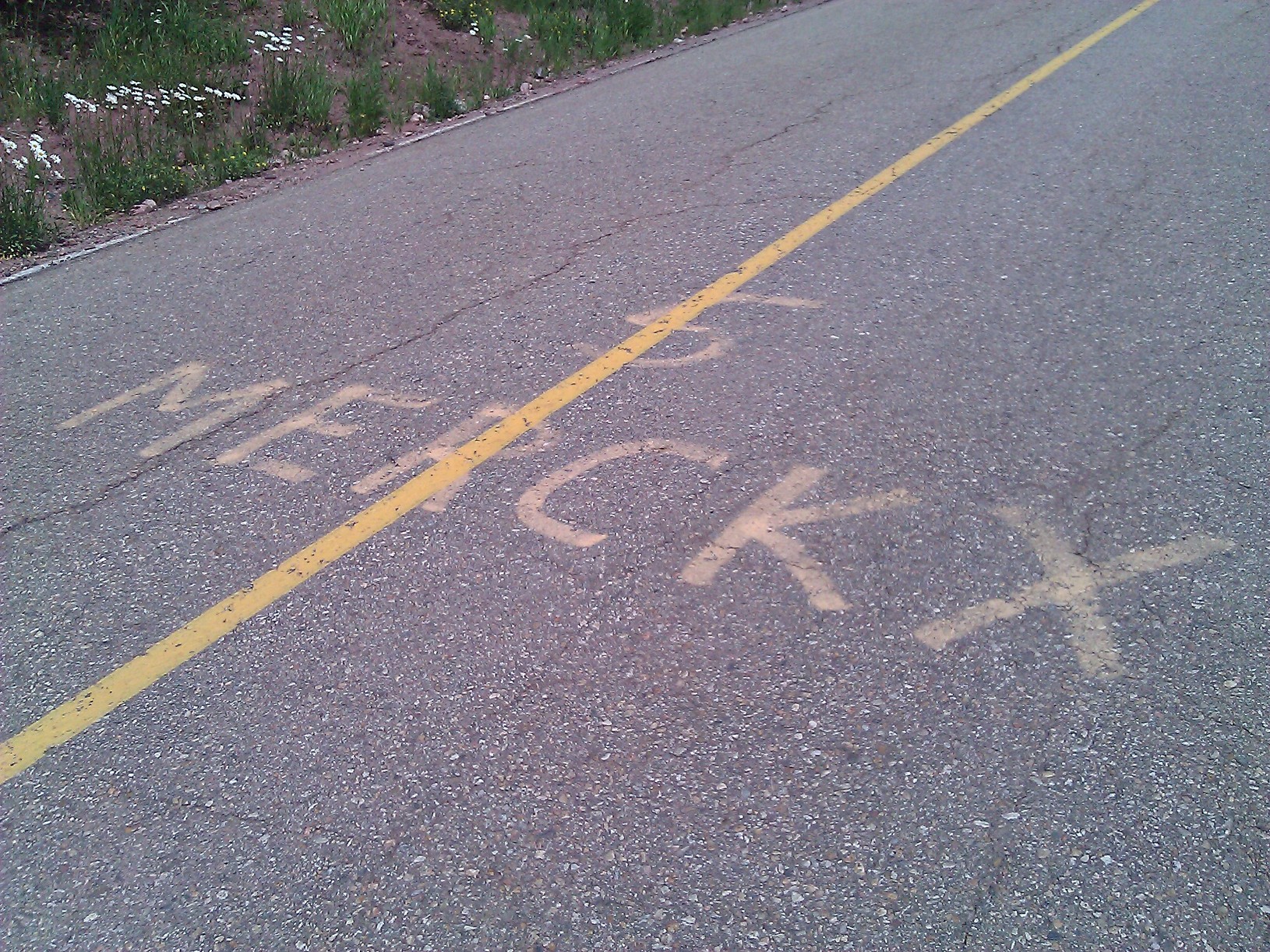
Old Vail Pass Road Art, Merckx's 5 TDF Victories
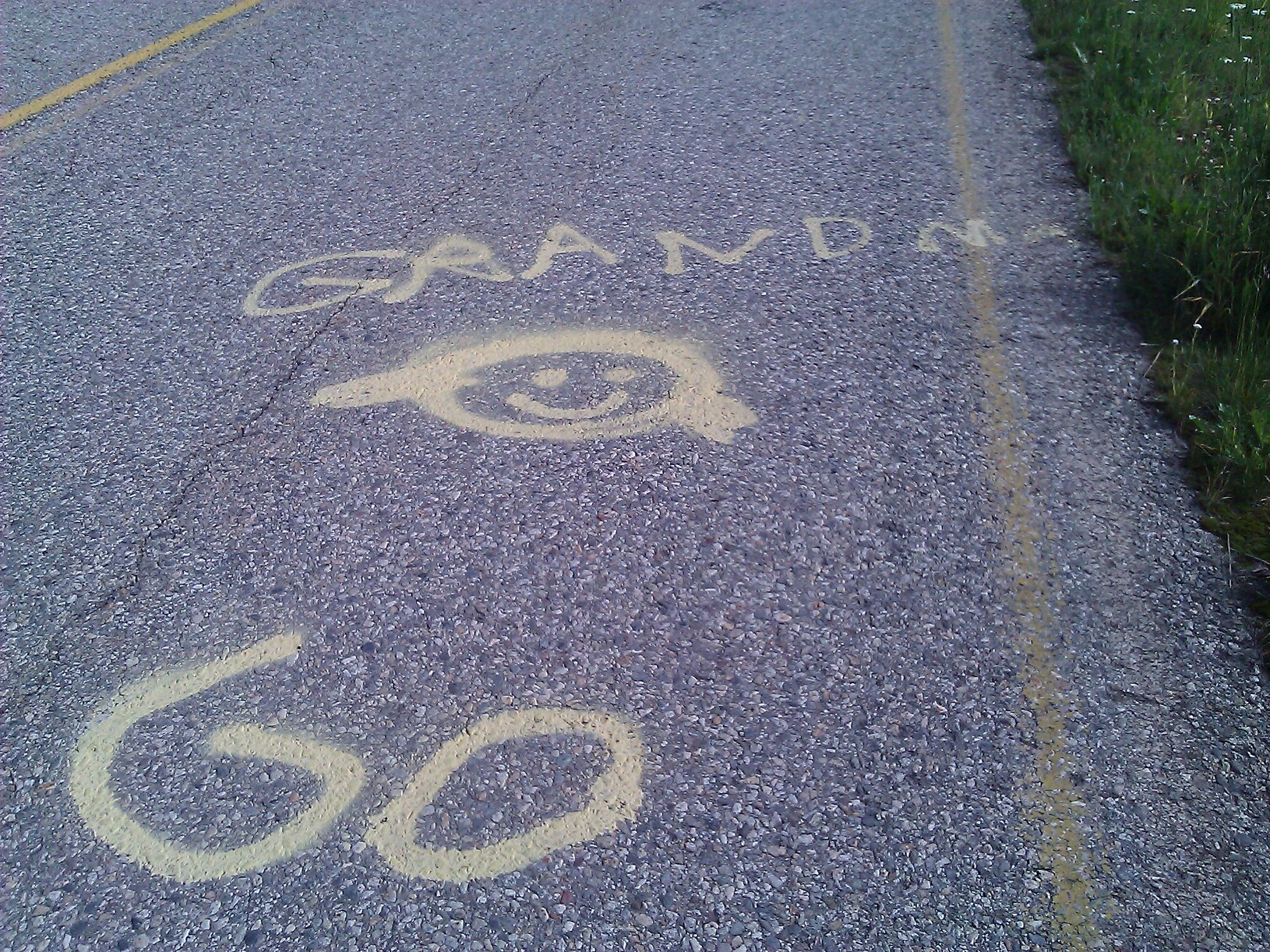
Old Vail Pass Road Art, Go Grandma, My Favorite

Old Vail Pass Road Art, Ladies with Soccer Balls
I’ll post something on the road’s condition separately. It’s not a smooth surface. It is relatively straight, with some sweeping curves, a pretty consistent ascent with a few places where it levels off a bit. The commentators for international TV might find our beetle problem in Colorado interesting fodder for fill-ins; it scared me to see how many of these scarecrows stand around Vail, which up to last year — at the ski resort across I-70, had seemed immune to these hungry little devils. On a positive note, spectators might enjoy the first golden tint on the Aspens at higher elevation.
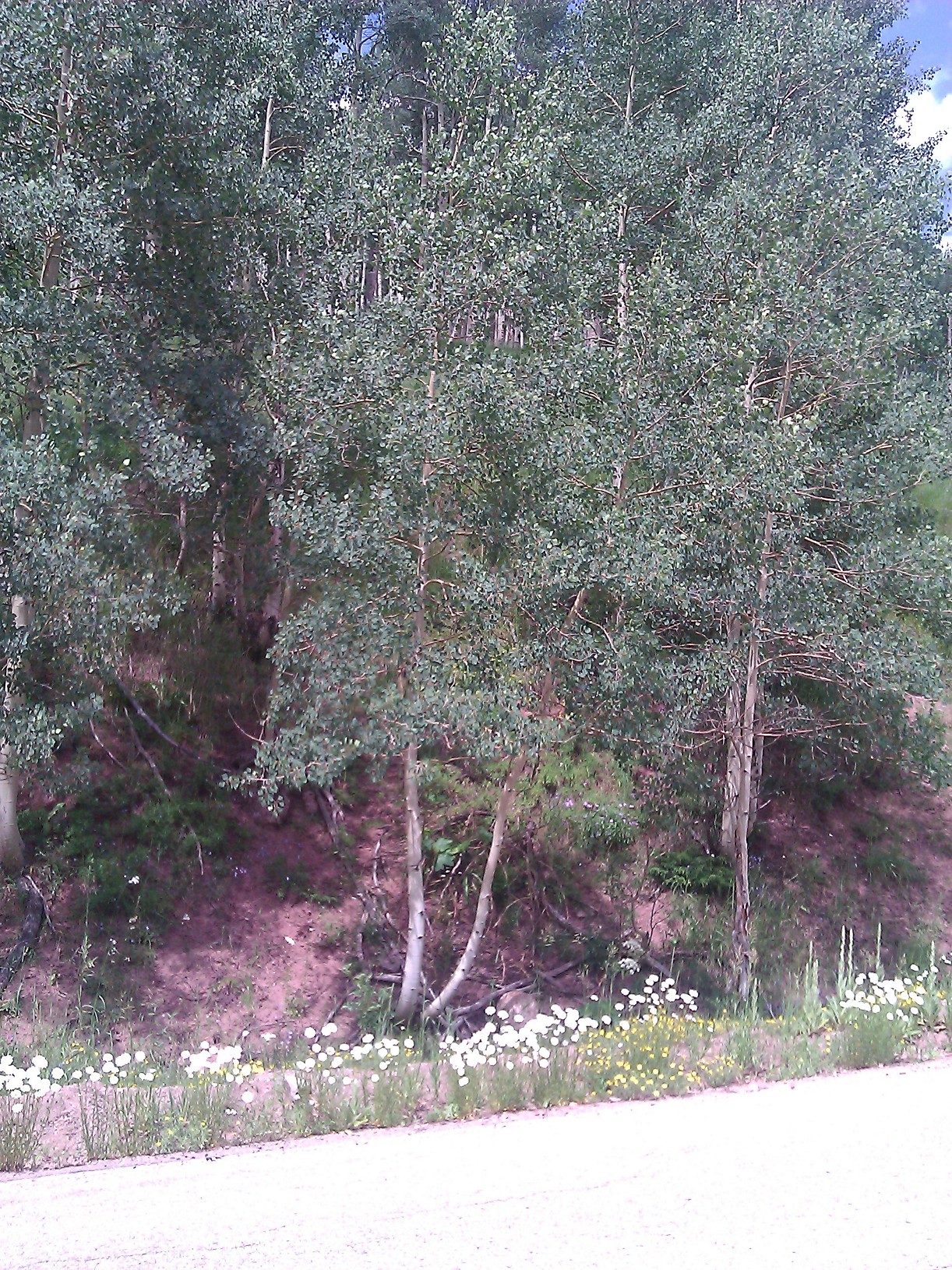
There are many Aspens on Old Vail Pass Rd and the surrounding hills
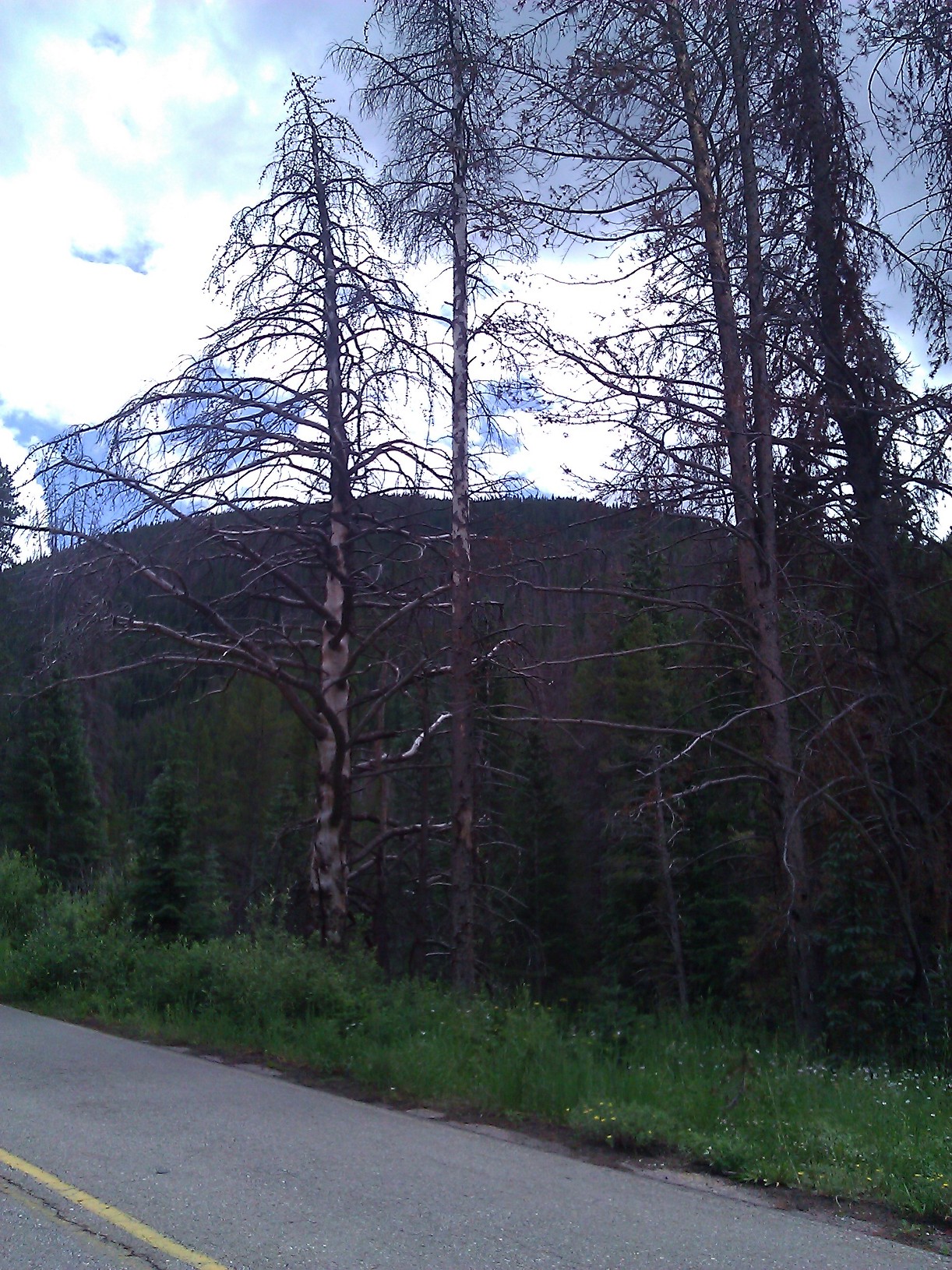
Beetle trees on Old Vail Pass Rd
About two miles up the road the Two Elk trail branches into the grass and down the hill toward what I think is Gore Creek. The trailhead sign listed a warning; Leopards, take heed.
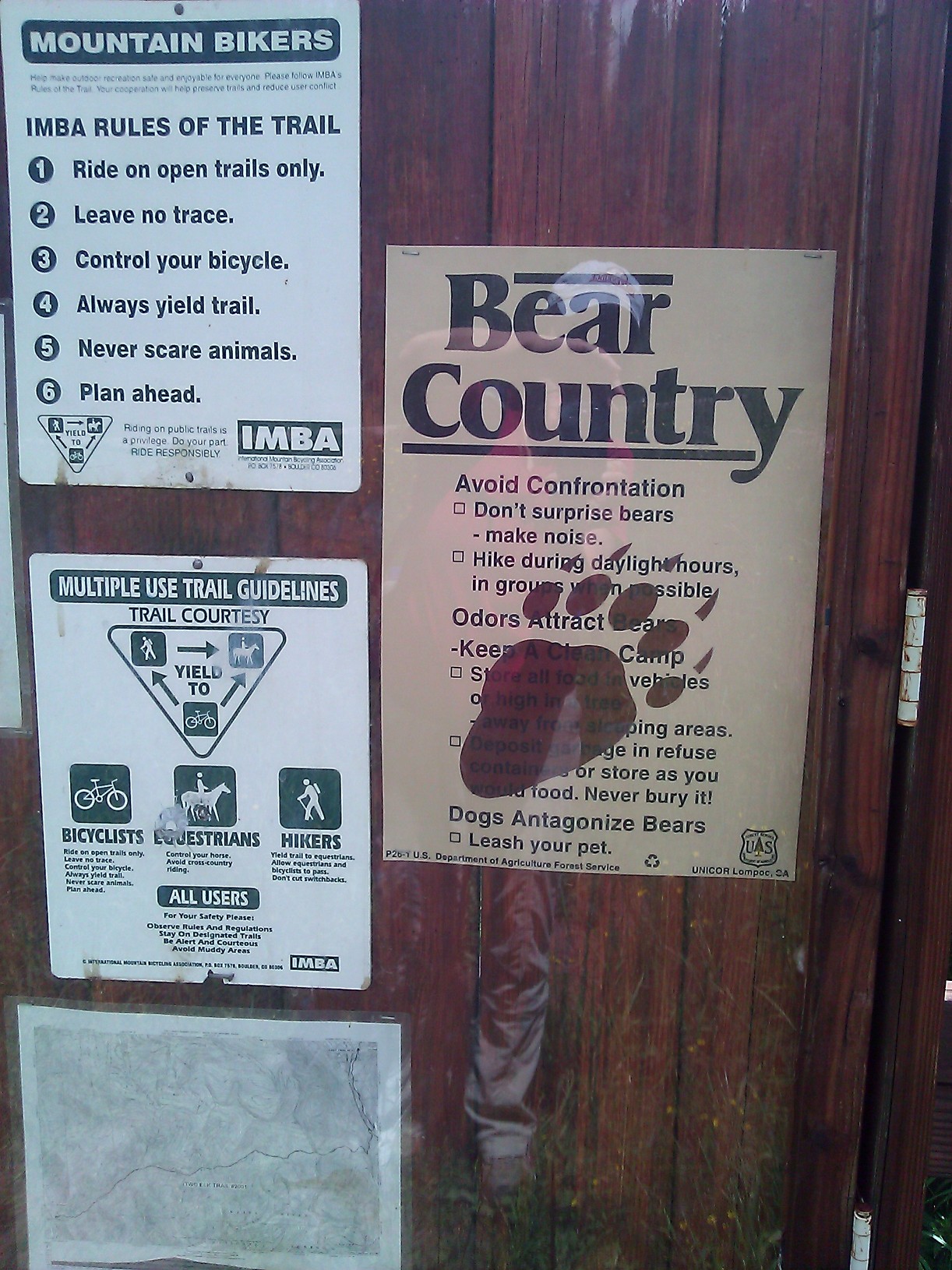
Leopards aren't afraid of bears, are they?
Signs of a different type of animal on the side of the road, their presence perhaps contributing to some of the road conditions described in my next post:
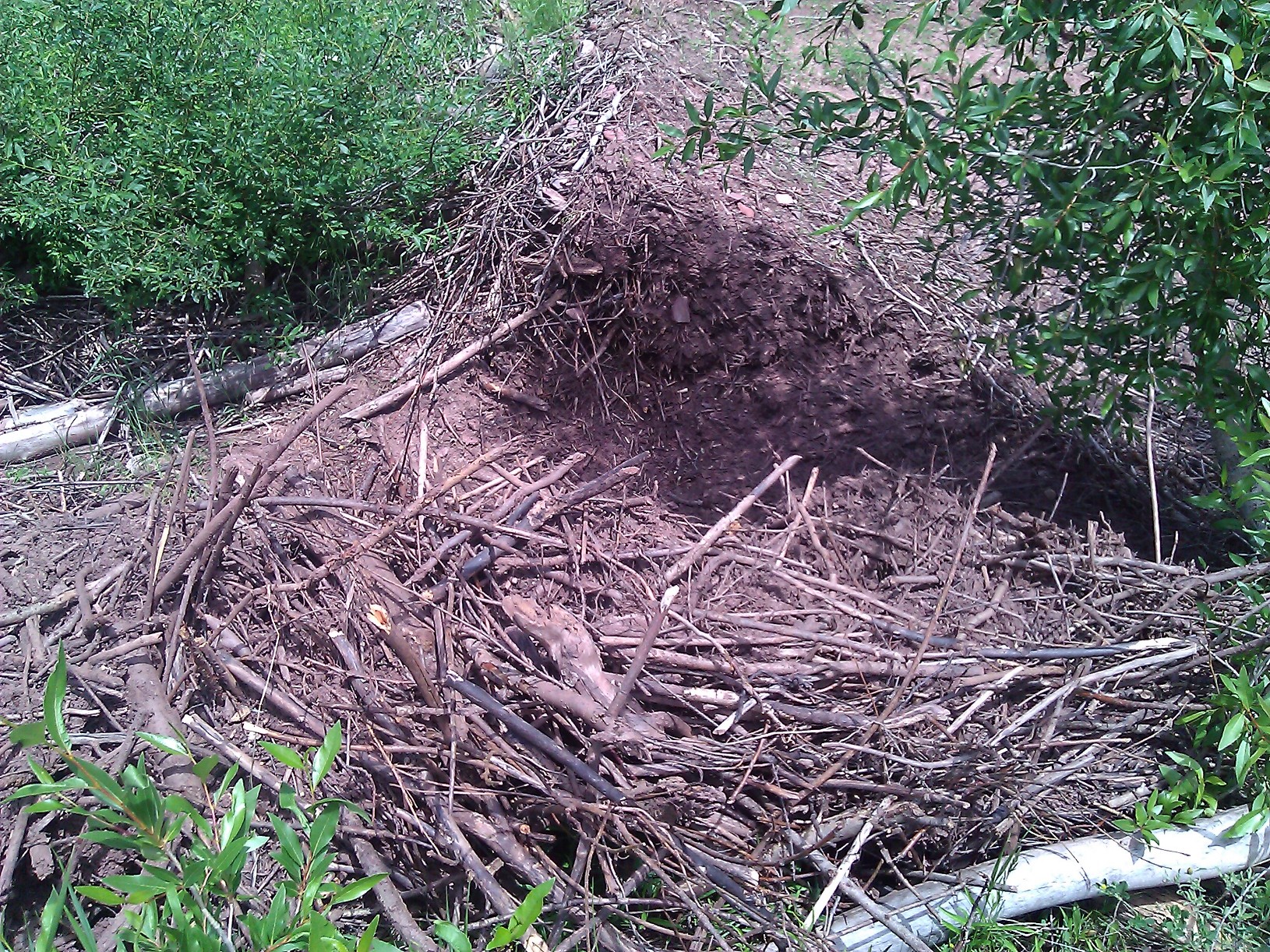
Remains of beaver dam on Old Vail Pass Rd
The road continued up for another two miles.
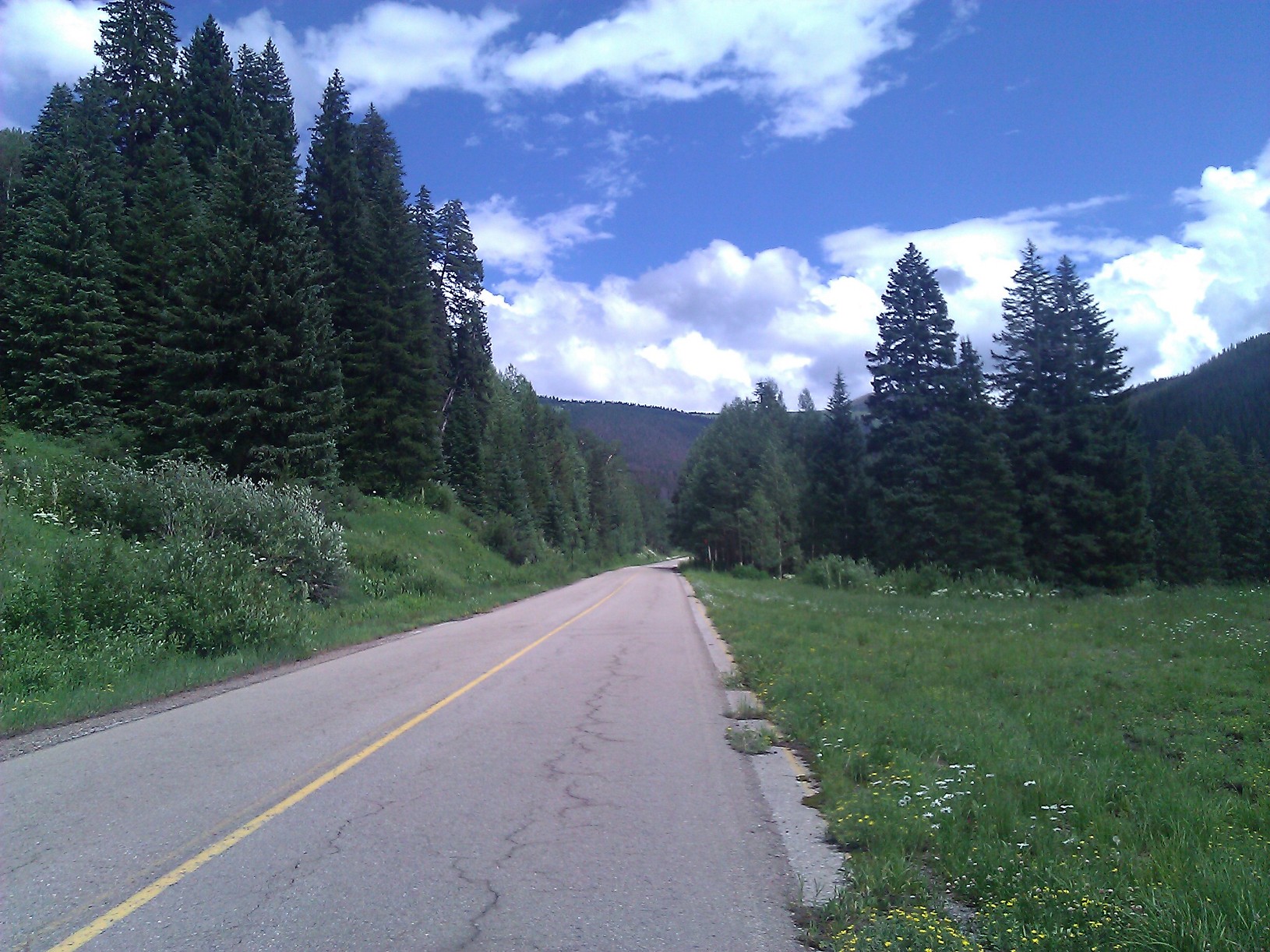
View looking up Old Vail Pass Road, after mile 2
At about mile four, a sign appeared, pointing the way to the bike path that ascends the remaining four miles to Vail Pass, elevation about 10,600 feet.
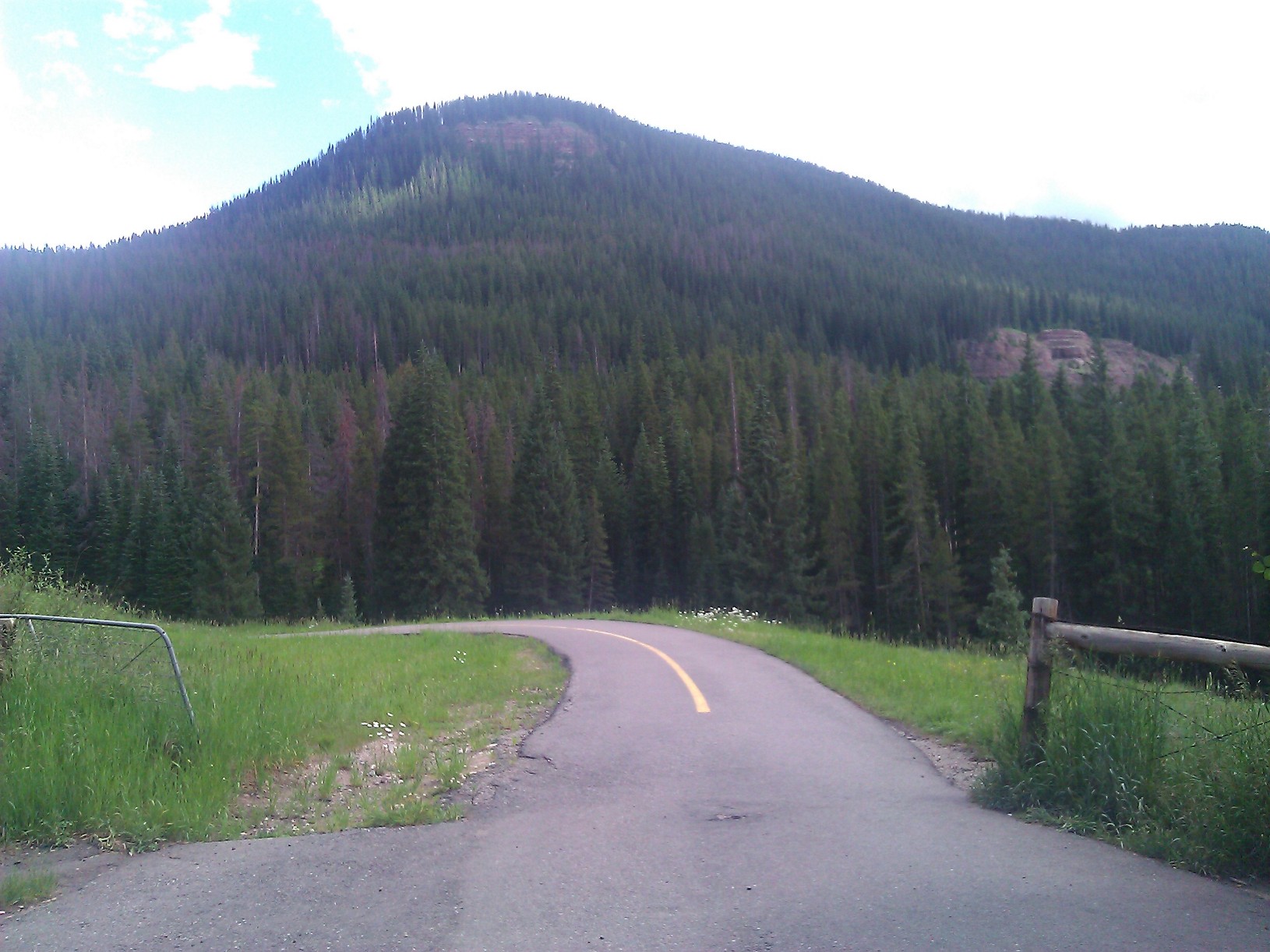
Bike path turn-off from Old Vail Pass Road

Old Vail Pass Rd, sign for turn-off onto bike path, half-way up Vail Pass
Then probably less than a quarter mile up the road from the bike path turn-off, the paved road ends. A dirt road appears to continue, though I’m not sure for how far.
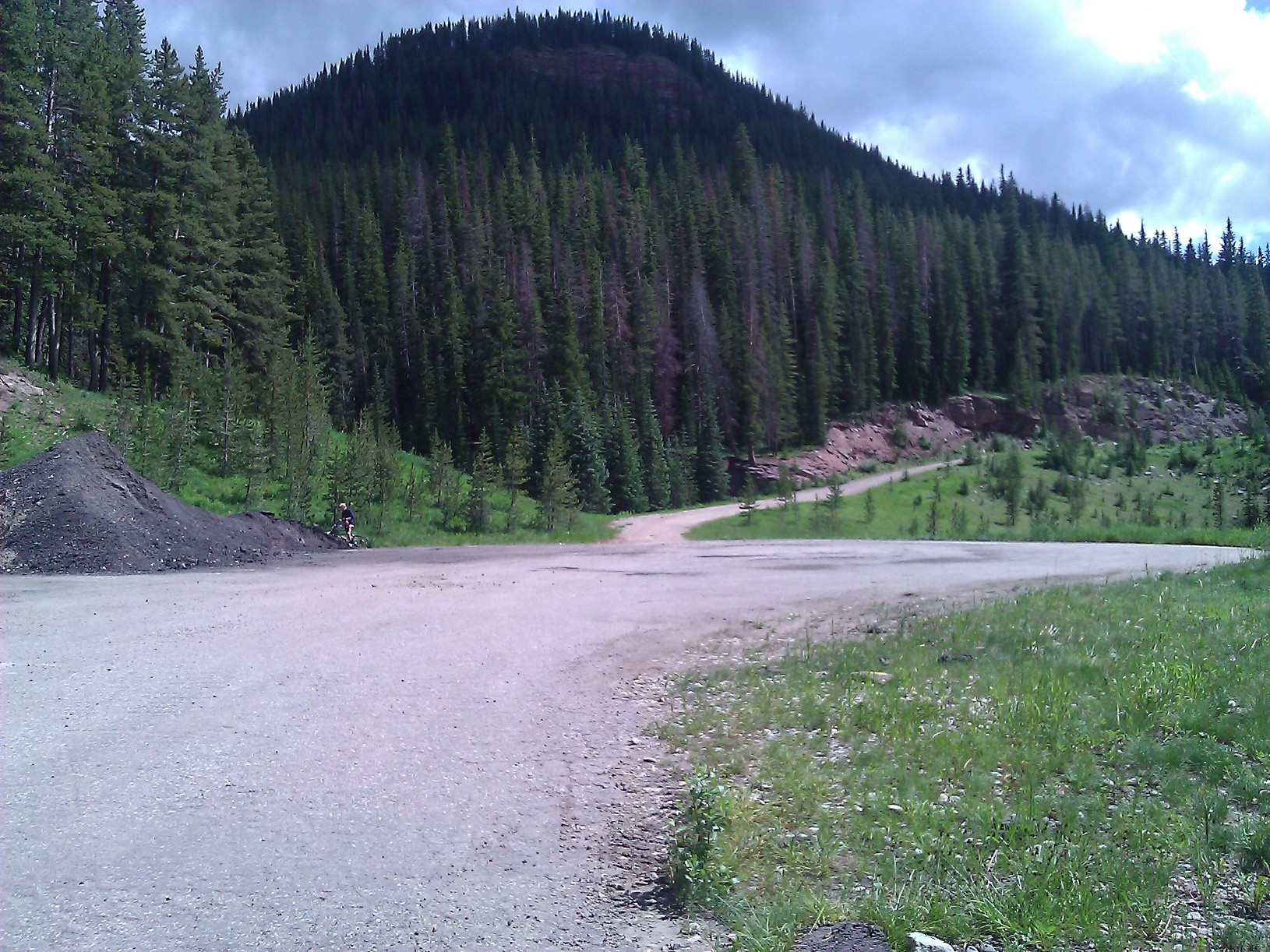
Finish of the Vail UPCC TT, the Cul-de-Sac?
This seems to be the finish line. I still wonder how the vehicles will go back down to town; with an 18 foot-wide road, I can buy (though with concerns) riders flying downhill on the same road as those racing up, but the vehicles? Perhaps motorcycles will replace follow cars à la one of the TTs at this year’s Giro, with the passenger carrying a spare bike? The map on the race website shows the route ending before the top of Vail Pass, so I think the mystery is solved — the race ends in this cul-de-sac as Brian believes, and will not continue on the approximately 9 foot wide bike trail to the top. Whew.

 ProVéloPassion