

Grand Prix Cycliste Québec Montréal 2011 logo
“A race like this is all about waiting,” said Leopard Trek sports director Kim Andersen, who commented on Fabian Wegmann’s fourth place finish after the 2011 edition of the Grand Prix Cycliste Québec. “You wait and wait and wait — and then you wait some more.”
During one of the later 2011 Vuelta a Espana stages, Todd Gogulski said, “Patience is very important in bike racing.”
Waiting and patience seem antithetical to the speed involved in winning a bike race. These two actions – or inactions – also exist in opposition to American culture, which teaches that success arrives when a person is a “go-getter,” not a waiter and certainly not a hesitator. “He who hesitates is lost”.
But in fact as Andersen and Gogulski say, waiting and patience are not antithetical to bike racing. Track racing, a discipline that didn’t attract my attention until I saw last Thursday’s Grand Prix Cycliste Challenge Sprint, is a more obvious example of how cyclists use these two tactics. Just after the turn in the out-and-back Challenge Sprint course, with 500 meters to go to the finish line, most groups of three or four competitors slowed to a crawl, some close to track-stands, to watch each other. And wait.
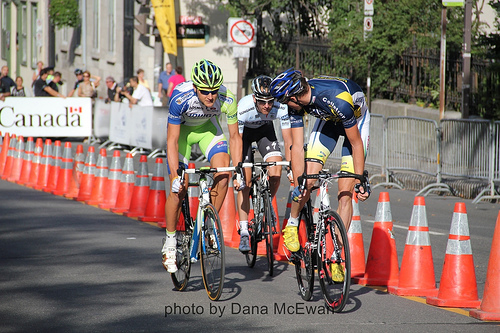
Wouter Mol, Vacansoleil-‐DCM in track stand at GPCQM Challenge Sprints (Don & Dana McEwan)
No one wanted to take-off first – funny, to finish first, don’t be first in the sprint, another kind of oddity in bike racing. Suspense built in these moments while the riders watched and waited. Who would go first? Who could wait the longest? When the first guy went suspense drained away quickly; it was a rush. Personally I began to wonder how long each rider could wait until he said to himself, “Ah, I can’t stand this anymore, the hell with it, I’m going.”
It can feel excruciatingly painful to wait. It’s uncomfortable. To the rescue comes another cliché: “All good things come to those who wait.” Almost all, if not all, pro-cyclists lose many times before they win. The cycle of racing, and racing, and racing some more is akin to waiting. Waiting becomes a trait our culture admires: perseverance.
Ryder Hesjedal knows about waiting. In an article about Ryder published in The Walrus, “The Pain Principle,” he said, “You have to not be able to do it a hundred times to be able to do it a few times.” Meaning, you won’t come in first until after you’ve lost a hundred times.
Will Ryder cash in his hundred tomorrow in Montréal?
[you can watch video of the Challenge Sprint here]
[my preview of the Grand Prix Cycliste Montréal, here]
Grand Prix Cycliste Québec Montréal 2011 logo
First, Québec race recap
Philippe Gilbert toughened the pace with less than two laps to go in the Grand Prix Cycliste Québec and won Eddy-Merckx-style by attacking. He didn’t sit on a wheel. That deserves respect, indeed, applause. For a good summary of the race action, check out cyclingnews.com’s report.
For me, Robert Gesink is the story of the Québec race, the man who wins the passion prize.
His outstanding performance in Québec, so close to the one-year anniversary of his dad’s death in late October of 2010, is a tribute to his personal strength and growth. The death of a parent is for many one of the biggest losses they ever experience. To perform so well near this often first challenging milestone after such a loss is extraordinary, especially at Gesink’s age of twenty-five.
In February it seemed like Gesink had passed through the pain of grief. He won the fourth stage of the Tour of Oman and dedicated his win to his dad.
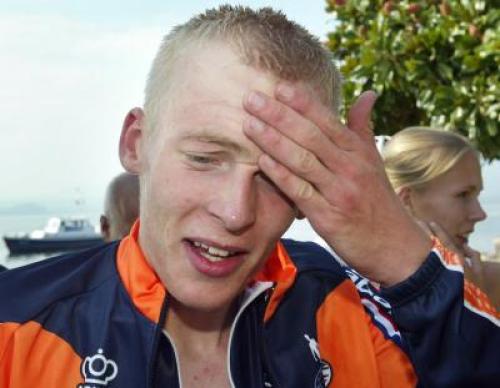
Robert Gesink in Oman, Feb. 2011
“I did it for my dad,” an exhausted Gesink said at the finish of the fourth stage, fighting back the tears. “I tried not to think about him too much because I was afraid that I wouldn’t be able to get to the finish the way I did, but it was on the finish line, and just after, that I remembered him.”
Coping with such a loss isn’t often completed after just three months. I get the feeling from his comments at the September 8th Grand Prix Cycliste press conference that it still isn’t over for Robert. “My season was really difficult. In fall I lost my father in a bicycle accident and it’s something which is hard to cope with,” he said. ” I really want to show this season that I’m still a really good rider. At the moment, it’s a season to get through.”
A poor Tour de France result, which many say is due to his crash in stage 5, couldn’t have made the healing process any easier.
After such a loss, many live by going through the motions. Stopping isn’t a choice — if you stop, you disintegrate. Death is the equivalent of stopping. Perhaps this is why Gesink continued in the TDF to the end.
It’s common after the loss of a parent to question your trajectory in life. Many people change their goals, their careers. In the middle of this reflection imagine feeling as if you are swimming in a fog. Is this what happened to Gesink after finishing 33rd in the TDF? In a telling comment just before the start of the USA Pro Cycling Challenge, Rabobank trainer Louis Delahaye said, “For Robert, it is important that he enjoy sitting on the bike every day.”
Robert showed the world today that he’s doing just that.
Montréal Preview
The Grand Prix Cycliste de Montréal parcours, about the same length as that of the Québec race, covers 205.7 k. Riders climb in total 12,770 feet, 751 feet for each of the seventeen 12.1 k laps. The final run to the finish is a slightly uphill 0.5 k at 4% grade. This circuit has been used multiple times in the past as: a World Championships course in 1974, Olympic Games route in 1976, a men’s World Cup course in the 1980s and 1990s, and a women’s World Cup course in the 1990s and 2000s.
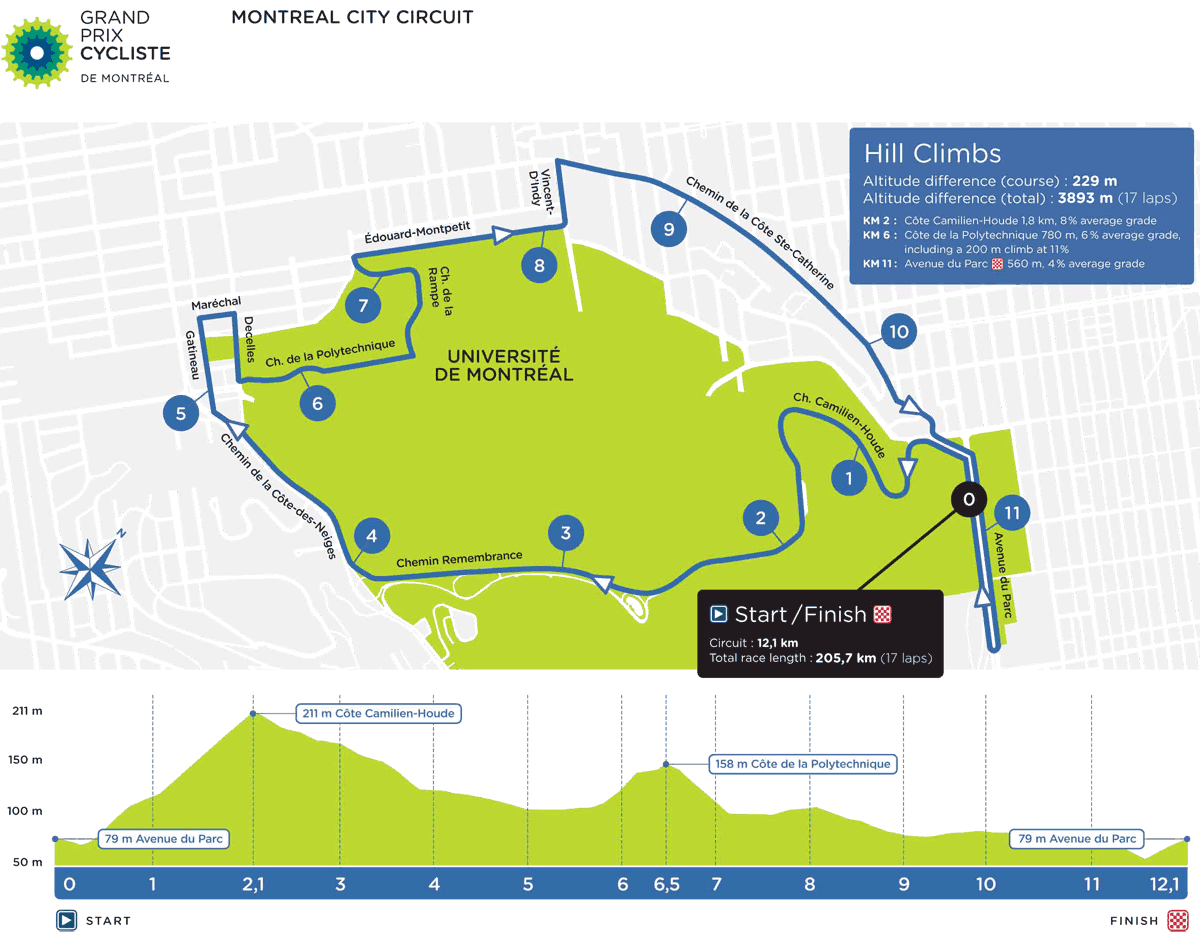
Grand Prix Cycliste Montréal 2011 course
As mentioned in the previous piece, with 3,000 more feet climbed than in Québec, Montréal is the more difficult climber’s race. The main climb is up Mont Royal (what the city of Montréal is named after) which continues for 1.8 k at an 8% rise. The riders will reach the second hill, the Côte de la Polytechnique, just after the descent of Mont Royal; it rises for 0.8 k at an average of 6% with a section at 11%.
In addition to Robert Gesink, we should expect strong rides not only from guys (les mecs) who performed well in Québec, but from strong men (les costauds) who decided to conserve their energy and even did not finish the Québec race. If it comes down to a sprint finish among a select group, that climber will also have to manage a decent sprint. I’m not great at naming climbers with good sprints, and would love readers’ comments on that topic. Possible winners that come to mind aside from Gesink: Jeff Louder (BMC) who has won a similar circuit in Salt Lake City (SLC) in the Tour of Utah, Pierrick Fedrigo (FDJ), Lucas Euser (CMS) and Pat McCarty (CSM) and Timmy Duggan (LIQ) who performed well on the SLC circuit this year, David Arroyo (MOV), Johnny Hoogerland (VCD), and Rigoberto Uran (SKY). Ryder Hesjedal (GRM) and Philippe Gilbert (OLO) go without mentioning.
Again, insight from Kevin Field, Team SpiderTech’s assistant directeur sportif: “The Montréal circuit really does come down to the climb up Mont Royal,” he said. “There are still transitional areas where attacks can and will go – like the climb up the Polytechnic hill. But in Montréal if you can’t climb well it is very tough to win.” At the same time, Field allows that a strong classics climber, like Gilbert, could succeed.
Here’s what Gesink thinks, from the September 8th press conference: “Montreal I think is a different race, it’s really tough parcours because the climb is longer. I expect also like last year, you can attack at the right moment.” Gesink concluded, “Of course it’s possible to do it the same way but this year everybody looks at Gilbert, he’s the man for the Classics and if he can do again like he did this year, it will be very difficult to beat him.”
Unless, perhaps you are Robert Gesink who wasn’t happy with his second place in Québec.
2010 Montréal results (note: of the top 10, only Gesink, Hesjedal, Sanchez, Duque, and Ballan compete this year)
1 Robert Gesink, Rabobank 4:58:22
2 Peter Sagan, Liquigas-Doimo +:04
3 Ryder Hesjedal, Garmin – Transitions
4 Haimar Zubeldia Agirre, Team Radioshack
5 Maxime Monfort, Team HTC – Columbia
6 Samuel Sanchez Gonzalez, Euskaltel – Euskadi +:09
7 Leonardo Duque, Cofidis, Le Credit En Ligne +:14
8 Alexander Botcharov, Team Katusha
9 Francesco Gavazzi, Lampre-Farnese Vini
10 Alessandro Ballan, BMC Racing Team
Thirteen additional riders arrived in the +14 seconds group. Eleventh through 15th placed were: Chris Anker Sorensen Team Saxo Bank, Jakob Fuglsang Team Saxo Bank, Francesco Reda Quick Step, Thibaut Jpinot Française Des Jeux, Mauro Santambrogio BMC Racing Team.
Grand Prix Cycliste Québec Montréal 2011 logo
The Québec and Montréal one-day races pack a welcome punch of energy after a summer of stage racing. The different tactics at work in a one day race, when it’s all or nothing, rouse attention. But the knock-out punch comes from the hill climbing each course delivers. Here’s what a couple of the competitors said about the hills during the September 7th press conference in Québec:
Samuel Sanchez, “You need to conserve energy in first few laps. We could have the same scenario as 2010, solo finishers.”
Philippe Gilbert, “We climbed the (Québec) hill once this morning. Climbing it every 12 km will hurt.”

Philippe Gilbert (Grand Prix Cycliste Facebook page)
And yet the Québec race offers less climbing than the Montréal race. Québec’s hills – except the 4% 1 k ascent to the finish line — rise steeply but for short distances, from about 200 – 400 meters each with 10%, 13%, 9% and 7% grades; all of those mini-ascents occur in the last 3.6 k of the lap. The Montréal climbs – three if you include the final 0.5 k of 4% — run longer overall with more separation between them.

Grand Prix Cycliste Québec 2011 course
The Québec course additionally challenges riders and teams tactically because of the narrow streets on the uphill portion and the sections leading up to and including the downhill. Kevin Field, SpiderTech’s assistant directeur sportif, said, “You simply don’t have any opportunity to move up until after the technical sections through the Plains of Abraham and the descent of Côte Gilmour back down to the Boulevard Champlain. Then once you’re there, you are almost on the climb again. It can be very tough, without a lot of recovery. A smart and strong rider can use this to his advantage.” The Plains of Abraham occur in the south-western section of the Parc des Champs-de-Bataille on the course map.
The Grand Prix Cycliste de Québec course covers 201.6 k, one lap more than last year’s course. Total climbing is 9,764 feet, 610 feet for each of sixteen laps. The final run to the finish looks pretty straight for about 0.9 k and is uphill at 4%.
Montréal, with 12,770 feet climbed, presents as more a climber’s race than Québec, which seems to suit a strong all-rounder. On balance the repeated punchy Québec hills exclude a sprinter, even a sprinter who can climb like Liguigas Cannondale’s Viviani, from the favorites. A look at the top ten from last year’s race blunts that last sentence: Cofidis’ Leonardo Duque placed 7th at Québec and 15th at Montréal; well, he’s Colombian. Edvald Boasson Hagen, who’s not Colombian and rides in this year’s edition, flew just one second behind the winning Voeckler in Québec last year.
In the September 7th press conference Gilbert named Simon Gerrans (SKY) as a favorite. Only a few hours later Gerrans tweeted, “fighting a losing battle with jet-lag..”
But I’m not going there. Not this time. No 1-2-3 predictions. But if I were forced to divulge my favorite, I’d name Ryder Hesjedal.
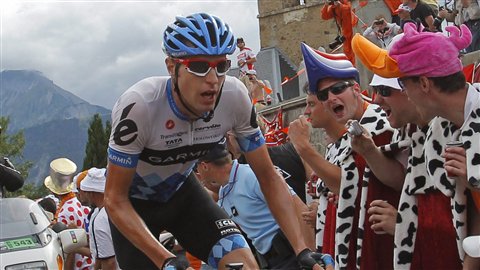
Ryder Hesjedal at 2011 TDF, L'Alpe d'Huez (La Presse Canadienne /AP Photo/Christophe Ena)
First, he’s extremely motivated. Last year with a sinus infection he finished one second behind Voeckler. And he’s got seven teammates ready to support him. We have seen Garmin-Cervélo dedicate the team to one of their guys many times, most recently in Colorado when they rode for Vande Velde and nearly brought Summerhill to a third place on the Denver stage. Boassan Hagen should be in the mix, as well as Clement, Hincapie, Steensen, Rolland or Veilleux, perhaps Fedrigo, one of the SpiderTech boys, and Van Garderen. Leipheimer’s performance is a hard one to predict: he could be tired from his recent wins or motivated to continue his winning streak.
Will Gilbert be strong? Of course. But he’s going to another team next year. And the Garmin guys will kill themselves for Ryder.
[For Part 1 of the Grand Prix Cycliste stories, see Bonjour à Grand Prix Cycliste 2011.]
[For a VeloNews piece on the Grand Prix Cycliste stories, click here.]
He stood with his pale back to me as he balanced a black Cervelo bike with the number 32 against the front of a Subaru; he hadn’t pulled the bib portion of his bike shorts over his shoulders yet. Was it OK to ask a half-naked pro-cyclist a few questions? His nakedness drew an invisible circle of privacy around him that held my voice hostage. And yet if not now, when? Who knew how long it would be until he was fully dressed? The sun already burned white-hot at 10 am, an hour before stage 2 of the Tour of Utah would begin.

Peter Stetina before stage 2 of 2011 Tour of Utah (Mary Topping)
So I gave it a go. “Peter?” I asked. Peter Stetina of Team Garmin-Cervelo turned his head and upper body toward me and away from the team car.
“Yes?” he asked.
I explained I was affiliated with the Golden LOC and its racing website, procyclinggolden.com. We want to put up on our website profiles of pro-cyclists who were born in Colorado and plan to race in the USA Pro Cycling Challenge (UPCC). I’d like to ask a few questions. “But is this an OK time?” I asked.
“Sure,” he said, “now’s fine.” He pulled the mesh suspenders up. The movement of his hands drew attention to several brightly colored squares, each the size of a nickel, tattooed near the top of the right side of his ribcage. I pointed to them, a reflex reaction; I didn’t stop and think he might prefer that his tattoo remain a secret. “What are those?” I asked, as I leaned closer to see them better.
He looked down at them then back up at me and replied, with either a twinge of amusement or sheepishness — I couldn‘t tell which, “Oh, they are Tibetan prayer flags.”
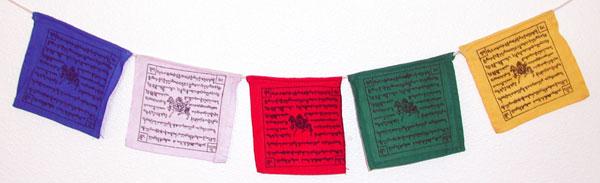
Tibetan Prayer Flags (from http://www.fourgates.com)
I’ve seen quite a few tattoos. Most are predominantly monochromatic blue; I don’t find them very visually appealing. But this one was three or four red, green, and yellow squares with wavy edges and black symbols written in them; they appeared to be lifting off his skin in a breeze. I dove into my first question about what the upcoming UPCC means to him given the Coors Classic wins in his family, wondering why he chose to place the tattoo exactly there.
Yes, I wanted to know about his objectives for the UPCC, but I really wanted to learn more about the tattoo: why did he get it, what does it mean to him, is he still happy it’s there?
[Here is a link to what I heard from Peter regarding the UPCC and more.]

Team Mengoni jersey on Keith Vierra (Geert Dessein)
What does Team Mengoni have to do with the Grand Prix Cycliste Canadian races? Enter another dinner conversation about bike racing between me and my husband. I mention over roast chicken and green beans, with the Vuelta playing on the TV in the background, that I plan to write about the Québec and Montréal races.
“Steve Bauer,” Donald said as he looked up from his plate. “I raced with him in Central Park, the year he was on the Fred Mengoni team. He just blew past all of us and won. Oh, and then there was the race when Jonathan Boyer, who was taking it easy at the back, all of a sudden flew past us like a lightning bolt. The pack strung out into one thin line and I was hanging on for dear life. He hit a jogger before he could catch the break. I remember an ambulance at the Boathouse. He broke his collarbone.”
What I want to ask my husband: who have you not raced with in Central Park? First George Hincapie, a team of Colombians, and now Steve Bauer and Jonathan Boyer. Tonight was the first time he mentioned Fred Mengoni, an icon in the sport. Read here for an amusing piece about Mengoni. The year Donald raced with the Canadian Steve Bauer was 1984. At that time the pros raced together with the amateurs, in a field of about 150 guys.
Fast-forward to September, 2011 when Bauer, as sports director for Team SpiderTech powered by C10, brings a team of eight to compete for the first time to the Canadian Grand Prix Cycliste races. A homecoming that means a lot to Bauer. In the races’ inaugural edition last year, SpiderTech, as a Continental level team, couldn’t compete in these UCI races.
In a cyclingnews.com preview of the Québec race, Bauer said, “These WorldTour races are vitally important to our team mission and the growth of Canadian road cycling. In essence the races are historic for Canadian road cycling as this is the first time in history a Canadian professional road cycling team competes on the WorldTour. That says a lot about how hard we have worked to get there.” Seven of the eight SpiderTech riders in Québec are Canadian, as well as six of the eight team members racing in Montréal.
If last year’s exciting finishes repeat, get ready for a couple of nail-biters. Robert Gesink (Rab) won the 2010 Montréal race with a four second lead over a group of four; Thomas Voeckler (BBOX Bouygues Telecom) raised his arms over the Québec finish line just one second before a group of fourteen. Voeckler isn’t starting the races this year. C’est vraiment triste.
Information on each race coming in subsequent posts. A bientôt!
[9/8 update: Québec race story here, Québec Promises a Punch.]
Grand Prix Cycliste Québec Montréal 2011 logo
SpiderTech riders for Grand Prix Cycliste Québec [updated September 8, 2011]
Canadians: François Parisien, Ryan Anderson, Zach Bell, Martin Gilbert, Svein Tuft, Ryan Roth, Will Routley. American: Patrick McCarty.
Other Canadians expected to race in Québec and Montréal
Ryder Hesjedal (GRM), Michael Barry (SKY), Dominique Rollin (FDJ), David Veilleux (EUC)
Teams racing at the Grand Prix Cycliste Québec and Montréal [start list as of September 8th here, page 2]
- AG2R La Mondiale
- Astana
- BMC Racing
- Euskaltel-Euskadi
- Garmin-Cervelo
- Katusha
- Lampre-ISD
- Leopard-Trek
- Liquigas-Cannondale
- Movistar
- Omega Pharma-Lotto
- Quick Step
- Rabobank
- RadioShack
- Saxo Bank Sunguard
- Sky Pro Cycling
- HTC-Highroad
- Vacansoleil-DCM
- Cofidis
- FDJ
- Europcar
- SpiderTech p/b C10.

Normandy, France
When Sam Johnson of Team Exergy mentioned on his blog that he would be riding the Duo-Normand on September 18th, in France, my ears perked up. First, a race I hadn’t heard about before. Second, imagining Sam’s alter-ego Krogg in France brings to mind some potentially silly situations we’ll enjoy reading about in Sam’s blog after the race. Sam will ride with Kai Applequist; according to the race website Exergy is also sending the two-man team of Matthew Cooke and Quinn Keogh. The elite men’s teams compete for a total of 6,010 Euros prize money; first place wins 2,425 Euros. It is a UCI 1.2 class race; UCI control applies only to the men’s elite category. The race began in 1982.
The Duo-Normand is a two-person time trial over 54 kilometers that starts and ends in Marigny, in the Normandy region of France. Marigny sits in about the middle of a peninsula, south of Cherbourg on the map. The race website indicates 30 countries will be represented in the 2011 edition of the race.
What’s really interesting about this race is both amateurs and professionals compete the same day on the same course, together with tandem, female, hand-cycle, and recumbent teams. Imagine sharing the podium with the pros. A team from Bike Radar experienced a place on the podium in 2009 when they won in the Corporation category of the Duo-Normand; their report describes the course and how foreign teams can stay with local families.
A collection of current and past pro-cyclists who have won this event include Jonathan Vaughters – Jens Voigt in 2001, Sylvain Chavanel – Thierry Marichal in 2005, and Brad Wiggins-Michiel Elijzen in 2007. Chris Boardman and Jens Voigt hold the record on the course in use since 1997; in 1999 they finished in 1 hour 4 minutes 17 seconds, average speed 50.3 km/hour.
The best team of two will win by each giving up self and focusing on their performance as a unit. A quote from Jacky Hardy on the Duo-Normand website describes this well. Jacky, a time trialist from Normandy, in giving advice to aspiring race entrants, said, “N’essayez pas d’être le meilleur des deux, mais la meilleure équipe de toutes.” Don’t try to be the best of the two, but the best team of all. A concept, based on an interview of the team, that Exergy’s dynamic duos will play-out on September 18th.
Categories for licensed riders: Elites, 2ème Catégorie, Junior, 3ème Catégorie, Départementaux.
Categories for “others:” Vétérans, Féminines, Mixtes, Handisports, Tandems, Corporatifs, Vélos-couchés, Non-licenciés
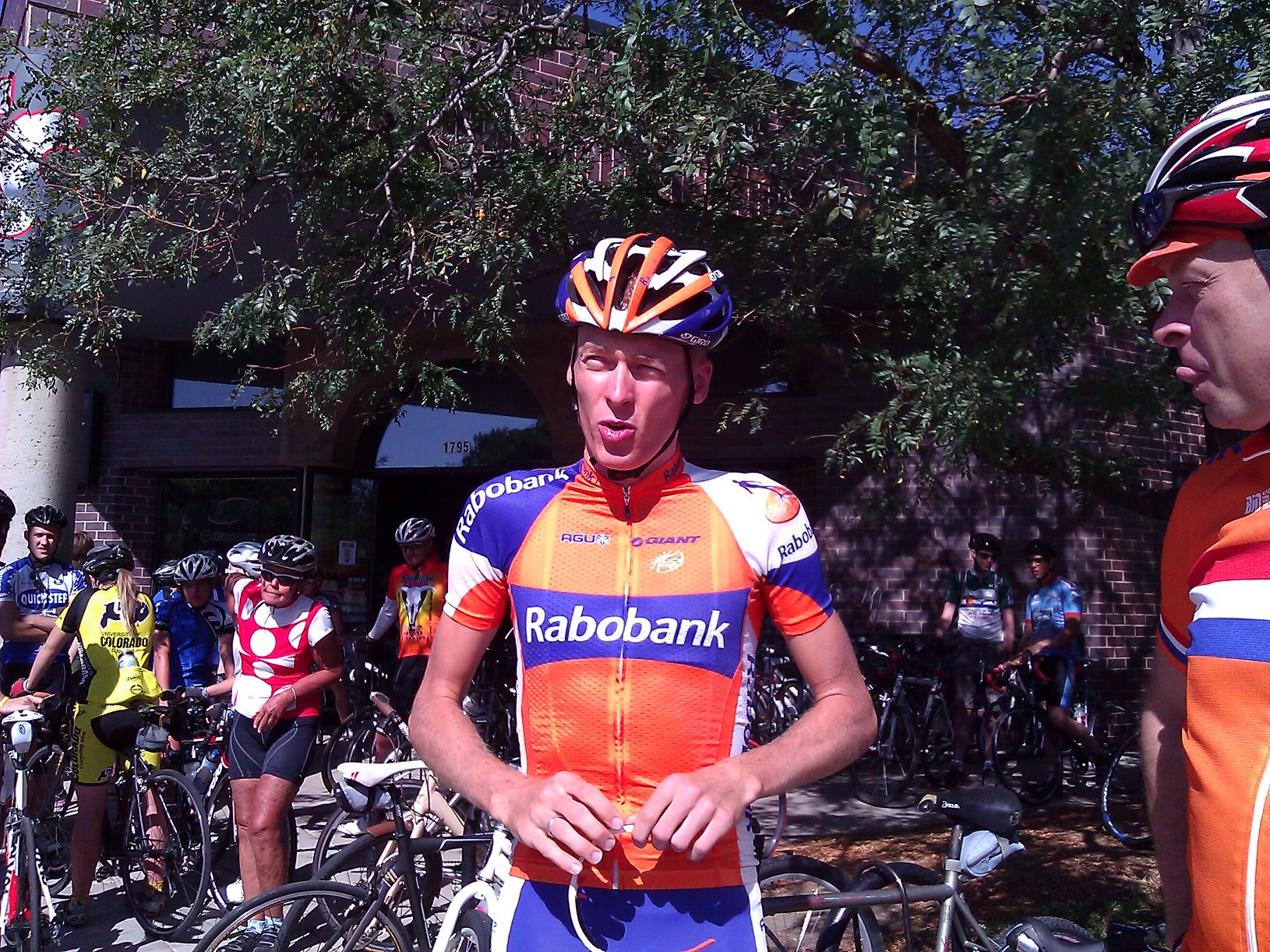
Robert Gesink at Full Cycle, Boulder, pre-ride (Mary Topping)
They appeared on our left silently as if out of nowhere, four silky, jointless young men dressed in orange and blue kits riding Giant bikes.
Robert Gesink, Dennis Van Winden, Stef Clement, and Pieter Weening rolled up to the shop together. The last three stopped and waited while Robert swung off his bike and entered the shop. The leader is always the leader. Immediately hidden items emerged from dozens of jersey pockets: posters and shirts for autographs.
Stef Clement, the current Dutch time trail champion, straddled his bike near me and my husband Donald. “How do you like Boulder?” I asked Stef. He liked it.
“It’s like a European city,” he said, “with a center.”
Then I asked, “Do you have rides from bike shops like this in Holland?”
“Yes,” he said, then added, “and I have a home there but I’m not in it much.” On the last day of the USA Pro Cycling Challenge (UPCC), Andy Schleck made the same comment during an interview with Frankie Andreu for Bicycling.

Stef Clement at Full Cycle, Boulder, pre-ride (Mary Topping)
Rabobank isn’t a team I often follow, though Robert Gesink’s strong, silent demeanor at the UPCC opening press conference inspired respect and anticipation for what he might accomplish in a race that on the surface promised opportunities for strong climbers. It’s amazing how this small, flat country with an average elevation of 36 feet (11 meters) turns out strong climbers like Gesink, Steven Kruijswijk who impressed so much at the Giro d’Italia this year, and 20-year-old Wilco Kelderman who joins Rabobank in 2012 from its development team. Instead of battling mountains they spar with the wind. The average wind speed in Amsterdam is 12.0 mph, which compares to 12.9 mph in Cheyenne, Wyoming, and 8.6 mph in Denver, CO. I imagined they felt right at home as fifteen minutes later our flotilla of cyclists turned onto Highway 36 into a cross headwind.
After I fell off the group’s pace, Donald and I took a shortcut to Hygiene and then continued on the same route the group took back to Boulder. We rode under huge cottonwood branches that dipped over the road. We pedaled past roadside sunflowers, grazing horses, barns, and tan fields of shorn, dry stalks abutting green fields of growing corn. To our right the rocky summits of Long’s Peak and Mount Meeker poked out from behind green and rust colored foothills. Our constant companion aside from these sights and a blue sky: the wind.
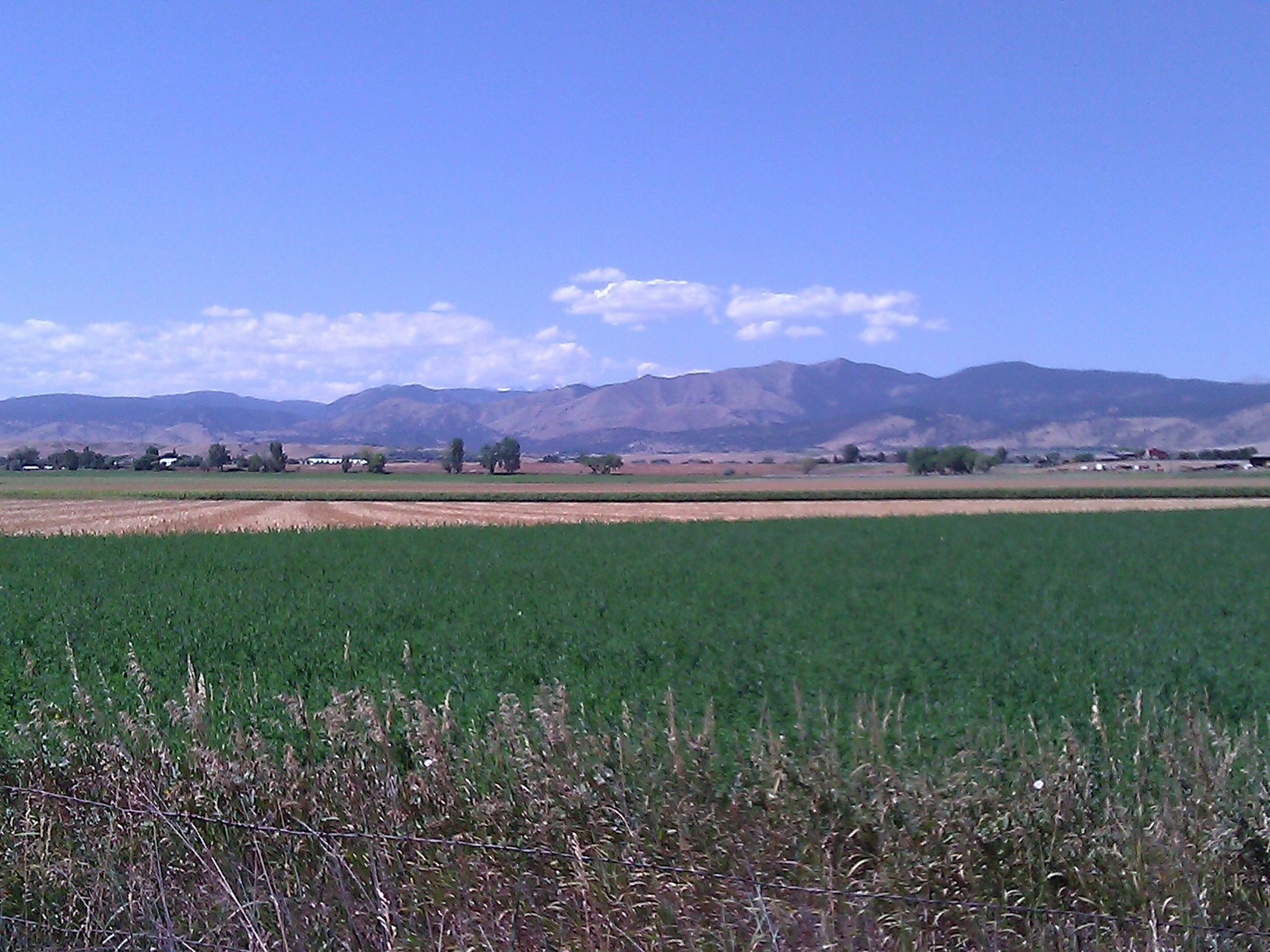
Fields and Foothills from Hygiene to Boulder (Mary Topping)
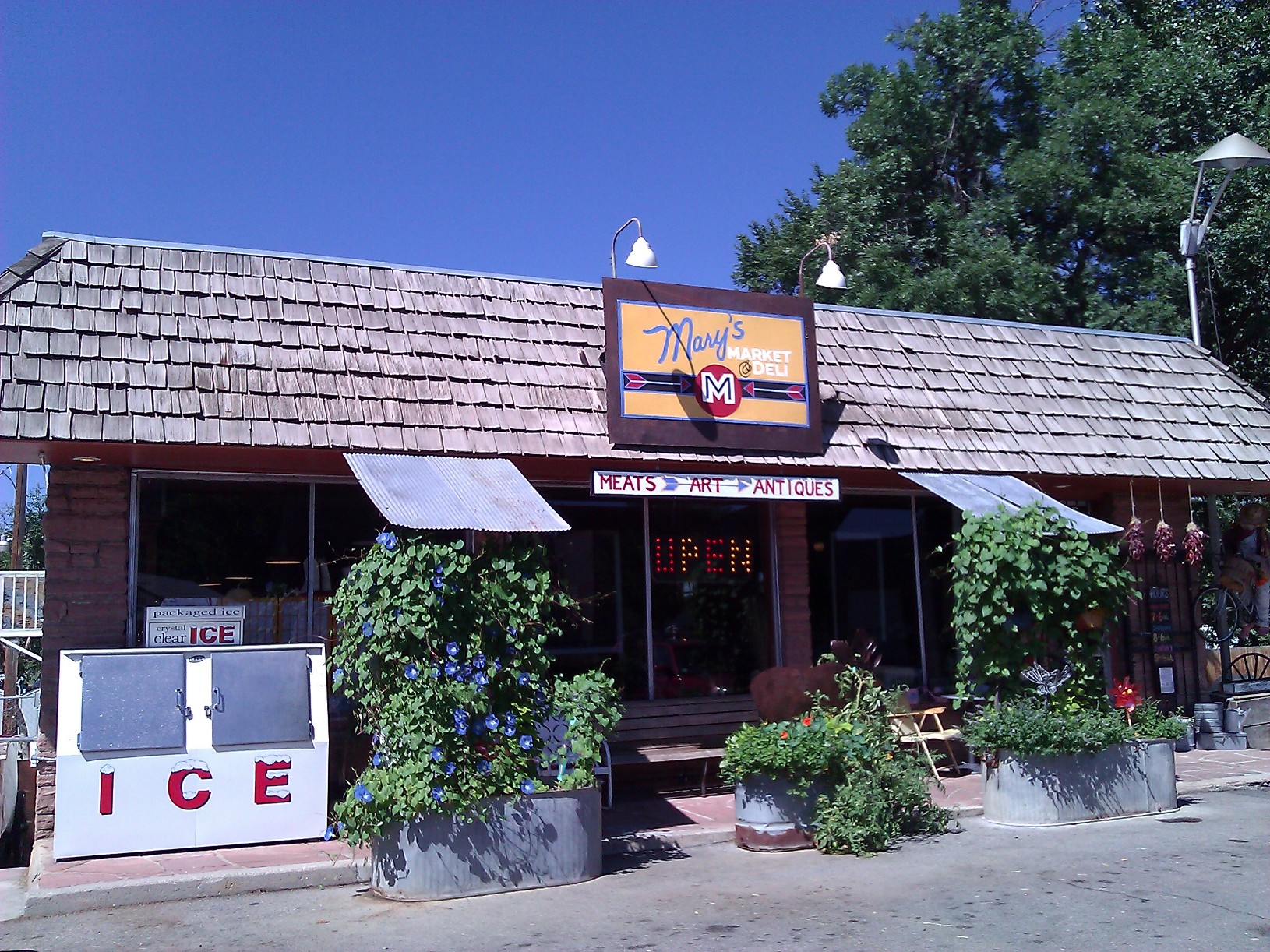
Mary's Deli in Hygiene, a Popular Cyclists' Break Place (Mary Topping)
Donald and I returned to Full Cycle in time to watch Robert, Stef, Dennis, and Pieter ride east from the shop down Pearl Street, standing on the pedals, each so fluid it seemed man and bike had fused together, one of the most beautiful sights in the sport.
Biking takes us places – down bucolic country roads, to foreign countries to watch iconic bike races like the Tour de France, even to weddings (Donald and I met on a bike). It’s a pretty safe bet all of us who came to ride with members of the Rabobank team returned home after the ride, while the Rabobank riders returned to yet another home away from home, getting ready to travel to yet another foreign country, another unfamiliar bed. For pros like Stef Clement, toward the end of the season it seems like cycling mainly takes them away from home, no matter how European-like the race location or how windy the ride.
If Rabobank returns to the UPCC next year, I’d like to bring the Dutch riders on the team a little reminder of home. Perhaps a miniature replica of a Dutch windmill. Funny how windmills, just like a bike’s wheels and a pro-cyclist’s legs, keep spinning.

Dutch windmill (Keith Lightbody)
Media credentials for a pro-cycling race provide access to resources so the media can promote the race through stories and photos. A fan or blogger can often access this information to enjoy the race more or cover it for their Twitter or blog followers.
What credentialed media for the USA Pro Cycling Challenge (UPCC) got

UPCC Media Credential for 2011
As I credentialed media person I received a “technical guide” with route maps that included a black diamond with a knife and fork on the course — the feed zones. This symbol didn’t appear on the route maps on the official UPCC web site, a bummer for fans seeking souvenir musettes or water bottles.
How can a fan or blogger get feed zone information?
At the starts ask team staff / soigneurs for feed zone locations. Some media folks post the technical guide maps on their pro-cycling websites.
Press conferences. Every day after the awards presentation the race hosted a press conference; typically that day’s stage winner and several of the jersey holders attended. The most enjoyable part for me was the visual reminders of the race effort: damp curling tendrils of hair escaping riders’ caps around the ears (except of course, for Levi). A few hours after each press conference, the PR firm handling the race compiled a rider quote recap and emailed it to all credentialed media. Much of what post-race website reports, such as cyclingnews and velonews, include as rider quotes are gleaned from the press conference.
How can fans or bloggers find out what the riders say in press conferences?
For 2011 the UPCC made press conference video footage available on YouTube and the UPCC website under “About –> Press Kit”. A few of the quotes from the press conference made it into the press releases that were posted on the UPCC website under “About –> News”. I don’t know how soon the webmaster put these up. For races that don’t publicize this information on their websites, I have to believe there is a way to find them on the internet by searching on keywords or using a site that logs all press releases. Or, wait for your favorite website to report its daily race summary.
Team bib numbers and prologue and time trial start times were also made available on the Press Kit page of the UPCC website.
The PR firm’s quote recap excluded some of the most interesting ones. One example is Vande Velde’s quip that fans’ gratefulness for a pro-race in Colorado would manifest in purchases of Quiznos sandwiches for a year. Similarly, the press releases played it safe with language; the stage 2 press release did not include Van Garderen’s statement regarding his descent, “I have balls.” (Is that cojones in Spanish?)
Free lunch, snacks, and coffee. The race fed the media folks well so they could work well — sandwiches stuffed so thickly you began to smell matzah ball soup from the Carnegie Deli on 57th Street in NYC, fresh salads, and killer brownies and cookies. Thank you to all the local organizing committees who funded this food.
How can fans and bloggers get free food at the race?
Don’t skip the start and finish festivals. Food vendors gave away free samples; Honey Stinger offered bite-sized pieces of their energy bars (if you visited five times you could snag in effect an entire waffle snack). The Cascade Farms folks set out whole mini-bars in Denver. At festival closing time some vendors give away bottles of energy drinks or other goodies they don’t want to carry back.
Media centers near starts and finishes. These press offices provided wireless internet access and a big screen with live race action which played ShackTracker coverage while reporters and photographers worked on laptops. I think pre-Tracker live coverage fed to the big screen but I didn’t sit in the media center early enough to know when it started.
Can fans and bloggers see the race and have wireless too while on the course?
An I-or android phone that can become a hotspot on which you have downloaded the Tracker app, paired with an I-Pad or laptop? I need help from a techie on that one. If a McDonald’s exists near the course, many in Colorado and Utah offer free wireless service.
Sometimes, a request to ask permission first. The evening before the prologue I wandered around the parking lot of the Colorado Springs hotel that hosted the teams and race organization. I like watching the hidden heroes of bike races, the mechanics, ready the athlete’s machines. Two Garmin mechanics worked under an awning in the drizzle and dull light of early evening, one on a white time trial bike with blue stars on the top tube. Usually Garmin’s bikes are black. Polite one that I am, I asked if I could take a photo of the white bike in the stand. “Are you media?” the mechanic asked. My credential dangled around my neck. He told me I would have to ask their press officer for permission to photograph the bike.
Could I have taken that photo if I was “just” a fan?
I got the feeling that I could have photographed Captain America’s special TT bike if I had left the media credential in the car.
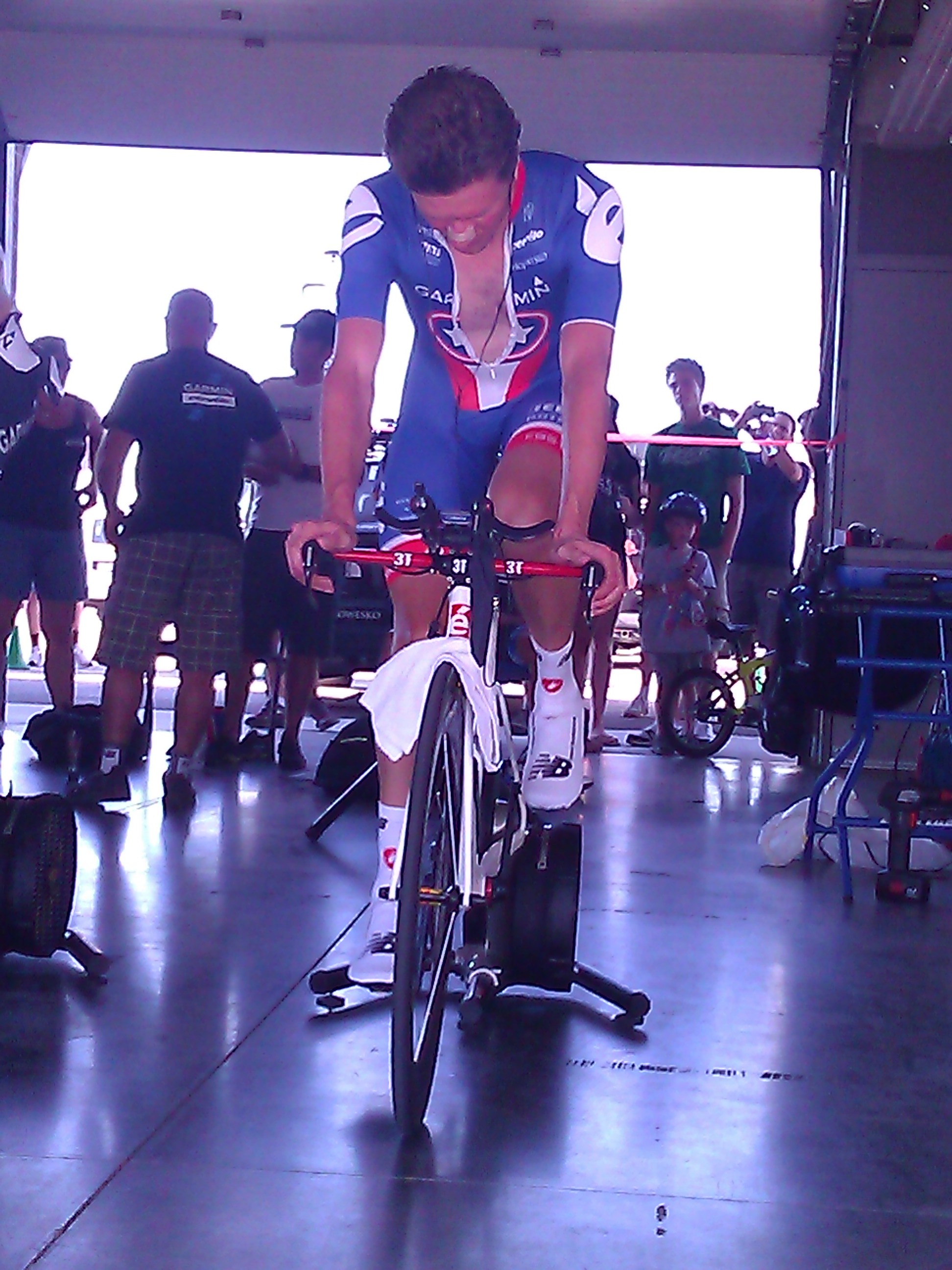
David Zabriskie warming up for the 2011 Tour of Utah time trial (Mary Topping)
More access to the athletes? I think it depends on the race. At the Tour of Utah I interviewed and spoke briefly with the athletes without a press pass. I explained I was a writer for procyclinggolden.com and a blogger and in all cases the guys talked to me. This approach might not work at a race with larger numbers of fans and media vying for the athletes’ attention.
Buena suerte. Good luck in Spanish. This, I can pronounce. I still have trouble pronouncing Gobernacion de Antioquia. But I know what the words mean. Gobernacion means “state” or “department.” Antioquia is one of the states in Colombia.

Antioquia, Colombian state or department
Orgullo Paisa translated into English means “proud people.” Orgullo Paisa is, based on my understanding from talking with Luis Barbosa of Nuestrociclismo, a cycling development program / team funded by the state of Antioquia that brings young people up in the sport. According to Luis, it’s the most important development program in the country.
For almost twenty years Orgullo Paisa has sought talented, young riders and launched guys such as Baez, Suarez, Infantino, and Botero into cycling careers. I think this list also includes Henao. From what I understand, the program provides access to equipment so that a family in need — like that of 16 year-old Johan Cardenas in the state of Boyaca — doesn’t have to sell its house to buy an aspiring teen-ager a good bike. What I am not clear about is whether the program favors cyclists from Antioquia; Baez, for example, is from the state of Boyaca and Infantino is originally from the Dominican Republic. I think I’ll ask “Klaus.” I’ll also ask him to confirm if the Gobernacion de Antioquia team we saw in Utah and Colorado is part of Orgullo Paisa — that’s how it seems (my lack of Spanish is getting in the way).
Orgullo Paisa has a Facebook page with lots of great photos of Henao, Botero, and others we’ve seen in the U.S. this August.
As much as Orgullo Paisa does, probably it can’t help allieviate the difficulty Colombian pro-cyclists have getting VISAs so they can travel internationally for races. Cycling Inquisition’s author, “Klaus” shared an interesting VISA story:
“It can take up to a year for most Colombians to get visas to most countries. Victor Hugo Peña had has visa stolen before the Tour on the year when he was in yellow for a few years with US postal. He was nearly unable to get into france legally. he was almost hours away from sneaking in across the border from spain, but the ambassador and people at the highest levels of government got involved and saved him in the last minute. amazing stuff.”
Update, 9/1/2011. Here is more background on Orgullo Paisa and GOB, from Klaus in response to my questions in the comments area on Cycling Inquisition:
“I actually spoke with Santiago Botero on the phone this morning, could have asked him for you. But this is what I understand. In Antioquia (the Colombian department), the state has funded a program to develop riders since 2003 I think. During that time, the program has had amateur teams for young riders, and an elite team, which only really turned professional this year. During its life, the program and the team has been named multiple things, including “orgullo paisa”, as well as the current name (which is that of the sports association of antioquia, as well as the government of the department). So Orgullo paisa is Governacion De Antioquia-Indeportes Antioquia. So in a way, the team doesn’t have a real sponsor per se. This explains why they buy their own bikes, riders buy their own bar tape etc. “
A cyclingnews article stated the program has been in place for 18 years and described how Botero borrowed trainers and the mechanics switched out parts during the UPCC Vail time trail so different riders could share a TT bike (the team didn’t have a TT bike for each rider). So while Orgullo Paisa provides for its recruits, it seems it doesn’t have sufficient backing to fund everything a rider might need.
You’ve stood on Alpe d’Huez or watched every stage of the TDF (and know what TDF stands for) on TV for at least three years. Gogo is a person you know and not something from a 60’s Laugh-In show or pole-dancing venue. This is for you. I expect lots of critiques because you know pro-cycling.
Best preparation for the USA Pro Cycling Challenge (UPCC)
On a media call three days before the UPCC prologue, Levi Leipheimer, said, “Racing Utah is the best preparation for Colorado because it’s racing at altitude.” The top five in GC at the UPCC rode the Tour of Utah (Leipheimer, Vande Velde, Van Gardaren, Danielson, and Hincapie). So study the 2012 Tour of Utah before the 2012 UPCC. Review the stage profiles and results at the race website and follow @podium_live on Twitter for live feeds.

Levi Leipheimer chatting with Santiago Botero before Stage 2 start, 2011 Tour of Utah (Mary Topping)
It’s interesting to compare the elevations as well as the average feet climbed for both races. My second post on the UPCC as an altitude test lab included a table of starting, finishing, and highest elevations for the stages of that race. The average start and finish elevation points for the 2011 Tour of Utah are about 2,000 feet lower than those for the UPCC; the average highest point about 3,300 feet lower.
| stage | start | elevation | finish | elevation | highest point |
| prologue | near Park City |
6,955 |
near Park City |
7,275 |
7,275 |
| stage 1 | Ogden |
4,200 |
Ogden |
4,200 |
6,100 |
| stage 2 | Lehi |
4,595 |
Provo |
4750 |
5120 |
| stage 3 | Tooele |
4,400 |
Tooele |
4,400 |
4,440 |
| stage 4 | Salt Lake City |
4,600 |
Salt Lake City |
4,600 |
4,840 |
| stage 5 | Park City |
6,490 |
Snowbird Resort |
8,100 |
8,100 |
| elevations approximate | |||||
Average feet climbed is very similar for both races.
| Tour of Utah Miles and Elevation Gain | ||
| stage | miles | elevation gain ft |
| prologue | 1.25 | 615 |
| stage 1 | 116 | 8,250 |
| stage 2 | 100 | 2,820 |
| stage 3 | 9.7 | 280 |
| stage 4 | 81.4 | 6,670 |
| stage 5 | 100 | 10,900 |
| total | 408.35 | 29,535 |
| avg ft/mile climbed: | 72.3 | |
| UPCC Colorado Miles and Elevation Gain | ||
| stage | miles | elevation gain ft |
| prologue | 5.18 | 219 |
| stage 1 | 99.4 | 8,020 |
| stage 2 | 131.1 | 9,746 |
| stage 3 | 10 | 1,783 |
| stage 4 | 82.8 | 5,034 |
| stage 5 | 105.2 | 8,327 |
| stage 6 | 73.79 | 3,129 |
| total | 507.47 | 36,258 |
| avg ft/mile climbed: | 71.4 | |
Does on-site course recon in advance of the race really matter?
With all of the other variables involved in who succeeds on a given day and overall – recovery, illness, team tactics, mental preparation, and others – does reconning a course provide a significant advantage?
On the same media call mentioned above I asked Levi if he had reconned the Vail TT and what it would take to win that stage. His reply: “No, I haven’t seen it. I’ll ride it that day. I’ve talked to riders who have done it and looked at videos. It’s not a real climb; it’s more a time trial than a hill climb.” Levi won the Vail TT, though on nearly the same time as Christian Vande Velde. Did Christian recon the TT?
Conversely, Stephanie Danielson mentioned in Avon that because of his recon on Independence Pass Tom knew exactly how to take a certain corner to gain time on the descent, and he finished in the first group in Aspen.
Altitude Schamaltitude
The UPCC’s unique calling card, riders mentioned the high altitude as a significant factor in their performance and how the race played out. Andy Schleck described altitude’s impact after he finished stage 5 into Breckenridge (I believe the climb he’s referring to is Swan Mt.): “It is a little bit of a slow-motion race. A climb like today, if we’d done it at sea level, I think we would have done it four or five minutes faster. This has definitely been a hard race. Altitude has been the biggest force. I don’t think the climbs are harder than places like the Alps, but it is the altitude that makes us suffer.”
Yes, altitude mattered, but there’s something about the uni-focus on altitude that has bothered me. @CubyPoldark summed it up for me: “agree about ‘altitude’ focus, thought it was reducing the race to a novelty event.” This leads to what to change and not to change for 2012.
Change this for the 2012 UPCC
Create a course that challenges on more than altitude alone. Increase feet of climbing per mile, add a mountain-top finish, and/or include steeper repeated climbs in a circuit-type race like the Salt Lake City loop in Tour of Utah (not as easy to do as in Europe, but we’ve got some steeper hills). Find a way to amp-up the challenge and still include a couple of sprint finishes. The sprint finishes this year added excitement to the race in the way only mass sprints can.
Offer a fantasy team challenge game on the official website like the one Versus created for the Tour de France, with a fan fantasy chat zone. The poster contest was artistically pleasing, but an on-line fantasy contest will engage more folks in the race.
There’s a whole world of women’s professional racing that would surprise even most pro-cycling fans. A reincarnation of the Coors Classic women’s race would recognize the hard work of female athletes, provide more exposure for sponsors that support racing by both sexes, and grow spectator interest in the UPCC. The race organizers would become heroes in the eyes of many.
Whoever is manning the official Twitter and account is doing a good job overall. They just need a bit more schooling in pro-cycling terminology and selection of the correct last name for Colombian and Spanish riders so readers don’t think Juan Pablo Suarez Suarez rides in the break when the right man is Eduard Beltran Suarez.
TV coverage in 161 countries but not Colombia when 12% of the peloton (and hence potential fans) call that their home country?
If it ain’t broke don’t fix it for 2012 UPCC
Team invites. The mix of Pro-Tour, new Continental, and Colombian teams drew attendance and added interest to the race via their participation in break-aways or pulling them back, and by introducing fans to new riders
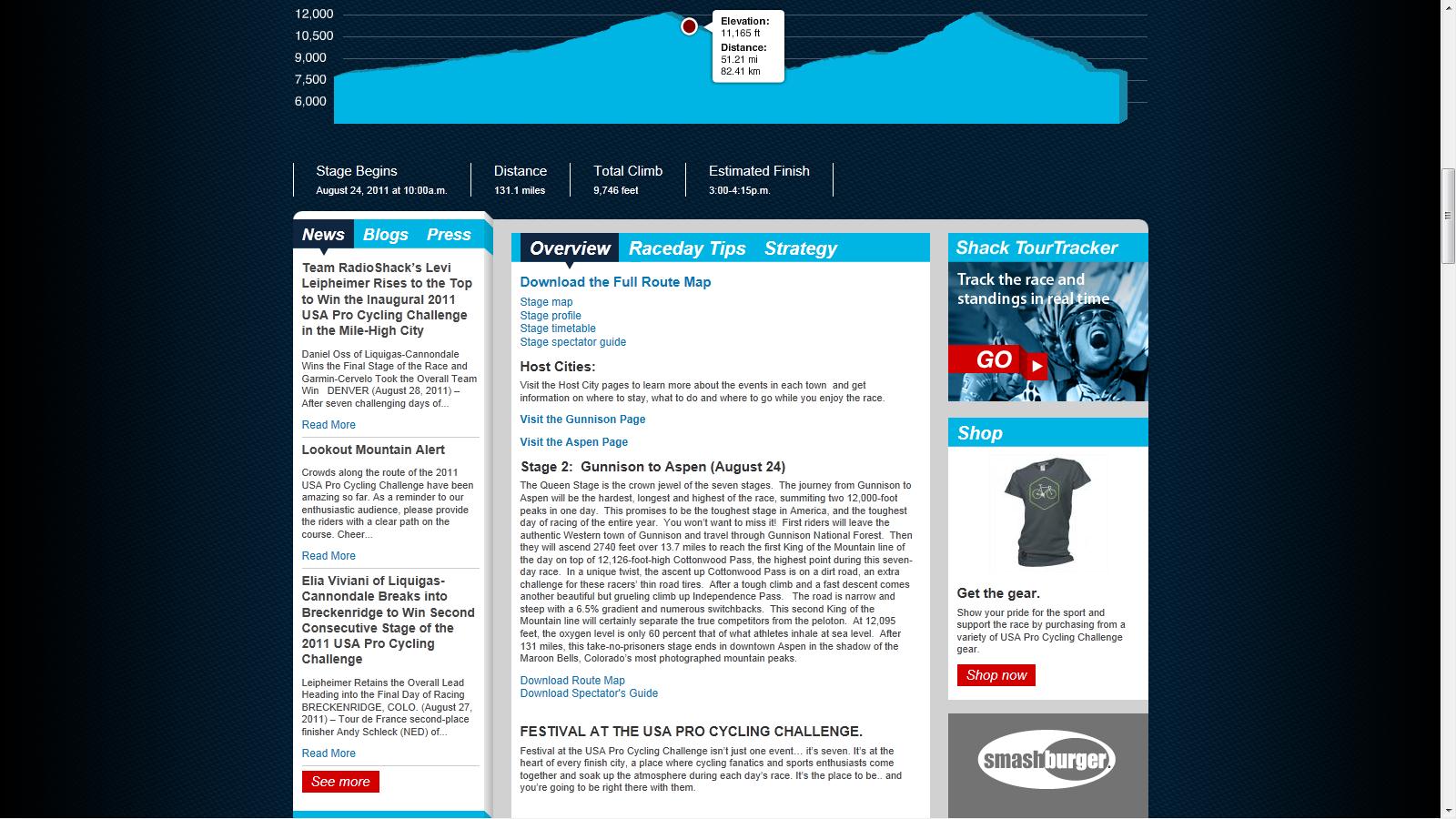
UPCC website stage 2 screen shot
Lots of information on the website. Yes, sometimes the website got hung up, and some of the rider bios weren’t accurate. But overall the website is a great resource with videos of the stages, advice on where to watch, route maps (just add the feed zone), timetables, a place for comments on each stage, and more.
Race organization / implementation. Teams cited the quality of the race organizer, Medalist Sports, as part of their confidence in the event. Was everything perfect? No. Was it a first-year race? Yes. Was more right than wrong? Yes. Many have commented on failures of the TV coverage. How many domestic races have had daily national coverage during the inaugural year?
Spectator enthusiasm and attendance. Comments abound on this topic; there’s not a lot more to say. Just one thing: keep Golden in the race as a host city for 2012.

UPCC stage 6, downtown Golden Start at noon after last riders passed through (Mary Topping)

 ProVéloPassion