
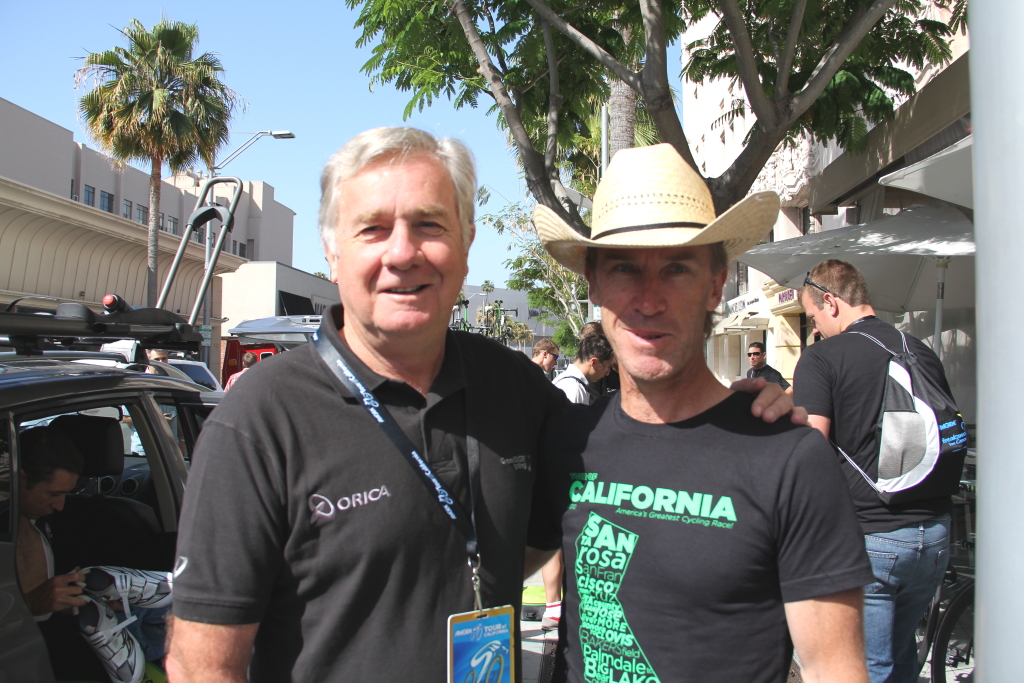
Gerry Ryan and Neil Stephens (Sports Director) at 2012 Amgen Tour of California stage 8
Australian entrepreneur and cycling patron Gerry Ryan makes things happen. That comes as no surprise after learning he grew up as one of nine children and worked as a kid, selling newspapers. Usually a kid works because he wants things his family can’t afford. He quickly learns the way to get something is to go out and make it happen himself.
That assessment of Ryan’s childhood – based on research and guesswork, suggests a couple of things. First off, after working in manufacturing for a couple of years, Ryan probably thought he could build something better if he did it himself, so he started his own company in a shed. Now over thirty years later he’s the wealthy owner of the recreational vehicle company he nurtured and grew, Jayco.
Secondly, wealth hasn’t erased Ryan’s understanding of the sacrifices a person makes when he works hard, especially for something with long odds that he believes in regardless, and where success requires risks and patience. And that’s why he understands sports, in particular professional cycling.
French connection
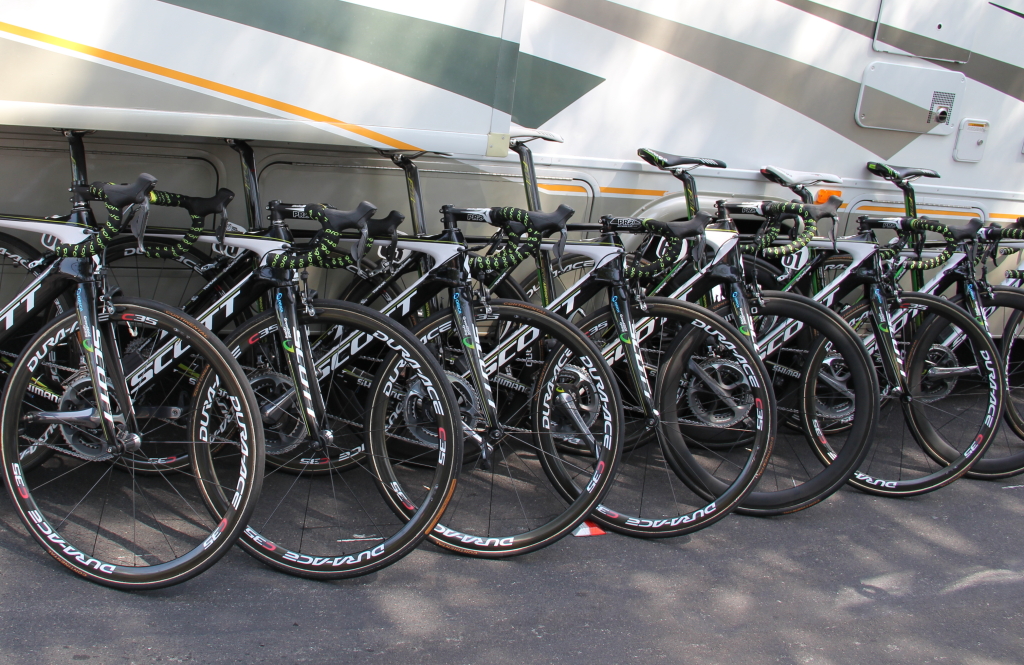
According to a Sunday Mail story on Adelaidenow.com, in 2010 Gerry Ryan attended the Tour de France and watched team cars roll by on the Champs-Élysées with French, English, American, Italian, and other countries represented. Australia was missing. He wondered how to fix that. So he called Shayne Bannan, Cycling Australia’s director. He asked Bannan what kind of budget would place an Aussie car in the Tour de France caravan.
Bannan and Ryan worked together through 2011 to make Australia’s first WorldTour team, at first called simply GreenEDGE prior to the appearance of the first naming rights sponsor Orica, a reality.
When Ryan posed that question to Bannan in 2010 he was already familiar with the costs of bike racing, but he hadn’t supported a WorldTour team before. Ryan has backed cycling, among other sports, for twenty years through Jayco. According to the company’s website, in 1992 Jayco formed the first Australian professional cycling team; the Jayco Cycling team evolved into the current Jayco VIS team. Cadel Evans, Simon Gerrans, and Baden Cooke have all had ties with Jayco VIS. Jayco continues to sponsor numerous Australian races including the Tour Down Under and the Jayco Herald Sun Tour.
Shared values
Cycling naturally shares many of the values behind Jayco’s business. Family, for example. Camper vans bring families together – for better or worse – as they log miles on the open road. Similarly, amateur bike racers and young pros drive miles to races and many sleep in their cars or camp on overnights. That’s what they can afford and they count on family and friends for support and to cheer them on.
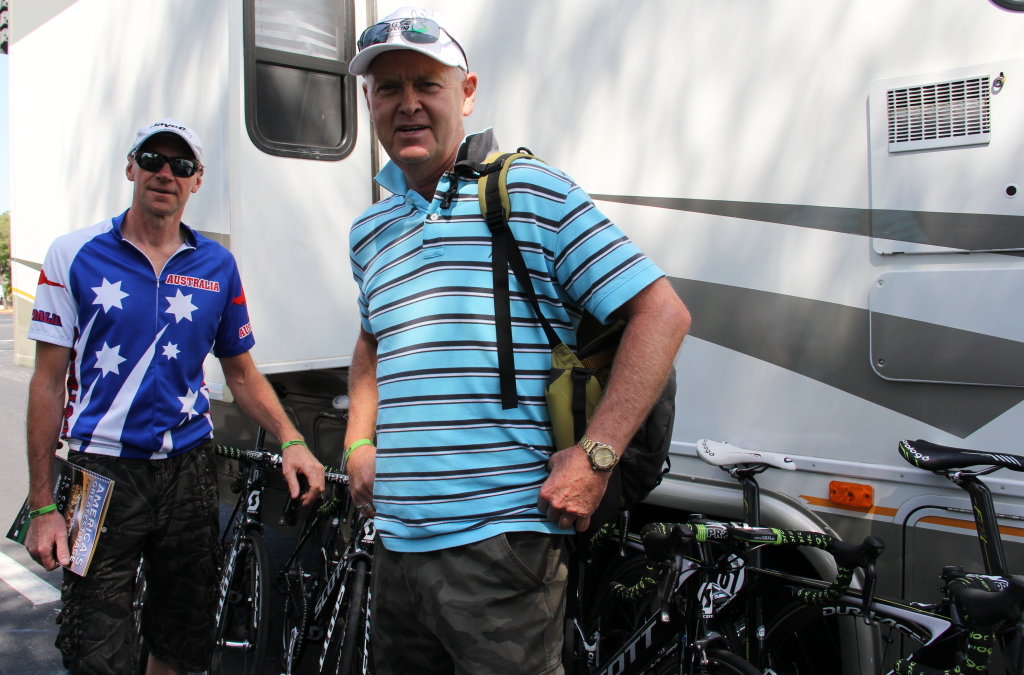
Dave Peters from Ballarat & Peter Hayes from Bendigo followed the entire 2012 Amgen Tour of California and became fixtures at the Orica-GreenEDGE bus.
Then there’s freedom. People steer camper vans to new places, coming and going as they like. Kids grab bikes to play but also to get away; with two-wheeled self-sufficiency kids can explore beyond their neighborhoods.
Many recreational vehicle owners meet up at destinations and spend time together. Cyclists share in community too. They wave to each other on the road. They’ll stop to see if someone with a flat needs a tube and gladly give one away. They welcome cyclists they have never met into their cars to ward off hypothermia after a long, cold descent.
It’s smart to lead an organization using values; people are willing to change for and follow values. That’s a good thing in professional cycling where making money is the exception rather than the rule. In September, 2011 Ryan told Cyclingnews, “Put it this way. We’re not out to try and make money. We’re out to be a sustainable financial model.”
Ryan is a businessman. For him Orica-GreenEDGE is a business project. But listening to him talk about the team, it’s clear it’s a project he’s sunk his heart into. Ryan shared some thoughts about the team’s first year to date with ProVéloPassion on the final day of the 2012 Tour of California.
Early success
Ryan said he had regarded the team’s first year as a set-up period: he hoped to win a couple of stages at major races while building a brand and attracting sponsorship. At the time of this article, GreenEDGE has fourteen wins, a naming rights sponsor in Orica who arrived ahead of schedule budget-wise, and a new name, Orica-GreenEDGE. “It’s certainly above our expectations,” Ryan said. “What we wanted to do is one, get the organization up and running, and develop a culture…if we finish the season now we’ve been very successful.”
The culture Ryan aims to create among riders and staff is about more than winning on the bike. “It’s being able to knit together, teamwork, developing spirit, a family spirit as I do in all my organizations I’m involved in,” Ryan said, “because you’re a family on the road. You’ve got to live together. It’s a big journey from the time they get up till the time they go to bed…it’s important during that time that everyone works close together to make sure they can prepare for the next day.”
Ryan beams when he talks about observing races where riders, management, and support staff worked together. He’s proud of the joint efforts of male and female athletes and staff from thirteen different nations.
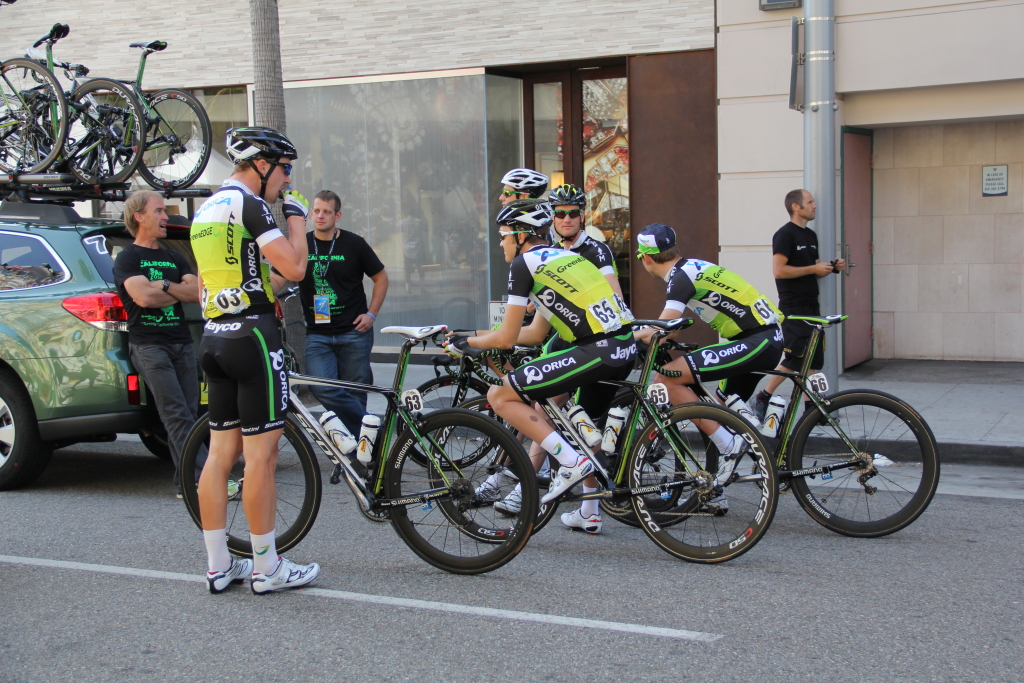
Orica-Greenedge men before stage 8 Tour of California
A state of green
When prompted regarding the team’s stance on innovation, Ryan said, “Green and gold – [that’s] Australian, but we are a global team. Green is for sustainability and environment. EDGE is for edge in sports science, edge in equipment, edge in systems. So we’re trying to be different.”
As the team brings up young talent, it ushers senior riders like Robbie McEwen into retirement from racing. As the older siblings leave the nest, focus intensifies on the youngsters like Luke Durbridge, the Australian national time trial champion. At age 21 Durbridge just upped the team’s win count to fourteen with his prologue victory at the Criterium du Dauphine which is currently in progress, a state Ryan understands well.
“I’ve got a philosophy,” Ryan said, as he applied sunscreen and offered it to the team staff, “change or become a victim of change.” It’s pretty clear he’s in the first camp.
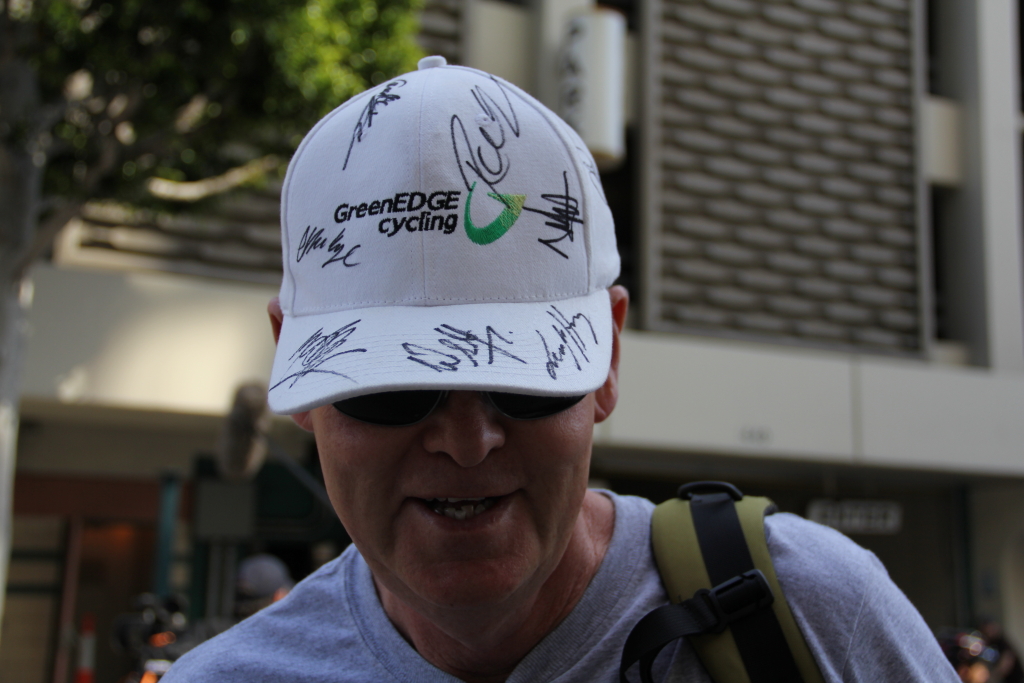
Peter Hayes lives in Gerry Ryan’s hometown of Bendigo and followed the entire 2012 Amgen Tour of California with his mate, Dave Peters from Ballarat
Orica-GreenEDGE 2012 victories
Australia Road Race Championships, Simon Gerrans
Australia Time Trial Championships, Luke Durbridge
Overall Tour Down Under, Simon Gerrans
Stage 1 Tirreno–Adriatico, Team Time Trial
Milan – San Remo, Simon Gerrans
Overall Volta a Catalunya, Michael Albasini
Stages 1 & 2, Michael Albasini
Stage 2 Tour of the Basque Country, Daryl Impey
Overall Circuit de la Sarthe, Luke Durbridge
Stage 3 (ITT), Luke Durbridge
Stage 3 Giro d’Italia, Matthew Goss
Stage 3 Tour of Norway, Aidis Kruopis
Prologue, Criterium du Dauphine, Luke Durbridge

Fernando Riveros (Bandwagon Racing) after Teva Mountain Games MTB XC race
Today riders in the 2012 Teva Summer Mountain Games XC MTB race covered a seven mile lap with an inverted “V” profile three times.
Vail, Colorado is the site of the Teva Mountain Games; the MTB course runs along the front side of the ski resort mountain.
Fernando Riveros on Bandwagon Racing started strong and finished 9th.
Check-out the interview with Fernando, who is from Colombia, at the end of the video to find out about his race.

2012 Amgen Tour of California stage 4 profile
What is it like to pedal 17,000 feet against gravity in 130 miles for over five hours when the temperature measures 90 degrees Fahrenheit? The answer lies in stage 4 of the 2012 Amgen Tour of California, a day the riders started having already raced 348 miles over the previous three days.
Riders crossed the stage 4 finish line in Clovis in open jerseys caked with salt from the evaporated perspiration of ascending six categorized climbs at a tough pace.
“RadioShack was chasing,” Andreas Diaz on Team Exergy said, as he changed in the team parking area after the stage had finished. “There must have been someone dangerous in the break.”
The Bontrager Livestrong staff must have been among the first to set up in the team parking area; their riders sank into fabric folding chairs in one of the few shady spots on the baking asphalt. The development team riders and nearly every rider present had stripped off their jerseys before packing up for the two hour trip to Bakersfield. Bib short straps, pulled down as low as riders dared, dangled around their thighs as riders attempted to cool off after a long day in the sun.
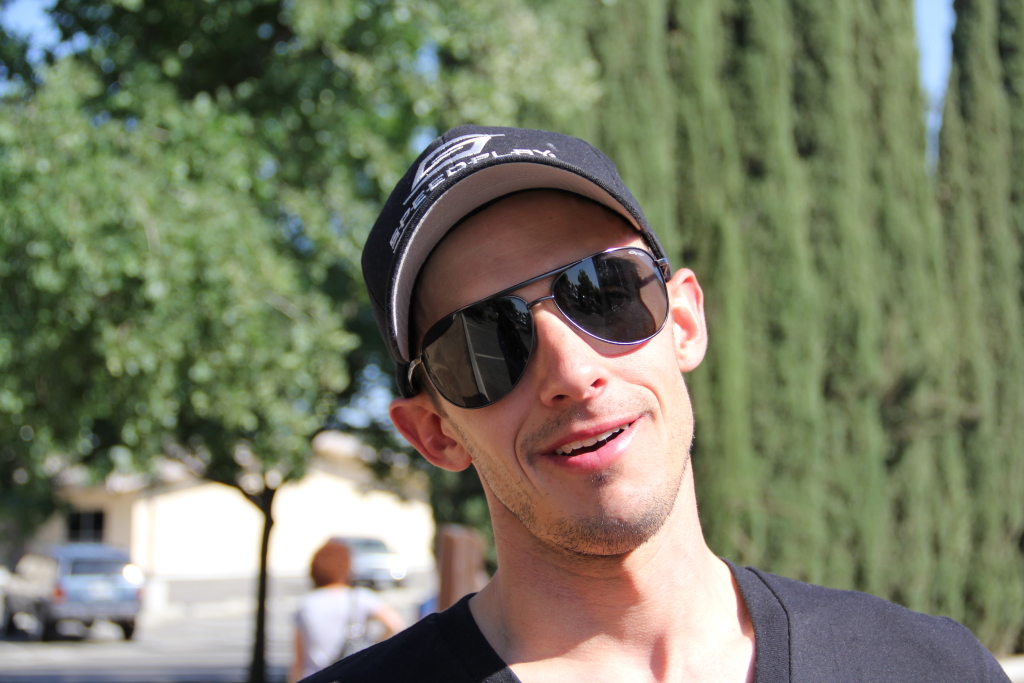
Matt Cooke of Team Exergy after 2012 Amgen Tour of California stage 4
Matt Cooke, a climber and previous elite road national champion, rides for Team Exergy and lives in Boulder, Colorado. When he trains at home he prefers riding on his own. Cooke won a road race stage at the Sea Otter Classic this spring. He and seven teammates formed the Team Exergy roster for the 2012 Tour of California.
Cooke had just finished showering and wore a casual tee-shirt and shorts. “I’m still hot,” he said, resting his eyes under Smith Aviators and sitting on a dusty team car bumper under the open hatch-back.
He also wore race-day scruff. “I probably won’t shave [my face] until the end; I’ll only shave my legs. I mean, I’m not trying to look good for anybody,” Cooke said.
He described the stage 4 experience on the road.
The day’s stage started hard. The riders expected to crest the first KOM after twenty miles, but an uncategorized climb tested the field before that and fast tempo riding continued all day long. “Personally I was very tired. The legs sort of came around as the day went on.” Cooke explained tempo riding: “When the field is three abreast they are going hard but these are not like Chris Horner race-ending attacks. It got really hot out there; we went through so many bottles.”

Jacob Rathe’s salt stained kit after stage 4 of 2012 Amgen Tour of California
Cooke drank about ten bottles of fluid during stage 4.
Cooke responded to a question about the difficulty of the first climb, a category 2 that included some steep pitches. “To be honest, I don’t really remember it well. My memory is really, really short, especially regarding this stuff…everything is moving so quickly. You have to get on to the next task…and partly it didn’t matter since it was just the group together, all riding tempo. If there was an attack that I went with or someone went with, I would remember that more succinctly than just riding along. You sort of save your brain cells, at least for myself.”
Cooke’s specialty is climbing. But every rider works for the team, so he helped to position Freddie Rodriguez, Exergy’s sprinter, near the end of the race for a shot at winning in Clovis. After he’d pulled Rodriguez as much as he could, he drifted back in the field as they closed in on the finish line. He said, “You help him [your sprinter] as much as you can and then he’s on his own.”
Some sprinters fought every inch of the 17,000 feet of climbing and arrived 15 minutes after the front of the field. Travis Meyer, on the Orica-GreenEDGE team, whose camper was parked next to the Exergy camp, had arrived with the later finishers. He rested his bare feet on ice cubes.
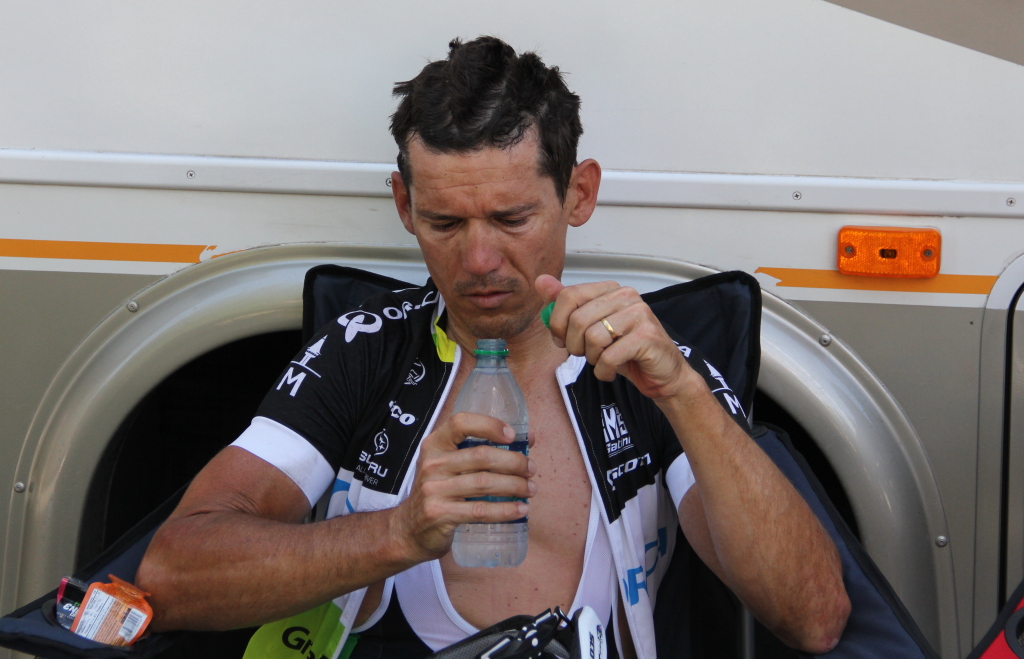
Robbie McEwen after 2012 Amgen Tour of California stage 4 — helmet hair extraordinaire
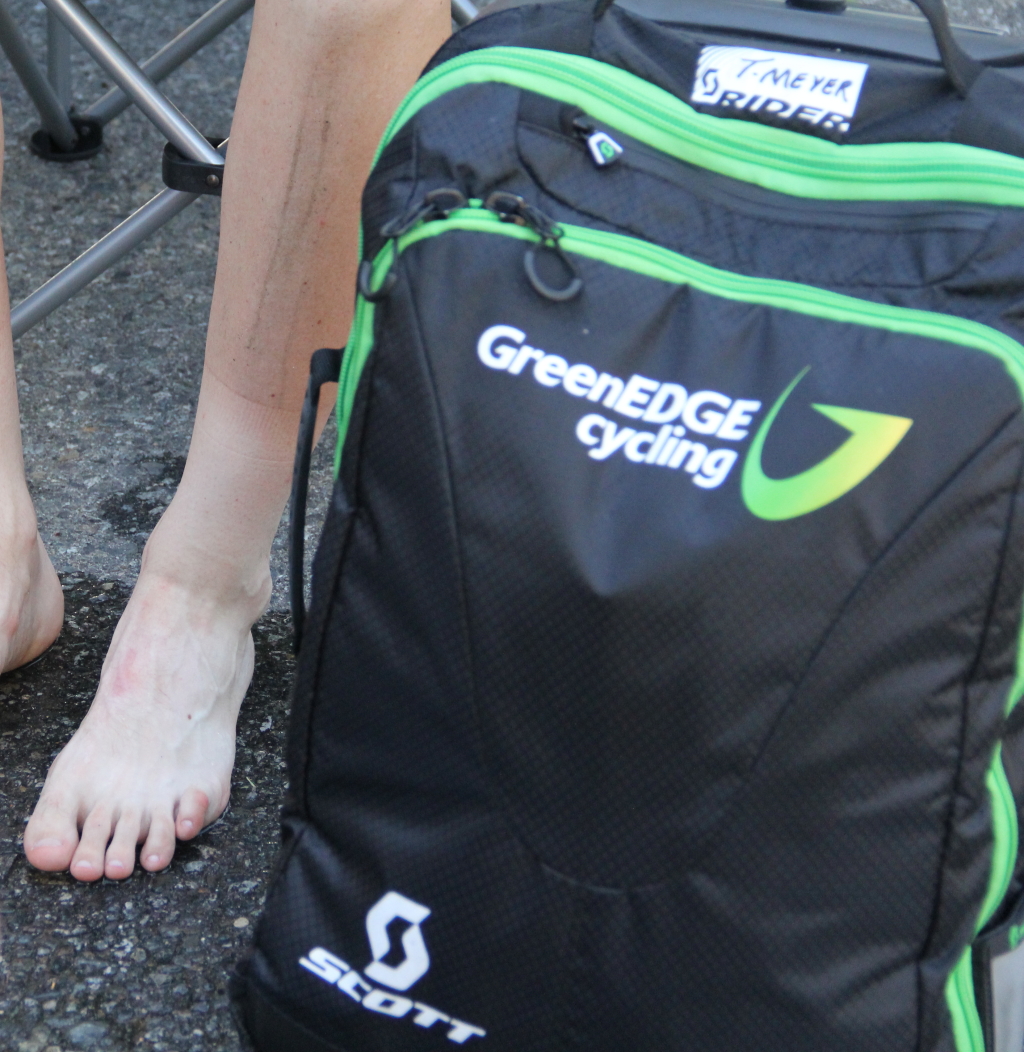
Travis Meyer’s foot cooling off after stage 4

Jeff Louder (UnitedHealthcare) in stage 1 breakaway on Coleman climb
Five riders who competed in the 2012 Amgen Tour of California share what they’ll most remember about 700 plus miles of west coast racing.
Jeff Louder, UnitedHealthcare: “Generally I’m going to remember just how difficult it was. It was a consistently hard race from the start to the finish; there was a really deep field and the courses were all harder than any other Tour of California that I remember. And specifically I’ll remember the break-away the first day that I was in and being able to hold on to third place…for four or five days – so that was really enjoyable. It’s nice to get your name out there and be a part of the race somehow. So I think it was a good California for myself and for the team. It was fun.” He secured third on GC by taking first place in the two intermediate sprints on stage one which earned him six bonus seconds. With the 2012 edition Jeff has competed four times in the Amgen Tour of California.
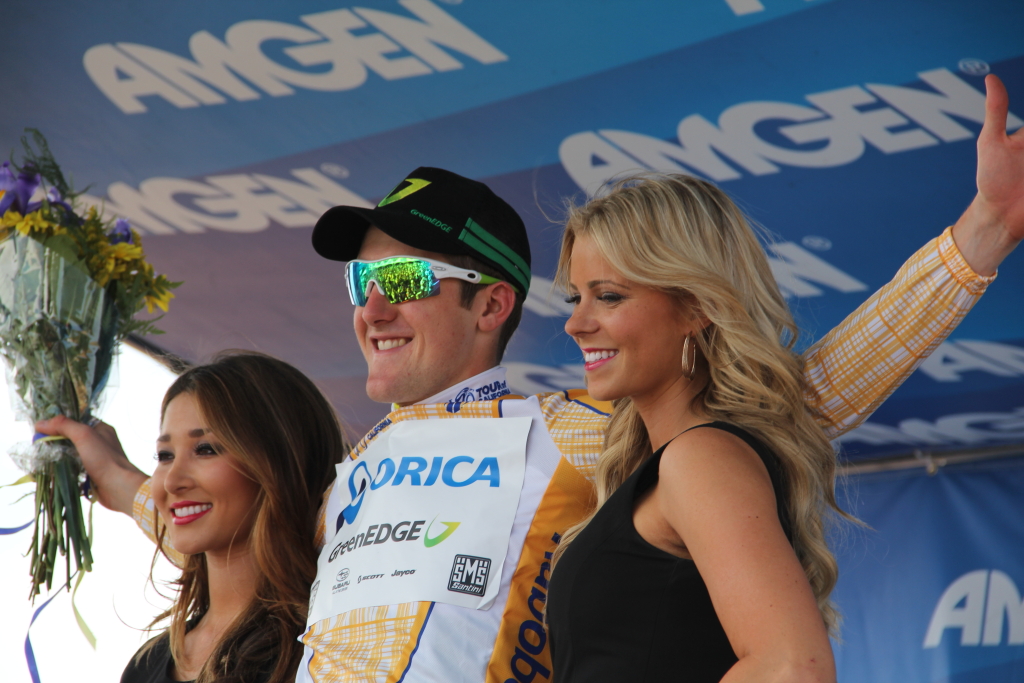
Luke Durbridge (Orica-GreenEDGE), best young rider after time trial
Luke Durbridge, Orica-GreenEDGE: “Definitely the crowds. The crowds are pretty unreal here, they’re really into it and they’re just really vocal…all the hype behind the race, people on the roadside, just love it. They are all dressed up and running alongside. It’s a really cool experience when you are racing up a climb and you see the guys next to you running along with so much enthusiasm.”
Luke is the current Australian time trial champion. Luke’s favorite costumed fan in California? “The guy with the goat helmet and the jocks.”
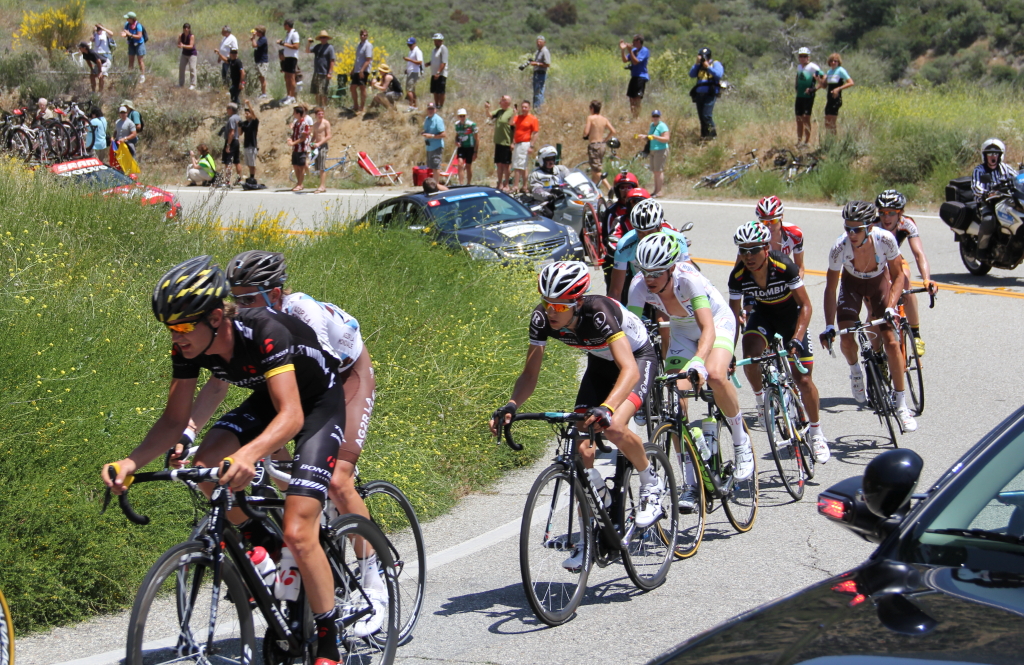
Mt. Baldy break-away, George Bennett (RadioShack Nissan Trek) center
George Bennet, RadioShack Nissan Trek: “I have a lot of good memories about the race — the crowds, beautiful roads, beautiful scenery.
“But, probably a little bit disappointing as well in terms of results. Personally, I had a bad time trial, and obviously Chris had a bad day in the TT and we didn’t achieve what we came here to achieve. But you know yesterday I was really proud of how we rode; that’s definitely going to stand out the most.”
George, Gregory Rast, and Jens Voigt rode for teammate Chris Horner in an audacious break-away move up to Mt. Baldy. George continued, “Chris has probably one of the best attitudes as a leader, he had a really bad day in the TT and saw the overall go out the window — probably a lot of guys would have quit…we laid it all on the line yesterday, and Chris ended up not where we wanted to — we thought we could have won the stage, we thought we could have maybe taken GC back. But we left everything on the road, we have no regrets really. There wasn’t anything more we could have done.” George, a strong climber from New Zealand who came to road racing from mountain biking, is a neo-pro this season. Last year he rode for Team Livestrong-Trek and won the Tour of Wellington in New Zealand.
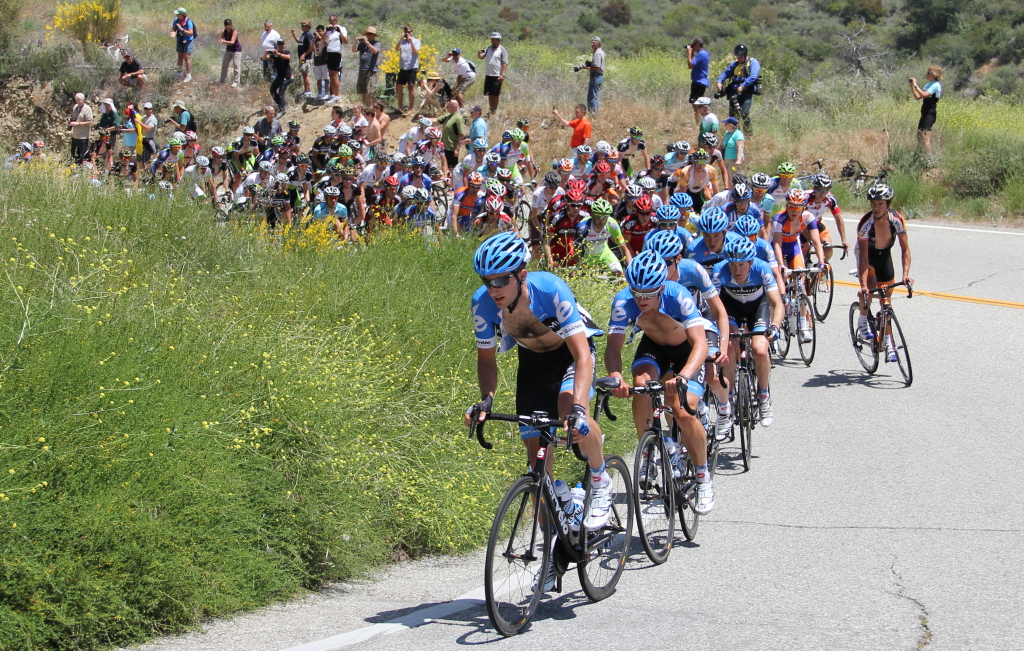
Chasing Mt. Baldy break, Nathan Haas (Garmin-Barracuda) second wheel
Nathan Haas, Garmin-Barracuda: “We had awesome food, we had a team chef this week, it was amazing…every night was different.” Chef Barbara Grealish did not cook in the team hotels; she cooked out of the team bus in parking lots. “We’d just go [to the bus] and she’s been cooking for hours before we’d get there every day, every night.”
Nathan is also a neo-pro. In 2011 he won numerous races, including the Jayco Herald Sun Tour in Australia.
The other teams must have been jealous, eating rice or pasta and chicken every night.

Joe Dombrowski (Bontrager Livestrong) left, and Fabio Duarte (Colombia-Coldeportes) near Mt. Baldy finish
Joe Dombrowski, Bontrager Livestrong: “Well, for sure yesterday [Baldy] for me was definitely a sticking point. It was a week of a lot of waiting for me, because Axel told me to just save myself; the two GC days were kind of late in the race. The TT didn’t really go as I’d hoped, so I was really hoping for a good day on Baldy. So to come out with a real strong ride, I was pretty stoked.”
Joe stamped his name on the race by crossing the finish line fourth on Mt. Baldy.
Joe recounted the key moment on that climb: “I was in the group with I think three Rabo guys, including Kelderman and Gesink, and Levi, and Van Garderen – mostly just the big GC names were there. And Gesink went pretty early with five or six K to go and I tried to go with him but didn’t quite have the legs. Tejay and Danielson came around and I ended up catching those two and working with them for a bit and just kind of rode my own pace to the top.”
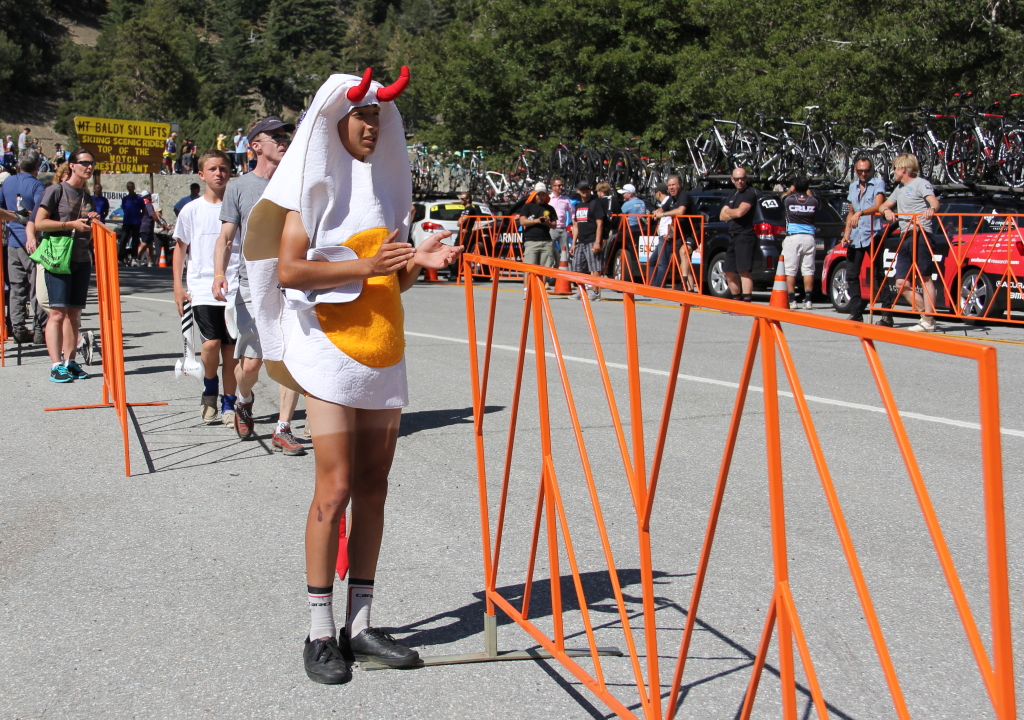
Deviled egg on slopes of Mt. Baldy
What will fans remember most when they look back on the 2012 Amgen Tour of California? They will recall the people that inhale professional cycling: the riders and the fans. Bike racing brings us closer to inspirational human performance as well as nutty and authentic expressions of love and appreciation.
Fans on the road at the AToC shared with ProVéloPassion what they will most remember when they look back on the race.
Remembering riders
Ronnie, Art, and Arnel from Glendale, Irwindale, and Marina del Ray in California arrived at 7 a.m. to set up on a hairpin turn just under three kilometers from the Mt. Baldy finish, the site of their camp last year. One said, “My favorite part of the race is getting close to the cyclists. They tour in Italy, France, all over the world, and here you can run alongside them and cheer them on and be this close to them.”
Anthony Feliciano from Hollywood, CA said, during a rest while riding up Mt. Baldy, “Yesterday’s stage with Sylvain Georges breaking away and staying away. That team really needed that win, and that was nice to see. I think even the leaders of the race were happy for him.”

Matt Busche (RadioShack Nissan Trek) chooses Reeses cupcake
David and his pre-teen son Gavin from Las Cruces New Mexico followed the race from Bakersfield to the finish in downtown Los Angeles. David spoke as he made sandwiches out of the back of the car six kilometers below the summit of Mt. Baldy. He and Gavin loved the TT because, Gavin said, “Matt Busche had a good TT time.” Gavin wore a cap Busche signed in Bakersfield, a cap Busche gave him last year. The family knew Busche when he lived in Las Cruces.
Anthony, Ryan, and Scott waited about 1.5 kilometers below the summit of Mt. Baldy in the shade. Scott from San Luis Obispo, CA, said: “I’ll remember that Sagan won four stages. I don’t necessarily like that, but that’s what I’ll remember…It’s more fun to see different guys getting different stages; I like to see it mixed up.”
“The Sagan wins, I have to agree with that, it was pretty spectacular to see four in a row. But I think for me, riding up here today and watching the leaders come up, I’m hoping it’s going to be something I’m going to remember for a while,” said Anthony from San Diego, CA. How hard did he think it was to ride up Mt. Baldy? “I was glad to get to the top and I don’t want to ride back up there to see the monitor so I’m going to just stay right here.”
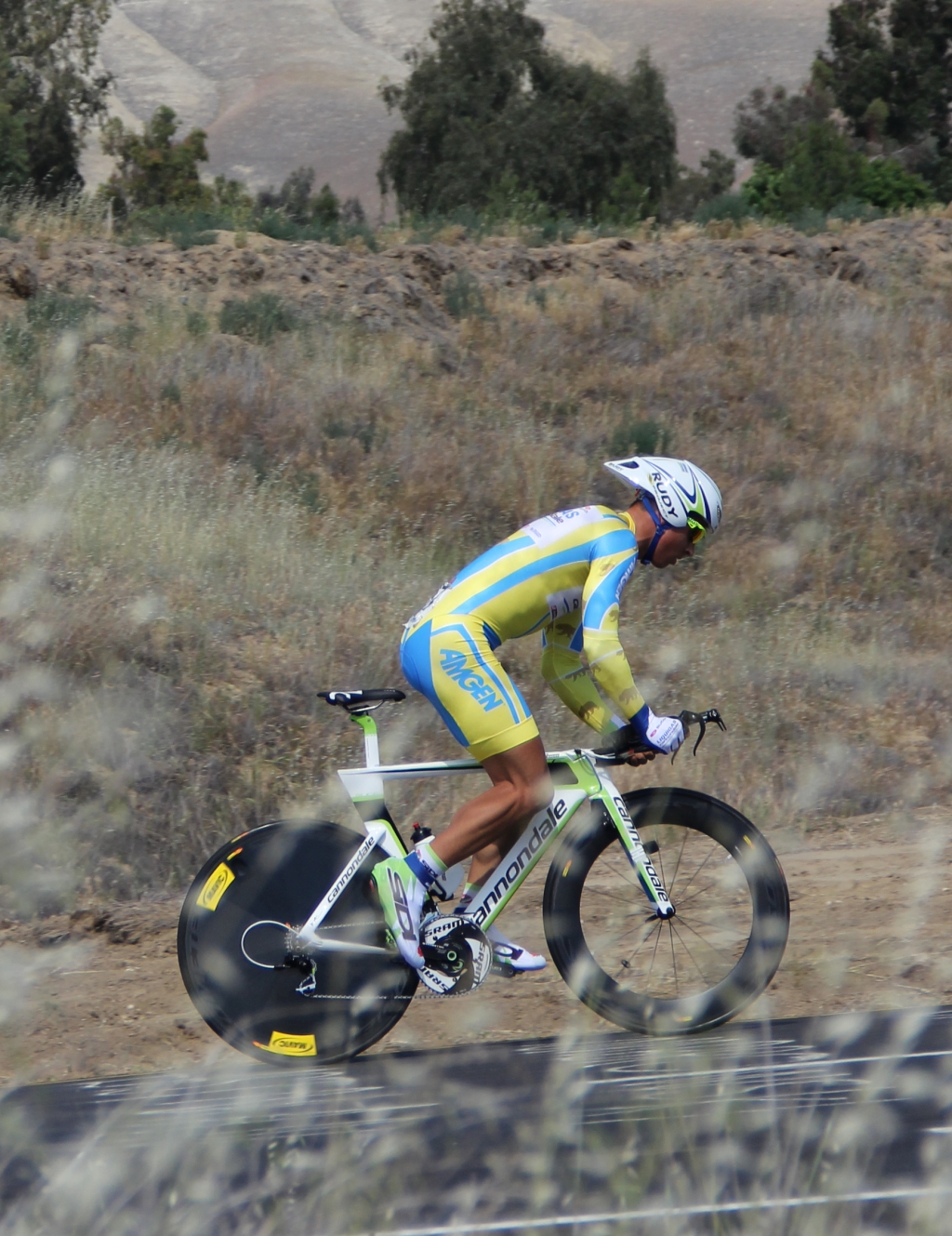
Peter Sagan (Liquigas-Cannondale) at the Bakersfield TT turnaround
Ryan Chandler from Nashville Tennessee will remember spectating at the time trial in Bakersfield. “I’m a triathlon guy so I love the TT bikes. I love watching them go fast by themselves.” Who was his favorite rider in the TT? “Dave Zabriskie won it so I gotta go for Captain America.”
Three guys from Santa Clarita and Fullerton, CA stopped and leaned over the top tubes of their bikes, catching their breath with about 2.5 kilometers remaining to the top of Baldy. Two of them hadn’t seen any of the race yet and had choosen Mt. Baldy to take it in, “Because someone convinced us [to ride up] – and we want to find them and kill them.”

Oregon helmet horns runner
For the love of fans
David Gordon is affiliated with Stage 17 Racing presented by America West, a U23 team in its first year based out of Orange County CA. The team set up tents on a steep corner about 3.5 kilometers from the top of Mt. Baldy and set about their work as the Good Samaritans of people on two wheels. They rang cowbells. They tooted horns. They pressed palms into cyclists’ backs. Gordon’s favorite part of the AToC: “Pushing the people that are hurting really bad and giving them the extra boost they need to make it to the top of Baldy. The race overall, it’s been pretty cool to see Sagan take the first four stages; yesterday was pretty impressive as well. We love the Tour of California. We come out here every year, to support where we can.”
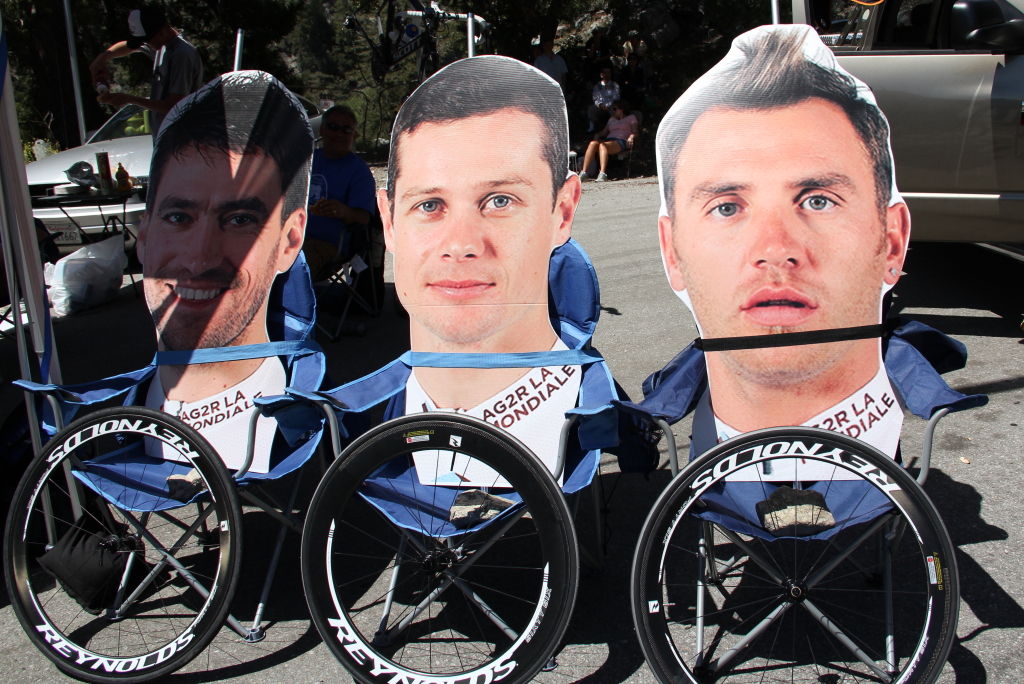
Reynolds camp on Mt. Baldy
A Reynolds Wheels crew set up camp on a turn just above Stage 17 Racing’s corner. They’ve been following the race since it started in Santa Rosa. Shelly Driscoll from Vista, CA, will most remember the finish on Mt. Baldy. “This has the crazy people. The Oregon guy with the big horns just went by, so he’ll be running next to the fans. And this is it, this will determine the race.”
Paul Schmitt from Roslyn, Washington, father of Morgan Schmitt on Team Exergy, will remember what he described as the beauty of California: “the many different ecosystems, the mountains, the deserts, the flowers, the cities, the people…were very friendly. I like the way the race was big but it was still small…accessible.”
This lady’s smile after Peter Sagan gave her his bouquet from Livermore says it all. An hour later she skipped along the sidewalks of Livermore.
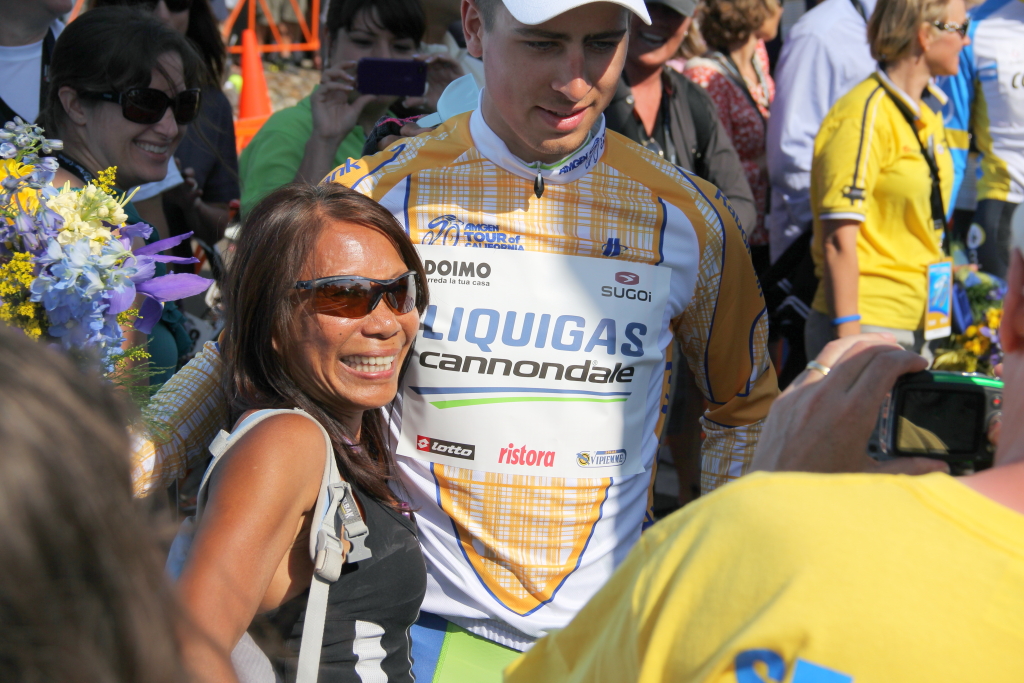
Sagan hands flowers to spectator in Livermore
What was your favorite part of the 2012 Amgen Tour of California?

Tom Danielson less than 1 k to the Mt. Baldy finish
The 2012 Amgen Tour of California course defined its overall leader in two of the eight stages: the stage 5 time trial and the Mt. Baldy finish on stage 7. When asked on the morning of stage 2 which would be more decisive, Tom Danielson of Garmin-Barracuda said, “They will both be important. There are GC guys who can do well on both.”
Danielson’s assessment was born out. Robert Gesink of Rabobank performed best among the favorites on both of these stages, and appears likely to retain his current overall lead after the final stage on Sunday into downtown Los Angeles.

Robert Gesink less than 1 k from winning stage 7 of the Amgen Tour of California
| (seconds lost) | TT time | Mt. Baldy time | Total time |
| Robert Gesink | 39 | 0 | 39 |
| Dave Zabriskie | 0 | 85 | 85 |
| Tom Danielson | 67 | 26 | 93 |
| Tejay Van Garderen | 34 | 82 | 116 |
| Chris Horner | 170 | 38 | 208 |
| Cameron Meyer | 86 | 148 | 234 |
| Joe Dombrowski | 215 | 18 | 233 |
| Rory Sutherland | 70 | 193 | 263 |
| Vincenzo Nibali | 112 | 14 min 49 sec | |
| Andrew Talansky | 48 | 25 min 40 sec |
Going into the Mt. Baldy stage, Danielson, who finished ninth in the time trial, occupied seventh place in the GC. Mt. Baldy provided him with a chance to knock on the door to the podium. He supported his teammate and race leader Dave Zabriskie as long as he could. Then he knocked.

Chasing the break that contained Horner, 17 k into stage 7
With about four kilometers remaining to the finish line and Chris Horner (RadioShack Nissan) and John Atapuma (Columbia coldeportes) up the road, Danielson responded when Gesink attacked.
“I really wanted to try for the victory today but I rode as smart as I could — I didn’t do any attacks so Dave could ride steady up the climb,” Danielson said after he stopped to speak with Jonathan Vaughters where the team cars had parked below the finish. “I just followed Robert and didn’t take one pull with him.”
Gesink and Danielson rode together until about two kilometers remained in the stage. “I rode well all day,” Danielson said. “I just came unglued a little bit towards the end and I had to let go of Robert. I was riding with him and I was comfortable and then started cramping up a little bit and then just had to ride my own pace.” Danielson told Cyclingnews he had become dehydrated.
The presence of Horner in the break-away rendered this year’s stage, which is very similar to the 2011 stage, more difficult than last year, according to Danielson. “It was pretty amazing actually how fast that break-away went,” Danielson said.
Danielson moved up to third place in the GC after stage 7. Sunday’s 69 kilometer stage isn’t expected to alter the final GC.
When you’re a sports director for a pro-cycling team, you don’t just use your head. Sometimes your legs act as your best asset.
Today Neil Stephens, sports director for the Australian Orica-GreenEDGE team, jogged alongside Luke Durbridge for part of the last kilometer of the Amgen Tour of California stage 7 uphill finish on Mt. Baldy.
Perhaps Stephens told Durbridge something like this: “Keep on it mate. You’ve made it this far, the finish is just around the corner.”
Likely Stephens wouldn’t have mentioned to Durbridge that Joe Dombrowski of Bontrager Livestrong had finished far enough ahead of him to pinch the best young rider’s jersey off his shoulders. Time for that later.
Durbridge came in 4 minutes 23 seconds after Dombrowski, in 21st place. That result and two days in the best young rider jersey are outcomes the 21 year-old neo-pro can be proud of.
Sylvain Georges crossed the uphill finish line of stage 6 of the Amgen Tour of California solo, rolled as far as his bike would take him on momentum, and collapsed onto the ground surrounded by a sea of photographers. He still wore the victor’s spoils on his cheeks at the press conference.

Sylvain Georges after his Amgen Tour of California stage 6 victory
“I didn’t think I would win,” Georges said after the race. “It’s a bit of a shock.”
Did he go to sleep without washing his face?
The worker-bees of pro-cycling teams pull at the front of the field to toughen the race for one or more reasons: so rival leaders can’t attack or will suffer and drop off the group and lose time, to prevent other teams from moving their sprinters into favorable position to win, or to reach break-away riders to prevent them from winning.
When a pro-cyclist rides as a worker-bee he doesn’t savor the glory of winning – though he wouldn’t turn that down given the opportunity. Instead, he savors the glory of making it possible for a teammate to win.
Guys like Timmy Duggan (Liquigas Cannondale), Nathan Haas (Garmin-Barracuda), and Sam Johnson (Team Exergy) will ride their hearts out for these reasons in the mountains, on the approach to a finish that suits a sprinter, or in the break-away to force other teams to work to bring the break back so their leaders don’t have to work so hard. They share thoughts below about their roles in the first two stages of the Amgen Tour of California (AToC).
Timmy Duggan defends leader’s position
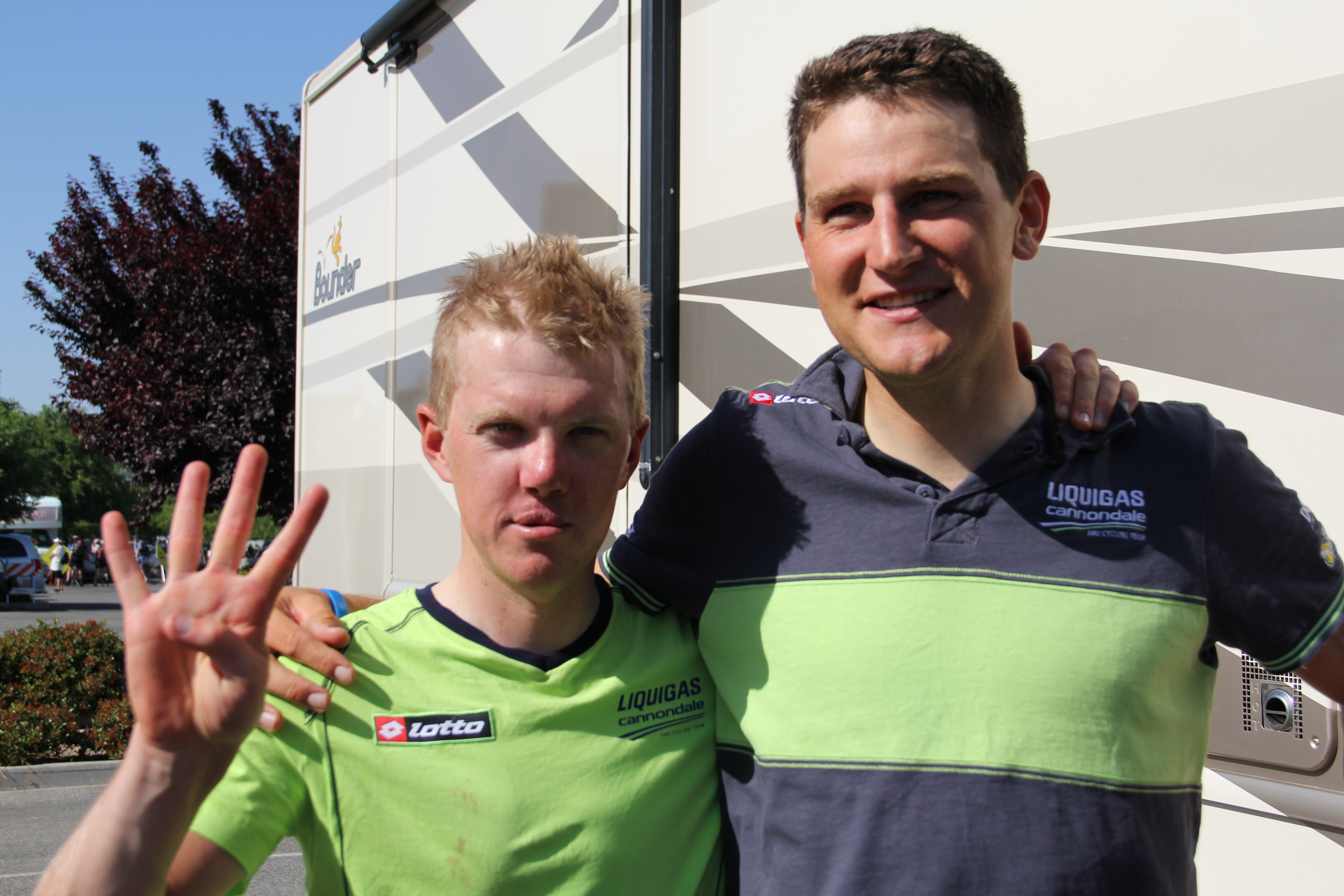
Timmy Duggan and Ted King of Liquigas Cannondale after Tour of California stage 4, celebrating Peter Sagan’s 4 wins
Duggan set the pace at the front of the peloton in the last part of stage 2 to position teammate and race leader Peter Sagan to win a sprint finish. He also helped to return Sagan back into the main group after Sagan went down on the side of the road with several riders on the first mountain of the day.
When asked what it was like to defend Sagan’s leader’s jersey today, Duggan said, “It’s always tough because everybody is hitting you up from every different direction…You put your manpower in the front, and we’re confident that we have the horsepower to do that whenever we need to, so it’s just a matter of believing in ourselves and the team and then Peter for the finish.”
Duggan appeared to take on the lion’s share of the work for the team going into the finish. “No use burning up four guys if it only takes one,” Duggan said, regarding his efforts.
Other teams can make a domestique’s job easier if their riders take some turns leading the group. Garmin-Barracuda set a hard pace for the peloton over the first climb of stage 2. “I think if we had to just have our team in front with the headwind all day we [maybe] would have blown over those climbs,” Duggan said. “But as it was Garmin helped us with some of the work, and then we were able to have a good chunk of our team in the end to help Peter.”
The team works together, and the team celebrates victories together. After Peter’s stage 1 win the Liquigas-Cannondale team enjoyed their day’s result over a beer. Duggan and Ted King choose a local IPA; the others preferred StellaArtois. After stage 2 it sounded like another round would be on order that evening. “Maybe it’s the secret potion,” Duggan said.
Nathan Haas helps GC and sprint teammates
Nathan Haas with Jonathan Vaughters
Haas rode a mean speed on the stage 2 climbs, he told Bicycling, in order to suss out which riders among the GC favorites would show weaknesses. Knowing who is riding well and not so well will help the Garmin-Barracuda leader(s) assess who’s a true threat as the race unfolds.
On stage 1 Haas looked after Garmin-Barracuda’s best sprinter in the race, Heinrich Haussler. “Yesterday I was driving back for 20 kilometers to get Heino back into contact, which put him in and he got second, but that put me out of the leadout,” Haas told Bicycling Magazine at the end of stage 2. “And then today I got told to ride the hill so I wasn’t going to see the finish. I’m a pretty fast finisher myself and I would really like to bomb Heino through one of the last corners and give it all and start it front of Sagan.”
Sam Johnson in stage 1 break-away

Sam Johnson, Team Exergy
Johnson’s account of his participation in an eight man break-away on stage 1 shows how a rider’s thinking changes as the race unfolds while still remembering his responsibility to his team.
“The break formed almost instantly and we all worked really hard for the first 15 or 20 minutes to establish that gap,” Johnson said. The riders continued to take turns in the front of their group.
“Things got a little blown apart over the first couple of climbs but it came right back together along the coast, and our cooperation was really solid until the top of the 4th KOM. After that some of the guys who had been fighting for that KOM jersey, I think they were a little fried, and the guy who won the KOM jersey was pretty much like, ‘I’m done. I don’t need to race.’ Some of the guys were resigned to going back to the field and some of the guys wanted to fight it out.”
Once the group established a lead of 11 minutes over the main pack, Johnson’s plans changed. “My goals changed throughout the course of the ride. At first I was thinking, this is a good way to get some publicity, it’s a way for me to maybe get an aggressive rider jersey or something like that. And then once the gap started going really high, I had to start reshaping how I rode because I wanted to potentially win the stage, at least get a result.
“Instead of thinking about being aggressive and trying to blow the break apart, it was all about make sure I don’t get dropped on those climbs and be able to try to fight it out to the finish, because if we stayed away, my team would if never forgive me if I got 11 minutes up the road and then got dropped on the fourth KOM and went drifting back to the field.”
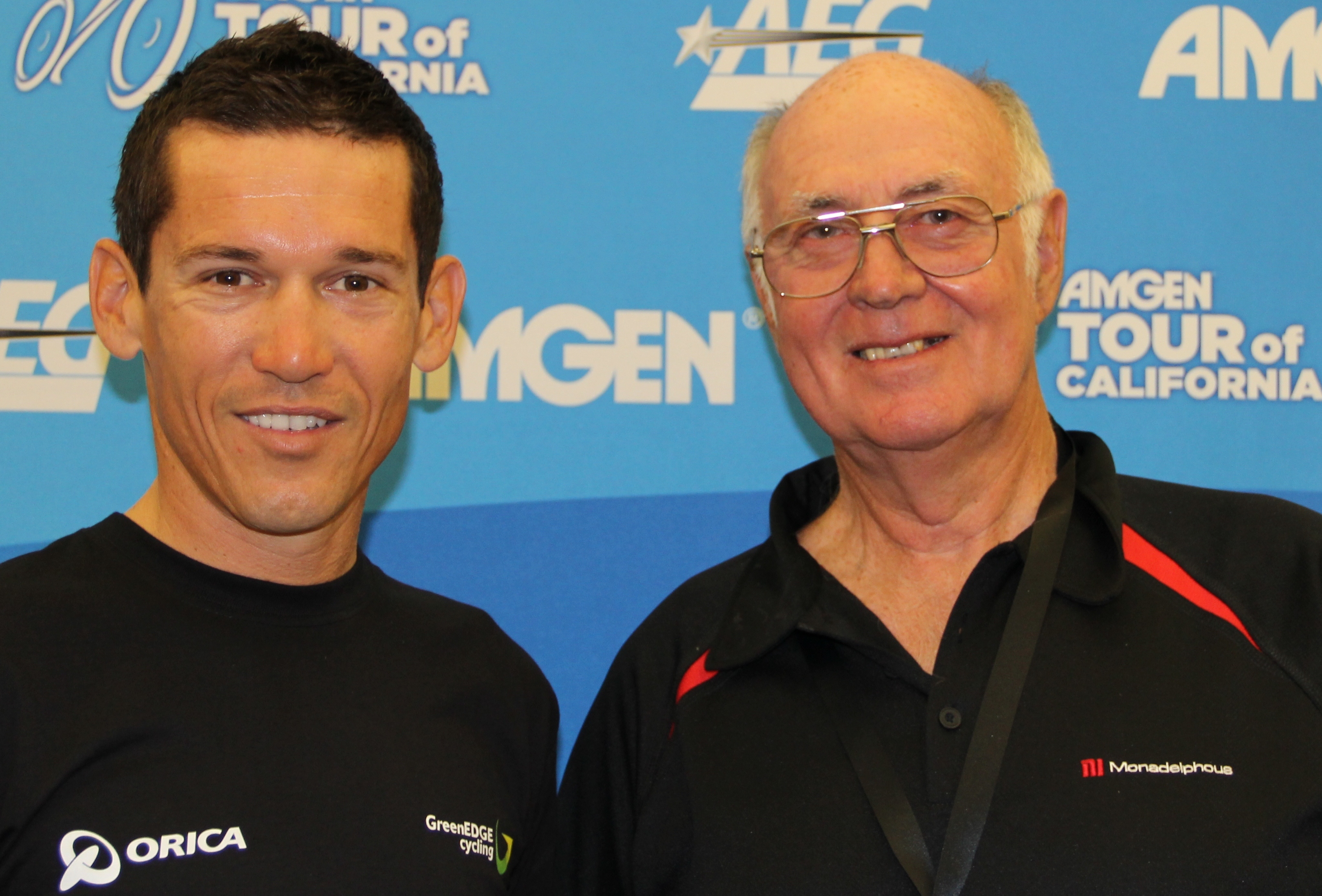
Robbie McEwen with his first coach, Bob Panter, at the Amgen Tour of California
Robbie McEwen announced he plans to retire from racing after the Amgen Tour of California. He gave a press conference prior to the AToC time trial today in Bakersfield and addressed questions with, unsurprisingly, very quotable responses.
What’s is like for you as a sprinter, going over the mountains? Robbie: “The mountains have been a nightmare. The GC guys say they have it hard because they have to pay attention all the time. Sprinters say that’s bullshit. The GC guys can go through transition stages easy, but a sprinter races every day.” When it’s a sprint finish day, sprinters are exhausted at the end of the day. And then in the mountains, they are fighting just to stay in the race.
When asked about the Orica-GreenEDGE project, Robbie said, “Guys like myself and Stuey O’Grady have been waiting for this all of our careers. I’m grateful to enjoy even half a season of it.”
When asked to sum up his twenty plus career, Robbie said, “It’s been fun. Cycling started as a hobby.”
Robbie will work for Orica-GreenEDGE this season in a coaching role. He said he’s very analytical about races — he studies the route, the finish maps, and develops a plan of how to attack it. Having information about the course is critical. It’s how HTC won a stage with Cavendish at a race when there was a left-hander with 500 meters to go. “HTC had all the information,” he said. Robbie couldn’t see around the corner and he backed off a tad. That cost him three-quarters of a bike length and the race. “The sprint was already ridden at 500 meters to go,” he said.
On what he’s looking forward to doing: “Just being there in the morning for the kids, being at birthday parties, sports day. I plan to go on my first skiing holiday.” Robbie said he’s had contracts that require him not to practice certain sports, like motocross and skiing.

 ProVéloPassion