

Tyler Farrar (Garmin-Sharp) takes first on Stage 1 of the 2012 USA Pro Challenge
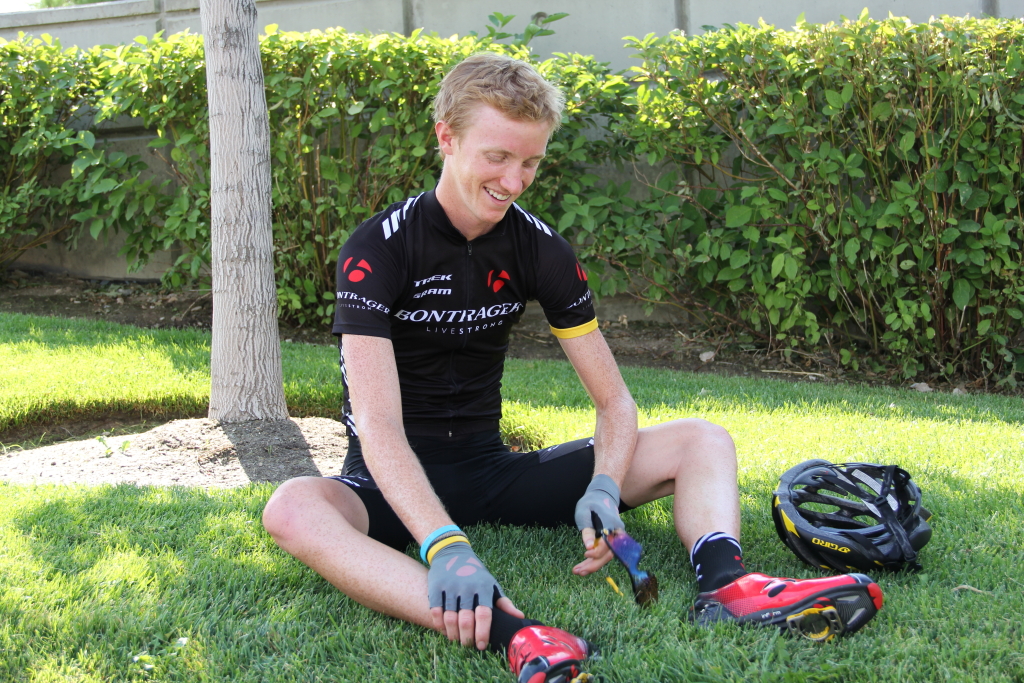
Ian Boswell (Bontrager-Livestrong) before Stage 4, Tour of Utah
Ian Boswell rested on cool grass before a stage start at the Larry H. Miller Tour of Utah, and thought about the complex answer to probably the most important question in bike racing.
The day before his Bontrager-Livestrong teammates had finished sixth, ninth, and eleventh on the stage. Although only between 19 and 21 years-old, the team’s riders in Utah clearly possessed the strength to compete with the best pro-cyclists anywhere. So what, Boswell wondered, did they have to do to win?*
Boswell’s in good company. He and the rest of the professional peloton know which elements must come together for a win. It’s the execution that’s challenging, even for the World Tour teams that just completed the USA Pro Challenge in Colorado alongside Bontrager-Livestrong.
Knowing the competition
Stage 1 of the USA Pro Challenge ended well for the Bontrager-Livestrong team. The day’s primary goal was for Gavin Mannion or Lawson Craddock to contend in a bunch sprint finish if the stage ended that way.

Gavin Mannion (Bontrager-Livestrong) in the Best Young Rider’s jersey in Montrose, Colorado
Mannion entered Telluride in the leading group and negotiated three turns with 250 meters remaining to the finish line after the last corner. He positioned himself to fight for the win by following certain riders. “I knew Tyler Farrar was obviously going to be a guy to watch…as well as Rory Sutherland who won the first stage in the Tour of Utah,” he said.
That day Mannion used to his advantage his familiarity with the strengths and history of other riders in the event, demonstrating just one of the “small things” in the realm of tactics and communication that Boswell named in Utah as crucial to winning races.

Gavin Mannion (Bontrager-Livestrong) after finish at Mt. Crested Butte
Mannion, who said he’s not as fast as the bigger sprinters but a better climber than most, finished sixth in Telluride on the wheels of the strongest sprinters in the race and earned the first Best Young Rider jersey.
Who to chase
The Tour of Utah provided an arena in which to practice two additional small but important things.
On the stage that ended in an uphill finish at Snowbird, Boswell and Joe Dombrowski rode in a select group with Levi Leipheimer (Omega Pharma – Quick-Step) behind race leader Johann Tschopp (BMC Racing Team).
When Leipheimer attacked near the finish, Boswell said, “I kind of jumped. His attacking speed is really high, the momentum is really high so it’s easy to follow.” Dosing out energy in a bike race is critical. Assuming he and Dombrowski rode that day to protect or improve their GC positions, Boswell didn’t need to mark Leipheimer’s move that close to the finish line because Leipheimer sat nearly one minute behind them on GC.
Tejay van Garderen (BMC Racing Team) appeared to have displayed similar youthful enthusiasm recently on Stage 6 in Colorado on the Flagstaff climb. When Vincenzo Nibali (Liquigas-Cannondale) attacked van Garderen chased him even though the Italian was five and one half minutes back on GC. That effort left van Garderen vulnerable to attacks by his GC rivals; when Leipheimer subsequently attacked van Garderen couldn’t follow and lost the yellow jersey to him that day.
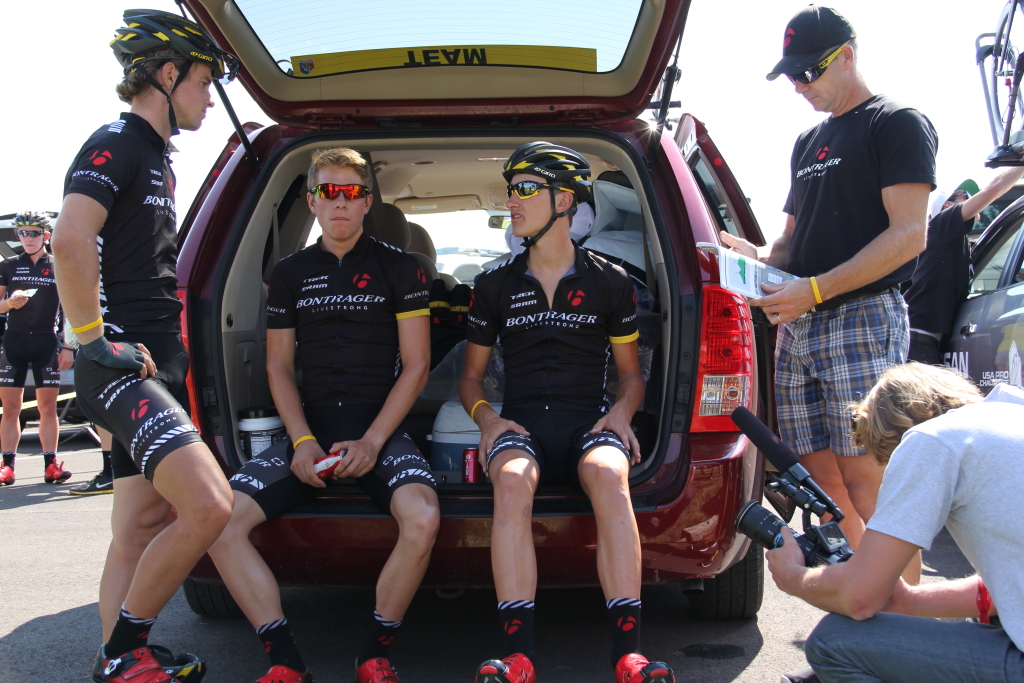
Connor O’Leary, Ryan Eastman, and James Oram (l to r) of Bontrager-Livestrong in Montrose, Colorado
Sharing information
Back on that day at Snowbird in Utah, Tschopp rode in for a solo win and Boswell and Dombrowski claimed third and fourth places. At one point Boswell launched from the group and rode ahead of Dombrowski and behind Tschopp.
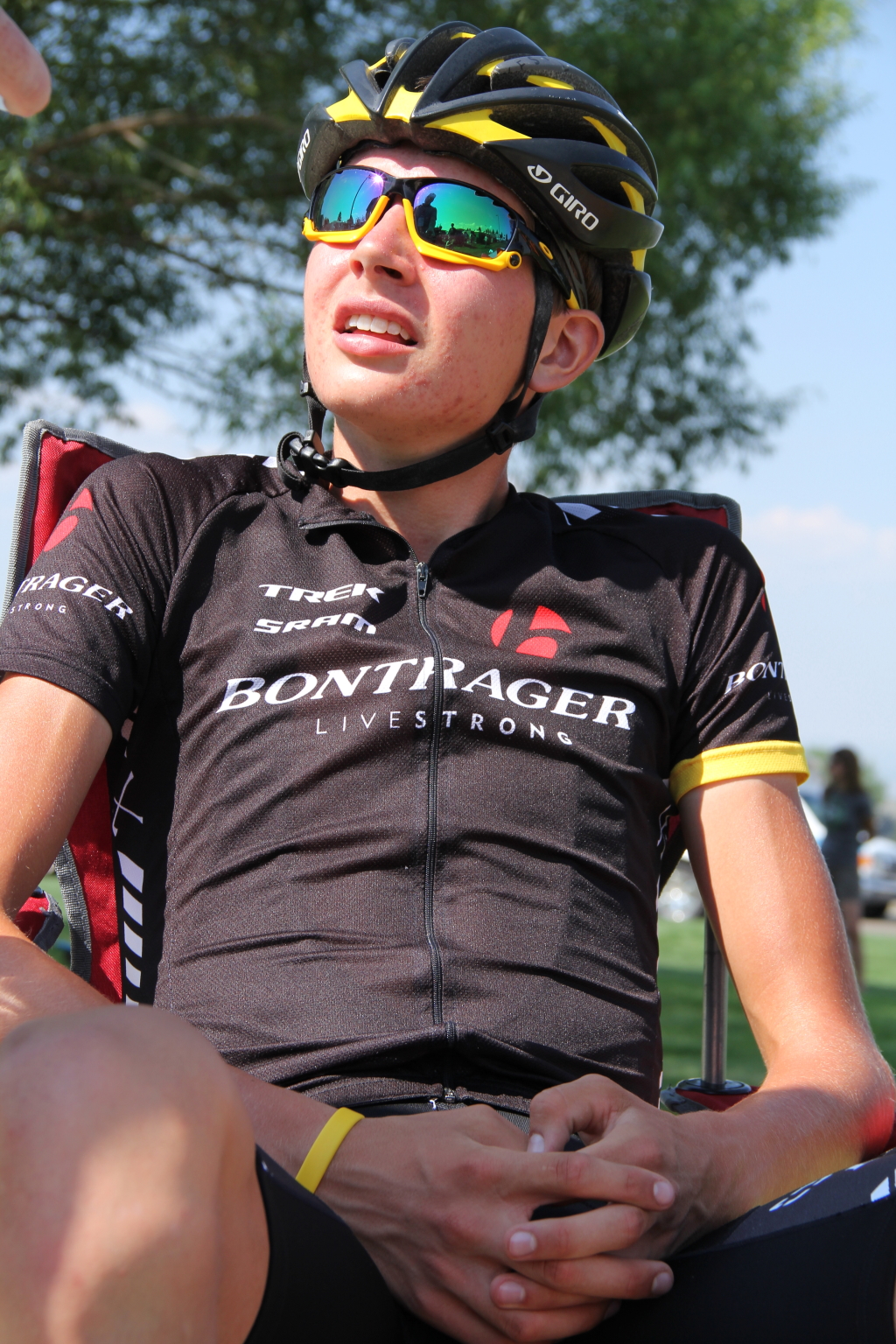
Joe Dombrowski (Bontrager-Livestrong)
Later in Utah Boswell shared an example of how better communication could have changed the results on Snowbird. “It sounds kind of stupid, but Joe didn’t even know that the BMC guy was up the road…I knew he was there. Joe didn’t. I didn’t tell him, he didn’t ask me, so Joe thought he would be racing for the win, which makes a difference, and even if Joe didn’t we would have ridden harder.” They might have decided, for example, to try to prevent Tschopp from gaining as much time as he did over them in GC at the end of the day.
Putting it together
“Every time we get in a situation where we are close to winning the stage, we do get closer to figuring out how to win,” Boswell said in Utah. “It’s just a matter of making the small little details [work] to win…and that’s why it’s great because we have the opportunity to learn, and the pressure’s not there to necessarily have to win. We’re getting closer every time we race, which is important.”
This week Boswell and five U.S. teammates race the Tour de l’Avenir in France. It’s his third start in one of the most important races for young riders. It’s a sure bet he’ll be employing everything he’s learned this season on Bontrager-Livestrong in his bid to win.
[*Boswell’s comments are taken in the context of the Tour of Utah. Bontrager-Livestrong riders have enjoy several wins this season, including: Stage 5, Tour of the Gila; Overall at the Baby Giro; Stage 1, Tour of Walla Walla; and Belgian Provincial Road and TT Championships.]

Christian Vande Velde (Garmin-Sharp) reacts to Phil Liggett’s announcement, “Christian has just won the USA Pro Challenge.”

George Hincapie blows double kiss to fans from the USA Pro Challenge stage
It became an annual event. Each April cycling fans crossed their fingers and toes so George Hincapie would stand on the top step of the podium for the race he most wanted to win.
Hincapie never did win Paris-Roubaix during during his 19 years as a professional cyclist. But yesterday in downtown Denver he ended his career as number one, once and for all. Paul Sherwen and Phil Liggett called it.

George Hincapie, the winner
From the final winner’s stage of the seven-day USA Pro Challenge, Liggett called up Hincapie. “Let’s hear a great Colorado welcome for the last time, George Hincapie!”
Hincapie blew a two handed kiss to a cheering crowd of thousands as he stepped on stage.
Number one in cycling fans’ hearts for more reasons than his record 17 Tour de France appearances, George hopped onto the top step of the podium and received two large framed pieces of art commemorating his cycling career.

Then Liggett said, “It’s over to you, the winner today,” and Hincapie took the microphone.
“Thank you. I hadn’t been very emotional this week but during the time trial I really felt emotion from the crowd and this is what got me through the last several years is this sort of support from all of you. I’m so happy that I chose Denver to be my last race ever and thank you…” The crowd replied with a “you’re welcome” of thundering cheers that drowned out the end of his sentence.

George Hincapie kisses wife Melanie during retirement celebration at the USA Pro Challenge
When Liggett asked Hincapie to name his favorite memory from his career, he said without a moment’s hesitation, “That’s easy. This lady right here giving me a lion in the Tour de France in Paris and I asked her to marry me a year later.”
His wife Melanie joined Hincapie on the podium. As they looked in each other’s eyes it was clear he had spoken the absolute truth.

George and Melanie Hincapie
Hincapie ended the special celebration with these words: “Cycling in general has brought me everything, so I’m very much appreciative for one of the most amazing, beautiful sports in the world and I’m glad that you all feel the same way.”
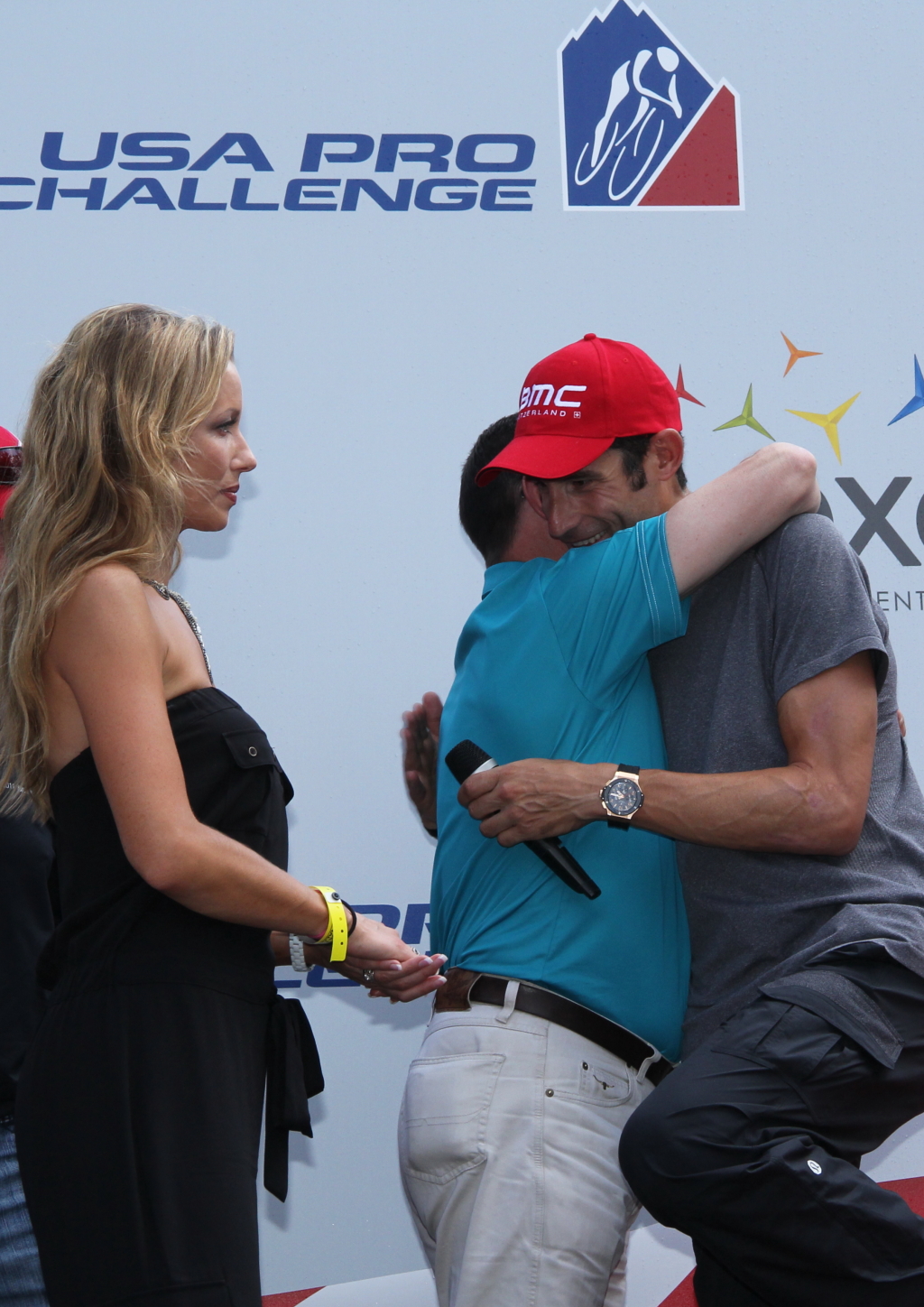
George Hincapie hugs Paul Sherwen, who called Hincapie “one of the greatest champions”
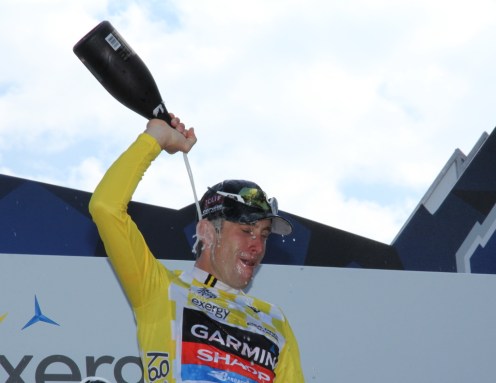
Vande Velde (Garmin-Sharp) celebrates on the podium after winnning the 2012 USA Pro Challenge (photo by Mary Topping)

Joe Dombrowski (Bontrager-Livestrong) keeps Best Young Rider jersey after Flagstaff

Tom Danielson (Garmin-Sharp) with his wife Stephanie on Flagstaff
The long-awaited finale up Flagstaff Mountain did not disappoint fans, but it disappointed many riders. Tejay van Garderen (BMC) lost the yellow jersey, Jens Voigt picked up enough KOM points from his work in the break-away to steal the climber’s jersey from Tom Danielson (Garmin-Sharp), and the climb lacked the length and steepness that could have netted Joe Dombrowski (Bontrager-Livestrong) more time on the other GC contenders.
“I wanted to try to go from the bottom just because I needed the time,” Dombrowski said after Stage 6. “I’m going to lose time to some of the top GC guys in the time trial, so I figured if I could get a gap, I’d just go for it and ride aggressive because I’ve got nothing to lose at this point.” He attacked at the bottom, but couldn’t get away. He put at least one important GC rider in difficulty.
When Dombrowski attacked, van Garderen couldn’t follow. His effort provided Levi Leipheimer (Omega Pharma – Quick-Step) with important information.

Levi Leipheimer (Omega Pharma — Quick-Step) crosses Flagstaff finish line
“If Tejay didn’t jump on his wheel right away, that means he’s hurting and he’s trying to gamble,” Leipheimer said at the post-race press conference. “I waited to make sure he wasn’t following Dombrowski.” Then Leipheimer launched the attack that earned him the overall leader’s jersey.
Dombrowski took a realistic point of view regarding his chances to gain significant time on Flagstaff. “It would have been nice to get some more time but it’s steep at the bottom and then flattens off. The climb itself is only 15 minutes or so, so it’s hard to really get a gap and maintain it in that amount of time, especially for me, being a little bit less powerful than some of those other guys like Christian or Tejay.” A longer climb would have suited him better.
His ride on Flagstaff moved him up two places on GC to fourth, tied on time with van Garderen 21 seconds behind Leipheimer, and just one place off the overall podium. Dombrowski said he was happy with the day overall.
The Bontrager-Livestrong rider shouldn’t have a problem holding onto the Best Young Rider blue jersey after the final day’s time trial. The next best-placed young rider, Javier Gomez (EPM-UNE), would have to make up one minute and 15 seconds; barring illness or a time-consuming mechanical problem for Dombrowski erasing that gap is unlikely over the 9.5 mile course.
Even with that kind of time cushion Dombrowski should give it everything in Denver. At yesterday’s post-race press conference, when asked about defending his overall lead in the time trial, race leader Leipheimer said, “Anything can happen.”
Flip the possibilities 180 degrees, from defending to picking up time, and there’s a chance Dombrowski will stand on the podium as third overall at the conclusion of the 2012 USA Pro Challenge.

Riders emptied themselves on Stage 6 of the USA Pro Challenge. Mike Creed (Optum Pro Cycling p/b Kelly Benefit Strategies) after Flagstaff
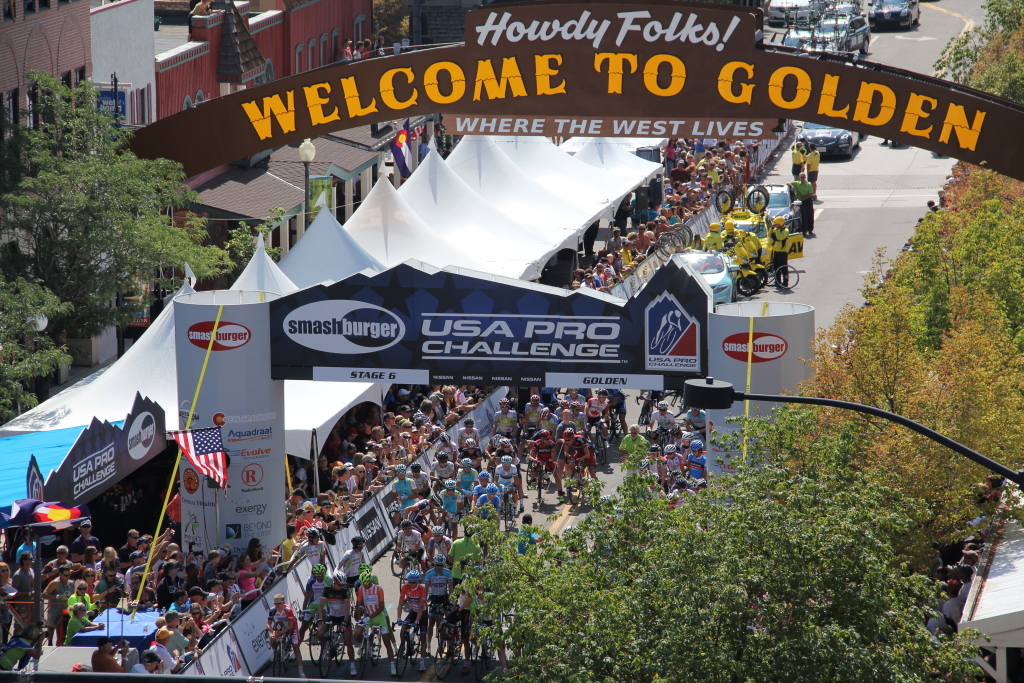
Line-up at Golden start, Stage 6 of 2012 USA Pro Challenge
Startlist for the individual time trial that will wrap-up the 2012 USA Pro Challenge with Stage 7 in Denver, Colorado.

Lucas Euser before Stage 4 in Aspen in the SpiderTech p/b C10 bus
Some athletes prefer not to set expectations going into events; it puts too much pressure on them. Pressure has the opposite effect on Lucas Euser (SpiderTech p/b C10). “It fuels me,” he said in Aspen on Thursday morning. “I’ve always been able to handle pressure really well in my whole life. I’m just now figuring out how to do it in cycling.”
Pressure is good, Euser said, because it provides a carrot to produce that extra push of effort. He arrived in Durango for the USA Pro Challenge this year with big ambitions: a stage win and standing on the overall podium in Denver this Sunday.
Euser has ridden aggressively in Colorado. It’s yielded a high GC result but so far no stage win. After summiting Independence Pass and speeding into Aspen for 15th place on Stage 3, he felt frustrated. “I’ve been so close in the last two races, getting closer and closer,” he said on Thursday morning. “And that’s a good thing. I’m happy that I’m frustrated – I could be frustrated for completely other reasons. I’m riding really well and I like that, it feels good. But I want to win a bike race.”
Euser’s climbing skills outshine his time trial. To realize his ambitions he must master the Flagstaff uphill finish today. As each day in the race has brought Flagstaff closer, Euser’s excitement has been building. He loves that climb. He knows it by heart.
At the Stage 4 arrival into Beaver Creek where riders clutched barricades after the finish line to stay upright and catch their breath, Euser once again finished with the leaders.
“This is one of the hardest races I’ve ever done – the combination of the course, all the guys that brought the big-boy pants, and the altitude,” he said in Beaver Creek. “It will be hard on Flagstaff and everyone will try. It might not be as explosive as people want, but we’re going to go. We’re going to try to win this race.”
Going into Stage 6 Euser holds 11th place on GC. Despite the frustration and the difficulty of the race, he appears to be enjoying every minute. Two hundred meters from the top of Hoosier Pass yesterday he glimpsed the thick rows of fans that lined both sides of the road up to the KOM arch. An enormous smile lit up his face.

Lucas Euser (center) on Hoosier Pass, Stage 5 of USA Pro Challenge
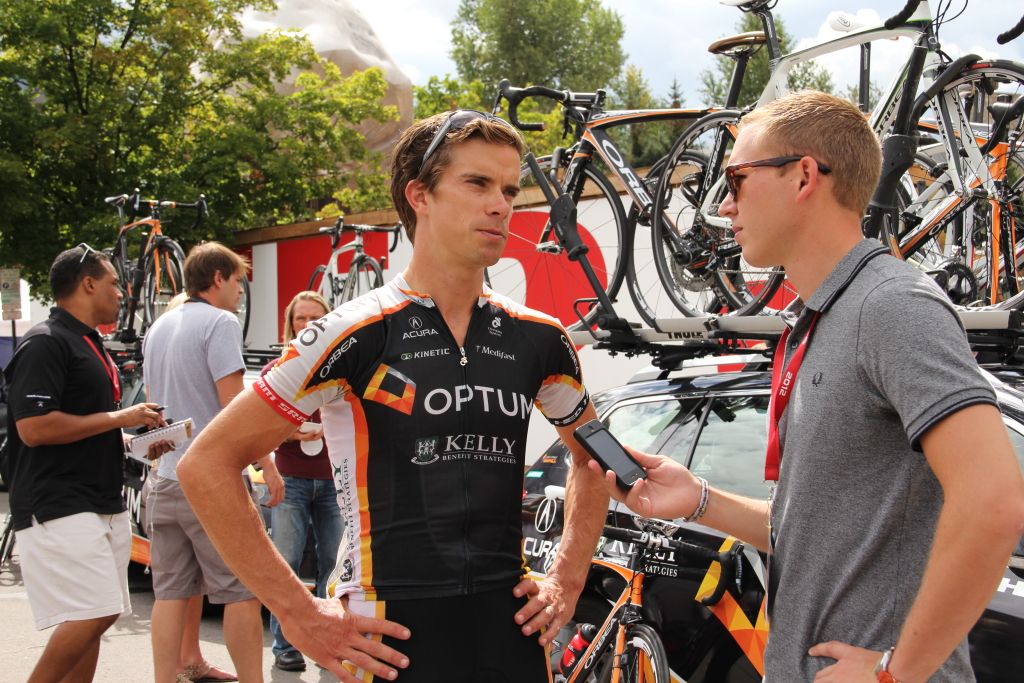
Mike Creed (Optum Pro Cycling p/b Kelly Benefits) before the Stage 4 start in Aspen
The USA Pro Challenge Stage 5 finishes in Mike Creed’s hometown of Colorado Springs today. The Optum Pro Cycling p/b Kelly Benefit Strategies rider would love to arrive first and salute the crowd with his arms in the air.
But even as late as 24 hours before the start of Stage 5, Creed said he couldn’t really think about it yet. “It’s hard. It’s pretty distant because I’m here in this bike racing bubble with these guys. You kind of detach to a certain level because it is a race.” Tomorrow, he said, might as well be next week. His task on Stage 5, which began with the climb up Independence Pass and surely meant rain and cross-winds, required 100 percent focus.
He said the meaning of racing on home roads will probably start to hit him when he reaches Divide and then Woodland Park and Garden of the Gods. He rides those roads all the time and that knowledge gives him an advantage. He thinks most teams might look at the stage profile, which appears to be a downhill run, and underestimate the hills leading into Divide and Garden of the Gods. Those hills could act as launch pads.
“If I don’t make the early break I will definitely be looking to do a little surprise attack up through Balanced Rock into Ridge Road and just try to get onto Colorado Ave. as quick as I can,” he said.
Creed’s performance to date in the event places him 24th overall in the GC, one minute and four seconds behind the overall leader. At the Aspen finish Creed arrived with the lead group consisting predominantly of ProTour riders that came in seconds after winner Tom Danielson (Garmin-Sharp). Creed’s GC standing could put a solo break-away win, like Jens Voigt’s victory on Stage 4, in jeopardy.
He’ll also face the aspirations of teams with strong sprinters. Stage 5 is the last opportunity for them to celebrate a stage win. In Utah Garmin-Sharp’s sports director Charlie Wegelius said Tyler Farrar was still pretty “beat up” from his multiple crashes in the Tour de France. Farrar showed by winning the first stage in Colorado that he’s recovered and primed for more wins. Creed also expects UnitedHealthcare to work hard to see Stage 5 end in a field sprint.
Creed rode for the U.S. Postal and Discovery Channel teams early in his career, followed by Team Slipstream/Chipotle, Rock Racing, and Team Type 1. He’s a previous national champion in track and on the road.
He traveled to race in Europe at 17 years-old, first in Austria. “After that I moved to Italy when I was 19 and there to Belgium,” he said, “so after that you’re like, no way can I stay in school.”
After the recent fire that destroyed hundreds of homes in Colorado Springs, Creed initiated a fundraiser to benefit the Pike Peak Red Cross and fire victims. He set a goal of $20,000 and just closed the effort by raising a total of $35,000 via Twitter.
Speaking at the Larry H. Miller Tour of Utah, Creed said, “A dream would be top ten overall [in Colorado] but that might be a long shot.”
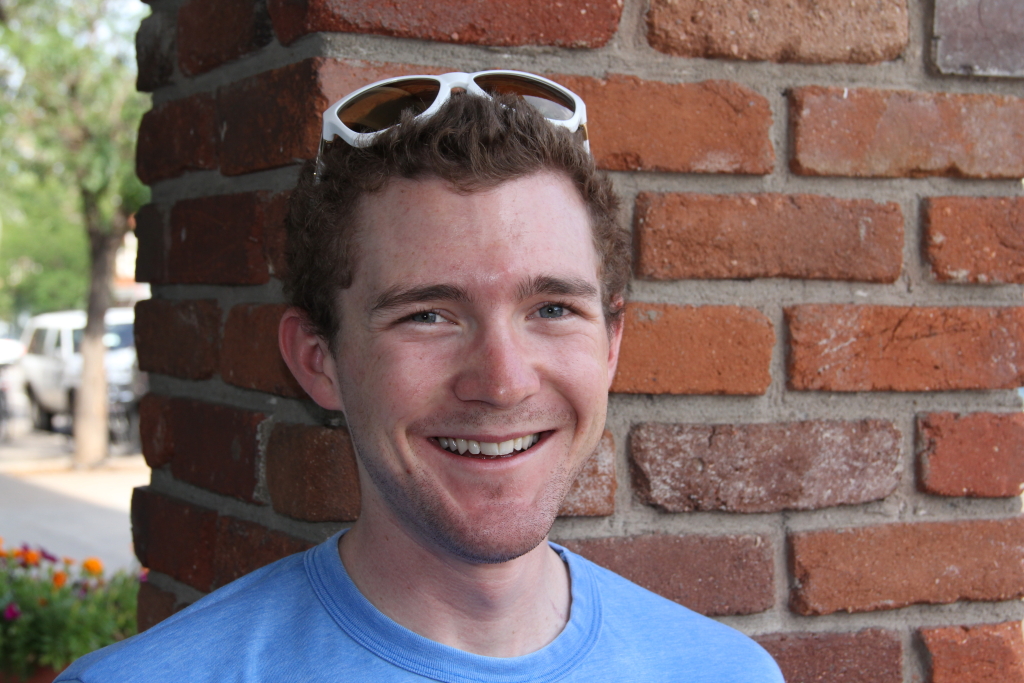
Julian Kyer in Boulder
Securing a spot on a cycling team at the professional level isn’t easy for any rider. Neither, as Julian Kyer knows, is returning to that level after dropping back to an amateur team.
Form wasn’t the only thing the Boulder resident had to rebuild after learning anemia explained the sub-par performance that likely separated him from a professional contract for the 2012 season. He also had to rebuild team directors’ faith in his talent.
Early promise stalled
Kyer called the Rocky Mountain Cycling Education Foundation his first “real” team. At 18 years-old he competed outside of Colorado for the first time, traveling to races in the Midwest. “I really looked up to all these guys who were local [category] 1, 2 guys,” he said. “I’d just get my teeth kicked in doing all these twilight crits.”
He earned a place on the Trek-Livestrong development team in 2009, where, paid to ride his bike, he became a professional athlete at the age of 20.
“It was a great team environment,” Kyer said, speaking about Trek-Livestrong. “Really great staff, riders got along.” He loved traveling with teammate Taylor Phinney, who together with soigneur Reed McCalvin entertained the team with their humorous commentary. Kyer has stayed in touch with the team’s sports director Axel Merckx; the two visit together over coffee when they attend the same races.
In the summer of 2010 Kyer’s racing suffered. Getting through training proved difficult and the fatigue he experienced stole away his motivation to train. At the same time several Trek-Livestrong teammates enjoyed a very good season and drew more attention.
When it came to landing on a professional team for 2011, Kyer felt he had fallen through the cracks. “I didn’t look hard enough for a team the next year and I kind of thought that more directors would approach me or be interested in me than was the case, and so I didn’t start building those relationships with directors.”
Anticlimactic 2011
Nearly without a team for the 2011 season, a late offer from Kelly Benefit Strategies-OptumHealth Pro Cycling team ignited Kyer’s motivation. He moved to Santa Rosa for the winter. He trained hard with Levi Leipheimer. “I was just stomping that winter and…throttled everyone in Kelly Benefits training camp,” he said. ”That’s unfortunate because generally if you win training camp you don’t do anything else the rest of the season.”
He started a vegan diet to lose weight and followed it for two months. “I’d probably been bordering anemic for a while and that was just the nail in the coffin and threw me overboard. I started going worse and worse and worse all spring.” Kyer’s friend Alex Howes encouraged him to get a blood test to understand why he wasn’t riding well.
“It was three days before US Pro that I found out my iron was super low, my hematocrit was super low.” He told the team who said, “Just get better.” Kyer believed he could address the anemia and return to the performance he knew he could deliver.
Criteriums filled out his racing program for the remainder of the season; this contributed to what Kyer labeled an “anticlimactic” year in 2011 as he wouldn’t call himself a criterium rider. An offer to continue with Kelly Benefit Strategies for 2012 didn’t materialize.
In fact no professional team showed interest in signing him for 2012. Kyer didn’t know what to do. Quitting the sport just wasn’t an option. “I thought I would just race for some Colorado team and try and get a big race or two,” he said.
An amateur team named juwi solar saved Kyer’s 2012 season. Juwi couldn’t pay Kyer, but they got him to races and supplied him with road and time trial bikes. “They really went above and beyond what any other seven person team in the U.S. really would be capable of as far as I know.” [juwi is pronounced like “ uv” – ed.]
The road back
After learning the reason for twice, as he described it, “falling to bits,” Kyer changed several habits and his diet.
He eased up on training and shuffled sleep to the top of his priority list. He studied nutrition, in particular how to maximize iron absorption, like taking iron with orange juice and vitamins D and B. He cut way back on coffee because it reduces iron absorption. He called that decision “a killer for me because it’s my favorite thing in the world.”
In addition to a plan to reverse anemia, he needed results; he needed to stun pro team directors like he had once stunned his dad.
When Kyer was in his mid-teens, the two set out on a mountain bike ride to discuss his desire to start competing in a sport. At the time Kyer wanted to race on skis. His dad ski-patrolled and Kyer started downhill skiing at the age of three. But his parents didn’t relish the idea of shuttling him to ski practice on the nearby Eldora Mountain.
“We were talking and I just started racing him uphill and beat the shit out of him,” Kyer said. “It was the first time I had ever really beaten him at anything and he was really kind of stunned.”
His dad said he’d buy him a new road bike. Kyer could take himself training and they would drive him to races. Until then Kyer rode around on a borrowed family friend’s Bianchi with downtube shifters and toe-clips.
Kyer grew up in Boulder where he attended bilingual elementary and middle schools. He started racing in high school in Lyons, Colorado at about 16 years old. The school didn’t sponsor a cycling team but Kyer found his own way to focus on training, completing senior year primarily through independent study so he could train in the afternoon. “I basically wrote my own syllabus for PE credits and they waived me having to take PE.”
He went on to the University of Colorado to study Spanish and Portuguese for two years. “When I turned pro it was not a hard decision to stop going to school,” he said. “All I wanted to do was race my bike.”
Building a case
In 2012 Kyer set about scoring an A in road racing so he could return to a pro team.
He surmises that after 2011 people in the sport assumed he had peaked during his time with Trek-Livestrong and couldn’t achieve results since leaving that team. “I don’t think a lot of people realized how bad it was for me last year and they had written me off, and so this year I really think even at the races where I didn’t get a result, I showed that I was up there.”
Only Kyer responded when race favorites attacked on the last climb of Stage 1 of this year’s Tour de Beauce. Kyer seemed guaranteed a top five that day when a crash took him down 500 meters before the finish line.
Even though he flatted and didn’t finish Battenkill, Kyer rode strongly there. Team directors spoke with him after the race; they had noticed he was going well again. Battenkill fits Kyer’s preferred kind of racing; he likes hilly, selective races. He also prefers stage racing, but has recently been getting his arms around the mindset of a one day race.
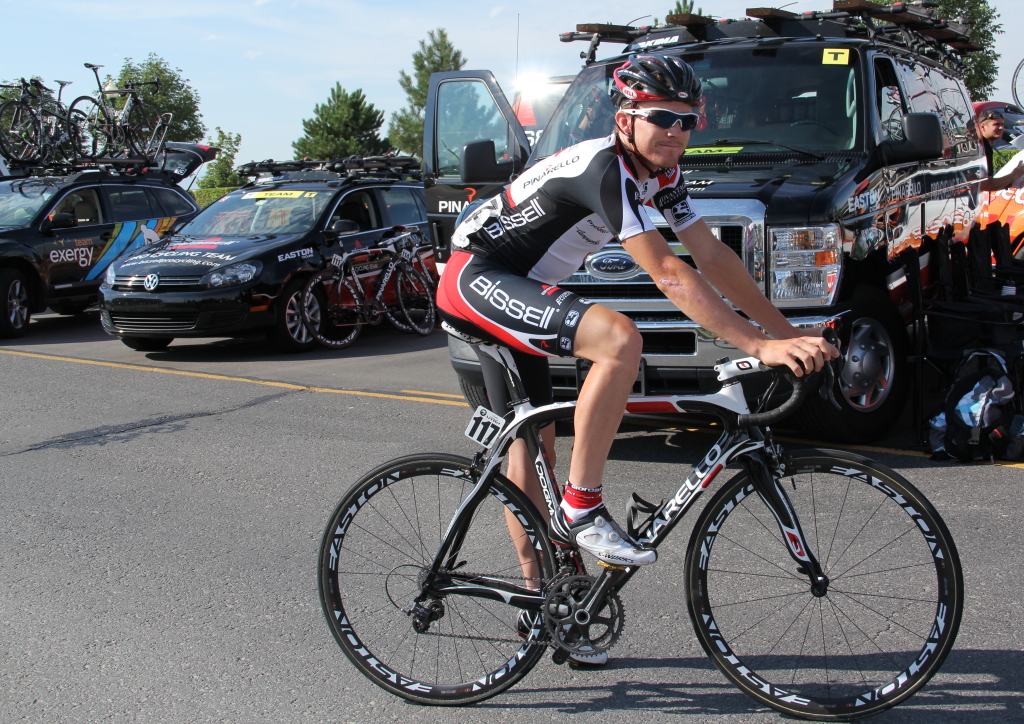
Julian Kyer in his first race with Bissell Pro Cycling Team at the Tour of Utah
He placed second in the prologue at Redlands where he lost just three seconds to the winner. “It’s an uphill prologue, you can’t bullshit that,” he said. In Kyer’s mind, those performances demonstrated he had redeemed himself and could succeed at the top level of the sport, “at least in the United States for sure,” he said.
When Kyer won the road and time trial races at the U.S. elite nationals this past June, his value soared. He received an offer from Bissell Pro Cycling Team who raced him right away in the Larry H. Miller Tour of Utah, followed by the USA Pro Challenge in Colorado.
Fulfilling a need
In Kyer’s opinion only a certain kind of athlete can accept the not-so-fun aspects of a career in pro-cycling – frequent travel with inconvenient schedules, separation from friends and family, next to no job security, and sometimes less than enjoyable locations and accommodations.
“It has to be something that you really are in love with, and it has to be a need for you to do,” he said. “You can tell the guys who don’t have that need because they don’t last that long.
“One question I get a lot is, ‘What do you want to do after cycling?’ That’s never something that goes through my mind. The only answer I can give is, ‘I don’t know,’ because I’m not close to being done with cycling.”

 ProVéloPassion