
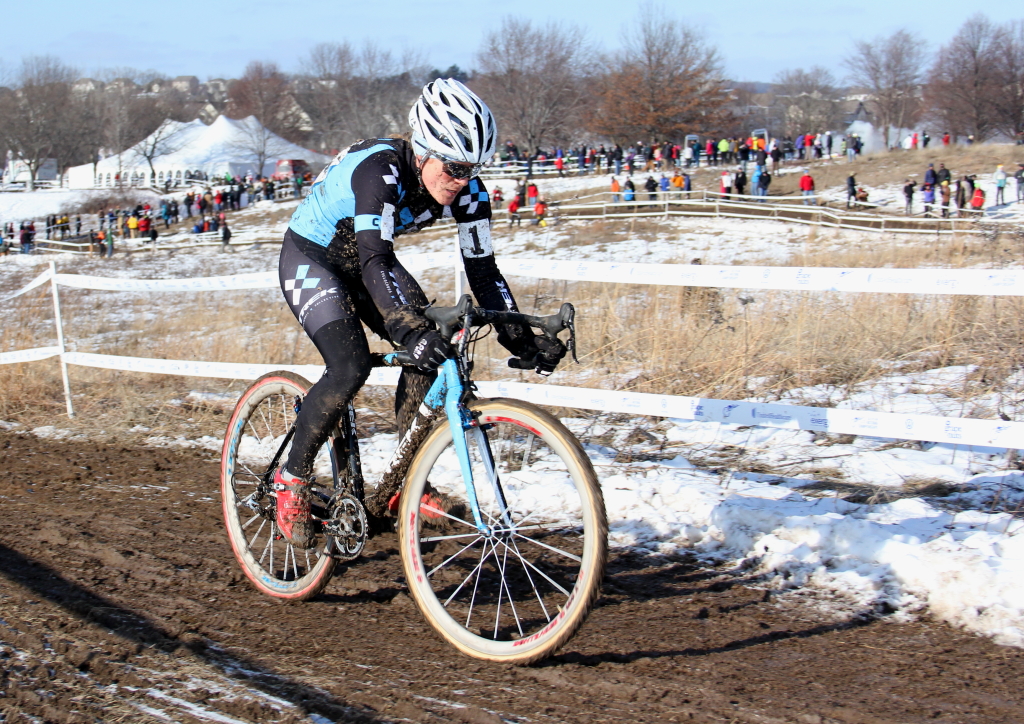
When asked what her thoughts were as she crossed the line first, Compton said, “Thank God I don’t have another lap.” She said the 2013 ‘Cross Nationals course was among the hardest of the season.
dd
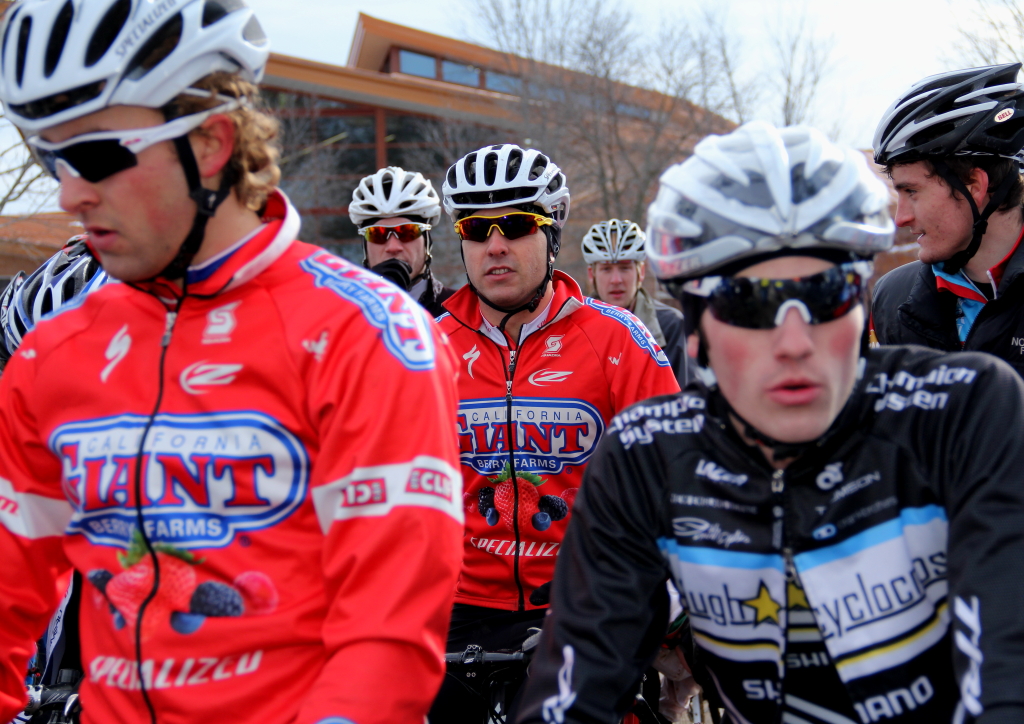
Yannick Eckmann, center, at the U23 ‘cross nationals line-up, behind teammate Cody Kaiser
[updated 1/14/2013]
Yesterday Yannick Eckmann (California Giant Berry Farms / Specialized) won the event he’s been dreaming of racing all season.
Riders can only enter the U23 contest in the U.S. Cyclo-cross National Championships if they are U.S. citizens or members of the U.S. armed forces. Born in Germany, Eckmann gained U.S. citizenship last November, which allowed him to race U.S. ‘cross nationals for the first time this year.

2013 U23 start at Cyclo-Cross Nationals
He lined up in the second row of the U23 field and began the fifty minute race with what he later described as a bad start. “I didn’t want to be first right away, so I just slowed up, but I slowed up too much.” This put him midfield when the pack left the pavement for the gooey mud that lined much of the course and rapidly covered nearly every surface on the bike.
But he passed riders quickly, reaching the barriers over half-way through the first lap in the lead, with Skyler Trujillo (Boo Bicycles) close behind. Andrew Dillman (Bob’s Red Mill Cyclocross), Joshua Johnson (Indianapolis Cycling Club), Eckmann’s teammate Tobin Ortenblad, and two other riders who would soon drop back in position chased.
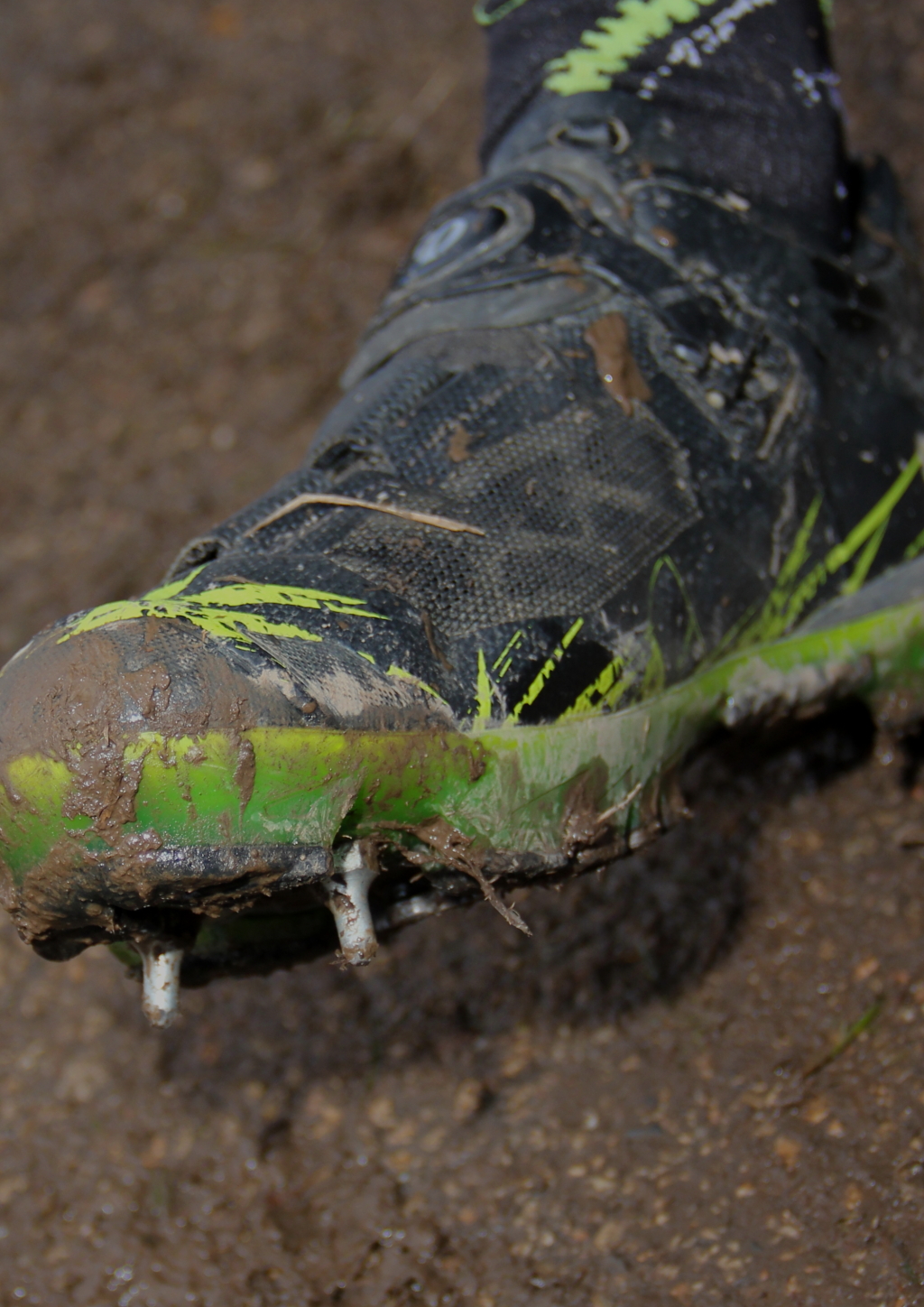
Yannick Eckmann’s shoe spikes
In the second lap Eckmann consolidated his lead to about a minute’s distance to the second-placed rider Dillman. “I went hard the whole time, as hard as I could,” Eckmann said after the race. His effort increased his lead to about two minutes when he crossed the finish line.
As team staff rubbed mud off his face, he said, referring to his win, “It’s good to finally have it.”
The night before Eckmann and his father attached spikes to the toes of his shoes; they improved traction on the muddy, slippery hills when he needed to run the bike.

Logan Owen pre-rides the 2013 Cyclo-cross Nationals course
When a young man lines up to race against a guy who ranks second in the world and typically drops the competition immediately to ride to a solo victory, does he think he has a shred of a chance to win?
Today fifty-two juniors of racing age 17 to 18 could answer that question as they wait at the start line in Verona, Wisconsin for a cyclo-cross national championship race with that second-in-the-world guy, Logan Owen (Team Redline). If Owen wins, he’ll have earned his eighth consecutive junior cyclo-cross championship, a number Redline’s Tim Rutledge believes would be a record in the junior classification.
A victory for one of the fifty-two other juniors, including Maxx Chance and Garrett Gerchar from Boulder, could be their first national cyclo-cross championship. They haven’t traveled to Wisconsin to race for last.

Maxx Chance in the air at New Year’s Resolution race in early January, 2013
Chance (Clif Bar Development Cyclocross Team) is aiming for a top five result. He’s improved his result every year since his first cyclo-cross national championship event in 2009. His best to date is fifth last year. Chance also races on the road with Boulder Junior Cycling.
The Clif Bar rider seems like he is always finding a way to have fun on the bike, whether it’s bunny-hopping up stairs or catching air when it’s there for the taking. He’s achieved some serious results this year, like junior 17-18 points leader in the USGP series.
“After my fifth place last year and riding onto the podium at some of the UCI races, I’m more confident racing at Nationals because I’ve been able to test myself against those guys the whole season,” Chance said. “It’s not like you go into Nationals as a 16 year-old and you’re racing against kids you [don’t know].”
Gerchar (Boulder Junior Cycling) is newer to the cross scene, with a love for mountain biking that developed about the time he jettisoned the training wheels at age four. This will be his second visit to the ‘cross national championships. One week ago Gerchar said he didn’t have any expectations for a particular result: “I’m just going to go out there and see what happens.”
Gerchar has been having a break-out season, including two podiums at the final USGP in Bend. He talked about how he’s been a bit surprised by his results. “I didn’t really set out this year to accomplish anything in ‘cross but it just happened; I started getting faster and faster and it worked out…It’s all been such a great experience and it’s been so new to me.”
What will it take to defeat Owen?
On Thursday Owen described his strategy for today’s contest: take the lead, pull away, and ride his own race. “There’s nothing to it,” he said, likely referring to the simplicity of the plan. “I mean I’ve done it at every race this year, so I’m feeling good.”
Short of hiding Owen’s favorite warm-up pants and his extra shoes and socks – part of his important pre-race routine is changing them after warming up, what can the rest of the field do to derail Owen’s strategy?

Garrett Gerchar floats ahead of Maxx Chance in a bumpy section of the CO State champs course
“They need to concentrate, focus,” Gerchar said, and “mainly they just need to get on his wheel, stay with him, and just get around him when they can and see what happens. But he’s one fast kid. It would be a challenge to defeat him.”
Chance agreed with that conclusion. When asked how to mentally prepare to race against Owen, he said, “Well, I don’t know. You don’t really expect to win. You’re really like fighting for third place when Curtis [White] and Logan are in the races.”
The Clif Bar Development Cyclocross Team brought Chance and two teammates as well as Gerchar to Belgium for late December racing; they returned home about a week ago with lessons about super-fast starts and first laps, and riding in the mud.
Speaking about his experience racing in Belgium, Gerchar said, “It’s made me a little more aggressive on the bicycle because they are a lot more aggressive in Belgium. It’s helped me relax and calm down and try to focus, because I realize that I’m not going to be number one. I’m not going to be maybe even top five. I just have to concentrate and do the best I can with what I have.”
The trip to Belgium was Chance’s first opportunity to compete in Europe; it expanded his point of view.
“You get a whole different perspective after racing the world champion, Mathieu Van Der Poel, who can just drop Logan in 100 meters on some days.” Chance said. “So, Logan’s not as scary when you race with Van Der Poel, because Van Der Poel can lap us, easy.”
Worlds on his mind
The situation U.S. juniors face when racing Owen mirrors what Owen faces when he races in Europe against the current junior world champion and his nemesis, Van Der Poel. The Dutch rider’s name popped up a few times on Thursday, often with a chuckle. Owen joked about how “consistently getting second to Van Der Poel” gets him respect in Europe. After saying “I just want to win all the time” in response to a question about how he remains motivated when winning so frequently, Owen added, “I’m pretty sure Van Der Poel’s pretty bored of winning, so hopefully I can disrupt that [at Worlds].”

Logan Owen
Right now it seems like Van Der Poel and the cyclocross world championships occupy Owen’s thoughts more than today’s national championship. But that won’t give the competition an edge today, because Owen’s focus and confidence seem unshakeable.
The course conditions might be a factor. Logan said the frozen conditions on Thursday were making him a little nervous. “It’s not a real cross race to me, it’s just an ice rink. And right now I don’t really enjoy the course as far as the frozen ruts go…Even I was having a bunch of trouble going down descents and I mean I’m pretty decent at bike handling, so all the people that aren’t really the best, it’s difficult for them and they can really hurt themselves out here. So I hope it warms up and becomes muddy, or even if it gets fast that’s fine as long as it’s just not frozen.”
The weather forecast called for a high of 36 degrees Fahrenheit Friday night with partial sun and 39 degrees today. That means Friday’s mud probably won’t freeze. But there’s a layer of frozen ground underneath the mud, so the impact of the conditions on the outcome of the race will be interesting.
Owen will race today for a historic eighth junior national championship in a row. He viewed it as “just one more race,” an opportunity “to go out there and have some fun, just like all the time.”
When asked if he expected to win, Owen said he didn’t expect anything. “I’m just feeling really good this year. I’ve had a great year, so I’m not going to say that I’m like super worried about it, but I’ve just got to be cautious and make sure everything goes right because anything can happen in a race.”
And that’s what fifty-two other kids are counting on.
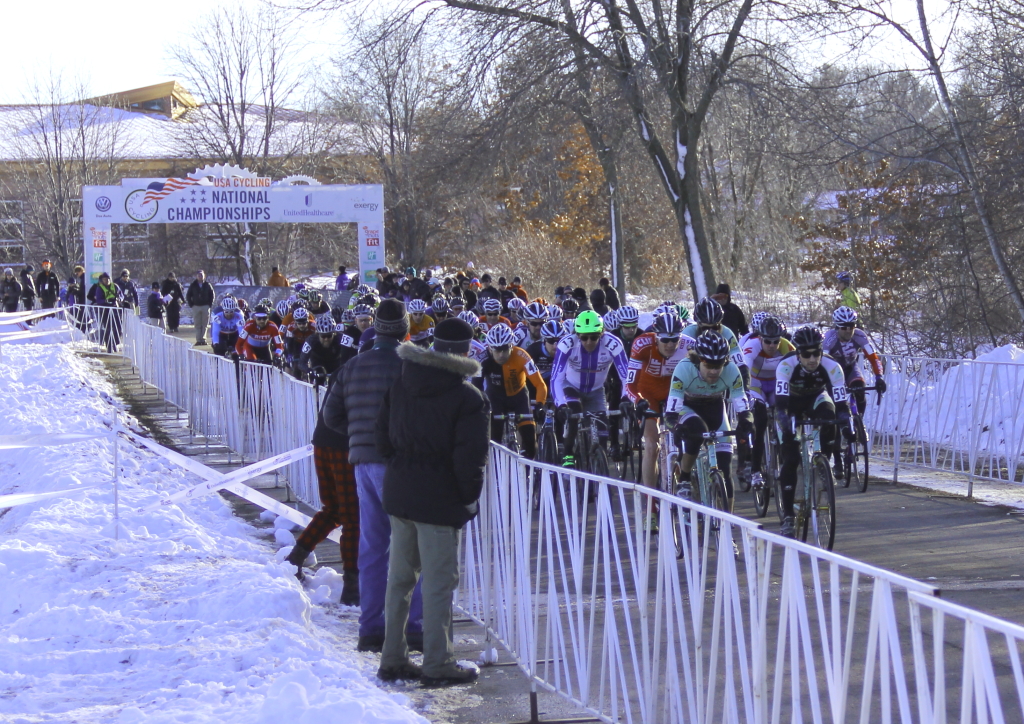
2012 Cyclo-cross Nationals men’s single speed start
The riders at Cyclo-cross Nationals in Verona, Wisconsin are like kids in a candy store, with a few significant differences.
At ‘cross Nationals, the candy store is Badger Prairie Park where a track of squishy mud and frozen ruts runs through open fields of snow perforated by the tips of brown-gray branches and tall grass.
Instead of which sweets to choose next, riders choose their next lines along the track – outside edge to inside edge, through the middle, or some combination. Sometimes the bike and the mud and ruts choose for them and toss them onto the ground where they slide ten feet in the mud or kick up piles of snow until they can right themselves, shake their heads, and remount their bikes for more.
On Wednesday Adam Craig (Giant Factory Off-Road Team), Brady Kappius (Clif Bar), and fifty-six other male “kids” raced one-geared bikes into the ‘cross National candy store. After the starting whistle Aaron Bradford (Bicycle Bluebook/HRS/Rock Lobster Cyclocross) led the single speed pack down the paved starting straight with Kappius on his wheel.
While Craig would proceed to grab all the sweet lines, for Kappius the single speed race was like arriving at the store after a long trek and staring at the door as the shopkeeper flipped the “Open” sign to “Closed.”
Kappius closed out by a broken tensioner
Both Craig and Kappius rode traditional ‘cross frames. While Craig turned over the 42 x 16 “magic gear,” Kappius had decided to go with a chain tensioner and 39 x 15, a decision he soon regretted. The tensioner broke after the run-up in the first lap. He coasted down the hill, dismounted, and at a pace that seemed like slow motion, stepped over the barriers and pushed his bike by the seat into the pit area.
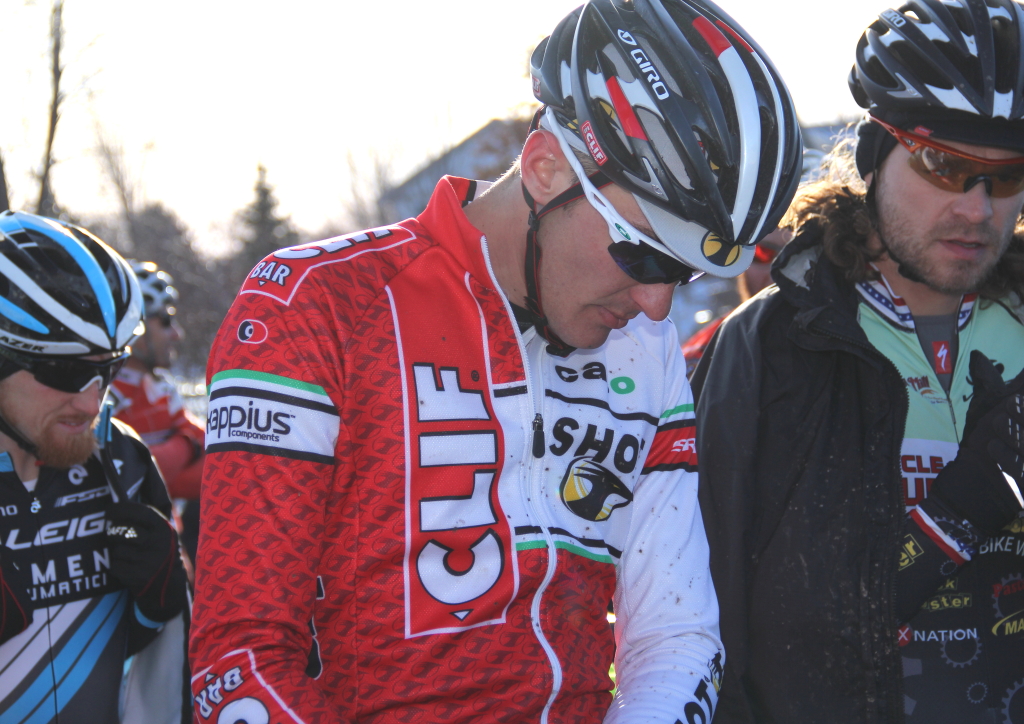
Brady Kappius before the start of the men’s single speed ‘cross national championship race
“The pulley came off the bearing; I’ve seen it happen a couple of times but it never happened to me,” he said after pushing his bike into the pit and calling it a day.
“It’s a bummer,” Kappius said. “I spent all this time coming out here so early. I don’t know…This isn’t the right way to do it. The right way to do it is to have a real single speed bike. So, next year.” He looked outwardly calm, but words came out a bit shaky. His teeth chattered slightly in the late afternoon cold.
When asked if he was more pissed off than he let on, Kappius said, “I’m just pissed off at myself. I should just spend more time with my equipment and care a little bit more about this race…” He said he could have brought his single speed bike. Instead he brought the bike he’s been riding all season; he said before the race he likes how it handles. He could have run the “magic gear,” a selection he made recently at Castle Cross. “It’s my fault,” he concluded.
Kappius will ride in the elite race on Sunday.
Craig forges solid lead
Out on course the riders fought for their places. According to Craig, he and Bradford rode together until Bradford punctured halfway through lap one. Then Craig took off. “I just wanted to ride hard the whole race just to see what it felt like to ride hard on this course the whole time,” Craig said after the race, “so I just kind of gave ‘er because it’s a race and that’s what you do.”

Adam Craig on a sketchy corner on Badger Prairie Park course
Craig rode hills others – including Bradford – ran, and negotiated twisty descents with efficient lines.
“There’s great lines all over this course,” he said. “Just riding a lot of outside snow to inside snow, to drift through the mud into the outside snowbank. The snowbanks are pretty supportive;
you can actually use them to turn, so that was fun to work on.”
He gained thirty seconds over Bradford about half-way through the race; that lead increased exponentially in the second half and he finished two minutes and nine seconds over second place Bradford.
Bradford also stretched out his lead over a chase group of three as the race progressed. Isaac Neff (Trek Cyclocross Collective), Jared Nieters (SEAVS/Haymarket), and Adam Myerson (Team SmartStop p/b Mountain Khakis) almost came to the line together. According to the race announcer a mishap in the sand pit by Myerson helped Nieters move ahead. Neff came in third with Nieters fourth, just one second in front of Myerson.
For Craig winning proved to be “a relief,” he said after the race. “I’m kind of like the one actual pro guy racing. I mean there’s plenty of super-talented riders in the race like Aaron [Bradford], but I’m the guy who’s getting paid to do it so I should probably win.”
Winning probably also felt like a relief because he’s recently tried a different kind of training program. With all the snow in Bend over the last month, he primarily trained off the bike, by backcountry and Nordic skiing and running. “I just was going to take whatever the weather gave me at home,” he said. “It’s a pretty bold experiment as far as just not forcing riding a bunch when riding is difficult and trying to stay fit other ways.”
As he spoke, Craig stomped his feet. He seemed pleasantly surprised that plaques of mud leapt off his shoes. He obviously enjoyed the forty-three minute effort. “Anytime you can throw snow in the air on your cyclocross bike is entertaining,” he said.
Craig will also ride in the elite race on Sunday.

[updated 1/30/2013]
Today Kristin Weber will take full advantage of having just turned forty years-old when she lines up for the Masters 40 – 44 race at the USA Cycling Cyclo-cross National Championships. It’s potentially an advantage to rank among the youngest in her age bracket, but that position also brings pressure to improve on the fifth place she earned as one of the oldest in her Masters 35 – 39 field last year.
She’s based her season around rising to the occasion.
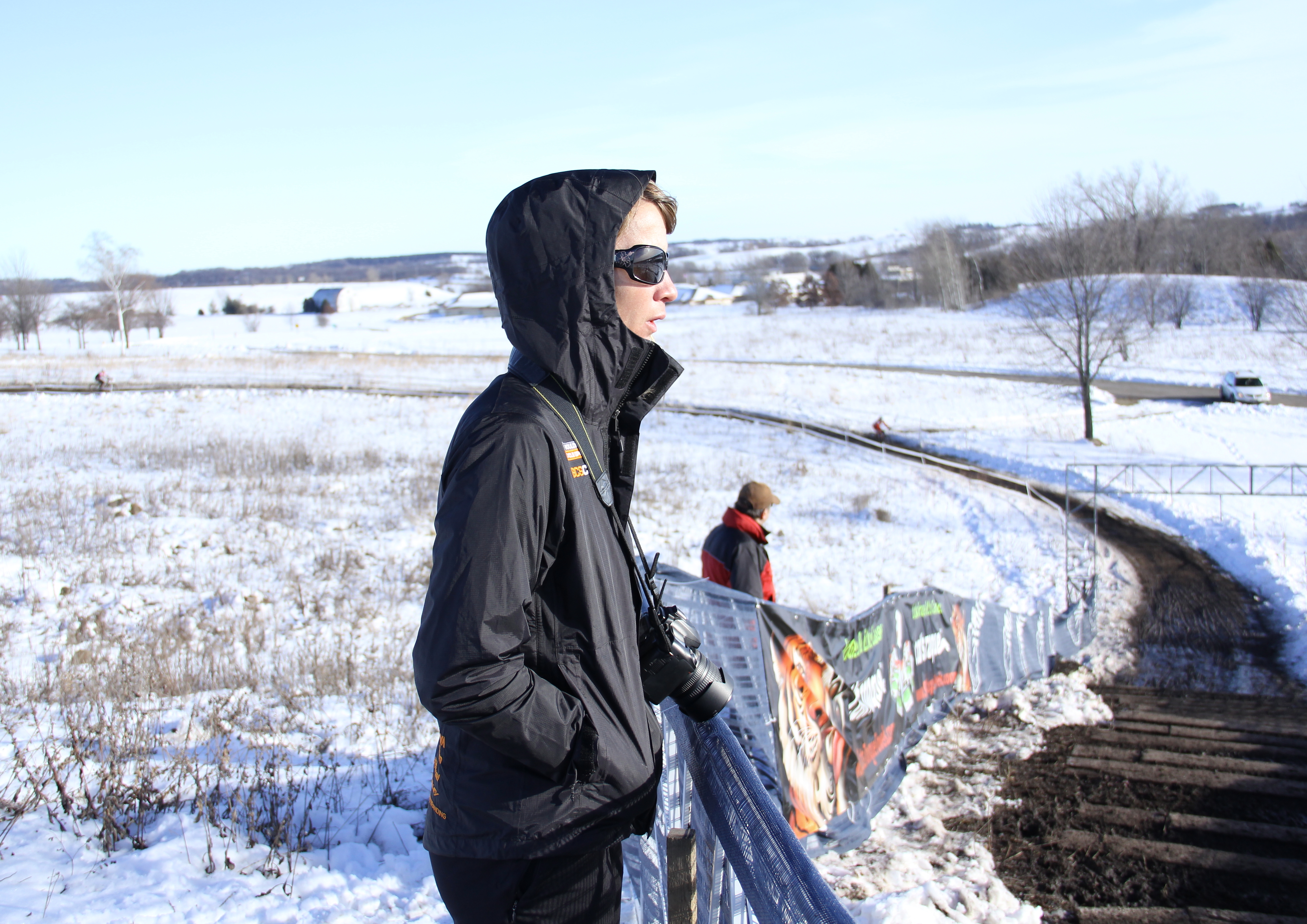
Kristin Weber spectating and scoping out conditions at ‘cross Nationals yesterday
“I feel like my big birthday present to myself was to go to Nationals and Worlds and have my best races,” Weber said in December. “So I put a lot of pressure on myself to really perform there and that’s been my end goal all season.” She designed her program to peak twice. The first peak she scheduled for three-quarters of the way through the season. After ten days off the bike she aimed to peak again for strong end-of-season results at these two big events.
Now in Verona for Nationals it’s time to find out if the plan will pay off. “I trained hard during these last few weeks and the only thing that is missing from my equation is the racing aspect to get to the best form possible,” Weber wrote in a message earlier this week.
“This is the same issue everyone has and in fact I feel lucky that BRAC put a race on to help bring the legs back to life…I feel strong. I managed to dodge the sickness bullet (which is no small feat with 3 school age kids) and now we just hope it all comes together.” [The Bicycle Racing Association of Colorado ran New Year’s Resolution Cx on January 5th —ed.]
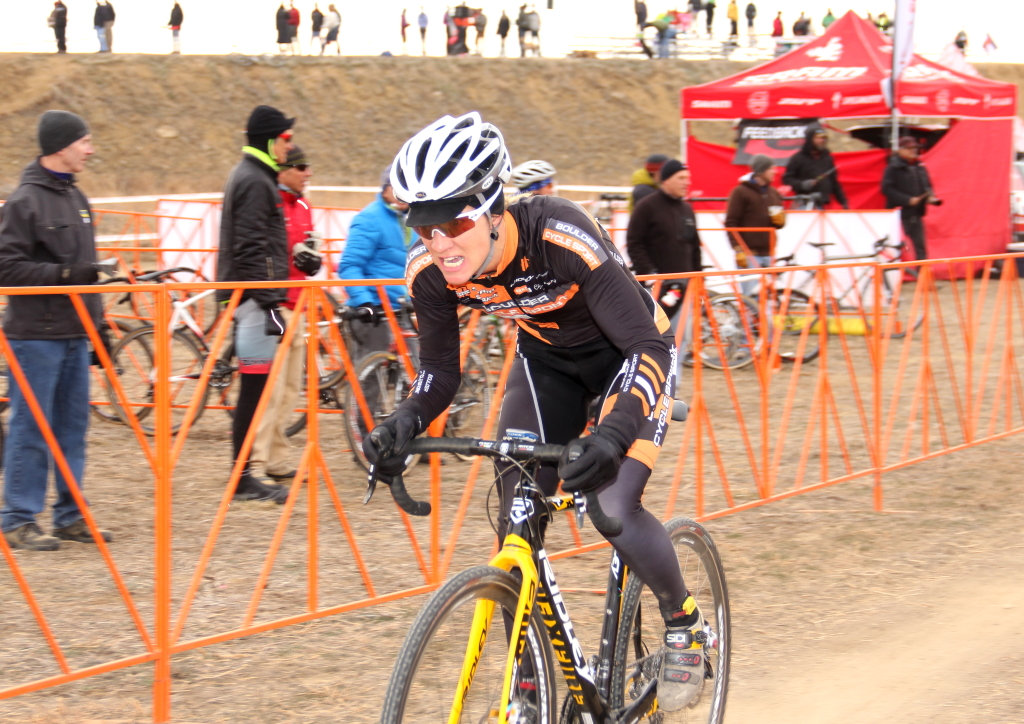
Kristin Weber chasing in lap 2 to keep her Colorado Cross Cup lead, at 2012 States
Weber also uses her mind to prepare. “I have been doing a lot of visualizing too as I have ridden this course a lot and I think that helps to know where your hard efforts need to be, where your passes can / should happen and where you might catch a quick breather.”
Weber rides for Boulder Cycle Sport. She is relatively new to the sport, having completed her first full ‘cross season in 2010. So the newbie experience is still relatively fresh for her and she enjoys helping women who are just getting into or exploring the sport. Weber and others affiliated with the Boulder Cycle Sport shops run a clinic for beginners from late summer through October.
“I like to foster an environment of inclusion in ‘cross and give people the opportunity to come and make mistakes and learn something new,” Weber wrote. “Also as a mom, I like to show people that really anything is possible after having kids…It is nice to train hard, push your body to do things you weren’t sure it could, and be successful – whether you land on the podium or not – everybody measures their successes differently. For a long while, a successful race for me was remounting my bike properly, so it’s baby steps.”
After such a dry ‘cross racing season in Colorado – Weber lives in Boulder, she can’t wait to compete in the messy conditions at the Nationals venue in Verona, Wisconsin.
“Thank god for the mud,” she wrote.
“I love the bad conditions, the mud, the snow, the sketchy ice is where I get to play out my advantages…as a runner and mountain biker.” She described the snow, ice, and slush in Colorado as similar to Wisconsin’s but called Wisconsin mud greasier, which means slippery. Recent snow in Colorado has afforded Weber and other Colorado ‘crossers the opportunity to train with it on the ground.
“So for me, I am psyched,” Weber wrote. “Now it’s about being smooth and skilled as well as being powerful, it’s not just a dirt crit like a lot of our season. In fact, I hope it rains. The more heinous the conditions the better.”
A few weeks ago the almost forty-year old Weber said she’s always surprising herself when it comes to the level at which she competes and the fitness she’s achieved. She became the state 35+ champion in her first season. This year as the most consistent rider in a series of local races, she won BRAC’s Colorado Cross Cup competition.

Kristin Weber finished 3rd at 2012 Castle Cross in December

Adam Craig (l) finishes day 2 of the 2012 USGP Smartwool Cup at Fort Collins with Ben Berden
Like most bike racers, Adam Craig pays little heed to predictions. USA Cycling’s race prediction engine has called Craig the expected winner of today’s single speed race which takes place on the opening day of the Cyclo-cross National Championships near Madison, Wisconsin. When asked what he thought about the prediction, Craig said, “We’ll see if that’s right.”
Craig will ride at nationals as part of the Giant Factory Off-Road Team; his three-year relationship with Rabobank concluded on December 31, 2012. A many-time mountain bike national champion, he recently won the Single Speed Cyclocross World Championship race in Los Angeles. It’s been about a month since his last race at the USGP Deschutes Brewery Cup where he placed third both days in the elite race. Since then he’s been training at home in Bend, Oregon. Craig won the 2010 single speed national championship event.
While he’s “cautiously optimistic” about his potential single speed results today, the field will consider Craig a favorite, especially in the messy course conditions which should play into his strong bike-handling skills.
Those skills developed in part from training on a single speed bike during college in Maine when he was twenty years-old. Calling that time his “break-through year as an elite professional,” Craig said, “I got a lot stronger that year. Since then I enjoy it [single speed] but it’s also invaluable training…it not only makes you strong physically, it teaches nuanced lessons like using momentum and line selection. It makes you be clever and fast.”
This year’s 3.2 kilometer hilly Badger Prairie Park nationals course will hand riders lots of chances to find out just how clever and fast they can be. Craig explained that single speeders will have to take advantage of momentum and “be forced to carry more speed through corners before the uphills…” Then he added, “There are a couple of fast awesome downhills that will be pretty rad.” Getting onto the podium will require the nerve and skill to carry speed and remain upright.
Other starters who can do well include last year’s champion Aaron Bradford (Bicycle Bluebook/HRS/Rock Lobster), Craig Etheridge (Raleigh-Clement), and Brady Kappius of Clif Bar. JT Fountain earned silver last year but commented in social media that he won’t start tomorrow.
Isaac Neff (Trek Cyclocross Collective) and Adam Myerson (Team SmartStop p/b Mountain Khakis) scored single speed second and third places respectively with the USA Cycling prediction system.
Kappius’ thoughts about the race also indicated the course and conditions should ferret out a deserving winner. He’s looking forward to the challenge. “The conditions are favorable for me I’d say,” he wrote in a message. “I like bike driving courses not dirt crits. The best rider will win on this course, I’m sure of it. Adam [Craig] will be hard to beat but I’ll give it my best.” Kappius’ last single speed win took place at Castle Cross in December. He finished fifth in last year’s single speed national championships.

Brady Kappius on the backside of the 2012 Castle Cross course
Craig and Kappius both view the single speed race as great preparation for Sunday’s more prestigious elite race. “It’s cool to have a single speed option,” Craig said. “It lets people do a good, solid, legit single speed race. [My] real goal is the podium in the elite race.”
“I don’t put much pressure on myself for this race,” Kappius wrote. For him the single speed event provides another benefit: he can explore a full lap at speed before Sunday’s elite race. “I know the conditions will change but every other pre-ride time is jam-packed of people going different speeds.”
Craig rode the course yesterday near sunset. A plow recently shoved aside eighteen inches of snow that covered the circuit which he described as one to two inch-deep “warm-packed snow,” with grassy and muddy sections. After that sunset ride he tweeted, “Some seriously entertaining hooligan riding is going to happen on this #cxnats track this week.”
Perhaps he was referring to those “rad” downhills. Even if today is a “preparation” race, these guys will show some serious speed. “I’ll be going as fast as I can,” Craig said. “That’s the plan.”
Craig’s single speed steed, in his words
“I took delivery of two brand-spankin new Giant TCX Advanced SL’s with SRAM Red kits a couple days ago and promptly removed the drivetrain from one and turned it into my preferred (and likely only option) magic gear of 42×16 with a half link and a semi-roached SRAM 1x chain.” Craig said he prefers not to use a chain tensioner. Instead of a new chain which would be too tight, he played with chains he’s already broken in (“semi-roached”) before selecting one for today.
Craig will execute his plan to go fast on Schwalbe tires. “Just had two sets of Rocket Ron’s glued up for this week, presuming some kind of mud/snow/rain junkshow. They work awesome. Good to see some serious siping on a tubular. Next level stuff. And, I’m sick of cotton sidewalls. They look cool, and rot, and perpetuate antiquated technology in cross…”
Kappius’ single speed steed, in his words
“I’ll be running my standard Stevens Super Prestige Disc bike. I’ve put a [chain] tensioner on for the race. I like the handling of the bike and it’s what I’ve raced all season so I’m used to it. I will change the gearing after I see the course. 39-14, 15 or 16. We will see.” The bike is equipped with Kappius Components front and rear hubs with their single speed cap on the rear.
“I’ll have Challenge Limus tires front and rear, I’m expecting plenty of mud.”
Different reasons can render a photograph a favorite: an artful composition or conglomeration of color; the emotion or intent it symbolizes; a particularly expressive face; or the memories from a related event it brings to mind. Here’s part 2 of a collection of photos I took in 2012 that have become my favorites. Find part 1 here.
Outpacing the best riders in the world to a 9,375 foot elevation uphill finish at Mount Crested Butte during the USA Pro Challenge made Tejay van Garderen thirsty.
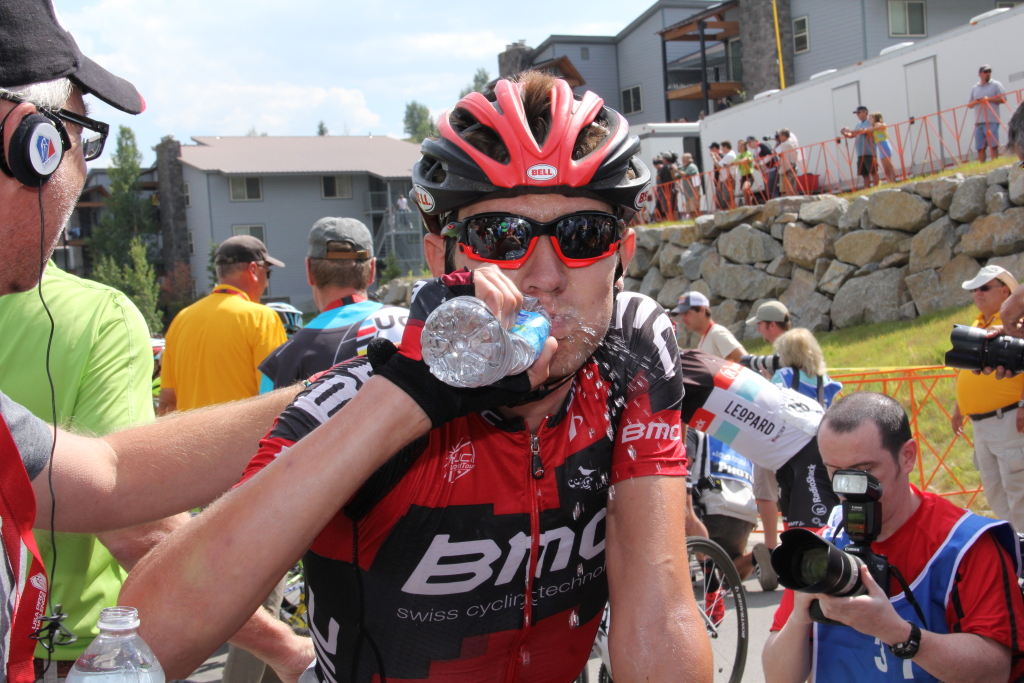
Tejay van Garderen after winning Stage 2 of the 2012 USA Pro Challenge
Taylor Phinney’s 2012 was a rich year – a Giro stage win and pink jersey, the Olympics, and a USA Pro Challenge time trial win in his home state of Colorado. What momento of that amazing year did he treasure the most? Maybe those silver Giro shoes.
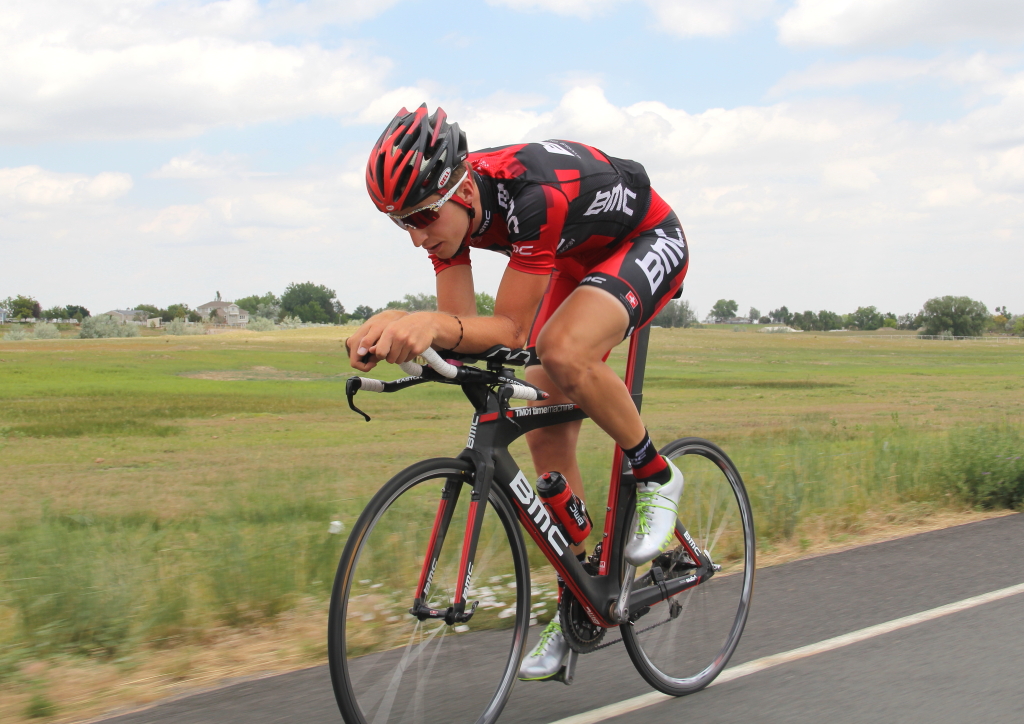
Taylor Phinney during pre-2012 Olympic training near Boulder, CO
The sand section on the shores of Boulder Reservoir tested riders during the Colorado Cross Classic in late October. Jamey Driscoll’s strong second, his best result in the season so far against some of the strongest ‘cross racers in the country, led him to say after the race, “I feel like a bike racer again.” He parlayed that confidence into at least three wins over the next two months.

Jamey Driscoll aced the sand at the 2012 Colorado Cross Classic
Ultra-endurance racers rely on their support crews. At the Mountain Bike 24-Hour National Championships in Palmer Park in Colorado Springs this young man supported his parents who contested the duo race.

A couple in the two-person MTB 24-Hour National Championships received support from their son
Tinker Juarez and Cameron Chambers kept each other in sight in the initial hours of the solo men’s race at the Mountain Bike 24-Hour National Championships. This rocky uphill on the lap challenged the majority of riders, including Juarez, who later dropped out early due to illness.

Even Tinker Juarez walks his bike sometimes
Moist red carnations provide a striking contrast to the arid Utah desert near Moab where the last 24 Hours of Moab event took place and Team Type 1 – SANOFI entered two categories. Kerry White (far right) won the women’s solo race; her son explores the podium flowers. Dustin Cottle, Nathan Bartels, Daniel Schneider, Dustin Folger, and Dan Cunkelman (left to right) placed second in the 5-man team race. Folger’s dad’s, seated to Folger’s right, assisted the team.
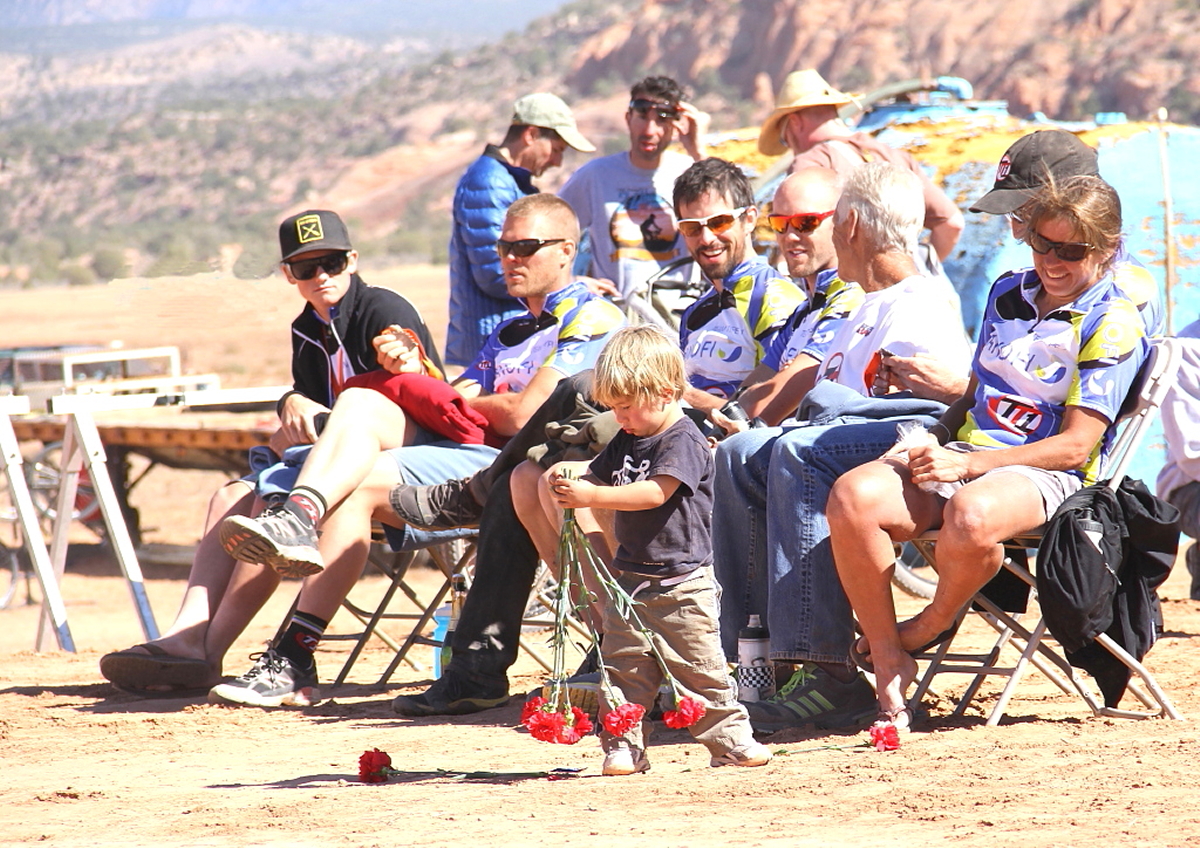
Team Type 1 – SANOFI’s Kerry White and 5-man team at 24 Hours of Moab awards ceremony
One of my favorite expressions from 2012, and it’s not a pain face.

Allen Krughoff at the USGP Smartwool Cup in Fort Collins
I’ve wondered what types of prizes riders receive, so after Gage Hecht won the Junior 15-16 Colorado State cyclocross championship and opened his goody bag, I asked him to unveil the contents. It included a great pair of socks, too.
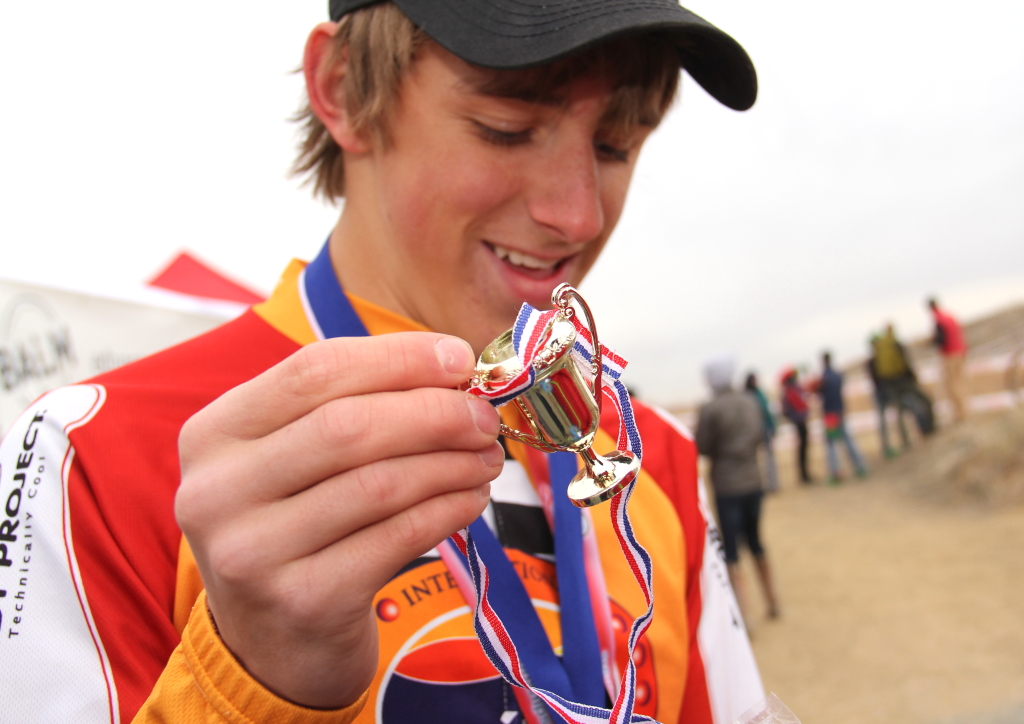
Gage Hecht pulls an item out of his prize bag
Different reasons can render a photograph a favorite: an artful composition or conglomeration of color; the emotion or intent it symbolizes; a particularly expressive face; or the memories from a related event it brings to mind. Here’s part 1 of a collection of photos I took in 2012 that have become my favorites.
Lucas Euser, Kiel Reijnen, a young rider, and Alex Howes (left to right) shepherd a young rider in the turkey feather race at Tom Danielson’s Turkey Day Ride for Juniors which took place on Thanksgiving Day. Who’s feeling more accomplished?
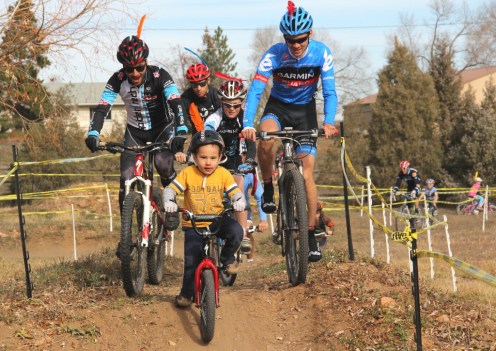
Sometimes we all need a big cheering section to get over a hill
Peter Sagan owned the Amgen Tour of California in 2012, winning five stages and the sprint jersey. When asked after his third win whether he’d go for more, Sagan said something like, “I think people will get tired of me.” Well they didn’t, especially this lady who received his podium flowers after Stage 3 ended in downtown Livermore.

Sagan hands flowers to spectator in Livermore
I first met Joe Dombrowski at the Tour of the Gila, a five day stage race in early May in southern New Mexico. After seeing him finish the time trial looking like this, I knew I would follow his career.

This is what happens after an amazing time trial
Sometimes the best moments at a bike race happen after the race is over. This one’s from Castle Cross in Rhyolite Park.

2012 Castle Cross clean-up crew
In this post Colorado Cyclocross State Championship race shot of Maxx Chance, Mike Dessau, and Ian McPherson, Chance, who scaled this loose hill first, attempts to keep his king of the hill crown.
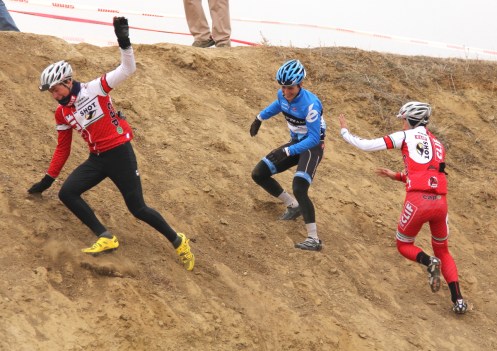
Maxx Chance, Mike Dessau, and Ian McPherson in “King of the Hill”
This is an example of a composition I love. The race leaders approach the Mogollon mountaintop finish in Stage 1 at the Tour of the Gila. The riders have a moment of respite from the wind that typically tears the race to pieces after the ascent begins.

Mogollon climb: Rory Sutherland, Chris Baldwin, Sebastian Salas, Chad Beyer, Marc de Maar, Tyler Wren (l – r)
Temperatures averaged in the upper 90 degrees Fahrenheit at the Tour of Utah, where the lack of moisture on top of the heat made riders thirsty. Here Nathan Haas attempts to ventilate after the Stage 4 Salt Lake City finish.
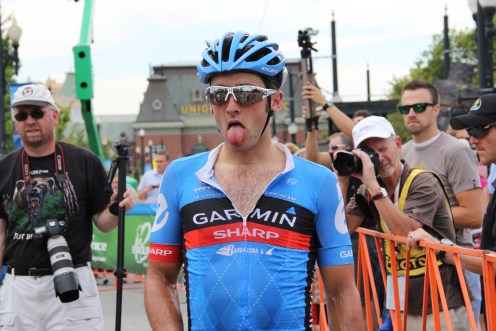
Nathan Haas after the finish of Stage 4 of the Tour of Utah in Salt Lake City
More to come in part 2.
[updated 12/31/12]
A particular story caught my attention early in the 2012 Tour de France. It was July 1st, a day Fabian Cancellara of RadioShack-Nissan attempted a punchy uphill stage win while fighting to keep the yellow jersey. He finished second after towing Peter Sagan (Liquigas-Cannondale) to a win and then collapsed, spent, alongside the press tent where Joe Lindsey of Bicycling and 200 other journalists awaited the stage finish.
It’s Lindsey’s job to ask questions, but he didn’t pose any to Cancellara. In fact, as Lindsey reported it, no journalist asked a question; they waited for Cancellara to recover. “Cancellara was utterly destroyed by his effort,” Lindsey wrote, in his Boulder Report column about the day. “To stick a microphone in his face at that exact moment would be, for lack of a better word, cruel.” While Lindsey added that the questions were obvious and maybe didn’t merit asking, he also wrote, “Instinctively, everyone present knew that to ask a question or to put a microphone in front of Cancellara would shatter the raw, vulnerable human moment we’d been gifted.”
Perhaps I’m not so different from others who report on sport, but it’s the human moments that I most love to write about: the actions, emotions, and decisions that make athletes like us mere mortals. That’s why I liked Lindsey’s story about Cancellara. In the spirit of fair play, other reporters remained quiet as well, and if another journalist had written a similar story, I could be writing about him or her instead of Lindsey.
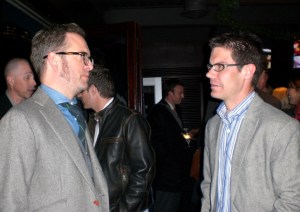
Joe Lindsey (r) with JonathanVaughters
But it’s also true that earlier this year, in January, I asked Lindsey if I could meet and interview him, in large part due to a different kind of piece he had written in November for the Boulder Report. That story explored the dilemma facing Slipstream Sports as it considered cutting funding for – and thus ending – the Garmin-Cervélo women’s team. Lindsey wrote about the many factors and consequences involved in making that kind of a decision; I felt awed by the way he had handled the complexity of the situation.
How, I wondered, did a reporter gain that kind of 360 degree insight into the sport? Lindsey seemed like an ideal person to talk to in order to begin to understand what I didn’t know I didn’t know when it came to writing about pro-cycling. In that November story he had also broached the subject of what might be required for the business of pro-cycling to become sustainable, and given the recent demise of the winning, talent-rich HTC-Highroad team, that topic fascinated me.
Having broad knowledge about the sport, Lindsey said, simply came with covering it for a number of years. He started in 1996. Between then and now the internet and social media have contributed to what he called “an explosion in cycling-specific media” with more people having increased access to and interaction with athletes.
Lindsey suggested that transformation of the business model of a mature sport like pro-cycling would take some time; then again, it might not. It was hard to say. In a note after our meeting he mentioned changes were already happening, and it was possible that change could ensue rapidly once “enough attitudes change” and when “enough people not only change their minds, but are forced by some motivation to act on it.” All of our communication transpired prior to the October USADA tsunami, a force that might lead to such a tipping point.
But as fascinating as those topics were and about which I learned a lot during our short meeting, as I listened to Lindsey recount anecdotes over the clink of porcelain coffee cups in Amante North in Boulder, what struck me most were his observations about how his perspective has evolved after fifteen years or more of immersion in the sport.
One observation in particular emerged as he talked about the Festina scandal that broke in 1998 during that year’s Tour de France. “…at that time I was very young, very new to this whole thing, and I was very much coming from a fan transitioning into being a journalist – I had journalist training and all that, but I was a fan of bike racing before I was a journalist, and so I was like a lot of people,” he told me. “I think I was very shocked at what was going on. And was very puzzled by how the riders at the time reacted.”
Lindsey recalled some of those reactions: the departure of the TVM team and other teams, riders protesting and saying things like “This is terrible. You are treating us like criminals.” At the time Lindsey found these actions counter-intuitive. Why would riders not welcome catching and penalizing cheaters or – and these are my words – not want to complete the biggest race on the planet?
Years later, Lindsey interpreted the riders’ reactions differently.
“Doping at that point was so epidemic in the peloton that if you look back at it now, the action of the TVM team and various other teams, riders, the sit-down protests, all that kind of stuff, that reaction is understandable because what they were saying basically was, ‘Hey, look, this [PEDs] is something you have to do to do this sport right now, and everybody’s doing it and so if you are going to throw these guys [Festina] out then you have to throw us out too. And we’re just doing our job.’”
Lindsey elaborated, “Now I understand where they were coming from. And I don’t agree with it; I still think of it as a terrible episode, but I understand what was going on a little bit better.”
It’s that understanding of human reactions that enriches story. It also helps a reporter act in a respectful manner with the athletes he or she interviews; it is an integral part of 360 degree insight into a sport. To stand near Cancellara after he collapsed and not ask a question was to understand where Cancellara was coming from at that moment on July 1st – I’m human. Let me breathe.
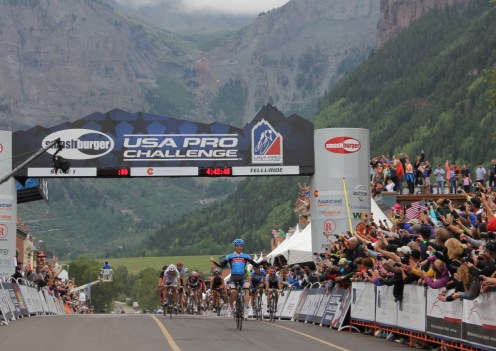
Tyler Farrar wins stage 1 of the 2012 USA Pro Challenge in Telluride
Twenty days after riding onto the Champs Elysées, scabs from multiple crashes during that 2012 Tour de France still clung to Tyler Farrar’s arms and legs before the start of one of the hardest climbing days in the 2012 Tour of Utah. For the American sprinter stage five to Snowbird would be another hard day. Another winless day. While he had contributed to three team time trial victories during the 2012 season, Farrar’s last individual win occurred during the 2011 Tour de France.
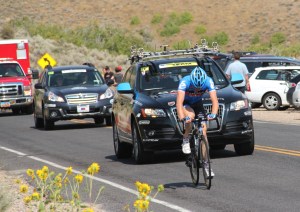
Tyler Farrar, last on the final hill of the 2012 Tour of Utah stage 3
A few days prior to Utah’s stage five he came in third on stage two in the bunch sprint that United Healthcare’s Jake Keough won. The next day he completed a hilly stage three alone in last place just before the time limit.
Farrar’s next opportunity to win would take place in just over a week during the USA Pro Challenge where more mountains waited.

2012 Tour of Utah stage 4, Jake Keogh 1st, Tyler Farrar 3rd
In Utah Garmin-Sharp sports director Charlie Wegelius said Farrar was still “quite beat up” from the Tour de France. He also sounded hopeful about Farrar’s chances on the likely sprint finish days in the Colorado race.
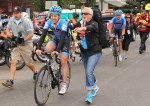
Tyler Farrar on his way to the podium in Telluride, 2012 USA Pro Challenge
Near the end of stage 1 of the USA Pro Challenge the peloton caught the break-away and set up for a bunch sprint. Farrar had made it over Lizard Head Pass close enough to the front to contend for the win in Telluride.
He crossed the line first, handing out the beating instead of receiving it.
The “W” he formed by bending his arms at the elbows could be explained as part of the flow of a victory salute. But there’s an alternative explanation. And if it’s accurate, Telluride provided not only a place to redeem a frustrating season, but a way to continue to honor the memory of his friend, Wouter Weylandt, who passed away in May 2011.
Farrar won again four days later in Colorado Springs on stage five and wore the overall sprinter’s jersey home after Denver.
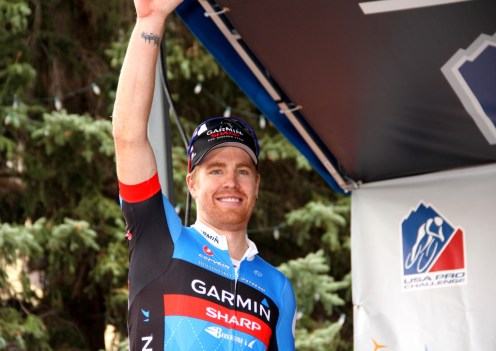
Tyler Farrar steps onto the podium in Telluride to receive the first 2012 USA Pro Challenge yellow jersey
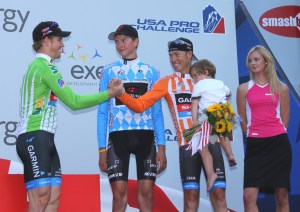
The final 2012 USA Pro Challenge podium, Farrar and Danielson celebrate, Joe Dombrowski looks on

 ProVéloPassion