
Dave Grossman traveled to Prescott, Arizona for the Epic Rides Whiskey Off-Road event last April with something simmering in the back of his mind. Since his appointment to the role of Coordinator of the new Grand Valley Trails Alliance, the Grand Junction, Colorado resident had realized the area’s trail treasures deserved more recognition.
In Prescott Grossman rode the 50 mile amateur course and experienced what he called “an event that surpassed anything I’d seen before.” During thirty years of mountain biking Grossman has attended more events than he can count. But the Whiskey turned his head.
He knew right then and there that he wanted something just like it in Grand Junction.
Whiskey history
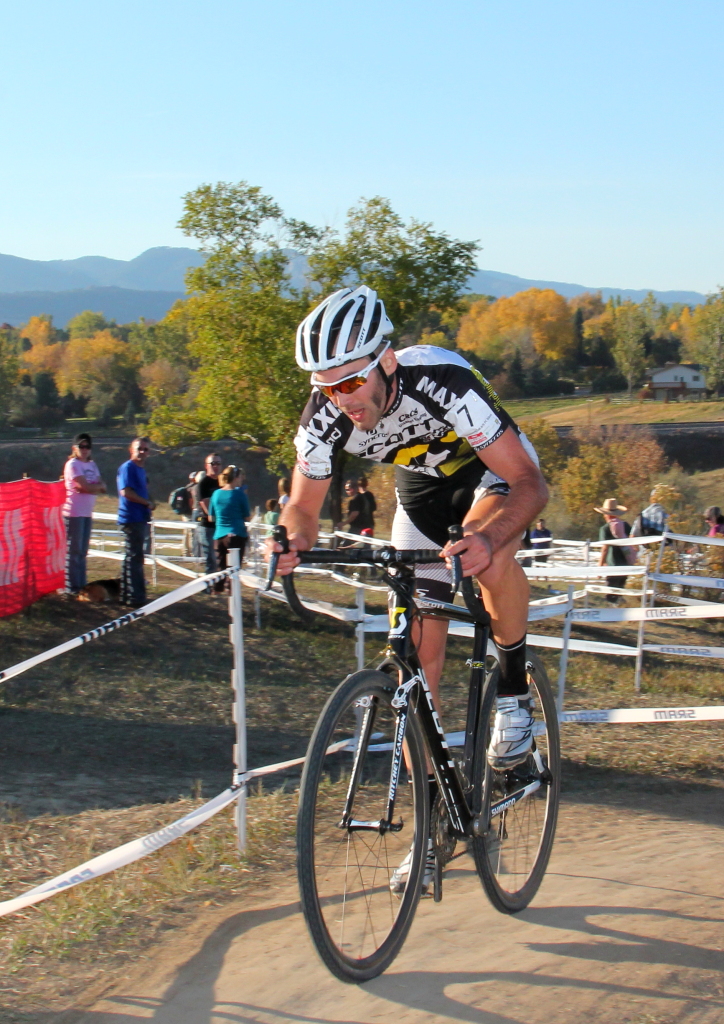
Geoff Kabush at the Smartwool Cup USGP cyclocross event in Fort Collins, Colorado
The Whiskey Off-Road is an endurance mountain bike event produced by Epic Rides. It takes place Friday through Sunday on the last weekend in April in the central Arizona town of Prescott where the elevation is about 5,300 feet. The event is famous for its generous Whiskey-50 pro-race cash prizes as well as its fun vibe and challenging amateur races of 15, 25, and 50 miles in length.
Pro-rider Geoff Kabush (SCOTT-3Rox Racing) described the Whiskey Off-Road in an event press release as “a template for what a great mountain bike weekend should look like. The festive atmosphere, great riding, superb coverage and unique location make it a memorable weekend for riders of all ability.”
Sealing the deal
Grossman commenced his pitch to bring a similar extravaganza to western Colorado at the 2012 Whiskey start/finish line where he encountered Epic Rides’ President Todd Sadow. Securing a subsequent conversation took several efforts on Grossman’s part, but he didn’t give up. The two connected. Sadow saw the potential and began to prepare a proposal to develop a three-day Grand Junction Off-Road race and festival.
As explained by Grossman, the purpose of the Grand Valley Trails Alliance is to bring together all kinds of trail users such as motorcyclists, hikers, horsemen, and bikers as well as conservationists and federal and municipal entities to carry out successful trail projects. Grossman, now also event manager for the Grand Junction Off-Road, told ProVéloPassion that his ability to hook Sadow into this network helped to create a compelling proposal to the City of Grand Junction.
Grossman also benefited from the knowledge base of a committee of community leaders that has for three years submitted bids to land a stage of the USA Pro Challenge. And while that road race has yet to select Grand Junction as a host city, the committee’s on-going work around what’s required to organize a big cycling event in the Grand Valley proved useful in shaping the Grand Junction Off-Road proposal.
Getting passed over for the USA Pro Challenge was not, Grossman stressed, the reason behind the Grand Junction Off-Road proposal. Work on the mountain biking event had begun before the city learned it wouldn’t host a USA Pro Challenge stage.
In addition to promoting the Grand Valley’s extensive trail resources, the Off-Road proposal stood on its own economic merit.
Everybody benefits
Based on attendance at the Whiskey Off-Road, Grossman expects 1,500 to 1,800 people will attend the 2013 Grand Junction Off-Road. He believes visitors will stay for three days at a minimum and create a real economic impact in the community, a benefit that enticed the city to welcome the event.
“When I went down to Prescott I came in Wednesday and I left on Tuesday and made a fun weekend of it. You bring your family, you bring your kids,” Grossman said. “You stay a long time and you have a very dramatic and very significant economic impact on the community… the Grand Junction Off-Road can bring real dollars into the community from day one and the community sees that.”
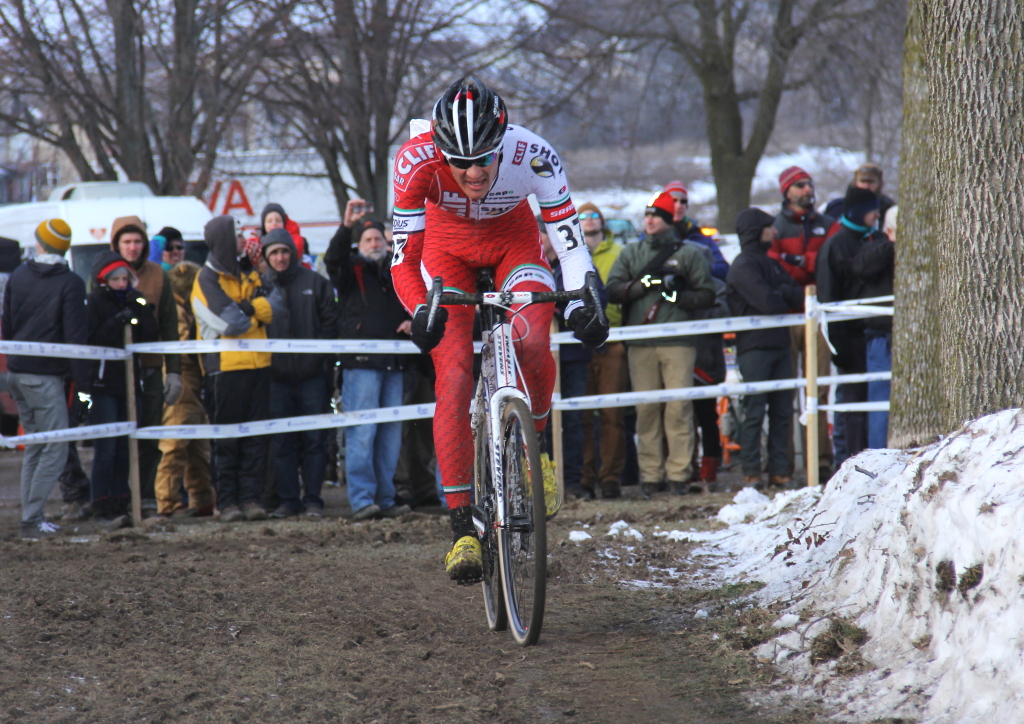
Brady Kappius, shown here at the 2013 ‘cross nationals, rode the 2012 Whiskey 50
Grossman’s attendance estimate reflects those registered to race or traveling with competitors. He hasn’t yet estimated how many spectators will visit to watch the pro-race or soak in the atmosphere. But he’s expecting them too.
“I think that we’re going to have a lot of important cyclists, we’re going to have a big industry expo, and we’re going to throw an amazing event. So the draw if you have any interest in mountain biking is going to be pretty significant,” he said.
The three days of mountain biking will take place over Labor Day weekend from August 30th through September 1st. Grossman thinks other local events that will draw people to the area at the same time, such as the Western Colorado Classic car show, could also influence attendance positively.
Tempting trails
The Epic Rides event concept is designed, Grossman said, to appeal to a wide range of people. Male and female pros will race for a combined purse of $20,000.
Mountain bike newbies will like the “15 Grand,” a 15 mile course. “It’s going to be an interesting challenge for people that are learning to ride a mountain bike but not so hard that they can’t succeed in it,” Grossman said.

Jari Kirkland, women’s solo winner at the 2012 24 Hour national championships, could appear at the Grand Junction Off-Road
More experienced riders can choose between the 30 Grand and the 40 Grand.
“For those that really want to push their limits and try a whole completely different class of x-country racing,” Grossman maintained, “the 40 Grand is going to open up some eyeballs and show people what we’ve got here in the Grand Valley and the quality trail system we have.” Course routes should include the Lunch Loops, Magellan Loop, and Bangs Canyon area trail systems.
Racers and non-racers alike can sample all-day free concerts on Saturday, and the schedule includes kids’ races in downtown Grand Junction. “There’s going to be lots of fun for everybody,” Grossman promised, “so bring your bikes.”
Registration for the Grand Junction Off-Road opens on March 16th. In addition to presenting sponsor U.S. Bank, major sponsors include Blackburn, Cirrus Visual Communication, Rocky Mountain Health Plans, Scott USA, Stan’s No Tubes, and Springhill Suites by Marriott.

Paketa’s D2r Tandem on display at the 2013 NAHBS
The casual North American Handmade Bicycle Show visitor would not have noticed anything unusual about the Paketa display. Tucked away at the end of one of the exhibition rows, several tandems dominated the booth. A mountain and road bike completed the collection.
But lettering on one intensely pink seat stay gave away what set Paketa apart from the other 86 frame exhibitors at NAHBS this year. It read “Magnesium.”
A magnesium frame? What planet does that come from? The answer is Broomfield, Colorado, where Paketa has been making magnesium bikes for twelve years. One of their tandems won Best in Show for Alternative Frame Material at the 2012 NAHBS.

Paketa’s Dave Walker and Terry Malouf at the 2013 NAHBS
According to Terry Malouf, a Tandem Specialist who helps customers decide what they need, and Dave Walker, Designer and engineer, Paketa is the only magnesium bike fabricator in the U.S.
The couple described the advantages of a magnesium frame: it’s one of the lightest metals available, durable, and with ten times better vibration dampening than steel, aluminum, or titanium, it delivers an extremely smooth ride.
So why are magnesium frames so rare?
“As a practical matter it has a very narrow window where you can get a good strong weld. So it takes a very high level of skill to do it right,” Walker said. “There aren’t that many people that have that skill.” Master welder JP Burow owns the company.

An example of Paketa’s magnesium welding skills
Magnesium’s properties as a frame material make it very suitable for tandems, and Paketa has built a niche in the bicycle made for two. Walker said when it comes to building tandems the only main competing material is carbon fiber. Because carbon fiber tandems are also handmade, Paketa can compete well on price. The cost for a Paketa tandem ranges from about $10,000 up to about $18,500, depending on the components.

This Paketa D2r tandem weighs 22.5 lbs
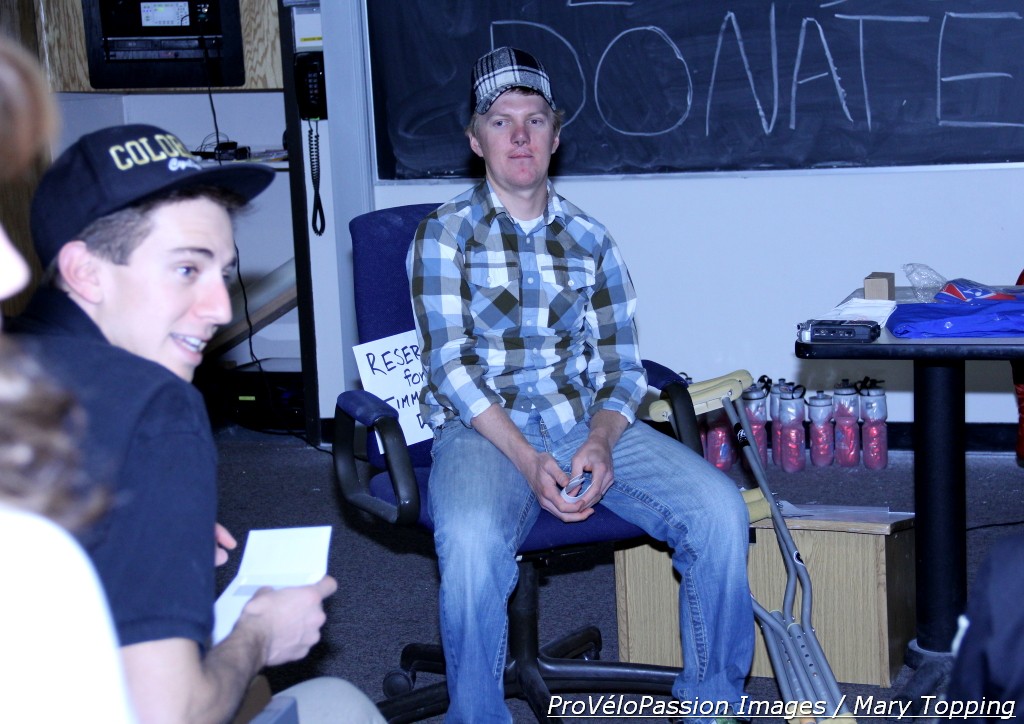
Timmy Duggan waits for audience questions after speaking at a fund-raiser for the CU Cycling Team
Smiles flashed across their faces as national champion Timmy Duggan spoke their language.
“This sport is wicked hard,” he said to the audience of University of Colorado Cycling Team members on Monday night. “Most days suck.” Duggan balanced those words with a positive note when he advised them to have fun racing their bikes. That, he said, “will help you through the downtimes.”
Duggan has weathered several downtimes, most notably a traumatic brain injury from a 2008 crash. Now he’s recovering from tibia and collarbone fractures that prevent him from filling his need for speed on two wheels as well as racing with his new Saxo-Tinkoff team; the injuries occurred in late January at the Tour Down Under in Australia.
At the CU campus in Boulder Duggan spoke while seated with his crutches at arm’s length. He faced cyclists who practice their sport in a collegiate environment very different from where he found himself over ten years ago at the age of a freshman. Duggan practiced his sport then out of his parents’ minivan where he slept when traveling to races, sometimes to the sound of bears feasting on the food in his cooler.
Duggan attended CU. He didn’t stay. Back then racing his bike 100% of the time – aside from delivering pizza to pay for entry fees and gas – felt like the right path. The only regret he mentioned Monday night, in fact, was not finishing school.
But Duggan has attended one of the most prestigious virtual universities on the planet and it’s from years of study there that he gained the wisdom he shared with the student cyclists.
Duggan is a graduate of NGU. All athletes, in fact anyone who strives for something, know it. It’s called Never Give Up University.
Duggan’s way
The national champion distilled his lessons from NGU into three points for the collegiate audience of over thirty people. In attendance were his FasCat coach Jon Tarkington, FasCat and CU head coach Frank Overton, and others who made a donation to the CU team to see Duggan speak.

Frank Overton, head coach of FasCat and CU Cycling team
Set a goal. “Be realistic, but don’t limit yourself…Things can happen that you can’t even imagine right now.” Duggan has practiced this tip since he began seriously racing at age 18. He told the audience that at 19 years-old he fixed probably his most audacious goal ever. At the time a category 2 rider without a team, he decided he would wear red, white, and blue as a member of the U23 U.S. Worlds team. Months later in the autumn of 2003 he sat on a plane flying to Ontario, Canada as first string for the time trial and alternate for the road race at the World Championships.
Pick a path. Duggan cautioned against overthinking the selection of a path to reach the goal. There’s a few reasons for that. First, he emphasized that everything can change in an instant. Second, multiple paths lead to a goal. Third and perhaps most important, as Duggan said, “You’ll find the way.” There’s no benefit to judging whether you’re doing the “right” or “wrong” thing. Instead he advised, “Trust in yourself that you’re doing it right.”
Believe in yourself. And the corollary: believe in your goal and your path. “Anyone can play when it’s easy,” Duggan said. “But to keep going when everything is against you, that’s what makes you a champion. So don’t give up.”
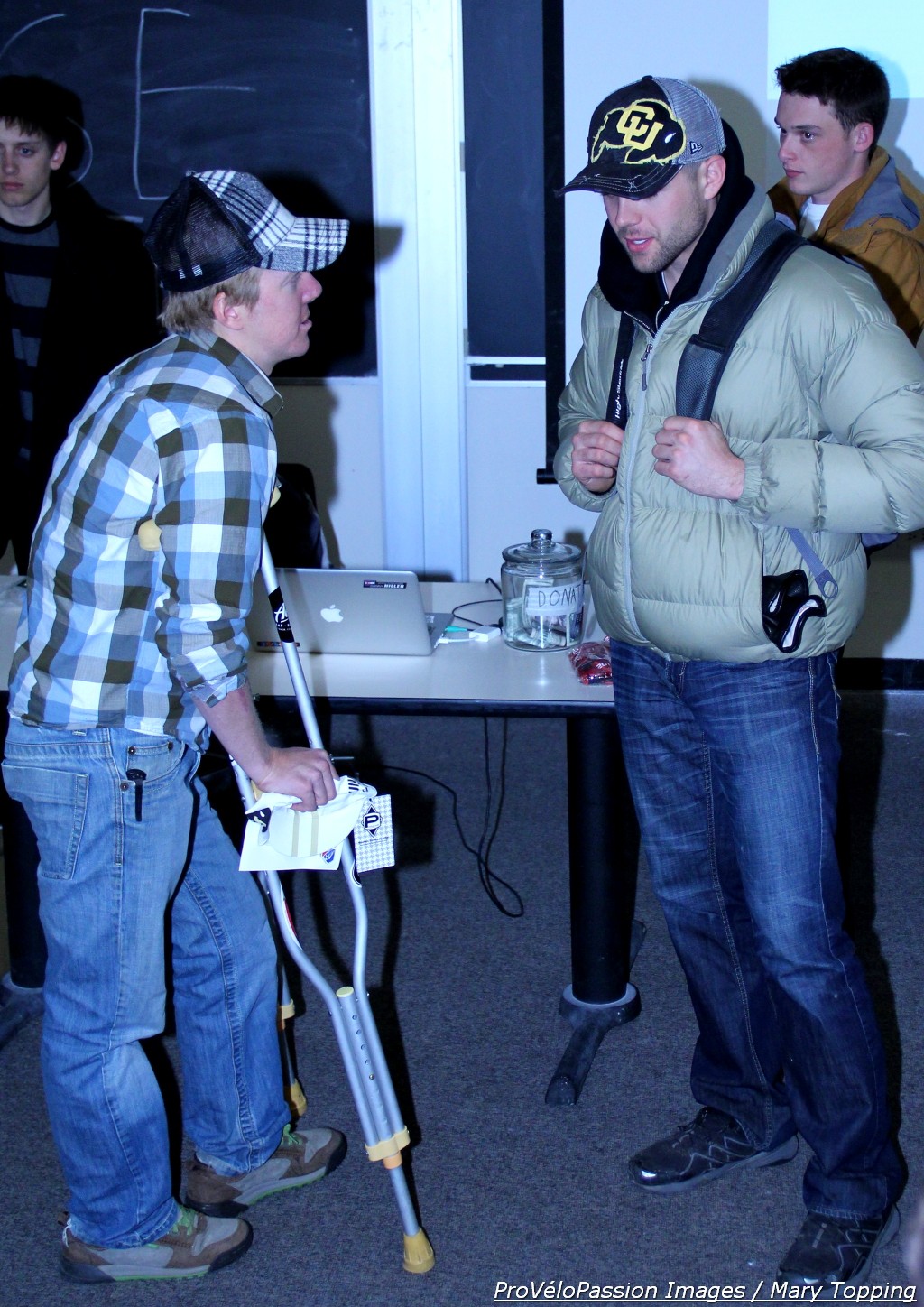
Timmy Duggan after the talk at CU
When Duggan returned to the professional peloton after recovering from the traumatic brain injury, the racing effort felt harder than ever before. After the seventh day in the eight stage Critérium du Dauphiné in 2009 he was exhausted. He wandered into a meadow. In the shadows of the high French Alps with cowbells sounding from nearby pastures, he decided the time had come to call it quits.
“This is just too hard,” he thought in the meadow. The next day on the start line for Stage 8, the same thought occupied his mind, as well as what he might do that fall instead of racing a bike.
Then as an example of his statement on Monday night that anything can change in an instant, he made the early break-away, rode away from other talented riders, and after a hilly 146 kilometers reached the line second, just half a wheel behind the winner.
“Maybe,” he thought then, “I do still have it.” The eighth day in the Dauphiné that he didn’t want to race became a turning point. From then on things improved.
If Duggan hadn’t shown up on that final Dauphiné start line in 2009, chances are on Monday night he couldn’t have called himself the 2012 U.S. national road champion. Or an Olympian.
2013 goals
While elaborating on these three points Duggan shared a specific piece of advice about racing.
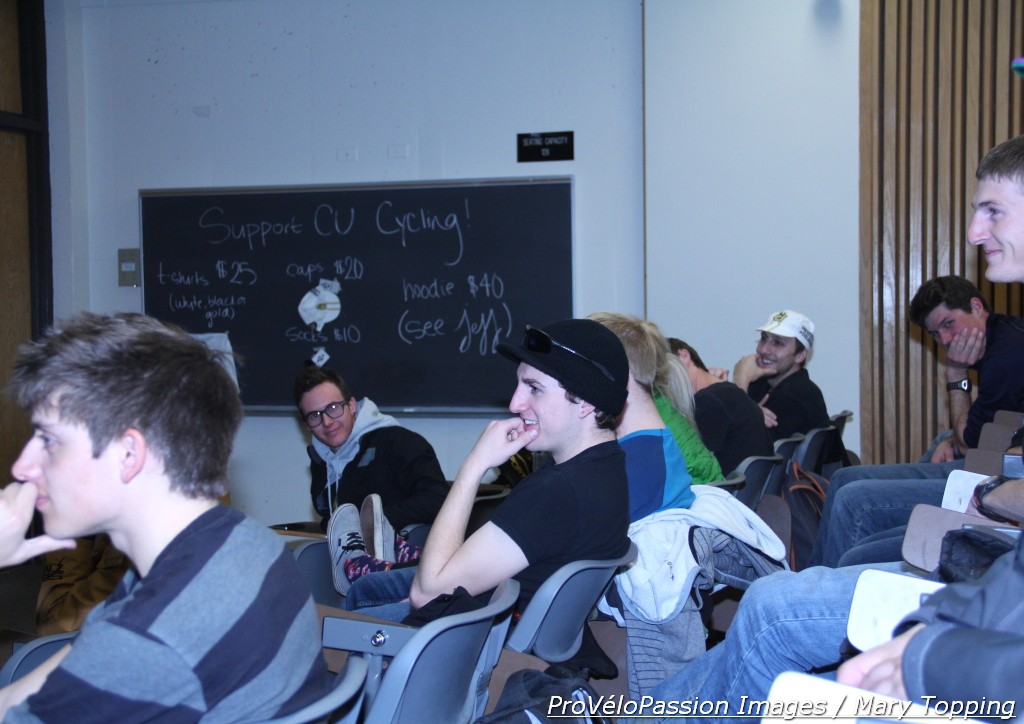
University of Colorado at Boulder Cycling Team audience listens to Timmy Duggan
Be a good teammate. “It’s not just about the watts,” Duggan said as he leaned forward in his chair, “but laying it on the line for your team…It’s very important to build your reputation as a good teammate.”
He pointed out that the job of 90 percent of the peloton is to help the teammate among the 10 percent who can win to do just that. So a young rider is better-served to finish twenty minutes back because he fatigued himself helping a teammate than to collect a string of twelfth places.
At this point in his career, Duggan still polishes his reputation as a good teammate.
His 2012 Tour of California performance exemplified this as he pulled tirelessly on the front of the field to set up Peter Sagan for five victories. This season Duggan intends to help Saxo-Tinkoff’s Alberto Contador to an overall Vuelta a Espana win. If Contador doesn’t start the Spanish grand tour, Duggan would like to earn a stage win.
Then there’s yet another audacious goal. In 2013 he aims to hold onto the U.S. road champion’s stars and stripes. Freddie Rodriguez was the last male road champion to repeat in consecutive years, in 2001.
Likely two thoughts occupy Duggan’s mind right now as he ambles around on crutches or spins on the trainer to the sounds of Metric and The Submarines. One is the vision of a Saxo-Tinkoff teammate that he worked hard for during a race raising his arms in the air. The second is similar, but the Saxo-Tinkoff teammate is a national champion named Timmy Duggan.

Jake Wells piloted this Twenty2 Cycles MTB to victory at 24 Hours in the Old Pueblo. When Twenty2 paints Ti, they leave a portion of the stays unpainted to preserve the titanium identity.
[updated 3/12/2013]
Vail-based Twenty2 Cycles plans to launch a new mountain bike team this summer with Jake Wells as its anchor rider.
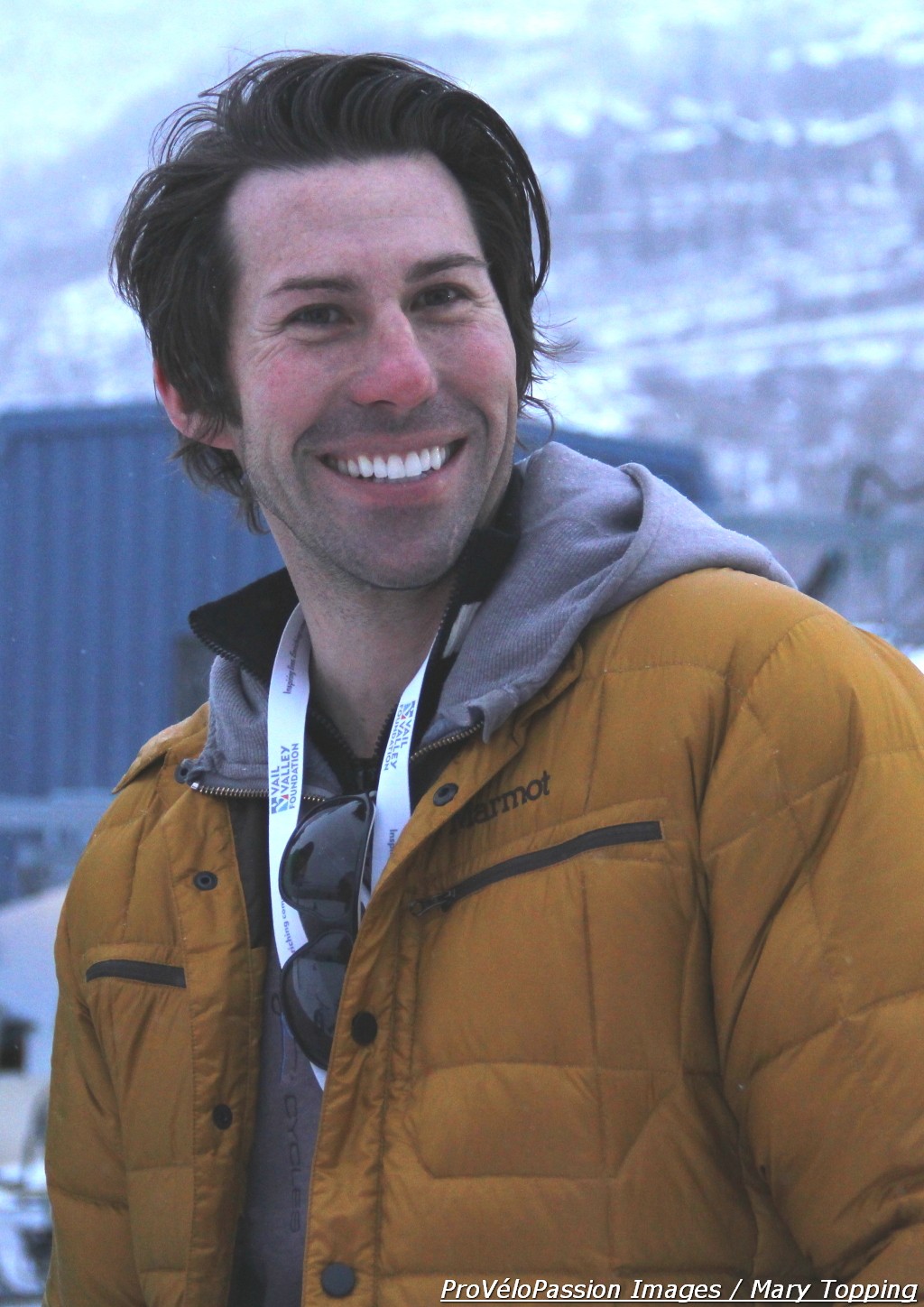
Todd Robison of Twenty2 Cycles in Vail after the Winter Mountain Games snow-crit
The custom bike maker’s co-founder, Todd Robison, shared this development during the North American Handmade Bicycle Show in Denver. Two titanium machines on which Wells rode recently to first place results were among the brand’s models displayed at the show.
Wells, an Avon, Colorado resident and previous mountain bike national champion, propelled a Twenty2 Cycles Bully fatbike to two wins at the recent Winter Mountain Games where he rode in the colors of his Stan’s NoTubes team. He subsequently raced a Twenty2 Cycles 29er mountain bike as part of a co-ed five person team that earned a title at 24 Hours in the Old Pueblo. Robison indicated the new team will race on that mountain bike design.
Wells wrote in an email that in addition to riding for the Twenty2 Cycles team, he will continue to have support from Stan’s NoTubes during the mountain bike season. He will also race for Stan’s NoTubes p/b Proferrin road team this summer.
Both Wells and Robison hope Stan’s NoTubes will sign-on as a sponsor of the new mountain bike team. Wells also mentioned that he wants to foster a connection between NoTubes and Twenty2 Cycles. “Helping to grow these kinds of relationships can be truly valuable down the road, and is one aspect of being a sponsored rider that I enjoy and take a lot of pride in,” Wells wrote.
Many aspects are to be determined as the team’s early development stages unfold. The results of ongoing conversations with potential co-sponsors will decide the team’s official name. Robison wasn’t ready to announce other team members, though he did say the roster will likely include local Colorado riders. Kit design is underway.
While schedules haven’t been finalized, Robison said the squad will focus on endurance races as well as Colorado events. Robison named the Trans-Sylvania Epic and the Breck Epic as examples, two events Wells looks forward to.
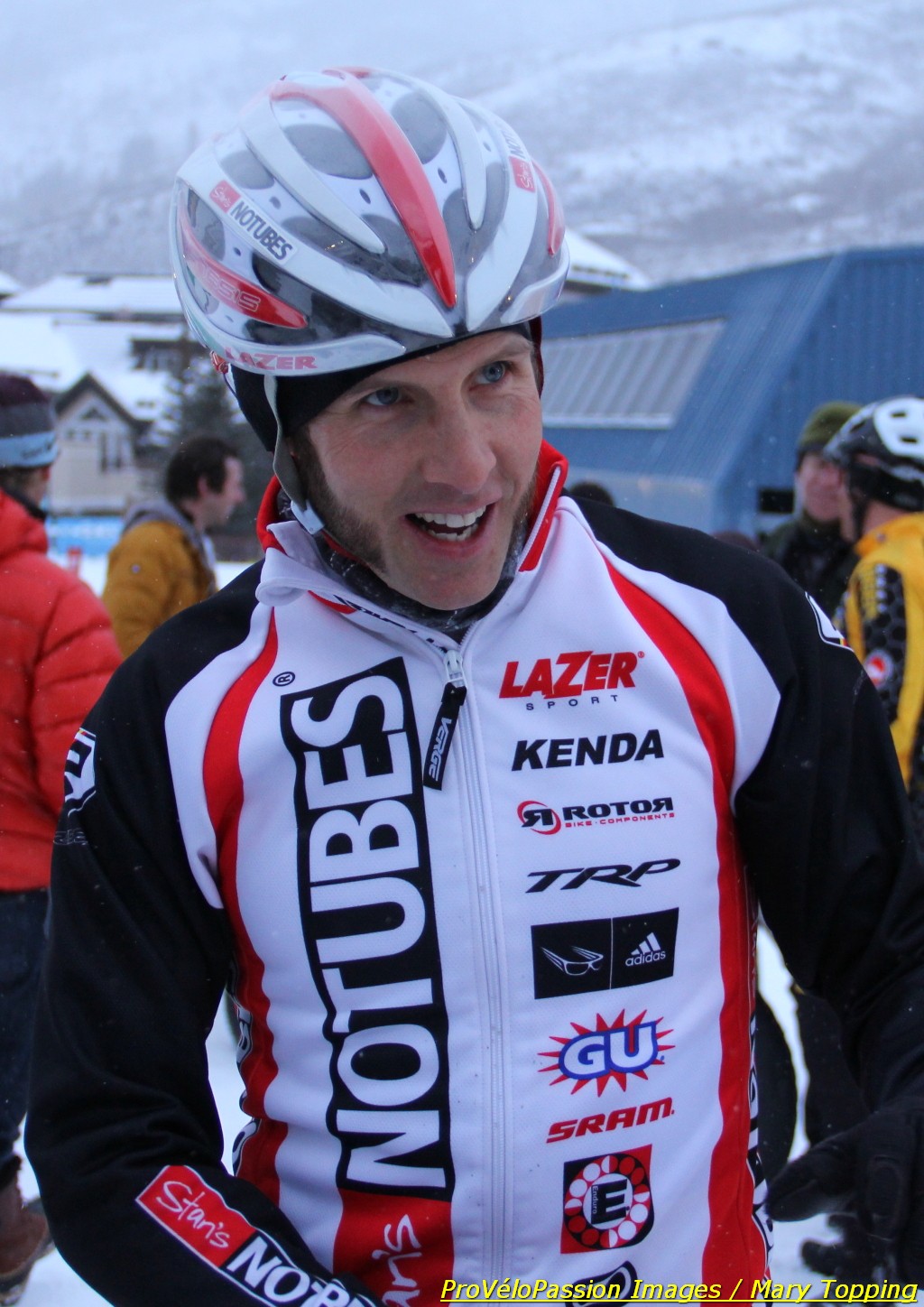
Jake Wells after winning the 2013 Winter Mountain Games snow-crit. The aero shell cover on his Lazer helmet keeps moisture out and heat in.
“I am really excited about having this opportunity to work with Twenty2. With my current commitments on the road and with ‘cross this gives me some flexibility to pick and choose some really cool events this summer, like the Transylvania Epic, and the Breck Epic,” Wells wrote.
“I also appreciate the opportunity to be involved with a small, local brand that I believe in. It is a chance to help grow the brand and to give some feedback on frame design and product development.”
At NAHBS, Robison buzzed with excitement as he talked about his plans for the team. “I think we will have a fun time doing it,” he said, “hopefully get our brand out there, let people see what we do, and get more people on our bikes.”
Twenty2 Cycles has experienced good results in its two-and-a-half year history, especially with its fatbike line which Robison described as more agile than others on the market, in part due to shorter chainstays and head tube. The company also manufactures an expedition-style bike; the Rohloff hub with an internal gearing mechanism, Gates Carbon Drive belt, and no external derailleurs together deliver a reliable ride under harsh conditions.
Robison plans to open a Twenty2 Cycles shop with his partners Ryan Van Ness, Alan Christie, and Jerry Oliver in the Vail Valley area.
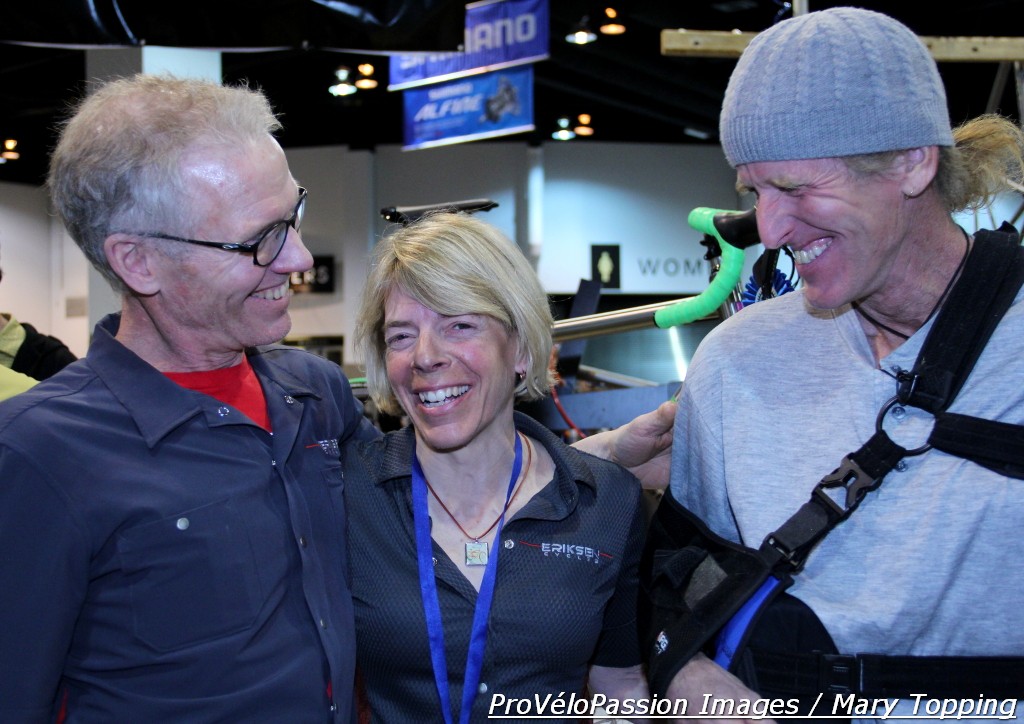
Kent Eriksen, Katie Eriksen, and national and world champion Steve Tilford share a laugh at the 2013 NAHBS in Denver
[updated 2/25/2013]
The object Katie Eriksen calls “beauty with a bod” – meaning gorgeous without needing embellishment – won a prize last weekend in a unique kind of beauty contest.

Eriksen road bike, Best Titanium Construction prize-winner at 2013 NAHBS
Katie works with her husband, business partner, and custom bike creator Kent at the couple’s Kent Eriksen Cycles out of Steamboat Springs, Colorado. The “beauty” is an Eriksen unfinished titanium frame on a demo road bike. It won this year’s North American Handmade Bicycle Show (NAHBS) Best Titanium Construction prize, the latest in a string of NAHBS prizes over the years for the builder.
The Eriksens decided to leave the frame unfinished – in effect naked, to expose their titanium workmanship.
Bead blasting is a common way to finish titanium frames after they are built. That process yields a matte-like silver surface. Katie explained that bead blasting hardens the metal and removes imperfections like scratches and scuffs. It also removes any residual color in the welded joints, basically disguising any instance of what Katie called an unclean or imperfect weld.
Only a builder who can produce perfect welding and mitering would display an unfinished titanium frame.
“Color in welds means not a clean weld. So to have a bike that is that clean – and that’s how all our bikes are – we just wanted to show off the skill of our welder, the skill of our mitering,” Katie said. “The guy who cuts the tubes, form fits it, squishes it – all of these joints have to be so perfect and seamless. If they are not then the weld fills in, you’ll get a dip. You just don’t get this completely clean line and you get colors because you overheat it.”
The Eriksen prize-winning bike’s joints, raw and unfinished, had nothing to hide; they shined only silver.
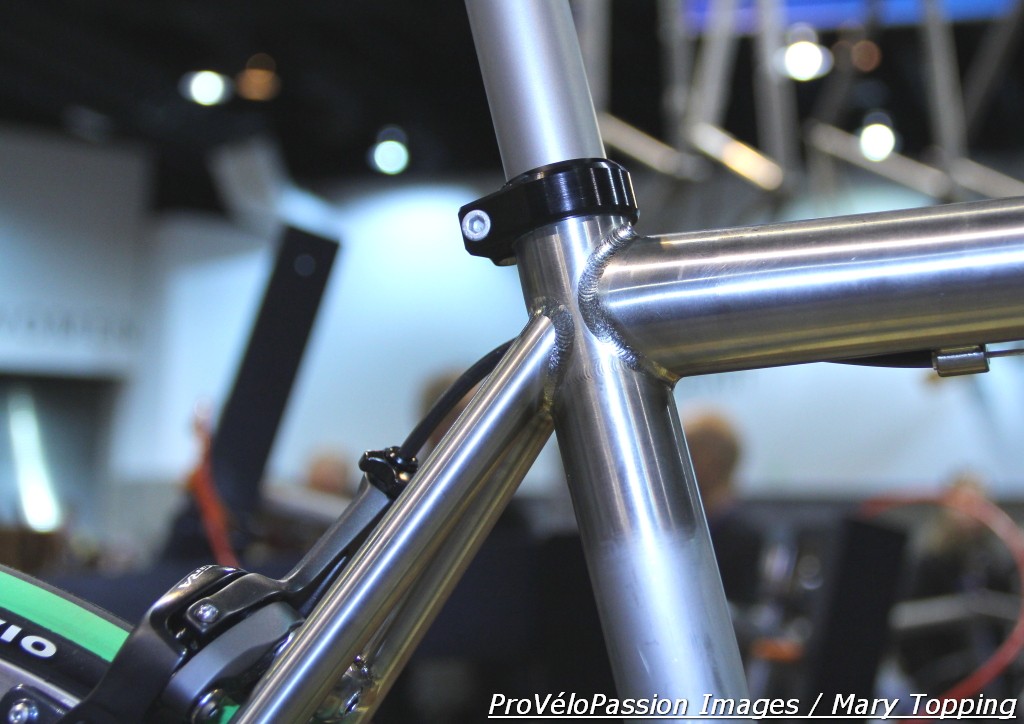
“Beauty with a bod” 2013 NAHBS prize-winning Eriksen road bike welding is clean without browning or color
Ti and Kent strong together
Katie believes the bicycle industry has evolved to a post carbon-centric market where buyers are considering other materials. She also thinks cyclists want more than one bike, and when they reach for their reliable favorite, it will be one shaped from titanium.

Eriksen bead-blasted titanium frame with matte finish
“We like to talk about these bikes as your ‘forever bike’,” Katie said. “Frequently this is the go-to bike in somebody’s stable of bikes; it’s comfortable, it’s responsive, it’s stiff, you’re not going to crack it…So we do a lifetime warranty on our road frames; ten years on mountain bikes. That’s how strong that metal is. It doesn’t corrode, it doesn’t rust.”
Among those who trust the brand is cycling legend Steve Tilford, now a masters racer, and multiple national and world champion. The Eriksens hung the jersey he wore at his most recent cyclo-cross Worlds outing in Louisville last month near their winning NAHBS frame.
The couple also rides and races what they sell. Conversation about their endeavors revealed something that Kent had chosen to hide at the NAHBS.
As cyclists their strength resembles the strength of the titanium frames they build. In 2012 they finished the Leadville Trail 100 MTB event on one of their tandems. By finishing in less than nine hours they earned the larger size belt buckle prize. With 12,000 feet of elevation gain on that course, not even solo riders complete it in under nine hours.
Katie described Kent, having spent 35 years building titanium bikes, as more experienced in that realm than anyone anywhere. At the NAHBS Kent appeared to balance professional pride with humility in his personal athletic accomplishments. He hid the Leadville 100 belt buckle he wore under a tee and button-down Eriksen logo shirt.
Perhaps he didn’t want to distract visitors from the other, perfect metal that defined the Kent Eriksen Cycles exhibit space.

Kent Eriksen unveils his Leadville 100 belt buckle; it’s larger because he and Katie completed the course in under nine hours
Americans don’t have to travel far to experience extraordinary chapels packed with cycling memorabilia.
Of course the European shrines will make any pro-cycling fan tingle with awe as she stands inches from jerseys worn on the backs of historic heroes like Coppi, Bartali, and Anquetil. Visiting one of these shrines also provides a restful break from the hours of waiting and traveling to watch a Grand Tour.
In addition to Notre Dame des Cyclistes in a French village north of the Pyrénées which celebrates the Tour de France and reportedly protects a bike that slaved over the first Tour de France route, Madonna del Ghisallo welcomes travelers near Lake Como in Italy. Nuestra Señora de Dorleta at the Puerto/Alto de Arlabán greets visitors in Spain’s Basque country.
But right under many cyclists’ noses lie their own personal chapels: their basements, garages, or wherever they store their cycling tools and mementos.
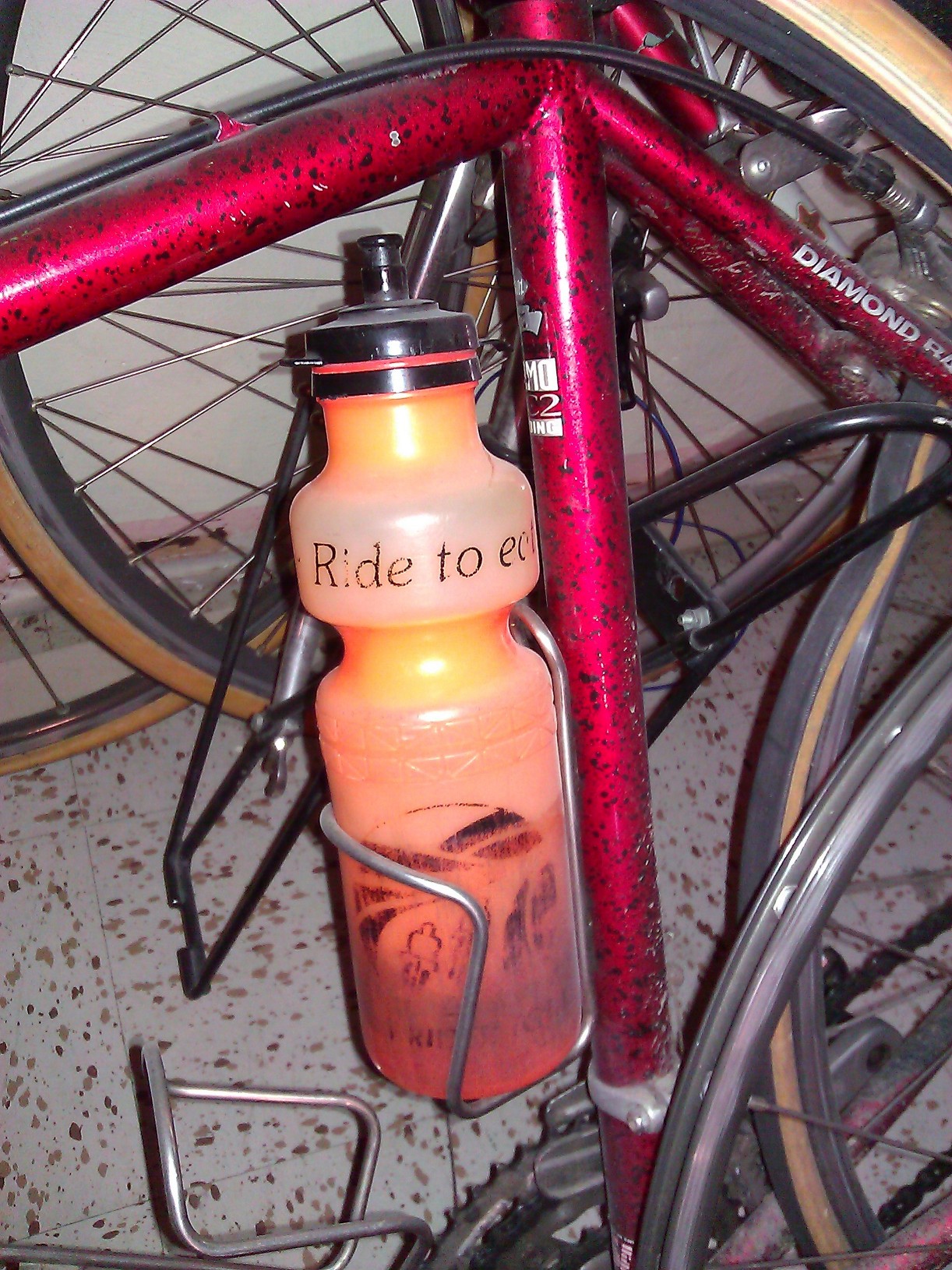
The collection doubtless includes a handful of bikes. The brown Olmo that escorted her to her first race in Central Park where she wondered if she could hang on to the back of the field. The Diamond Back with which she alternately labored and sailed over 4,500 miles with forty pounds of clothing, tent, sleeping bag, and extra tire to see the country from Seattle, Washington to Bar Harbor, Maine, and in whose water bottle cage rests an orange bidon with the barely legible phrase “eat to ride, ride to eat.” A newer road bike, paint still shiny and tires at full pressure. Her first mountain bike, now converted into an errand machine with a rear rack and panniers, on which she learned in the company of a group of women she’d just met at a clinic how to negotiate a sand slick on the trail.
The bikes live with the mixed fragrance of rubber, oil, and sweat from equipment. The pile of punctured tubes languishing on shelves. Multiple pairs of partial-fingered cycling gloves. An old hard-sided suitcase that acts as home to wrenches, allen keys, spokes, black-streaked rags, gunk-coated splayed heads of old toothbrushes, and rings of new cable bought for ambitious maintenance plans but still unused.
It’s worth pausing in that basement or garage for a few minutes, just like standing on the cool stone in Madonna del Ghisallo. Both are perfect places to recall and give thanks for the wonderful places and people encountered on a bicycle.
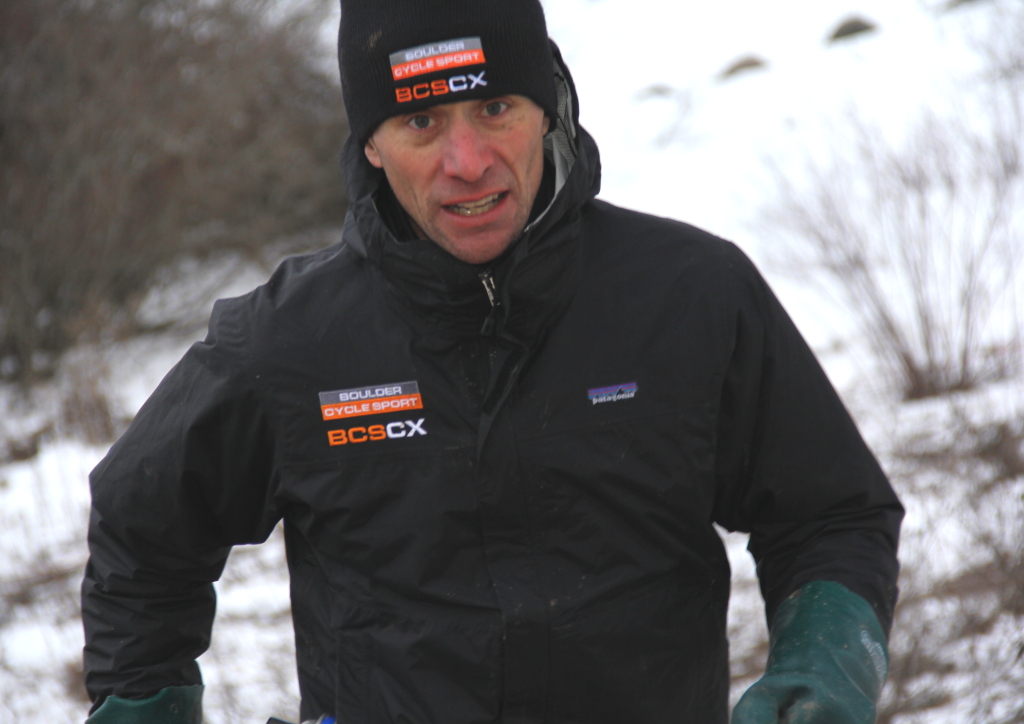
Pete Webber at 2013 Cyclo-cross Nationals when he crewed for teammate Russell Stevenson in the pit
The anvil is unbreakably tough; as a tool it exists to absorb poundings. So with national and past world cyclo-cross champion Pete Webber accepting the Anvil Award last Friday night, it’s reasonable to guess the award acknowledges the “hardest” male or female cyclo-cross racer, the one who can endure the most suffering on the bike.
While a good one, that guess is not correct. The Anvil Award recognizes the person that best promotes cyclo-cross community.
After expressing thanks for the award in front of members of the Boulder-area ‘cross community who had gathered in the Boulder Cycle Sport shop to celebrate the close of the season, Webber displayed the 2014 Boulder logo. “It’s going to take community to pull this off,” he said, referring to hosting thousands for the cyclo-cross national championships in Boulder next year.
The award and Webber’s emphasis on community reminded me of a quote from Christopher McDougall’s book about ultra-running and the athletes and cultures that embrace it, Born to Run. He wrote,
“The reason we race isn’t so much to beat each other…but to be with each other…other runners try to disassociate from fatigue by blasting IPods…but Scott [Jurek] had a simpler method: it’s easy to get outside of yourself when you’re thinking about someone else.” [Scott Jurek is an accomplished ultra-runner. – ed.]
Effectively what McDougall means is this: we get the best from ourselves in the company of others and when we minimize self-absorption by helping others. It makes sense. People have needed each other since we came into existence – to catch or grow food, continue the tribe, build a barn. Together we create things much larger than we can by ourselves.
As Webber pointed out, it’s impossible for a single person to carry off a sporting event. Take the cycling discipline of cyclo-cross. Someone designs the course. Someone manufactures the tape and stakes that define the course. Someone provides the location. Officials ensure competitors follow the rules of fair play. Riders compete against each other.
Wait. Is it “against” each other or “with” each other as McDougall suggests?
Except for those who practice sport purely for fitness, athletes aim to win. Professional athletes must win; each is in business for himself and winning generates revenue.
But it’s only with others that winning – one person achieving a better result than another – becomes possible. In that sense an athlete can’t win unless others also participate in the same event. And as some have pointed out, competitors can movitate an athlete to do better than he thought he could.
Robin Eckmann (California Giant Berry Farms/Specialized) expressed a related sentiment today in social media. He wrote, “Had a great time at grasshopper race ride. Nothing on the line but experience and good time with team mates and friends. :)”
Since an athlete can’t win all the time, it would be pretty demoralizing if the only reward for competing was winning.
Making the Anvil Award a symbol of forging community is to recognize that community is the foundation of sport. Without community, there wouldn’t be anything to compete for.
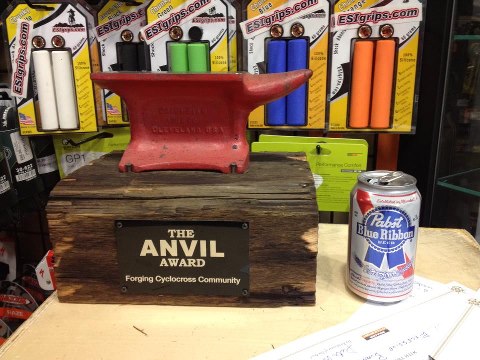
The Anvil Award (photo by Jamie Servaites)
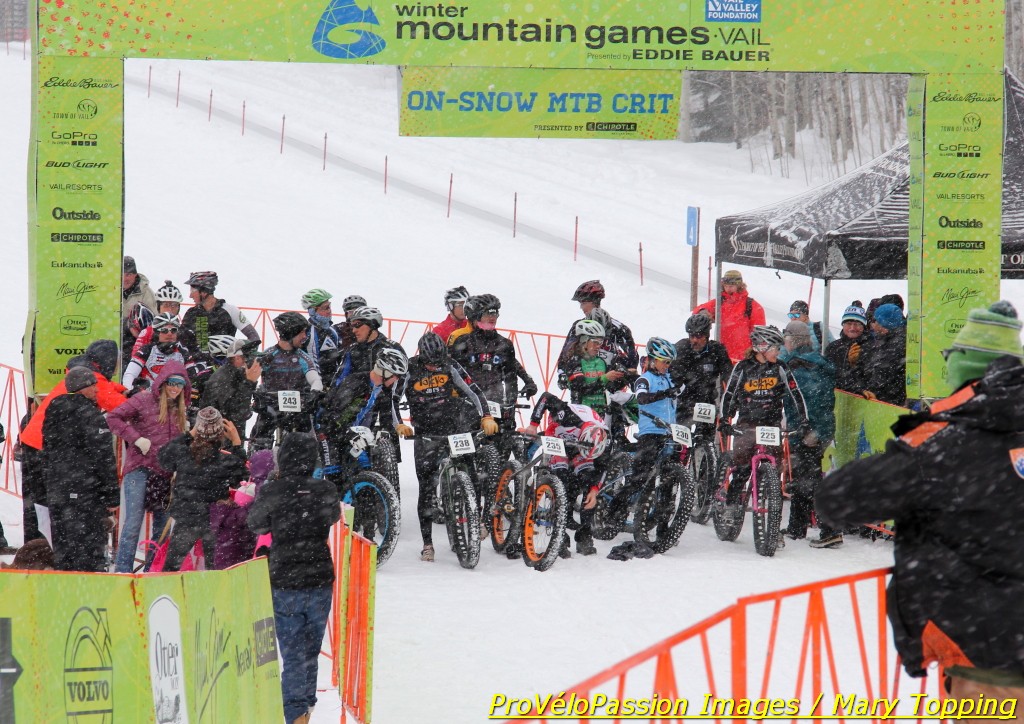
Snow fell and the wind blew moments before the start of the 2013 snow-crit
It was a question that really didn’t need to be asked. “Jake, are you going for the double?”
Jake Wells (Stan’s NoTubes) considered his answer as the snow fell in earnest Saturday evening. He stood astride a snow bike at the base of Vail’s Golden Peak, meeting friends before taking the start of the snow-crit race in the Winter Mountain Games p/b Eddie Bauer. The day before he had won the x-country MTB race at the Games on the same bike from Twenty2 Cycles.
His answer: “Yea. We’ll see. I came in second last year.” Then, as if he’d convinced himself of the possibility, he added, “I’m feeling good.”
Race action
The men’s category of the snow-crit unfolded just like the x-country race. Two strong leaders gained a lead on the field soon after the start. At the x-country contest it was Wells and Colin Cares (Kenda/Felt). At the snow-crit Tim Allen (Orbea-Tuff Shed) and Wells led the way.

Tim Allen makes the most of his ninth snow-crit lap
Climb. Descend. The twenty riders in the snow-crit repeated that formula for up to nine laps of the one kilometer course.
They climbed out of the start line, up and under the Golden Peak bunny slope lift. That climb, Wells later said, “takes a lot out of you.”
The first portion of the descent stole any chance of catching a breath; off-camber, every competitor slipped, fell, or tripoded their way across it and into a tunnel that delivered them to the long sweeping downhill which carried them back to the start/finish line.
In lap four Wells created a ten second gap over Allen.
Like Cares in the x-country race the day before, the snow-crit marked Allen’s maiden voyage on a snow bike. The snow-crit decides winners for both fatty tire-equipped snow bikes and standard mountain bikes. Allen won the snow-crit on a similar course last year on a mountain bike, likely with tires one-half as wide as the cushy snow bike tires he traveled on this year.
The race ended after about thirty-eight minutes when Wells polished off his ninth and last lap. Allen followed forty seconds later to claim second place.
Humble double
The back-to-back wins represented a rare gift for a guy who said he doesn’t win much. The last time Wells thought he had carried off two wins in as many days happened in 2010 at Frisco Cross.
“It’s like fishing,” Wells said, speaking about bike racing. “You may go out and fish all day long and not get anything and then you get that one bite or that one that gets away.” Or the line tugs and you pull in the prize.
Jake Wells after winning the 2013 snow-crit. The aero shell cover on his Lazer helmet keeps moisture out and heat in.
Winning, Wells said, no matter what race, is “like catching the big fish. It’s what motivates you going into the season or motivates you to continue on in the season to keep working hard, to know that that fitness is still there and you can still come out on top.”
He added, “There are a lot of people that never win, that never get on the podium. It makes it a little more special, I think – maybe the older you get or the more mature you get…the wins may be few and far between, so you try to take it when you can get it.” Wells’ racing age is thirty-five and he’s not taking his Winter Mountain Games success for granted.
* * *
Scenes from the 2013 Winter Mountain Games snow-crit, including post-race interviews with Allen and Wells.
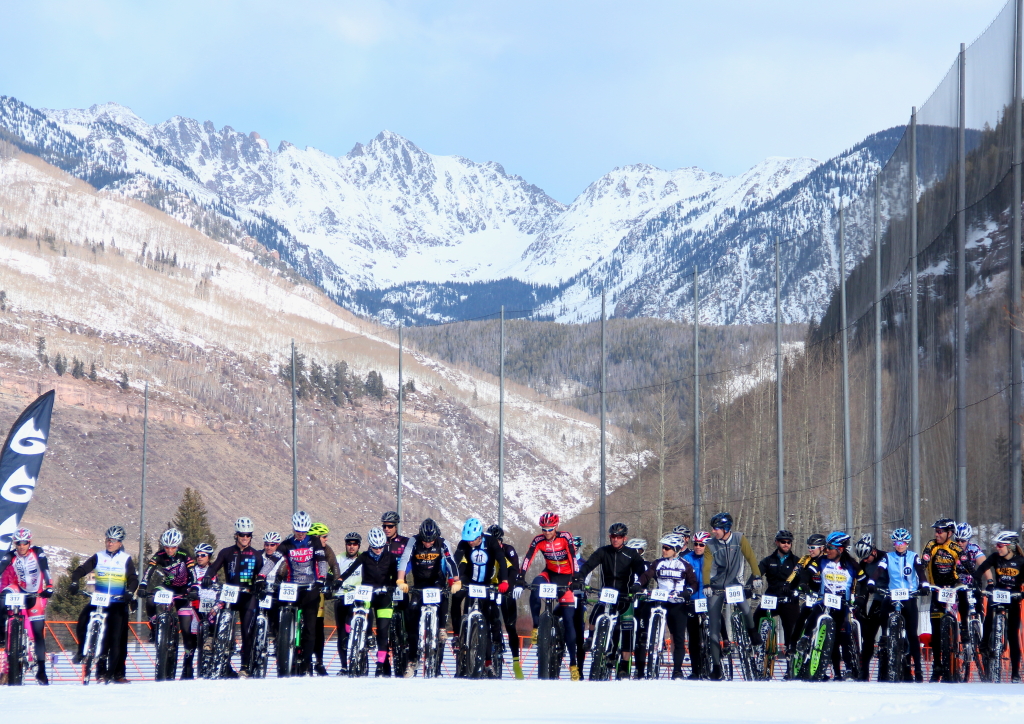
X-Country Winter Mountain Games start line in Vail
[updated 2/11/2013]
When twenty people do something that looks, well, odd, it starts to look kind of normal. So when twenty bikes with tires as wide as a bike racer’s thigh lined up on the snow covered Vail golf course with the Gore range soaring into blue sky behind them, an observer could think, okay, a bike race is about to go off. And he would be right.
At a pace that seemed like slow motion for bike racing, riders including Jake Wells (Stan’s NoTubes), Colin Cares (Kenda/Felt), Rebecca Gross (Tough Girl Cycling) and over thirty local cyclists pedaled off on Friday afternoon to tackle the 20K X-Country On-Snow Mountain Bike Race at this year’s Winter Mountain Games. Only one third of the entrants selected a mountain bike; the remainder rode fat-tire snow bikes.
Right out of the gate the snow showed who’s boss; the variable hard-pack and soft snow conditions both widened and narrowed the choices typically available to a rider on a dirt surface.

Rebecca Gross taming her snow bike beast
Gross, for example, found out early that snow provides a soft landing and safe haven from flying objects. She had fitted a pair of worn pedals onto her bike. On her first pedal stroke one foot unclicked. As others moved forward around her she dropped back. The field had already started to veer right and it pushed Gross in that direction and off the packed cross-country ski trail into soft snow.
As she flipped over the handlebars she could think about only one thing: the 35 pounds of metal and rubber that sought its rider. “There is nothing like knowing this thing is coming down on top of you,” she said after the race. “I just curled into a ball and fortunately I think I sunk into the snow so deep it didn’t even hit me.”
By the time she crawled out of the hole and set her bike straight, as Gross described it, “I was dead last after that crash so I was like, it’s just going to be fun. I might as well smile and wave at people. And I did. It was good.” She went on to tame her snow beast and finished on top of it.
Snow bikes are unusual enough that many of the riders entered the race with little experience on them. Wells, Cares, and Gross all competed on borrowed bikes.
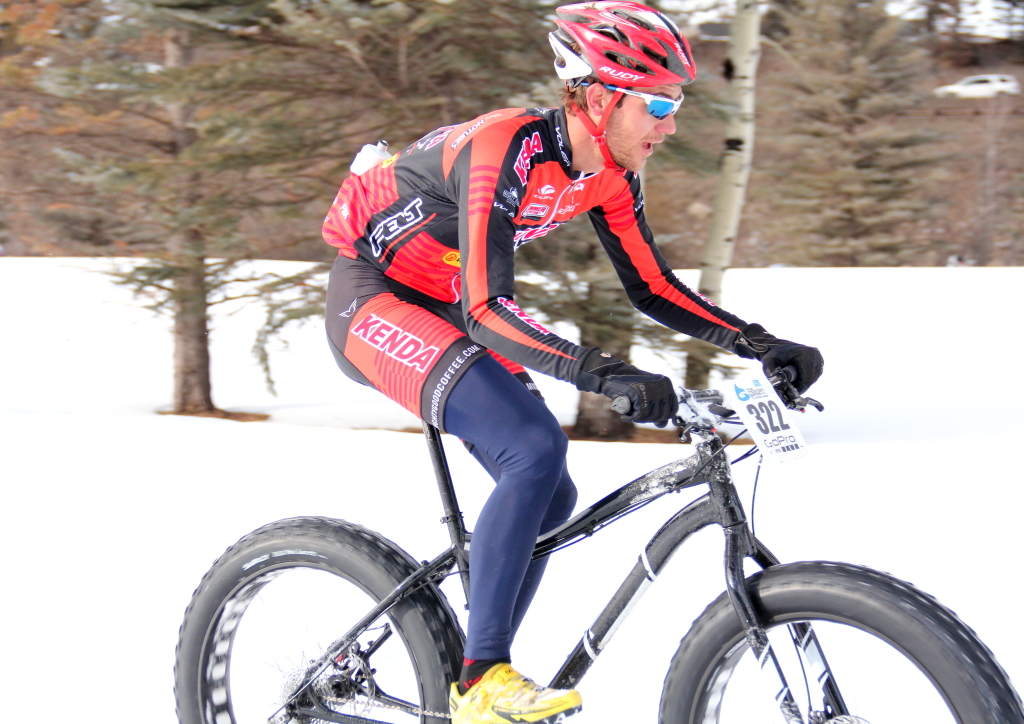
Colin Cares driving the snow bike
The Friday event was Cares’ first outing ever on a snow bike. Cares led as he and Wells swung downhill at the end of the first of six undulating laps. In lap two Wells came around him and started to open up a gap. “I got on Jake’s wheel and I felt comfortable with the pace but I think he’s just a lot better at riding in the snow than I am,” Cares said, after completing the fifty minute effort. “I was just sliding around and kind of got off course a little bit into the powder. It was super-fun. It’s a bit of a learning curve with the snow bike that I haven’t quite gotten onto yet.”
The course design ensured Wells never really felt comfortable with his lead. A foot-wide section of single track, a hiking trail in summer, created a bottleneck. “I was a little nervous,” he said. “I wasn’t sure how big the gap was, but I thought, shoot I’m going to get behind lap traffic and then have to sit up.” And that’s where a trail on snow limited his choices.
“It wasn’t really that fair to ask [riders ahead of me], ‘Hey, can I get by?’ because there was really nowhere for them to pull over; they’d have to get off and into deep snow.” So Wells’ lead stretched out and contracted. Not until two laps remaining did Wells believe he had created a gap that might last.

Jake Wells into the X-country snow bike finish at the 2013 Mountain Games
Wells attributed his strong showing to carrying over fitness from the cyclo-cross season, and maybe even more so to his borrowed bike from a Vail-based custom bike maker, Twenty2 Cycles.
“These tires were absolutely ridiculous,” Wells said, referring to his snow bike. “You could just pressure the front end and it just hooked up and made the corner.” The 45NRTH Escalator tires gripped with square shaped knobs, chevrons in the middle, and pincer-like knobs on the shoulders that helped Wells gain time through technical sections.
Just like any “normal” bike race, one rider won: Wells held on to win the overall men’s field. Cares finished second, just 18 seconds behind. Didn’t it take a lot of guts to race and ride a snow bike for the first time in one go? “I don’t know,” Cares said, “it’s just like riding a bike, right?”
Full race results here.

Chad Melis shows even snow bikes can do wheelies
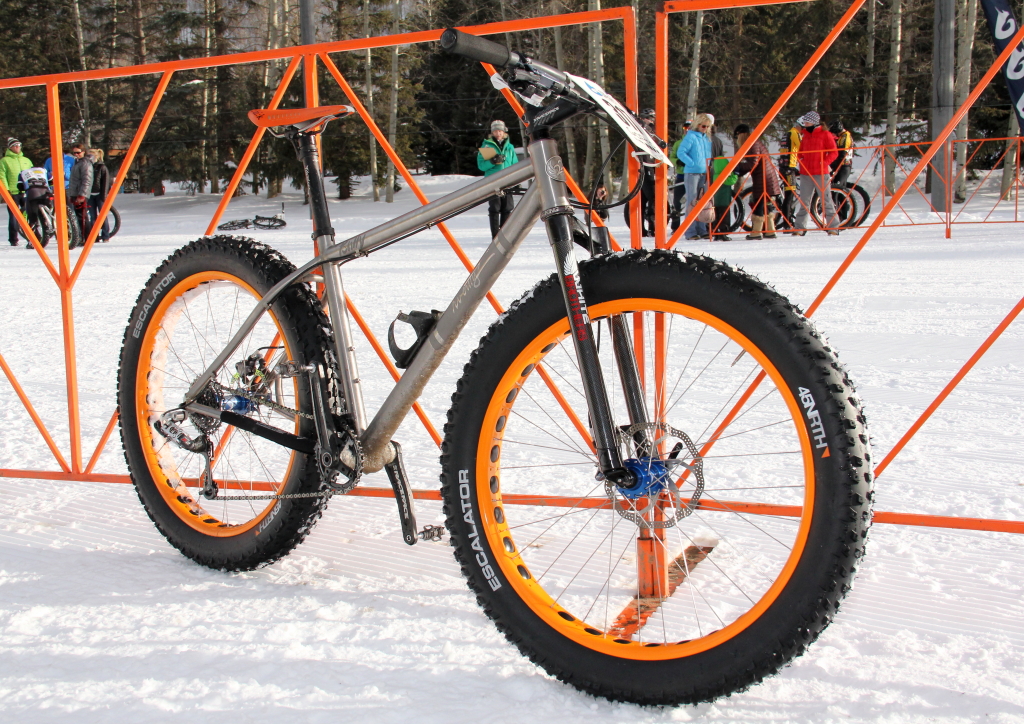
Jake Wells’ winning Twenty2 Cycles titanium snow bike
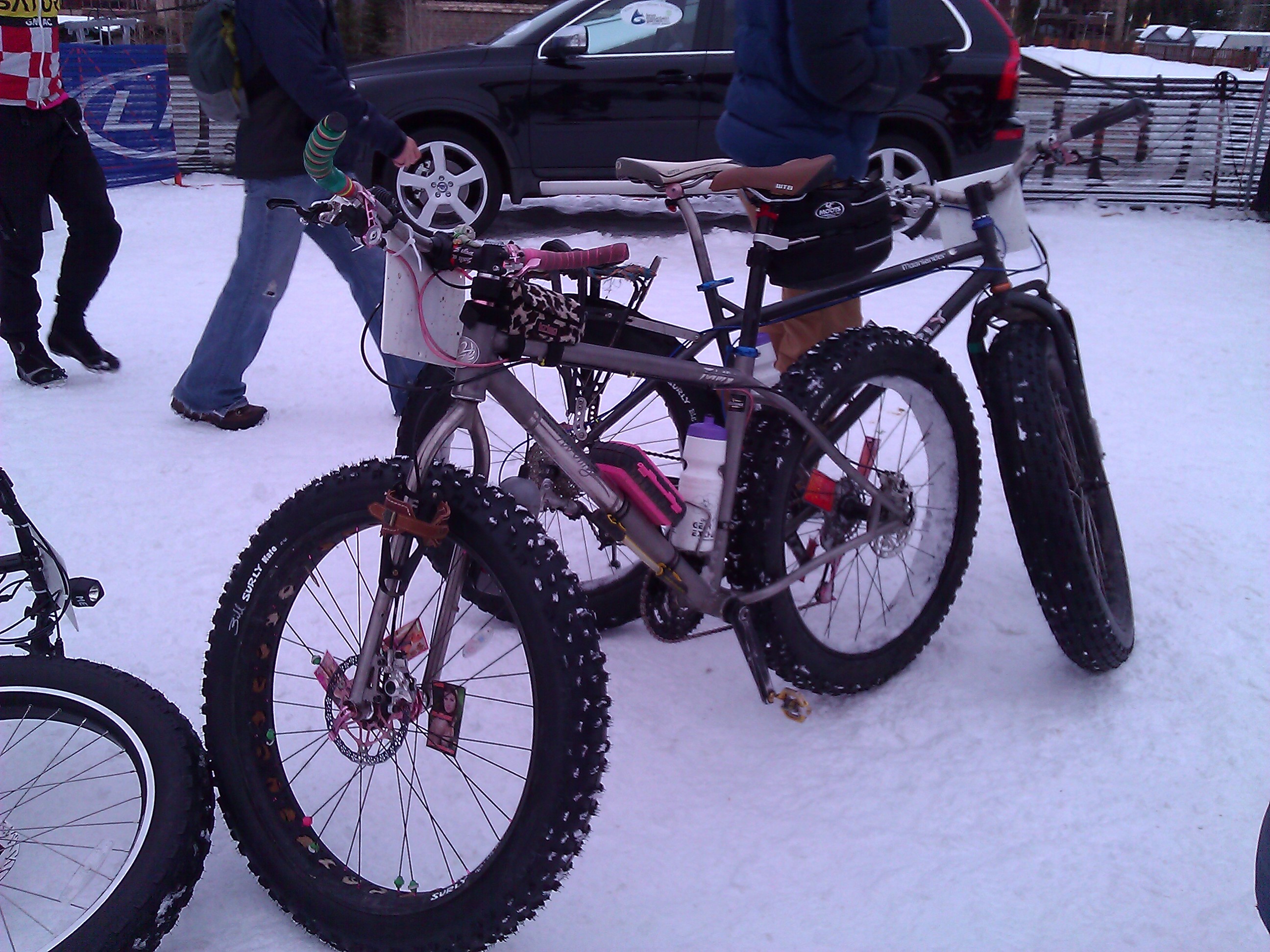
Snow bikes at the 2012 Winter Mountain Games in Vail
[updated 2/8/2013]
Bike racing fans don’t typically associate snow with fat tire bikes – except maybe if they live in Alaska. But this weekend at Vail they’ll have the opportunity to see what happens when bikes and snow mix it up at the Winter Mountain Games p/b Eddie Bauer, especially at the snow-crit on Saturday evening.
Riders in last year’s snow-crit slipped, surfed, and slid their way along the downhill on the 1 kilometer loop as many as ten times during the forty minute race. These maneuvers – some clearly in control and others not – made for some of the most interesting spectating at the event, which again this year takes place at Golden Peak.
Bikes respond differently on snow and dirt; understanding the differences affords a deeper appreciation for the riders’ efforts on Saturday as they compete for the $250 first prize in the MTB division and the $700 first prize in the snow bike division.
Mitch Hoke, a member of the Kenda/Felt MTB Team and a skilled MTB and snow bike handler, provided insight into how riding on the two surfaces differs.
Traction
Mitch Hoke (courtesy of Kenda/Felt MTB team)
“Snow and dirt have very different traction characteristics. Obviously dirt grabs your tires more than snow and for the most part offers more traction. On dirt you are very rarely drifting (sliding or skidding the tires, not from braking forces but from leaning and turning the bike), but on snow this is much more common. Snow is more stable and predictable to slide on then dirt, so you end up purposely sliding around turns. In my experience this is true for a snow bike with fat tires as well as a mountain bike on snow packed trails.”
Compaction
“Snow also has the added challenge of being less consolidated then trails normally are. When snow is fresh and not packed down it is similar to steering a bike in sand but with a lot less drag. This makes it hard to control.
“Lowering tire pressure to absurdly low pressure improves both aspects of riding in the snow. When the tire has less air it has a larger contact patch, which adds more traction and helps the tire to stay on top of the snow rather than sinking through.”

Hoke also commented on how MTBs and snow bikes handle. He pointed out that the snow bike’s frame geometry – longer chainstays to fit a larger tire, as well as the heavier wheels and tires, make turning slower, adding, “but you’re on snow, so you don’t need to turn quickly anyway.”
Snow-crit spectators may notice the snow bike riders appear more in control on the downhill portion of the course. “I found that for a lot of turns, especially downhill ones, it is fast to clip out and moto turn around it,” Hoke wrote. “You can also lock up the rear brake and skid and counter steer far more then you do on a normal mountain bike.”
The BIG difference in prize money between the MTB and snow bike divisions is intriguing. Perhaps the Winter Game planners recognize the sacrifice of investing in a snow bike which has a limited window of use, or they give credit to the extra energy it takes to drive a heavier snow bike uphill. In 2012 the field was split about 50/50 MTB to snow bike.
New X-Country event
In addition to the snow-crit event on Saturday, February 9th, this year the Winter Mountain Games added another bikes-on-snow event. Riders can compete on any tire width for 10K or 20K in the X-Country On-Snow Mountain Bike Race on Friday afternoon, February 8th.

 ProVéloPassion