
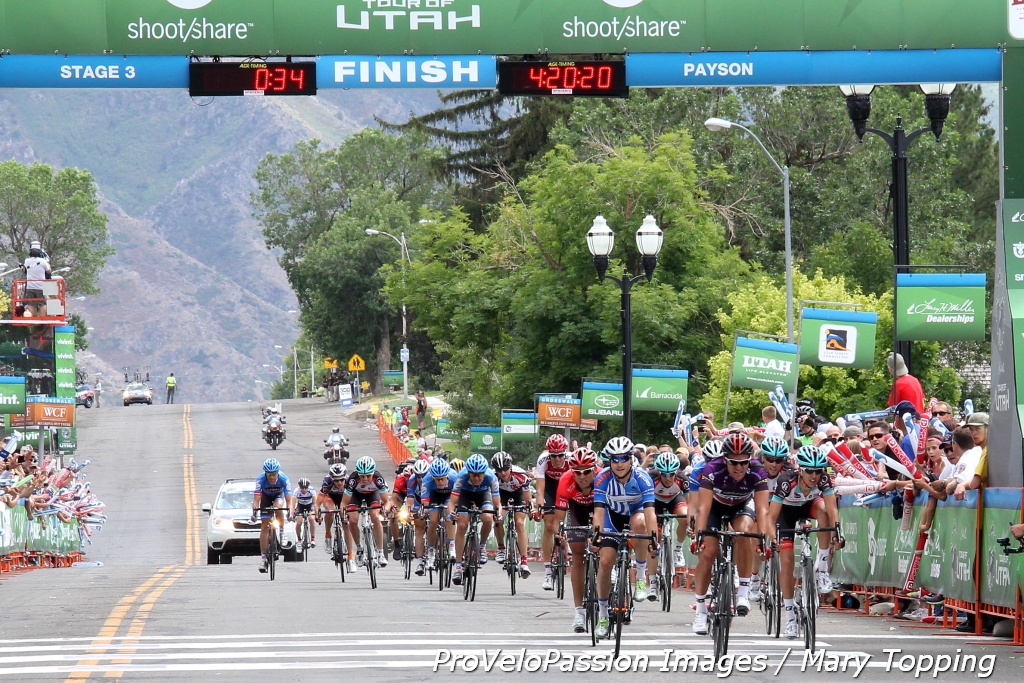
Chase group finishes 34 seconds behind Lachlan Morton on Stage 3
[updated 8/9/2013]
Lucas Euser wants to wear a black cowboy hat more than anything right now. It’s not for shade or to keep the rain off his head. Donning it would mean he’s the overall leader of the ongoing Larry H. Miller Tour of Utah.
Now that he’s third on GC after today’s Stage 3, the Stetson hovers tantalizingly just out of reach.
The UnitedHealthcare Pro Cycling Team rider ascended the last challenge of the day, cat 1 Mount Nebo, in the chase group to land third place in a select sprint behind winner and new yellow jersey Lachlan Morton (Garmin-Sharp). That effort moved Euser thirty-three places up in GC to where just 40 seconds separates him from Morton and that hat.
In May Euser finished third on the uphill finish Mogollon Tour of the Gila stage. Last year in Utah he placed in the top ten overall and then rode aggressively at the USA Pro Challenge. He’d like to spray champagne from the final podium when this year’s Tour of Utah concludes on Sunday in Park City.
The fifteen guys lined up behind him within four seconds of his time would love to get their hands on the same hat, not to mention Janier Acevedo (Jamis-Hagens Berman) who lurks another thirty seconds down in nineteenth place. The group includes guys who can fly uphill on the tour’s two final decisive days – Chris Horner, Matthew Busche, and George Bennett on RadioShack-Leopard; Tom Danielson and Peter Stetina on Garmin-Sharp; and Euser’s teammate Philip Deignan.
But for right now, he’s happy with third place overall and wasn’t disappointed about missing out on the victory. “I think it’s actually a really good situation for us because it puts Garmin in charge tomorrow and the next day. And they’re the team with the most cards so they’ll have to use up a few of those being in the lead,” Euser said. “When you’re dealing with climbs like Snowbird and Empire [a 40 second lead] is nothing. So it actually puts us in a really good position.”
If Euser wore a virtual hat this afternoon, it would be white. He expressed admiration for Morton’s results even though he started the day thinking he could win.
To launch from the field and stay away solo for 30 kilometers was a feat Euser didn’t think would succeed. “But it’s Lachlan,” he said. “That guy just rides with pure heart. It’s awesome.”
Morton’s tribute
To snag the biggest win of his career to date, twenty-one year-old Morton took advantage of teammate Ryder Hesjedal’s aggressive pace which forced a split in the field. Lachlan used the disruption to jump away on the Nebo climb. “When you have an opportunity like that as a young rider,” the stage winner said, “you just gotta take it.”
He worked his way through the remaining break-away riders then summited the pass and descended solo, coming to the line with a thirty-four second advantage over the ninteen man chase group that included Euser.

Lachlan Morton after winning Tour of Utah Stage 3 solo
Morton rode on Slipstream Sports’ development team from 2010 through 2012 before moving up to the World Tour outfit this year. The Australian’s talent impressed Garmin-Sharp’s Jonathan Vaughters significantly as much as five years ago when Morton would have been about sixteen.
Late 2008- day I found out @taylorphinney was to sign w Lance @dellisny asked me what young talent would replace him? Answer:@lachlanmorton
— Jonathan Vaughters (@Vaughters) August 8, 2013
As he crossed the finished line the Australian pointed his right index finger skyward and held his left hand over his heart. A report on the team website indicated Morton had made a tribute to his grandfather. Even on the podium Morton’s eyes gazed up into the Utah sky.
Tough climb for Kiel Reijnen
UnitedHealthcare’s Kiel Reijnen fought to close a thirty second gap to the chase group all the way up Nebo.
“I’m disappointed because today was a good day for me. I was just missing that last half a percent to stick with that front group…Over the top we were about 40 seconds off the pace and the descent was not technical enough to make that up. We tried hard but it was just too much pedaling on the descent.”
Reijnen now holds twenty-first position on GC, three minutes back. He has sprinted well from the start of the event with the fastest guys in the field, placing fifth on both Stages 1 and 2. He’s ready to give it a go tomorrow in the Salt Lake City circuit race.
That will be a day for Euser to stay out of trouble and keep his thoughts focused on that black hat.
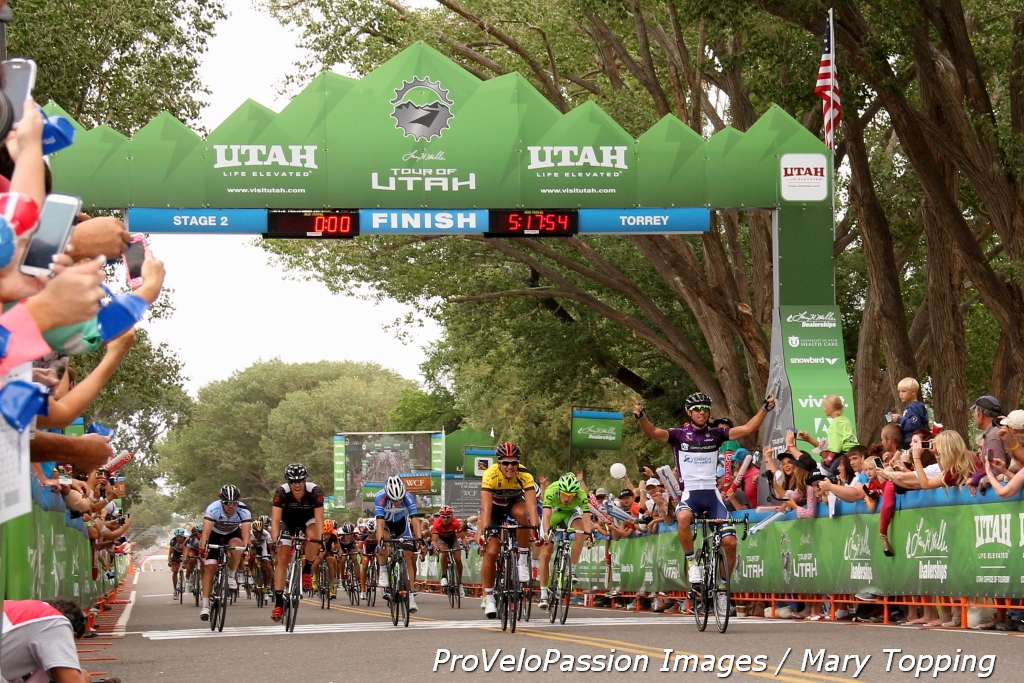
Michael Matthews wins Stage 2, 2013 Tour of Utah
Michael Matthews left memories of second place behind on Wednesday when he got his first win of 2013 in Stage 2 of the Larry H. Miller Tour of Utah.
The hilly profile that commentators expected to create a select group of up to twenty at the finish didn’t prevent Orica-GreenEDGE from making it over the last of four KOMs with energy to spare to position Matthews for the win.
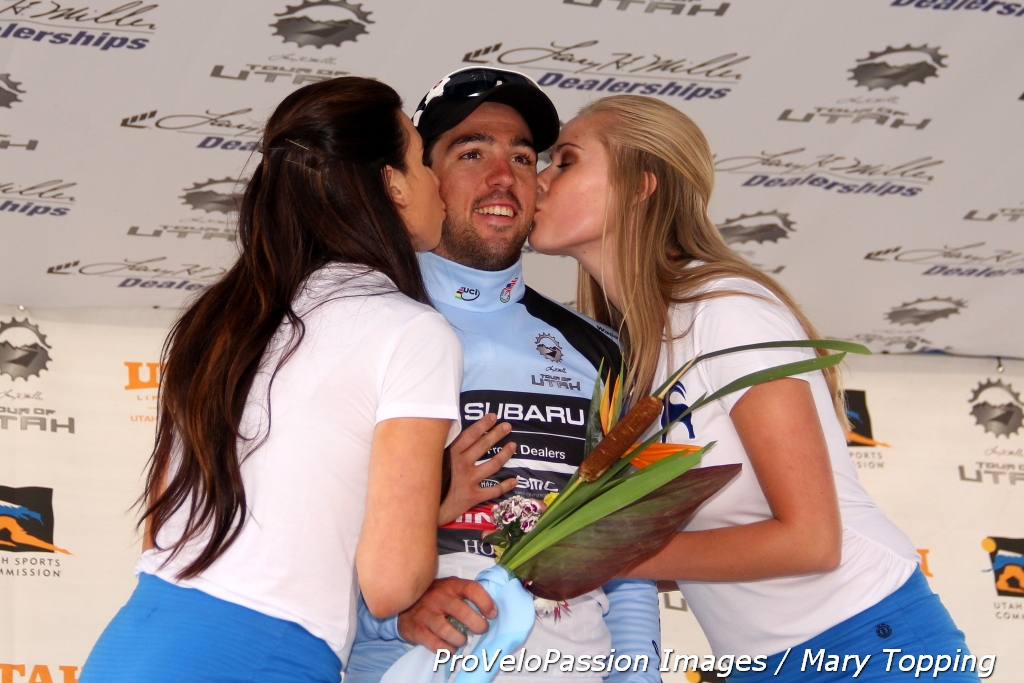
Ty Magner Stage 2 Tour of Utah best young rider
Hincapie Sportswear Development’s Ty Magner sprinted to third and Joe Lewis finished sixth. With just one of six days of racing completed on Tuesday in the Larry H. Miller Tour of Utah, the young team had already delivered notable results against more experienced riders in one of the hardest races in the U.S. and claimed the best young rider’s jersey.
But for current U23 U.S. national criterium champion Magner, who recently won the Cascade Cycling Classic criterium, the results were not unexpected.
“Yes, that was all part of the plan,” Magner said about placing high on Stage 1. “We did well at Cascade and just kind of wanted to carry that energy here.”
So far they’ve succeeded. With World Tour’s Greg Van Avermaet (BMC) and Orica-GreenEDGE’s Michael Matthews earning first and second, Magner’s result distinguished Hincapie Devo as the highest placed continental team on the opening stage of the tour.
The team is working for Magner on days that promise sprint finishes. Because the twenty-two year-old from Griffin Georgia makes it look easy, it’s hard to believe Assistant Sports Director Darren Fuller when he says participating in their biggest race of the year “is just a learning experience for the guys.”
But the Australian Lewis would agree in some respects at least. “It’s a little bit hard to keep six guys together without actually hitting the front,” he said, speaking about the Stage 1 finish. “We’re still learning…we got a little bit lost towards the end. I was trying to make my way back up to him [Magner] but by the time I got there it was just time to sprint anyway so I just had a crack.”
Lewis, who won the criterium stage in the 2011 Tour of the Gila in New Mexico, found his way onto Hincapie Devo based on a relationship with Chief Sports Director Thomas Craven. Lewis said Craven distributes the Osymetric chainring that he uses on the bike. Lewis is twenty-four.
The team’s ambitions in Utah stretch beyond its Stage 1 take.
“We’re targeting the circuit race for sure because that should be a sprint and we’ve got to get Ty and Joe [Lewis] to the finish,” Fuller said. “And we’ve got Joey Rosskopf who’s been riding super strong. He’s our GC guy and we’re going to watch out for him…”
Rosskopf, 23 years-old, factored into the team’s Cascade Cycling Classic success, winning the Stage 5 circuit race. He’s over six feet tall and finding the climbing and altitude in Utah somewhat challenging. When asked how he felt yesterday with two stages in the books, he responded with a carefully thought out “OK.” He added, “I think I get a little more sore at altitude, I don’t usually have muscle soreness…It’s a tough race. Even if we don’t do all the climbs fast, it’s still a lot of climbing you have to get over. I’m a big kid so it’s a little hard for me.”
Five of the guys made it to the last of four KOM’s on yesterday’s Stage 2. That set them up for another lead-out for Magner into the final. Magner placed sixth and retained the best young rider’s colours.
The teammates seem to gel together well. As Magner responded to questions for this story yesterday while the team prepared for the start, several guys chipped in to supply their thoughts on the topics. “We’re one person here,” Magner said.
At the end of Stage 2 Magner pulled on the best young rider’s jersey on the presentation stage for a second day. He sat next to stage winner Matthews at the press conference. He appeared to take it all in stride.
Magner described mixing it up with World Tour riders as simply “a great experience.” Not starry-eyed, he’s self-assured. Like he knows he’s where he belongs.
“We’re just taking it day by day,” he said. “In the end it’s just a bike race.”
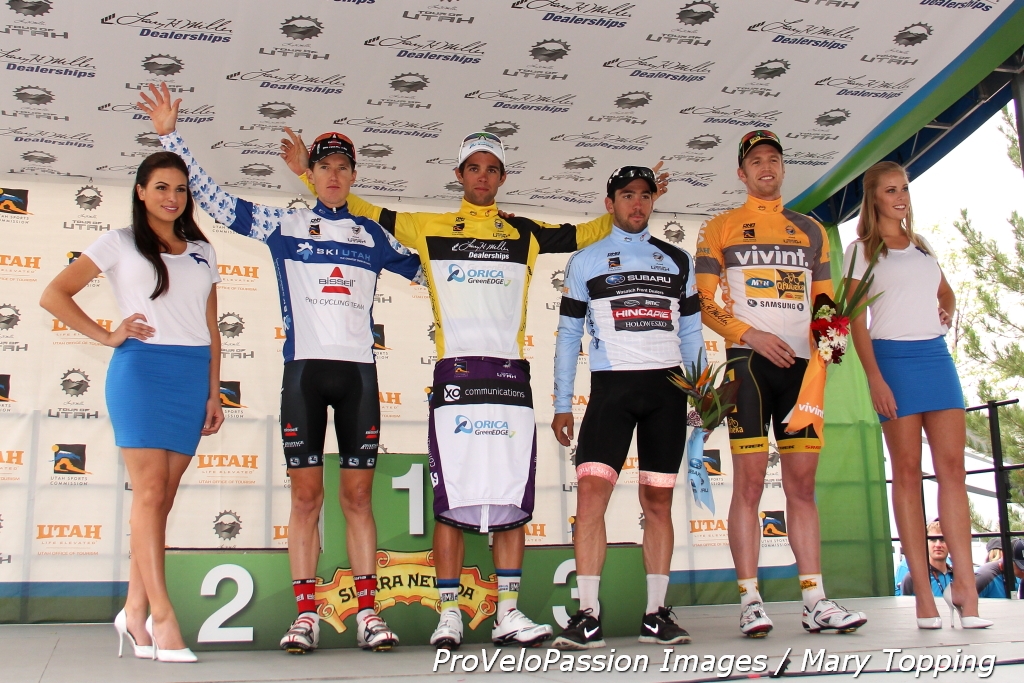
Tour of Utah Stage 2 jersey holders (l – r) Michael Torckler, Michael Matthews, Ty Magner, Martin Wesemann)

Stage 1 start line, Jens Voigt and Michael Matthews (photo by Luis Barbosa)
While Orica-GreenEDGE was looking for a win on Stage 1 of the Tour of Utah, the teams with GC ambitions sought something very different – an easy day. The two plans weren’t all that compatible.
By the finish line the GC guys achieved their goal.
Orica got second.
Rest for GC guys
Frankie Andreu, Director of GC hopeful Francisco Mancebo’s 5-Hour Energy p/b Kenda team, put it this way: “Today’s kind of a day off – if you can have a day off in the Tour of Utah. Because if you look down the road the stages are so extremely hard coming up, you need every ounce of energy, you need to save as much as you can…Even if it’s one day, I’m going to try to take advantage of that.”
So Andreu didn’t instruct his team to get into the breakaway. Other directors may have done the same because when Chris Jones and Michael Torckler pulled away from the peloton early on, they didn’t spy anyone coming up to join their party (literally, since Jones celebrated his birthday on Tuesday).
Matthew Cooke, a strong climber and recent edition to the Jamis-Hagens Berman team who said he will be working 100% for teammate Janier Acevedo, shared Andreu’s concerns. “If you shred yourself today,” Cooke said, “you will pay the price later down the road.”
Comments from Garmin-Sharp’s Tom Danielson hinted at a conservative approach by that team too, at least on Stage 1, as team members test their legs after taking a break from racing or riding the Tour de France.
Overtime for Orica
With Jones’ and Torckler’s Bissell and UnitedHealthcare teams sitting in and those with GC ambitions unwilling to take up the chase, Orica shouldered much of the work in an effort to shape the outcome according to plan.

Chris Jones and Michael Torckler broke away early
“We had to use all our team to bring the break-away back so we didn’t have much of a lead-out for the finish,” Michael Matthews explained after coming in second to BMC’s Greg Van Avermaet.
After the stage Orica director Matt Wilson shared one quick word as he drove away: “Disappointed.”
Matthews, who is searching for first win in 2013, was disappointed too though happy with his effort. “I felt really good all day. The boys worked really well for me all day – they had their trust in me,” he said. “I did my best in the final but there was just one guy that slipped away.”
Other teams who had sprint ambitions found the finish tough for different reasons.
Freddie Rodriguez (Jelly Belly), the new U.S. national road champion who finished ninth on the day, said he’s recovering from injuries. “Definitely it was a fast finish coming down that hill and everybody with fresh legs,” he said. “We were flying through the circuits. You could tell most teams didn’t have a good handle at taking control. It was just up in the air.”
The downhill angle to the last meters made it a finish for a more powerful sprinter. That’s why Van Avermaet attacked in the final kilometer. He said he didn’t think he could win going head-to-head with Matthews.
At the start UnitedHealthcare’s Mike Tamayo listed Kiel Reijnen and Alessandro Bazzana as the team’s two sprinters. Reijnen, this year’s Philly winner in a sprint, placed fifth.
“That sprint required a bit more power than I’ve got; I’m too small for that kind of stuff,” Reijnen explained after the finish. “Van Avermaet just went on that steep bit before the turn and I hesitated. I didn’t follow because it was a headwind and knowing it was a downhill sprint I thought it would be too fast to try and anticipate, but he’s a super strong rider so there’s only so much you can do.”
One more chance
There aren’t many projected large sprint finish days at this year’s Tour of Utah. Friday’s Salt Lake City circuit race is likely the only one remaining.
“That should be a good race for us. It’s got some little climbs and we’re all good climbers. We’ll be able to get through that all right so it’s another opportunity to sprint.” Matthews said after today’s finish.
The efforts Orica invested for a chance at a sprint win call to mind a statement Robbie McEwen made at his retirement press conference in California when he responded to a question about how sprinters get over mountains.
“The mountains have been a nightmare. The GC guys say they have it hard because they have to pay attention all the time. Sprinters say that’s bullshit. The GC guys can go through transition stages easy, but a sprinter races every day.”

BMC’s Greg Van Avermaet wins 2013 Tour of Utah Stage 1

Champion System and the 2013 Tour of Utah team presentation venue
The Larry H. Miller Tour of Utah team presentation took place in an open-air Shakespeare Theatre on the campus of Southern Utah University in Cedar City. The event remains free to the public.
-

- Tanner Putt seems a bit overwhelmed by all the attention he’s receiving.
-
- Serghei Tvetcov of Jelly Belly (center) just won the Cascade Cycling Classic and says he’s feeling good
-

- RadioShack-Leopard Trek’s George Bennett, Ben King, and Nelson Oliveira (l to r)
-
- Janier Acevedo is a clear favorite for the overall
-

- Philip Deignan talks about being Irish
-
- Freddie Rodriguez will be easy to spot in his new U.S. road champion’s jersey
-
- Chirs Horner and Matthew Busche. Horner’s been training for 3 weeks and looks fit.
-
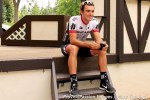
- Joey Rosskopf on Hincapie Sportswear Devo team just won a Cascade stage. The team of allrounders will be stage hunting.
-

- Mike Friedman explains why he’s nicknamed “Meatball” — Optum Pro Cycling p/b Kelly Benefit Strategies team
-
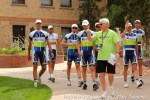
- Orica-GreenEDGE arrives from team lodging on the Southern Utah U. campus
-
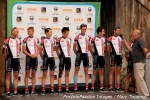
- Bissell Team’s Phil Gaimon takes questions
-
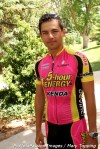
- Andres Diaz from Colombia will be working for Paco
-
- Tim Johnson is with Tour Tracker for the race
-

- Chad Beyer’s got the updo going on
-

- Christian Vande Velde, first race autographs
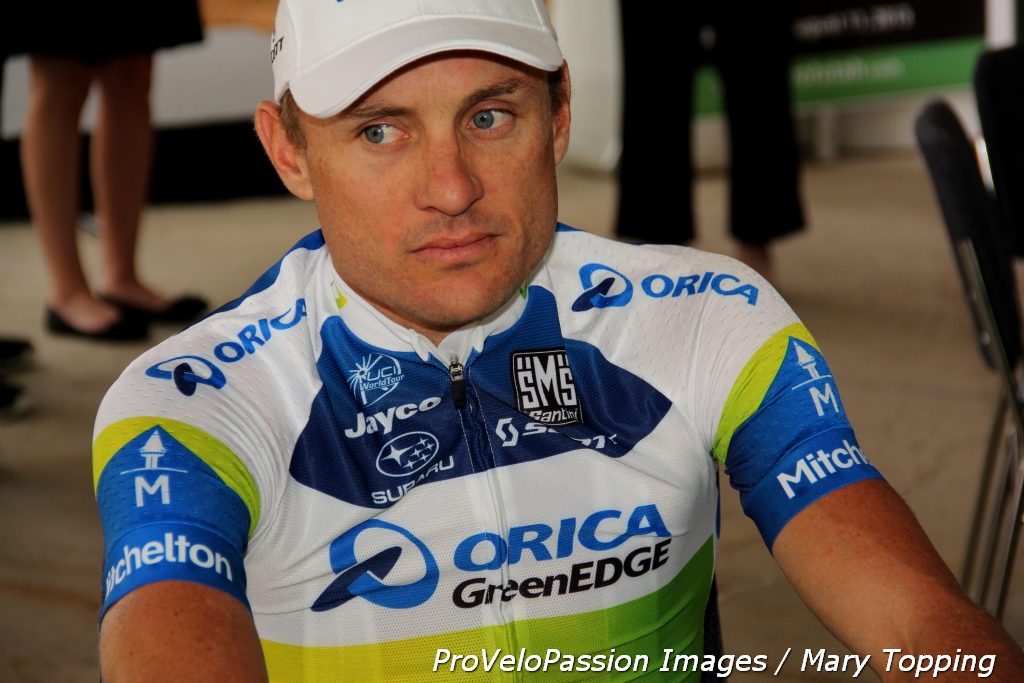
Baden Cooke will share his years of experience with the younger Orica-GreenEDGE riders at the 2013 Tour of Utah
Orica-GreenEDGE hasn’t sent a climbing team to tackle this year’s Larry H. Miller Tour of Utah terrain. But the guys are taking all the talk about 43,000 feet (13,106 metres) of elevation gain in stride and they have arrived prepared to hunt for stage wins.
In the weeks leading into the tour’s start on Tuesday, nearly all the guys spent time at high altitude. Michael Matthews raced here last year and won Stage 3 as well as the green jersey. He based himself at the location of the Stage 1 start in Brian Head which sits at nearly 10,000 feet (3,048 metres). Sam Bewley lodged in Park City for three weeks. The final stage begins and finishes in that resort town with an elevation of about 7,000 feet (2,133 metres).
One important team member is missing; videographer Dan Jones didn’t make the trip to Utah. Since a race with Orica-GreenEDGE just isn’t the same without a Backstage Pass video, ProVeloPassion filled the void by piecing together the following “unofficial frontstage pass” that captures the team presentation in Cedar City and an interview that followed.
Take a peek.
aa
Orica-GreenEDGE 2013 Larry H. Miller Tour of Utah roster: Tomas VAITKUS, Wesley SULZBERGER, Michael MATTHEWS, Baden COOKE, Michael HEPBURN, Sam BEWLEY, Damian HOWSON
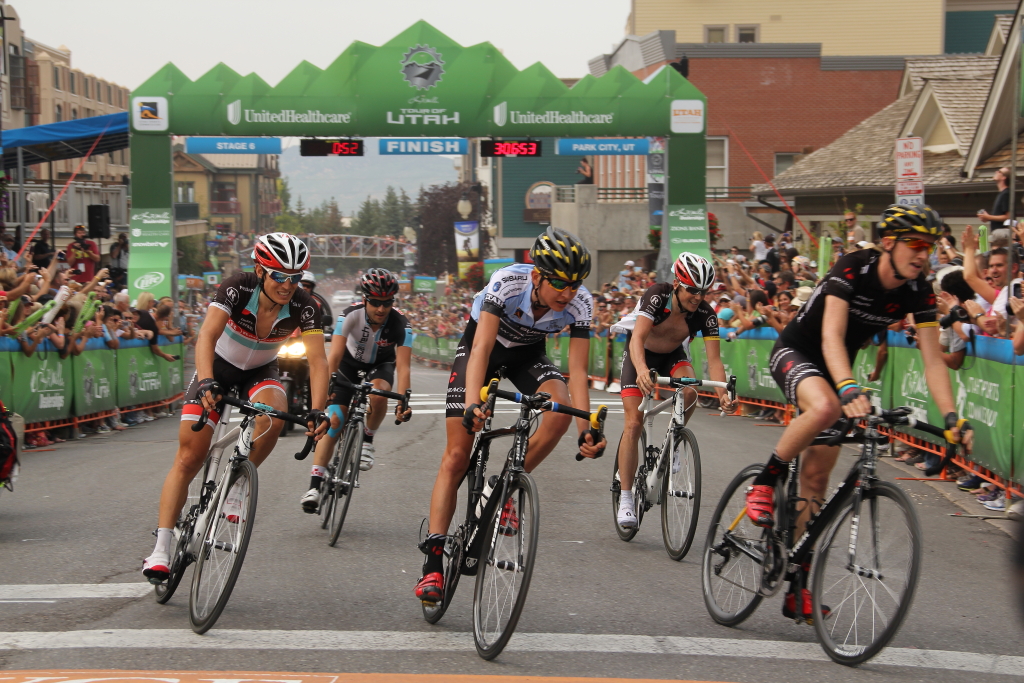
Matthew Busche (Radioshack-Nissan-Trek) finishes the 2012 Tour of Utah Stage 6 into Park City with the yellow jersey group
The 2013 Larry H. Miller Tour of Utah may well go down as the most exciting edition of the race to date.
Course designers broke the traditional mold to create the new 586 mile (943 k) route, adding roads in the southern part of the state for the first time while preserving fan-popular segments like Snowbird’s uphill finish and the Capitol Hill circuit with a steep run-up into the start/finish line.
It’s no coincidence those two favorites include challenging ascents. With 43,000 vertical feet (13,106 meters) of climbing – a 12% increase over last year, riders will extract more uphill effort from their legs than in any of the previous eight outings. The time trial stage was sacrificed to find extra miles to cover the distance from the new southern start to the northern part of the state in six stages.
In fact, directors are calling this year’s event a climber’s race. That includes retired professional cyclist and Cedar City, Utah born and raised Burke Swindlehurst, who contested the event several times and finished as high as fourth overall. This year he will again act as Sport Director for the Champion System team in Utah. The team brings international riders that the director expects will deliver good results as well as Americans Chad Beyer, Chris Butler, and Craig Lewis who can conquer rising roads.
“I think this year’s event more than any event I’ve seen in the U.S. is going to cater to the pure climber,” Swindlehurst said last week. “And I think it’s going to make for some really exciting racing and some really aggressive racing, especially without the TT. Everything is going to have to be done on those climbs…”
The cadre of climber-specialists to watch with Champion’s three Americans are Janier Acevedo and Matt Cooke of Jamis-Hagens Berman, George Bennett and Matthew Busche (RadioShack Leopard Trek), Peter Stetina and Tom Danielson (Garmin-Sharp), Lucas Euser and Philip Deignan (UnitedHealthcare), Phil Gaimon (Bissell), and Francisco Mancebo (5-Hour Energy p/b Kenda), among others.
Stages and climbs
Stage 1: Brian Head to Cedar City, 112 miles (180 k). Elevation gain: 5,748 feet (1,752 k). With a long 30 mile (48 k) descent followed by a cat 3 and cat 4 KOM this stage seems tame on paper. But fifty nearly all uphill miles culminate in the second KOM which reaches nearly 10,000 feet (3,048 meters) high. This stage could hurt anyone feeling the elevation which due to this year’s route profile Swindlehurst believes “is going to play a bigger role here than it ever has before.” The final descent includes S turns and then flattens out before the riders turn into downtown Cedar City for the three finishing circuits. Any riders who get away on the final climb will likely get caught, but maybe one will get lucky.
“There are some great climbers in this race and it’s going to tough for any one team to really contain some of these riders when they get into that terrain,” Swindlehurst said. “Every stage could be a game changer here. There’s not a single ‘gimme’ stage in this race…”
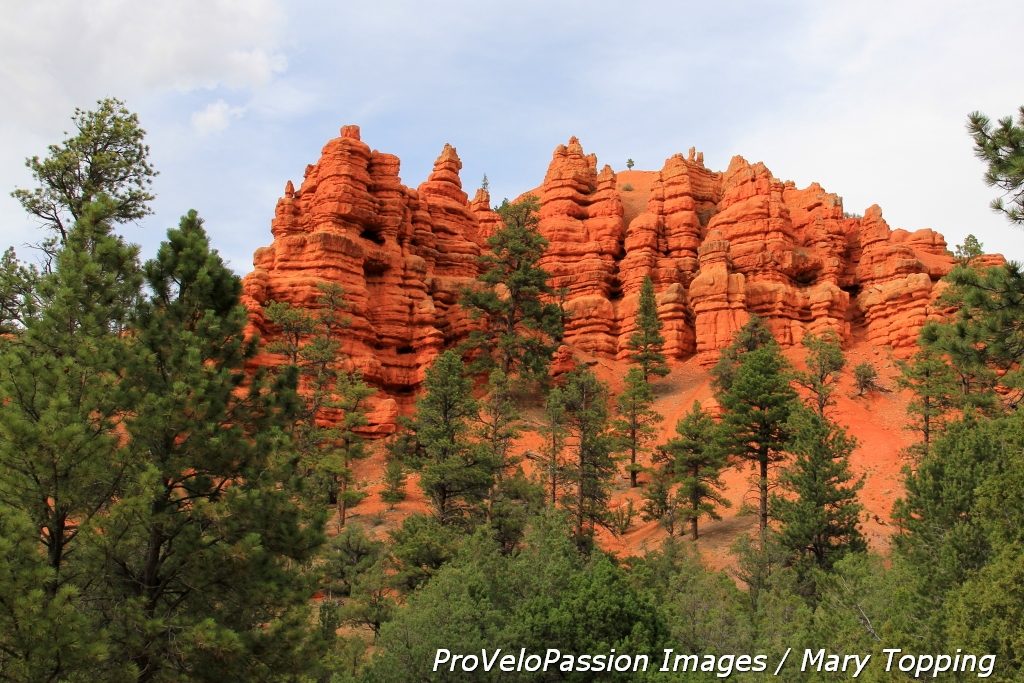
Red Canyon scenery along the 2013 Tour of Utah’s Stage 2
Stage 2: Panguitch to Torrey, 131 miles (210 k). Elevation gain: 9,877 feet (3,010 meters). The longest day of racing contains four KOMs, including the cat 1 Boulder Mountain, one of this year’s eight new climbs. The riders will sweep past Red Canyon’s orange-red rock sandcastles and the entrance to Bryce Canyon National Park. When they cross Grand Staircase-Escalante National Monument they will pedal uphill along a narrow ridge which drops steeply on both sides to canyon floors. The twenty mile drop down to Torrey after Boulder Mountain should help some riders regroup before a select pack or breakaway members reach the finish line.
Stage 3: Richfield to Payson, 119 miles (191 k). Elevation gain: 6,202 feet (1,890 meters). Mount Nebo is the one and only KOM today. It summits just over 20 miles (32 k) from the arrival, but Swindlehurst doesn’t expect to see a huge pack cross the line together.
He projects a small group of as few as three or perhaps up to fifteen riders will gain the top of Nebo ahead of the peloton: “…it’s not an overly technical descent and it is a descent that you can pedal so riders that are close are going to be able to close gaps. I’d be shocked to see a group larger than 20 riders [in a front group] because that south approach is quite steep and it goes up to nearly 10,000 ft.”
Stage 4: Salt Lake City circuit, 34 miles (55 k). Elevation gain: 3,550 feet (1,082 meters). This circuit last featured in 2011 when riders on Colombian teams attacked so often they left some domestic riders’ heads spinning. Acevedo won that grueling stage on a very hot day. This year the peloton will complete a shorter distance in total after only five loops. Fewer passes of the up to 11% grade State/Capitol Streets into the finish line should widen the number of possible winners, though it’s possible for one to get away near the end of the loop to win. Perhaps Acevedo will go for it again.
Stage 5: Snowbasin resort to Snowbird resort, 113 miles (182k). Elevation gain: 10,611 feet (3,234 meters). Last year Johann Tschopp (BMC Racing Team) won solo after attacking on the final hors categorie climb up Little Cottonwood Canyon and stole the yellow jersey from Garmin’s Christian Vande Velde. Climber-opportunists as well as GC riders have won on this uphill finish. The stage start at Snowbasin and ascent of cat 1 Guardsmans Pass from Park City into Big Cottonwood Canyon are new. Total elevation gain on the day increases 600 feet (183 meters) over last year’s 10,000 and stage length is up by about 12 miles.
Stage 6: Park City to Park City, 78 miles (125 k). Elevation gain: 7,633 feet (2,326 meters). Like the 2012 edition, this stage should be decided on Empire Pass, the last climb before the descent into town, where the road pitches up beyond 20 percent in places. One rider could leave a select group behind and win alone like Levi Leipheimer when he rode for Omega Pharma – Quick Step last year.
Changing scenery, changing leaders
As the climbs stun the riders’ legs the scenery should equally stun spectators watching the action in-person or on television or online. Utah is a state of color and contrast. The peloton will race along roads that bring them past spectacular rock formations of creamy white and red as well as along valley roads bordering irrigated hay fields and pastures with grazing horses and cattle.
When asked for this story about how the route would affect the race Swindlehurst couldn’t contain his enthusiasm over the direction the course is taking.
“This is really exciting from my perspective as a Utahn for people to finally see why Utah is a place that I would never leave. I think visually it’s going to make for some great photography and video, and I think the riders are going to be blown away too.”
The course design and climbs could mean the overall leader might not be crowned until the final day. “It’s going to be a dynamic race,” the Cedar City native said. “I foresee multiple lead changes.”
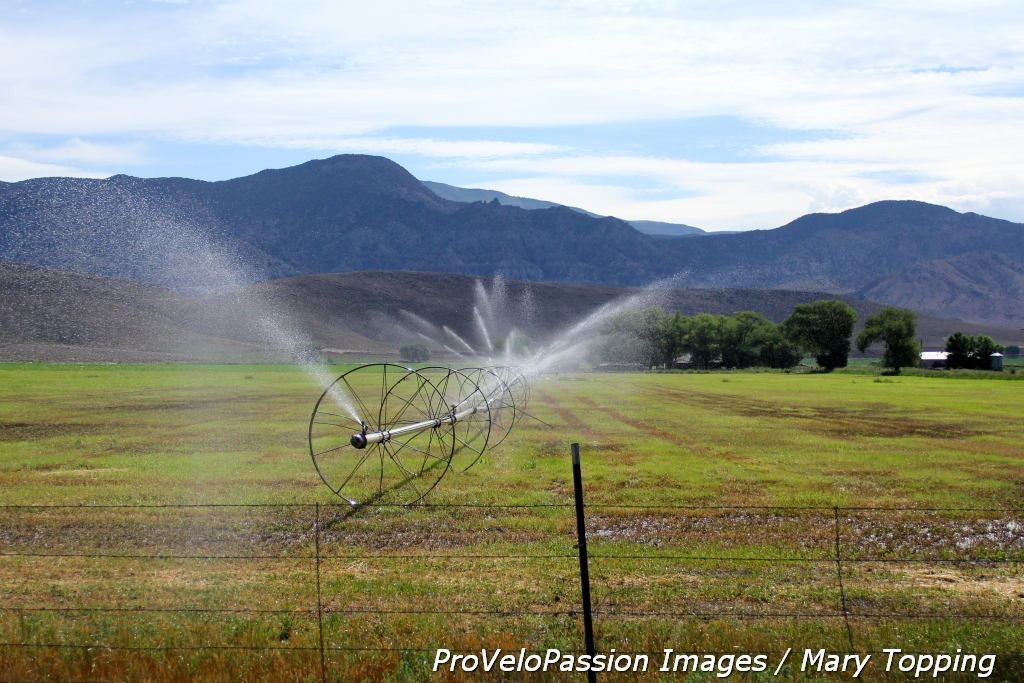
Irrigation along Highway 89 near Panguitch, Utah

Rays in Green River, Utah
This year the Larry H. Miller Tour of Utah starts in the southern part of the state in Brian Head at 9,800 feet (2,987 meters) elevation, near the town of Cedar City. It’s a 576 mile drive from Denver, Colorado so I decided to break the drive up into two segments with an overnight in Green River, Utah, a town of about 1,000 residents just west of Moab off I-70 and along the river of the same name.
A freelance writer’s budget means lodgings usually throw me back to the 1970’s as soon as I twist the door knob and walk into my room. Tonight it’s the Sleepy Hollow Motel. The proprietor, a man in his 50’s of average height with thinning hair, has just one arm. He uses the counter together with his hip as a second hand to hold the registration slip in place while he peels off my yellow copy.
It’s too late to check out Green River State Park. The silty river meanders in S curves through Canyonlands National Park at times 1,000 feet (305 meters) below the canyon edge. Any river that runs through red and orange sandstone canyons called Desolation, Labyrinth, Stillwater, and Cataract merits a visit.
During a 26 minute walk around downtown Green River, Utah I lean back to scratch behind my knee where two mosquito bites are swelling. I pass the town library with a door flanked by flower pots dripping fuchsia petunias and make way for one boy on a bike and a (likely) sister and brother on rollerblades – the pre-teen girl hugging the sidewalk. Laughter floats away from double-wide homes. The local restaurant scene past and present introduces itself to me: Ben’s (sign only) Café, Frank’s (no more) Pizza, a coffee shop with tables and chairs untethered on a porch, and the best place in town to eat because the most cars line the street in front of it – Ray’s Tavern, “The Place for Everyone.”
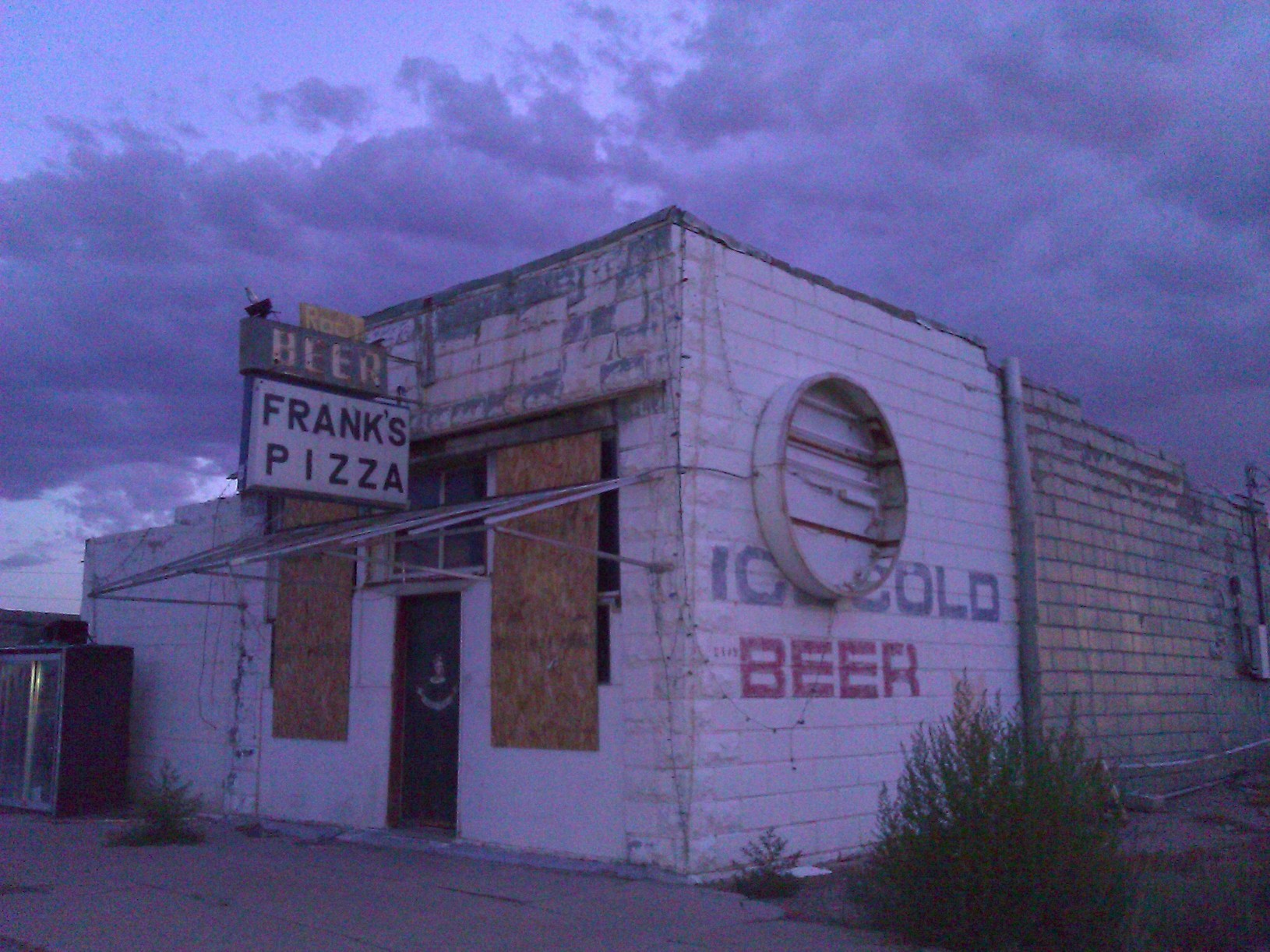
Rays in Green River, Utah
A recent tweet by Team Sky’s Luke Rowe suggests he’ll be racing in Colorado – he told teammate Ian Boswell he’s planning to see a couple of movies during an upcoming trip.
bbb
Boswell suggested he consider Legends of the Fall.
bbb
Rowe’s in-flight entertainment could be just something to pass the time. Still, it raises the question: how can pro-cyclists get acquainted with the U.S. before they arrive for August’s Larry H. Miller Tour of Utah or the USA Pro Challenge?
For some answers ProVéloPassion conducted an informal survey asking people to name movies and books that would show someone from another country what America is all about. Following is an abbreviated list from that survey.
Some of the suggestions were provided tongue-in-cheek and play up American stereotypes over every day sometimes hum-drum reality. No single film or novel stood out as a favorite, pointing out that it’s difficult for one resource to fully represent the diversity that is the U.S.
What do you think about this list? What would you add to it?
Movies
Lincoln. Set in early 1865, Lincoln primarily portrays the President’s fight to pass the 13th Amendment to abolish slavery and also depicts some of the impact of the Civil War on the country.
bbb
Breaking Away. “The story of four guys in danger of turning twenty” in Indiana in the late 1970s– and one’s love for the bicycle. It made the American Film Institute’s Ten Top Ten in the sports category. [quote from movie trailer]
Year of the Yao. The story of Chinese pro-basketball player Yao Ming’s first year in the U.S.
National Lampoon’s Vacation. The 1983 film trails a family on their cross-country driving vacation and their adventures along the way from Chicago to a Los Angeles amusement park.
American Graffiti. About teenage life in the early 1960s in Modesto, California.
The Natural. A film about Roy Hobbs, his baseball career and struggles.
Books
To Kill a Mockingbird, by Harper Lee. (adapted to film in 1962) A classic about childhood innocence and facing racial prejudice in the 1930s in a small southern town.
O Pioneers, by Willa Cather. A story about a Swedish immigrant family who farms the Nebraska prairie at the turn of the 20th century.
American Pastoral, by Philip Roth. “…an elegy for all our century’s promises of prosperity, civic order, and domestic bliss,” told through the story of a man who in the 1960s appears to have a great American life, until it gets interrupted. [Quote from synopsis on Amazon.com]
Adventures of Huckleberry Finn, by Mark Twain. This book that follows Adventures of Tom Sawyer is about the adventures of two runaways in the pre-Civil War Mississippi River Valley south – one a kid, the other a slave. [Written in vernacular or regionally spoken English, the book has been banned in the past and contains language considered to be racially offensive.]
Other suggestions and comments
The Simpsons. Animated TV series that satirizes middle class American life and American culture and society in general.
King of the Hill. Comic adult animated TV sitcom that follows the lives of a middle class Texas family.
Have an American breakfast in a nostalgic diner.
“Take them to a baseball game.”
[Many thanks to those who responded to the survey question, and Susan Messina who helped launch it in social media. Numerous suggestions were pared down to the list above.]
What if the Tour de France expanded its prize list to include more team competitions? Let’s imagine the possibilities beyond the traditional best team classification which Team Saxo-Tinkoff earned in the 100th edition of the French Grand Tour.
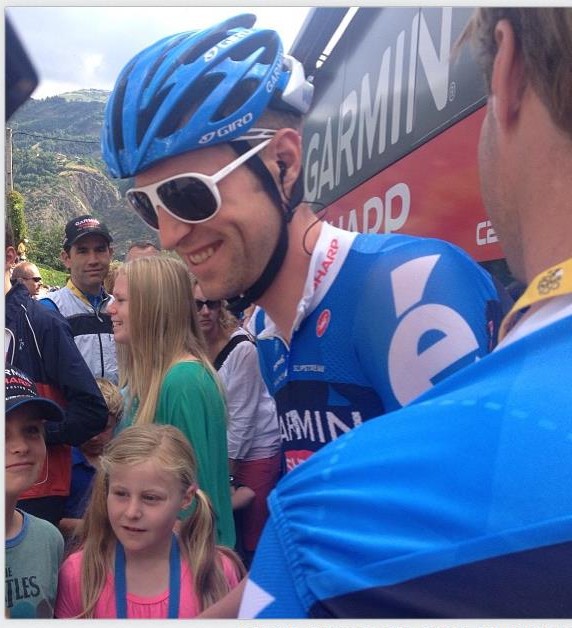
Ryder in POC glasses during the 2013 Tour de France (POCSports Instragram photo)
Best accessorized team: Garmin-Sharp: Ryder Hesjedal’s POCSports sunglasses drew a lot of attention with their retro style. Tom Danielson traveled across France with a little green dinosaur astride his bike, a gift he received from his son as he left home from France.
Most fun team: Orica-GreenEDGE. These boys know how to race but they also know how to play. On the first rest day the team released a video showing the guys and fans rocking out to AC/DC with blowup mini-guitars. The video’s been removed from YouTube but you can still find descriptions and stills from the video.
Most invisible team: Lampre-Merida. Roberto Ferrari flashed the team’s pink with a fifth place on the Champs-Elysées. Jose Serpa and Damiano Cunego appeared occasionally on the camera. But overall the team didn’t make its presence known as much as the other teams, aside from maybe Cofidis. Lampre also brought up the rear when it came to overall team earnings. It took away 11,180 Euros.
Most aggressive team: Leopard-RadioShack. This is a tough call. Jan Bakelants and Jens Voigt were on the attack again and again. In the end their shows of force won the team this category.
Best lemonade making team: BMC Racing Team. The Swiss squad didn’t live up to the heavy expectations the media set on the team, most notably a high GC placing for Tejay Van Garderen. But the team never threw in the towel and turned lemons into lemonade by placing many riders in break-aways. Van Garderen was on the attack in stages 14, 18, and 20. Philippe Gilbert, Manuel Quinziato, and Marcus Burghardt factored into escapes; Quinziato rode in a break on the Champs-Elysées.
Most flamboyant team: Cannondale Pro Cycling. This team nets this prize based on lime green wigs at sign-in, Peter Sagan’s green facial hair on stage 21, and Sagan’s ever-present wheelies.
Most passionate team: AG2R La Mondiale. The French team wins this prize based on several performances. Jean Christopher Péraud attempted to defend his ninth place best French rider position by starting the stage 17 time trial despite having injured his collarbone earlier during course reconnaissance. He subsequently crashed during the TT and withdrew from the Tour. After Christophe Riblon won on Alpe d’Huez, he and Péraud spoke by phone to celebrate. The team worked hard to keep the best French rider distinction and succeeded. Twenty-two year-old Romain Bardet fought for high stage results and ended the race as best-placed French rider in 15th overall as well as fourth in the white jersey competition.

 ProVéloPassion